
Adverse Action Notices and Decisioning Controls: Making Sure the Reason Matches the Actual Decision
Updated: Sep 22
Table of Contents
Regulatory Foundation: Aligning Regulation B and FCRA Mandates
Adverse action notice compliance rests on a straightforward premise: when a creditor takes an adverse action subject to Regulation B's notification requirements, the reasons provided to the consumer should accurately reflect the principal factors actually considered or scored in the decision. In practice, maintaining alignment between automated underwriting logic, policy-based rules, and outward-facing consumer disclosures represents an ongoing operational and governance challenge.
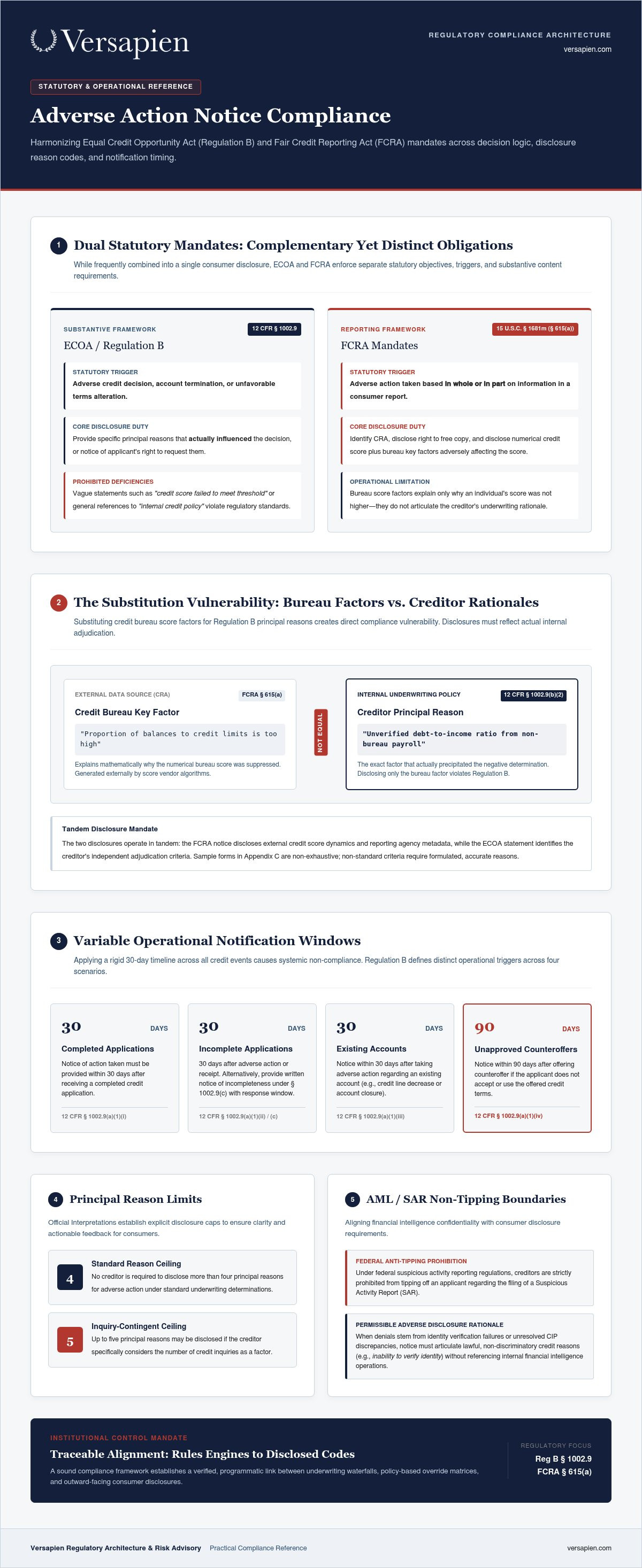
The legal framework governing adverse action disclosures derives primarily from two distinct federal statutes: the Equal Credit Opportunity Act (ECOA), implemented by Regulation B (12 CFR § 1002.9), and the Fair Credit Reporting Act (FCRA), codified under 15 U.S.C. § 1681m. While institutions frequently combine these disclosures into a single adverse action document, each statute serves a different statutory purpose, imposes distinct triggers, and demands separate content.
Under Regulation B, creditors must inform applicants of the action taken and provide the specific principal reasons for the adverse action, or notify them of their right to request those reasons. The Official Interpretations to 12 CFR § 1002.9(b)(2) clarify that disclosures must indicate the principal factors that actually influenced the decision. Statements such as "credit score failed to meet threshold" or vague descriptions like "internal credit policy" fail to provide the specific factors considered in the evaluation. The regulation permits creditors to rely on model forms provided in Appendix C, but the commentary cautions that these sample reasons are not exhaustive. If the credit decision turns on a factor not represented in the sample forms, the creditor should use an accurate and specific reason that describes the factor actually considered or scored.
A persistent operational point of confusion involves the interplay between ECOA's statement of specific reasons and FCRA's credit score disclosures. Under Section 615(a) of the FCRA, when adverse action is taken based in whole or in part on information contained in a consumer report, the creditor must provide notice of that fact, identify the consumer reporting agency (CRA) that supplied the report, explain the consumer's right to obtain a free copy, and, when a numerical credit score was used, disclose that score along with the key factors that adversely affected the score. These FCRA score factors, typically supplied directly by credit bureaus or scoring vendors, describe why an individual's score was not higher. They do not necessarily describe why the creditor made the adverse underwriting decision.
Substituting FCRA key factors for Regulation B principal reasons creates regulatory vulnerability. For example, a credit bureau score factor might indicate "proportion of balances to credit limits too high." However, if the creditor's internal decision was driven by an unverified debt-to-income ratio calculated from non-bureau payroll documents, disclosing only the bureau factor fails to satisfy Regulation B's requirement to state the factors that actually influenced the determination. The two sets of requirements should be addressed separately when applicable: the FCRA disclosure addresses applicable consumer-report and credit-score requirements, while the ECOA/Regulation B disclosure addresses the creditor's specific principal reasons for the adverse action.
Creditors should also account for the nuanced timing requirements established under 12 CFR § 1002.9(a)(1). Compliance frameworks that apply a rigid 30-day rule across all scenarios frequently misapply the regulation's variable notification windows. Regulation B establishes distinct operational timelines depending on the application status:
Completed applications: Creditors must notify an applicant of action taken within 30 days after receiving a completed application.
Incomplete applications: Creditors must provide notice within 30 days after taking adverse action, or within 30 days of receiving an incomplete application if the creditor denies the application for incompleteness without requesting additional materials. Alternatively, under 12 CFR § 1002.9(c), a creditor may provide a written notice of incompleteness specifying the required information, giving a reasonable period to respond, and informing the applicant that failure to provide the information will result in no further consideration.
Existing accounts: Creditors must provide notice within 30 days after taking adverse action regarding an existing account, such as an unrequested credit line decrease or account closure.
Unapproved counteroffers: Creditors must notify the applicant within 90 days after offering a counteroffer if the applicant does not accept or use the offered credit.
Decision-to-Notice Mapping: Bridging Underwriting Logic and Reason Codes
Modern credit decisioning frequently incorporates automated rules engines, policy-based override matrices, and scorecards. In complex environments, the primary risk to adverse action notice compliance is systemic disconnect: the logic executing inside the decisioning engine is not systematically mapped to the generation of consumer-facing reason codes.
The Official Interpretations to Regulation B do not mandate a specific number of reasons, although they state that disclosure of more than four reasons is unlikely to be helpful to the applicant. Where FCRA credit-score disclosures apply, up to four key score factors (or up to five when inquiries are a key factor) may also be required. However, selecting which reasons to disclose requires a methodologically consistent approach. A sound compliance framework establishes a traceable link between the data elements evaluated during underwriting, the programmatic decision outcome, and the final reason code printed on the notice.
Consider an automated waterfall decisioning process. An applicant might first pass basic credit bureau thresholds, proceed through a policy screen regarding maximum debt-to-income (DTI), and ultimately fail a custom underwriting scorecard that weights liquidity and length of employment. If the automated notice system is hardcoded to pull generic decline reasons based solely on initial credit report flags, the applicant receives a notice citing credit bureau attributes rather than the true DTI or employment stability factors that triggered the terminal decision.
To avoid misalignments, organizations benefit from establishing an institutional Decision-to-Notice Matrix. This artifact can document key decision rules, thresholds, scorecard factors, and other relevant decision logic across lending products, with corresponding adverse-action reason mappings appropriate to the institution's decisioning architecture. The table below illustrates how diverse underwriting factors should be categorized and mapped across both ECOA and FCRA disclosure mechanisms based on risk profile and operational context.
When underwriting models incorporate complex statistical formulations or multivariate scoring mechanisms, determining which specific factors actually contributed to an adverse decision requires deliberate design. The Official Interpretations to Regulation B outline two permissible benchmarking approaches for identifying principal reasons within credit scoring systems: comparing the applicant's attributes against the population average or comparing them against the target profile of applicants who barely achieve passing scores. Regardless of the methodology used, institutions should consider whether the approach is appropriately governed, documented, tested, and consistent with the decisioning system's risk and complexity.
Institutions must avoid post-hoc rationalization. In automated environments, institutions should retain sufficient decision data and relevant system outputs to support reconstruction of the decision and evaluation of whether the notice accurately reflects the factors considered or scored. Passing this audit payload downstream into document-generation engines ensures that notice reasons represent the actual criteria evaluated, rather than reconstructed approximations generated hours or days later.
Testing and Governance: Constructing Risk-Based Validation Controls
A static policy manual does not provide assurance that adverse action notices are issued accurately and within regulatory timeframes. Institutions require active testing protocols scaled to their transaction volume, operational complexity, and lending channels. Because notice deficiencies often stem from code deployments, credit policy updates, or system migrations, risk-based testing can evaluate relevant portions of the lifecycle, from decision inputs and notice generation through delivery, based on the institution's risks and control objectives.
Senior leadership and risk executives can assess the strength of their validation environment using a diagnostic structured control checklist. The following self-assessment framework highlights core control domains that institutions should review periodically.
When executing control evaluations, organizations often encounter breakdowns that slip past traditional high-level audits. For instance, in automated systems, a software release might inadvertently modify the order of operations in an underwriting waterfall, causing an application to fail on an early-stage fraud check while the output template generates an unrelated credit score denial reason. When managing institutional programs, conducting a structured consumer lending compliance risk assessment enables teams to evaluate these systemic intersections across the credit lifecycle.
Similarly, third-party underwriting platforms and loan origination software require active oversight. While an institution may contractually delegate the technical generation of notices to an external vendor, the regulatory obligation under Regulation B and the FCRA remains firmly with the creditor. Creditors should establish contractual rights and information access appropriate to the risks of the relationship and, where warranted, obtain sufficient information to evaluate decisioning and reason-mapping processes and test notice outputs. For organizations leveraging external technology partners, implementing robust third-party risk management for fintech vendors serves as an operational backstop against unexpected system changes.
Exception Handling and Control Improvements
Even in highly automated lending architectures, adverse credit decisions frequently involve operational exceptions, manual interventions, and alternative delivery workflows. A resilient compliance management system must accommodate these non-standard paths without compromising the accuracy or timeliness of consumer notices.
One common operational vulnerability occurs during manual underwriter overrides. In decentralized lending environments, such as indirect auto lending, commercial equipment leasing, or retail residential mortgages, credit officers often possess discretionary authority to overturn automated approvals or reject conditionally approved files based on compensating factors. When an underwriter manually declines an application that the automated system tentatively qualified, the system must prevent the automatic generation of generic automated reason codes. The underwriter should be required to select verified, policy-supported reason codes that reflect their qualitative assessment (e.g., unverifiable cash flow or unverified collateral encumbrance) rather than defaulting to standard bureau-driven decline templates.
To improve decisioning controls across exceptions and system updates, risk managers should consider the following programmatic disciplines:
Implement Pre-Deployment Change Gates: Material revisions to underwriting scorecards, risk cutoffs, or policy rules should be subject to change-management review appropriate to the nature and risk of the change. Compliance or other appropriate oversight functions should assess whether existing adverse-action reason mappings remain accurate. For guidance on structuring these internal reviews, see our analysis on UDAAP change management.
Establish Automated Reconciliation Workflows: Establish automated or periodic reconciliation checks, at a frequency appropriate to transaction volume, system complexity, and risk, comparing adverse credit decisions with notices generated and dispatched. Variance between these figures frequently highlights suppressed notices, system handoff failures, or mailing vendor pipeline errors before statutory timing deadlines expire.
Conduct Reason-Code Distribution Analysis: Compliance and analytics teams should routinely monitor the statistical distribution of adverse action reasons across lending products. Sudden, unexplained shifts in reason code prevalence, such as a material, unexplained shift in the prevalence of a particular decline code, often indicate software misconfigurations, misaligned logic tables, or corrupted input feeds rather than genuine shifts in applicant credit quality.
Standardize Incomplete Application Protocols: Incomplete applications often generate compliance errors when left dormant in loan origination systems. Creditors should establish standardized, systematic workflows under 12 CFR § 1002.9(c) that establish standardized workflows under 12 CFR § 1002.9(c) that provide the required notice of incompleteness or, where appropriate, take adverse action and provide the required notification within the applicable regulatory timeframe.
Refine Electronic Delivery Controls: For digital lending channels operating under the Electronic Signatures in Global and National Commerce Act (E-SIGN), systems must track whether applicants have provided valid consent for electronic disclosures. If an applicant withdraws consent or if an electronic notification encounters a hard delivery bounce, the institution should maintain an appropriate contingency process for notices that cannot be successfully delivered electronically, consistent with applicable Regulation B and E-SIGN requirements.
By treating adverse action notice generation as an integral element of credit model architecture rather than a downstream operational afterthought, creditors can maintain alignment between their credit decisions and regulatory obligations.
Executive Takeaways
Distinguish Between ECOA and FCRA Disclosures: FCRA credit score key factors indicate why a bureau score was not higher; they do not substitute for Regulation B principal reasons, which must articulate the specific criteria that actually influenced the creditor's decision.
Implement End-to-End Decision Mapping: Maintain a documented Decision-to-Notice Matrix that explicitly connects internal underwriting variables, policy cutoffs, and scorecard attributes to validated adverse action reason codes.
Account for Variable Regulatory Timelines: Replace generic 30-day compliance assumptions with calibrated workflows that adhere to Regulation B's specific timelines for completed applications, incomplete files, counteroffers, and existing accounts.
Validate External and Vendor Workflows: Outsourcing notice generation or underwriting technology does not transfer statutory compliance responsibilities. Establish contractual rights and information access appropriate to the vendor relationship and use risk-based testing to evaluate vendor-generated decision and notice outputs.
Monitor Decision Distributions for Anomaly Detection: Utilize statistical tracking of reason code distributions across product lines to identify logic disconnects, failed system updates, or underwriter override errors before they manifest across broader applicant populations.
How Versapien Can Help
Versapien provides specialized advisory services to regional banks, community institutions, fintechs, and consumer lenders seeking to strengthen their compliance management frameworks and decisioning controls. Led by former Big Four directors with over 30 years of practical industry experience, our practice assists institutions in evaluating adverse action workflows, aligning automated decisioning logic with regulatory expectations, and preparing for supervisory examinations. Our services include end-to-end credit policy and notice mapping, model risk governance reviews, vendor compliance assessments, and targeted remediation support. To discuss how our team can support your institution's compliance objectives, explore our regulatory compliance advisory services.


Comments