
Generative AI Data Leakage Risk: Controls for Confidential and Customer Information
Generative AI can help financial institutions analyze information, support employees, and improve customer service. But when an AI application handles confidential business information or customer records, a simple prompt, overly broad data connection, or poorly controlled output can expose information to people who should not receive it.
The risk extends beyond external attacks. Employees may submit sensitive information to unapproved tools, AI applications may retrieve records beyond a user’s authorized access, and generated content may circulate through documents, collaboration platforms, or customer communications. A provider’s security features alone cannot establish that a particular use is appropriate.
Financial institutions need controls that address the entire AI data lifecycle: what information enters a system, what it can access, how it generates responses, where those responses go, and how changes and incidents are managed. This article examines common exposure pathways, practical safeguards, and how the NIST AI Risk Management Framework can help institutions organize a risk-based approach.
Table of Contents
1. How Generative AI Creates Data Leakage Risk
Generative AI applications introduce data-exposure risks that can differ from those of traditional software workflows. Conventional systems often rely on predefined queries and access rules, while generative AI applications interpret natural-language prompts, synthesize information, and may retrieve supporting records from connected sources. The actual risks depend on the application’s architecture, data flows, access controls, provider terms, and operational safeguards. Whether sensitive data is compromised depends heavily on the specific use case, infrastructure configuration, data flows, provider contractual terms, and operational controls.
Employee Prompts and Unapproved Tools
Data exposure frequently originates at the input layer. Personnel seeking efficiency often copy internal spreadsheets, customer communications, software code, or strategic memos directly into generative AI interfaces. When staff use unapproved consumer AI platforms, often categorized as shadow AI, sensitive inputs may be processed or retained by external providers. Whether prompts are used for model training, reviewed by personnel, or retained for a particular period depends on the provider’s terms, product settings, and applicable contractual protections.
Even within approved enterprise tools, users can inadvertently upload documents containing non-public personal information (NPI), confidential trade secrets, or material non-public information. Without preventative client-side controls or automated boundary enforcement, input streams remain a continuous point of potential data leakage.
Connected Data and Unauthorized Retrieval
Many institutional deployments utilize Retrieval-Augmented Generation (RAG) architectures to connect large language models to internal knowledge repositories, customer relationship management (CRM) systems, and core databases. If the underlying data pipelines lack granular access controls, the AI engine can retrieve and surface information that the requesting user has no authorization to view.
Excessive service account permissions represent a critical structural weakness. When an AI retrieval agent queries internal repositories using an unrestricted administrative identity, it bypasses the access boundaries established within the underlying file systems. Consequently, an employee querying the system could view restricted executive compensation files, sensitive account data, or proprietary risk models simply because the AI tool had permission to read those files.
Generated Outputs and Downstream Disclosure
Data leakage risk does not terminate once a model produces a response. Outputs containing confidential information can easily migrate across downstream communication channels. A customer-support representative might paste an AI-generated draft containing another borrower's financial details into a live chat session, or an analyst might incorporate an unvetted model summary into a broadly distributed presentation.
Because generated text appears authoritative and polished, employees often neglect basic verification before sharing it across internal collaboration platforms or external emails. When downstream handling procedures fail to enforce information-barrier policies, generated summaries accelerate the secondary dissemination of confidential customer data.
Model Memorization and Prompt Injection
A critical technical distinction must be maintained between model memorization and unauthorized data retrieval. Model memorization occurs when a base model or fine-tuned system internalizes specific training records during model optimization, potentially reproducing that text verbatim when triggered by specific prompts. Unauthorized retrieval, by contrast, occurs during operational execution when an application dynamically pulls live enterprise data beyond a user's access entitlement.
Prompt injection presents an additional operational vulnerability. In an indirect prompt injection attack, malicious or manipulated inputs embedded in external documents, customer emails, or web pages may influence an AI application to disregard intended instructions or take unintended actions. If the application has access to connected tools or backend databases, these adversarial instructions can manipulate the system into exfiltrating internal records. While prompt injection does not succeed against every architecture, organizations must evaluate its potential to circumvent application-level guardrails.
2. Controls That Reduce Exposure
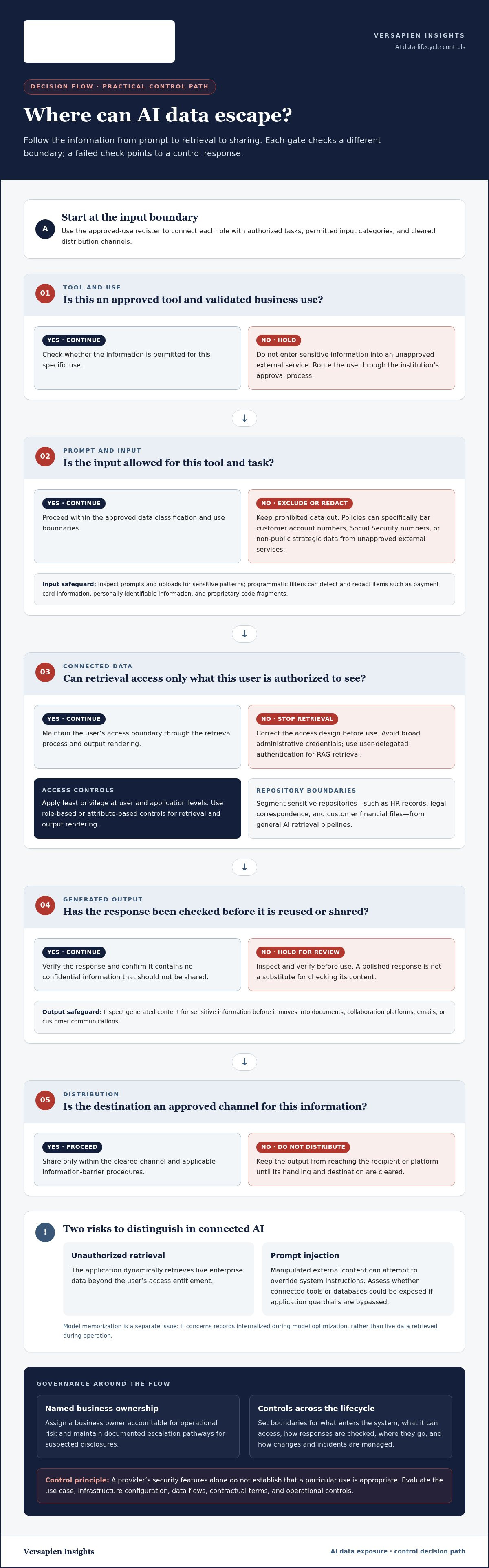
Mitigating generative AI data leakage risk requires layered technical, operational, and governance controls. Institutions cannot rely on standalone measures; effective protection demands that data boundaries be enforced at every stage of model interaction.
Approved Use and Data Classification
Financial institutions should establish clear boundaries by defining approved tools, validated business use cases, and permitted data classifications. Policies must explicitly identify prohibited activities, such as inputting customer account numbers, Social Security numbers, or non-public strategic data into unapproved external services.
Every deployed AI application requires an assigned business owner responsible for operational risk, alongside documented escalation pathways for suspected data disclosures. Rather than relying on generic acceptability policies, organizations should maintain an approved-use register that pairs individual roles with authorized tasks, allowed input categories, and cleared distribution channels.
Identity, Access, and Data Boundaries
Access governance must enforce least-privilege principles at both the user and application levels. AI systems should never operate under broad administrative credentials that transcend end-user entitlements. Instead, systems employing RAG architectures should implement user-delegated authentication, ensuring that the retrieval mechanism only accesses documents the specific user is permitted to see.
Institutions should segment internal databases so that sensitive repositories—such as human resources records, confidential legal correspondence, and customer financial files—remain isolated from general AI retrieval pipelines. Role-based access controls (RBAC) and attribute-based access controls (ABAC) must govern both the retrieval queries and the subsequent output rendering.
Prompt, Output, and Workflow Safeguards
Technical safeguards should inspect both inputs and outputs in real time. Organizations should deploy programmatic filters to detect and redact sensitive patterns, including payment card information, personally identifiable information (PII), and proprietary code fragments, before prompts reach the processing model.
Similarly, output inspection filters can scan generated responses for sensitive data categories prior to display. In high-consequence operational workflows, institutions should integrate human-in-the-loop validation, ensuring that subject-matter experts review AI-generated communications before they are transmitted to customers or external counterparties.
Provider and Platform Due Diligence
Due diligence expectations differ markedly across deployment models:
Public Platforms: Consumer-facing services often process inputs under standard terms that permit prompt data to be retained, reviewed by human evaluators, or used for model retraining. These platforms are generally unsuitable for confidential financial information.
Enterprise Deployments: Enterprise contracts should legally prohibit the vendor from using customer prompts, uploads, or fine-tuning datasets for base model training. Agreements must define data retention periods, encryption standards for data at rest and in transit, tenant isolation, SOC 2 Type II audit report reviews, and subcontractor limitations. For deeper contractual considerations, institutions should consult a structured guide to AI vendor due diligence.
Self-Hosted Architectures: Running models within dedicated cloud virtual private networks (VPCs) or on-premises infrastructure gives institutions direct control over data storage, access boundaries, and network perimeters, shifting full operational and security responsibility to the institution.
Monitoring, Testing, and Incident Response
Institutions need ongoing visibility into AI platform interactions. Audit logs should capture user identities, timestamps, prompt metadata, retrieved source documents, and response classifications without storing sensitive plaintext unnecessarily. Anomaly detection systems should identify suspicious behaviors, such as sudden spikes in prompt volumes, off-hours batch queries, or attempts to elicit restricted customer records.
Security teams should conduct boundary and adversarial testing, including simulated prompt-injection and data-extraction exercises, to evaluate guardrail resilience. Incident response playbooks must specify protocols for isolating compromised integrations, containing disclosed records, preserving forensic evidence, and notifying risk committees when an exposure occurs. Furthermore, formal AI change control procedures must re-evaluate controls whenever underlying models, prompts, or connected data sources are modified.
3. Applying the NIST AI Risk Management Framework
The National Institute of Standards and Technology (NIST) AI Risk Management Framework (AI RMF 1.0) offers a structured approach for managing generative AI data leakage risk controls. The framework supports governance and operational oversight, but it does not replace applicable legal and regulatory obligations, including the Gramm-Leach-Bliley Act (GLBA), HIPAA where applicable, relevant state privacy laws, or institution-specific compliance requirements.
Consider an illustrative financial services deployment: a retail banking customer-support assistant integrated with core servicing records to help agents summarize loan documents and draft customer responses. The four NIST AI RMF functions organize oversight across its lifecycle:
Govern
The Govern function establishes executive accountability, organizational risk tolerance, and decision rights. For the customer-support assistant, governance bodies establish clear policies regarding permitted data types, approve the system’s initial operational scope, and designate accountable business and technical owners. The function ensures cross-disciplinary coordination among business operations, legal, information security, and compliance personnel.
Map
The Map function contextualizes the system within its operational environment. Teams document the assistant’s intended users (customer service agents), data inputs (customer inquiries, loan files), connected databases (core banking systems, servicing notes), and potential exposure pathways. Mapping identifies who could be harmed if unauthorized data disclosure occurs, evaluates dependencies on external model providers, and defines the system's operational boundaries.
Measure
The Measure function applies qualitative and quantitative assessments to evaluate safeguard effectiveness. For the loan servicing tool, technical teams test access controls to verify that an agent assigned to Auto Loans cannot retrieve Mortgage Servicing records. Testing protocols assess output accuracy, evaluate prompt-injection vulnerability, and measure the accuracy of automated PII-masking filters. Unresolved issues and residual risks are documented for management review.
Manage
The Manage function allocates resources to treat identified risks, maintain ongoing monitoring, and respond to operational variances. For the deployed assistant, management establishes real-time logging of query anomalies, enforces human-review protocols for customer-facing drafts, and defines incident containment procedures. If the underlying model is upgraded or connected to a new data repository, the Manage function triggers a formal risk reassessment before expansion.
4. Implementation Priorities for Financial Institutions
Establishing effective generative AI data leakage risk controls requires a structured, phased implementation sequence. Rather than applying uniform restrictions that hinder productivity or deploying tools without oversight, institutions should execute five deliberate implementation priorities:
Inventory Applications, Owners, and Data Connections: Catalog all active, pilot, and third-party generative AI tools across the enterprise. Identify the designated business owner, technical custodian, approved business purpose, and specific data repositories connected to each tool.
Map Exposure Pathways and Prioritize Risk-Tiered Controls: Trace how information enters, traverses, and leaves each system. Prioritize controls based on data sensitivity; an internal code-documentation tool requires different controls than an assistant connected to non-public customer financial records.
Test Permissions and Guardrails Prior to Scaling: Validate identity boundaries, role-based retrieval limits, and prompt-filtering effectiveness in a controlled pre-production environment. Confirm that the application cannot surface data beyond the authenticated user's authorization level.
Document Decisions, Residual Risks, and Governance Exceptions: Record control evaluations, known vulnerabilities, remediation plans, and explicit approvals. Traceability ensures that executive management and oversight committees understand what risks remain and who owns their mitigation.
Monitor Interactions and Reassess Following Material Changes: Maintain operational surveillance of query volumes, prompt patterns, and security anomalies. Reassess controls whenever system owners modify underlying models, adjust system prompts, or integrate new enterprise data sources.
Institutions must also preserve clear distinctions across the three lines of defense. Operational management owns the business application, maintains system documentation, and implements daily controls. Independent risk and compliance functions provide objective challenge, set compliance standards, and review residual risk. Internal Audit provides independent assurance to executive leadership and the Board regarding whether internal controls operate as designed. These roles must remain distinct; Internal Audit should not design, operate, or approve controls.
Executive Takeaways
Enforce Explicit Data Boundaries: Segment enterprise repositories and prohibit generative AI tools from querying internal knowledge bases under unrestricted administrative credentials.
Apply Strict Least-Privilege Access: Ensure that retrieval-augmented generation architectures mirror the individual user's verified permissions, preventing unauthorized document access.
Implement Dual Input and Output Controls: Inspect inbound prompts for unmasked sensitive customer data and screen outbound responses before downstream distribution.
Verify Vendor Protections Contractually: Restrict third-party model providers from retaining or training on proprietary enterprise data through robust enterprise agreements.
Operationalize Ongoing Monitoring and Reassessment: Log model interactions to detect anomalous retrieval patterns, and mandate formal governance reviews whenever system configurations or data connections change.
How Versapien Can Help
Versapien is a boutique consulting firm that specializes in risk management, regulatory compliance, and digital transformation for consumer financial services. The firm assists organizations such as consumer lenders, mortgage providers, auto finance companies, fintechs, retail banks, and digital asset entities in establishing robust AI governance frameworks.
Through its AI & Digital Transformation Services and Risk Management Consulting, Versapien partners with leadership teams to evaluate generative AI data exposure pathways, assess third-party provider terms, design least-privilege retrieval architectures, and implement practical controls aligned with the NIST AI Risk Management Framework. Versapien provides structured, actionable advisory support to help institutions translate complex risk assessments into sustainable operational controls.
Contact Versapien to discuss your institution's AI governance, data protection, and risk management priorities.



Comments