
Human-in-the-Loop Controls: Defining When AI Recommendations Require Expert Review
Human review is often presented as an important safeguard for AI-supported decisions, but the presence of a reviewer does not necessarily make a process safer. If reviewers lack relevant information, sufficient time, appropriate expertise, or authority to challenge a recommendation, human oversight can become a procedural approval step rather than an effective control. Financial institutions therefore need to determine not simply whether a person is involved, but when intervention is necessary and what that person must be able to do.
A risk-based human-in-the-loop framework connects the potential impact of an AI-supported decision to clear review responsibilities, intervention triggers, escalation paths, and evidence of effective operation. The appropriate design will vary by use case: some applications may require review before action, while others may be managed through defined exception handling and ongoing monitoring. The objective is to ensure that human involvement can meaningfully influence decisions where it matters, without introducing unnecessary delays or duplicative controls.
Table of Contents
Human-in-the-Loop Controls: When Review Adds Value
Human Review vs. Procedural Approval
A workflow can include a review step without giving anyone a meaningful opportunity to challenge an AI recommendation. Assigning a reviewer does not inherently establish an effective control. Review is meaningful only when the reviewer has relevant expertise, adequate context, sufficient time, and the authority to challenge, reject, escalate, or halt an action.
For human-in-the loop (HITL) design to function as a control, its purpose and boundaries need to be clear. The reviewer should understand what they are assessing, have access to relevant context, and be able to take a defined action, such as requesting more information, escalating a case, or rejecting a recommendation.
When AI Recommendations Require Expert Review
Whether review is necessary depends on factors such as intended use, operational and customer impact, uncertainty, reversibility, and existing controls. A risk-based governance approach, not a universal human-review mandate, should be applied. Interagency model risk management guidance such as SR 26-2 informs model risk management but does not establish a universal human-in-the-loop requirement. Generative and agentic AI are outside its scope, but institutions should establish appropriate governance and controls for those systems based on their intended use and risk profile.
Consider an AI system that prioritizes applications for manual assessment. A substantive reviewer needs enough information to understand why an application was prioritized, the authority to change how it is handled, and an escalation route when the recommendation is unclear or conflicts with other evidence. A checkbox without those conditions records completion, not effective challenge.
Matching Intervention to Potential Impact
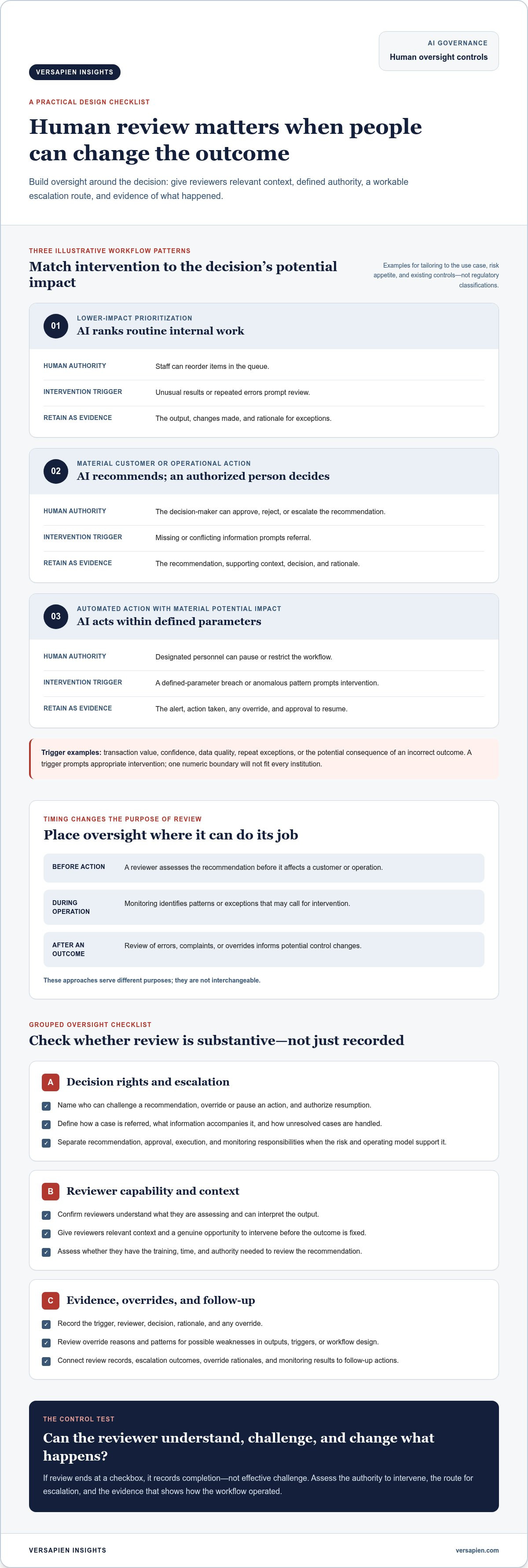
Oversight can take place at different points. Pre-action review assesses a recommendation before it affects a customer or operation. Operational monitoring identifies patterns or exceptions during operation. Retrospective review examines errors, complaints, or overrides to inform control changes. These mechanisms serve distinct functions and are not interchangeable. Not every AI system is a model, so institutions should assess each use case's purpose, impact, and available intervention, then align review to those factors.
Designing Risk-Based Human-in-the-Loop Controls
Define Decision Rights and Accountability
Controls should follow the decision, not a generic label for the technology. The illustrative control designs below connect potential impact with the AI's role, reviewer identity, required information, approval or rejection scope, escalation criteria, authority to pause and resume, and handling of unresolved cases. They are design aids, not mandatory regulatory tiers.
Lower-impact prioritization: The reviewer is the team member who owns the queue, with the ranking rationale and recent exceptions in view. Staff can reorder items but not close them. Unusual results or repeated errors escalate to the team lead, who can pause the ranking feed and approve resumption. Unresolved items default to manual handling.
Customer or operational impact recommendations: An authorized decision-maker with subject-matter expertise reviews the recommendation, supporting context, and data-quality flags. They can approve, reject, or modify within their authority. Missing or conflicting information, or an outcome beyond their authority, escalates to a senior owner, who can hold the workflow. Unresolved cases stay pending with no automated action.
Automated actions with material potential impact: Designated risk or operations personnel monitor alerts, action logs, and threshold status. They can pause or restrict the workflow and a senior approver authorizes resumption. Threshold breaches or anomalous patterns trigger escalation, and unresolved cases remain paused or revert to manual processing.
These examples illustrate possible control designs, not prescribed tiers. A trigger could relate to transaction value, confidence, data quality, repeat exceptions, or the potential consequence of an incorrect outcome. No single numeric boundary fits every institution.
Establish Intervention and Escalation Triggers
For each workflow, specify who can challenge a recommendation, who can override or pause an action, and who authorizes resumption. Separate recommendation, approval, execution, and monitoring responsibilities when the risk and operating model support that separation. Connect the escalation route to enterprise risk management so cases reach accountable personnel with authority to act.
Triggers should address conditions such as missing or conflicting data, high uncertainty, recurring exceptions, and material changes in system behavior. Institutions should also define what happens when a trigger fires, including who receives the escalation, whether the workflow continues or pauses, and who can authorize resumption.
Set Reviewer Information, Expertise, and Training Requirements
Reviewers need the AI output, relevant supporting information, known limitations, and sufficient context to assess the recommendation independently. Where available and appropriate, information about the factors influencing the output may help reviewers evaluate it. Define the expertise each role requires, and train reviewers to recognize errors, challenge unsupported recommendations, and escalate cases they cannot resolve within their authority.
Document Decisions, Overrides, and Exceptions
Make the handoff operational: define how a case is referred, what information accompanies it, and how unresolved cases are handled. Record the trigger, reviewer, decision, rationale, and any override, along with how overrides are reviewed.
Testing Whether Human Oversight Works in Practice
Assess Reviewer Capability and Decision Quality
Management can assess oversight by examining how it operates, not just whether a policy assigns a reviewer. Targeted sampling of reviewed cases, combined with analysis of override rationales and escalation outcomes, can help management assess whether reviewers critically evaluate recommendations rather than approve them by default. Workload analysis shows whether reviewers have time to do so.
Monitor Overrides, Escalations, and Exceptions
Override rates alone are not definitive evidence of effective oversight: a low rate may reflect rubber-stamping or a reliable system, and a high rate may reflect poor outputs or inconsistent reviewers. Read them alongside recurring error tracking and escalation outcomes.
Retain Evidence and Correct Control Weaknesses
Retain review records, escalation outcomes, override rationales, and monitoring results. Use them to adjust training, workflows, decision authorities, escalation thresholds, or the underlying AI system, and verify that corrective actions were completed and worked.
Reassess Controls When Use Cases Change
Reassess controls when changes to system scope, data inputs, user base, autonomy, or potential impact could affect the effectiveness of existing safeguards. Determine whether the change requires updated testing, revised reviewer authority, additional controls, or renewed approval before implementation.
Executive Takeaways and How Versapien Can Help
Executive Takeaways
Clarify decision rights: Identify who can challenge, override, and resume a paused workflow.
Test escalation: Confirm exceptions reach accountable personnel and unresolved cases have a defined disposition.
Assess reviewer capability: Confirm reviewers can interpret outputs and have time to act.
Read overrides in context: Combine rationales, error patterns, and escalation outcomes.
Reassess on change: Revisit controls when scope, data, users, autonomy, or impact change.
How Versapien Can Help
Versapien advises financial institutions, fintechs, and digital-asset businesses on AI governance frameworks, AI risk assessments, implementation roadmaps, and model governance. This work can be tailored to an institution’s use cases and existing governance, linking oversight design with broader risk management and AI and digital transformation.


Comments