
AI Decision Drift: Monitoring When Deployed Systems Stop Behaving as Approved
An AI system can continue operating as designed while the decisions it influences change in ways that introduce new or unexpected risks. Shifts in customer populations, input data, business policies, workflows, or human reliance on AI-generated recommendations can alter real-world outcomes even when the underlying model has not been modified. For financial institutions, the challenge is to distinguish routine variation from material changes that warrant investigation and management action.
Effective AI decision drift monitoring requires more than technical alerts. Institutions need a clear understanding of each system's intended use, indicators linked to the decisions and risks it affects, accountable owners, and defined processes for investigating exceptions and documenting responses. By integrating monitoring into existing risk, compliance, technology, and business governance, institutions can identify emerging issues and respond proportionately as conditions change.
Table of Contents
I. Understanding AI Decision Drift and Its Risk Implications
Consider a credit decision process that produces different approval and referral patterns without any deliberate change to its approved design. The applicant population may have shifted, a product term may have changed, or staff may be relying on recommendations differently. The question for management is whether decisions still serve their intended purpose within the controls established for their use.
Decision Drift vs. Model Drift vs. Concept Drift
Decision drift is a change over time in how an AI-assisted process shapes decisions or outcomes, assessed against the purpose, potential impact, and controls that apply to the decision. The three drift concepts are related but not interchangeable, and each can occur without the others.
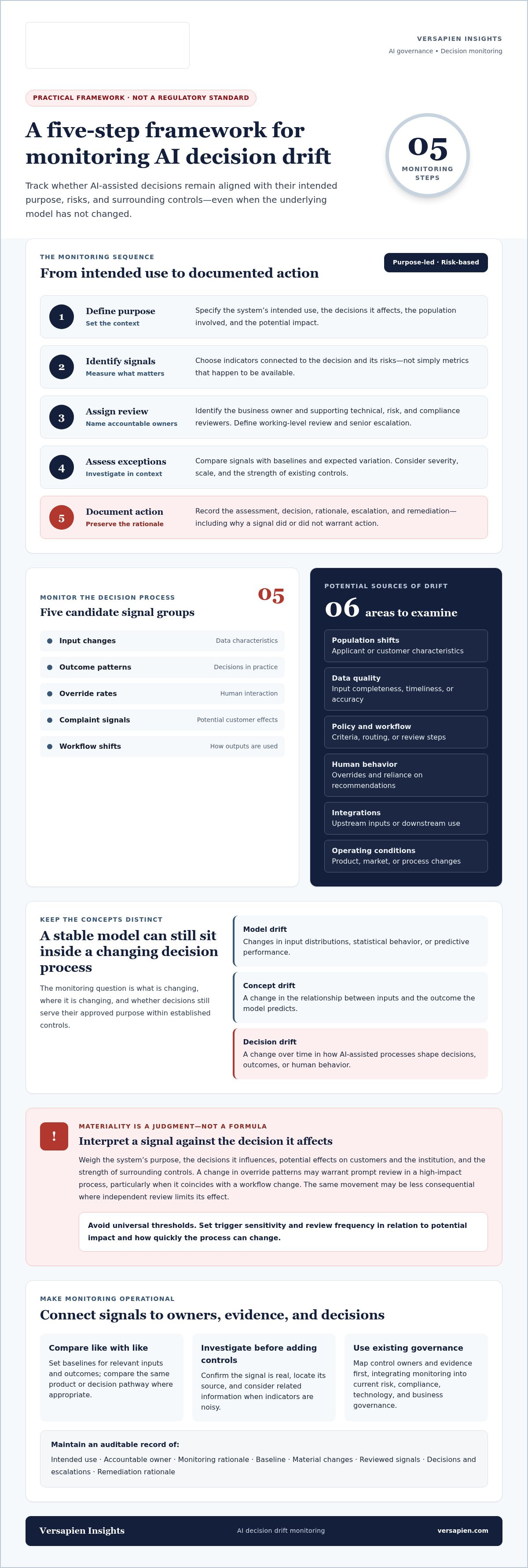
Model drift refers to changes in a model's input distributions, statistical behavior, or predictive performance.
Concept drift refers to a change in the relationship between inputs and the outcome a model is trying to predict, as described in the literature on concept drift in machine learning.
Decision drift focuses on what happens in practice: the decisions, outcomes, and human behavior that result from the system's use.
A stable model can sit inside a drifting decision process if policy, workflow, or staff reliance changes. Likewise, a model may show input drift while decisions remain consistent with their approved purpose.
Not every AI system qualifies as a model under regulatory model risk management definitions. SR 26-2 is interagency guidance on model risk management, not a comprehensive AI governance framework. Generative and agentic AI are outside its scope, but institutions should still establish governance and controls appropriate to those systems' intended uses, materiality, and risk profiles.
Common Sources of Decision Drift
Drift typically traces to one or more of the following sources:
Population shifts: changes in applicant or customer characteristics.
Data quality: changes in the completeness, timeliness, or accuracy of inputs.
Policy and workflow changes: revised criteria, routing, or review steps.
Human overrides and reliance: staff accepting or overriding recommendations at different rates.
Integrations: upstream or downstream system changes that alter what the AI receives or how outputs are used.
Operating conditions: product, market, or process changes that alter the environment in which decisions are made.
Variation in any of these does not automatically indicate a material risk event. Many changes are expected and are absorbed by existing controls.
When Behavioral Changes Become Material
Materiality is a judgment, not a formula. Management can weigh the purpose of the system, the decisions it influences, the potential effect on customers and the institution, and the strength of surrounding controls. A rise in overrides, for example, may call for prompt review in a high-impact process where it coincides with a workflow change, while the same movement may be less consequential where independent review limits its effect. This practical approach avoids universal thresholds that would be difficult to justify across different systems and purposes.
II. Building a Risk-Based Monitoring Framework
The framework below is a practical approach, not a regulatory standard. It follows five steps: define purpose, identify signals, assign review, assess exceptions, and document action. It aligns with broader AI governance and risk management practices and can draw on existing controls rather than replacing them.
Define purpose: specify intended use, affected decisions, and potential impact.
Identify signals: select indicators tied to that purpose.
Assign review: name the accountable business owner and the supporting reviewers.
Assess exceptions: compare signals with baselines and expected variation, considering severity, scale, and existing controls.
Document action: record the decision, rationale, escalation, and remediation.
Establish Intended Use and Baselines
Begin by recording the decision the system supports, the population it affects, and the risks its use could create. Then establish a baseline for relevant inputs and outcomes. Compare like with like, such as the same product or decision pathway, so that shifts in business mix do not obscure the signal.
Select Meaningful Indicators and Triggers
Indicators should reflect the system and the decision, not whatever metrics happen to be available. Candidates include input changes, outcome patterns, override rates, complaint signals, and workflow shifts. Monitoring frequency and trigger sensitivity should be proportionate to the system's intended use, potential impact, existing controls, and the speed at which relevant conditions can change. Avoid universal thresholds or unsupported performance targets; each trigger should be justified by the system's purpose and risk.
A risk-based trigger connects a signal to accountable review by defining who assesses it, what evidence informs the assessment, and how the outcome is recorded. Where a signal is noisy, refine the indicator or compare it with related information before adding another control.
Assign Ownership and Escalation Responsibilities
Name a business owner for each in-scope decision process, along with the technical, risk, and compliance reviewers who support assessment. Define what is reviewed at the working level and what reaches senior management. Map existing control owners and evidence before creating a separate process, so monitoring integrates with current governance rather than duplicating it.
Document Decisions and Remediation
Maintain an auditable record of intended use, accountable owner, monitoring rationale, baseline, material changes, reviewed signals, decisions, escalations, and remediation rationale. Where a signal is reviewed but no corrective action is taken, document the rationale for that decision as well. For further perspective on supporting evidence, see AI Risk Evidence: What Financial Institutions Should Document to Demonstrate Effective Governance.
III. Responding to Drift and Integrating Monitoring Into Governance
Investigate Signals and Determine Root Causes
Investigation starts by confirming the signal is real, then locating its source. Reviewers can ask whether the data feed changed, whether the population or product mix moved, whether policy or workflow was revised, or whether staff behavior differs. Technical causes, such as data pipeline faults or model behavior, call for different owners than process or policy causes, such as revised criteria or inconsistent human review. Separating the two early prevents a process issue from being routed to a technical team, or the reverse.
Implement Corrective Action and Verify Results
Corrective action should match the cause: restoring a data feed, adjusting a workflow, retraining staff, revising a policy, or changing how the system is used. Afterward, confirm through follow-up review that the signal has returned to expected variation and that the fix did not create a new issue. Record the rationale and results so the response can be understood later.
Coordinate Business, Risk, Compliance, Technology, and Audit
Each function has a distinct role, and monitoring can use their work without blurring it:
Business owners are accountable for the decision process and its outcomes.
Model validation and effective challenge assess whether a model is conceptually sound and performing as intended, where the system is a model.
Compliance testing evaluates whether decisions and processes conform to applicable requirements and policy.
Technology maintains data, integrations, and system changes.
Internal Audit provides independent assurance over the governance and controls, including monitoring itself.
These activities are not interchangeable. Where governance changes require new workflows or responsibilities, digital transformation advisory can help embed them in operating processes.
Manage Third-Party Systems and Dependencies
For vendor-provided systems, tailor oversight to the institution's intended use, exposure, materiality, and available information. Validation and monitoring should be appropriate to the system's characteristics and risk, rather than automatically mirroring the approach used for internally developed systems. Consider the vendor's change notifications, performance information, documentation, and testing evidence, while independently monitoring decision outcomes and other indicators available to the institution. Related guidance appears in Third-Party Risk Management: Building a Risk-Based Vendor Inventory and Tiering Framework.
IV. Executive Takeaways and How Versapien Can Help
Executive Takeaways
Name an accountable owner for each AI-assisted decision process and clarify who reviews material signals.
Distinguish decision drift, model drift, and concept drift, and determine whether each system falls within the institution's model risk management framework or requires other forms of AI governance.
Choose indicators and review frequency in proportion to purpose, complexity, and potential impact.
Define escalation paths and keep evidence of signals, assessments, and responses.
Reassess monitoring when purpose, data, process, or decision impact changes.
How Versapien Can Help
Versapien provides advisory support in AI risk assessments, governance frameworks, implementation roadmaps, and model governance, with a focus on practical implementation within enterprise risk and compliance processes. To discuss a specific monitoring need, contact Versapien.


Comments