
AI Governance Committees: Roles, Responsibilities, and Board Oversight
Updated: Sep 22
Table of Contents
The Convergence of Artificial Intelligence and Regulatory Oversight
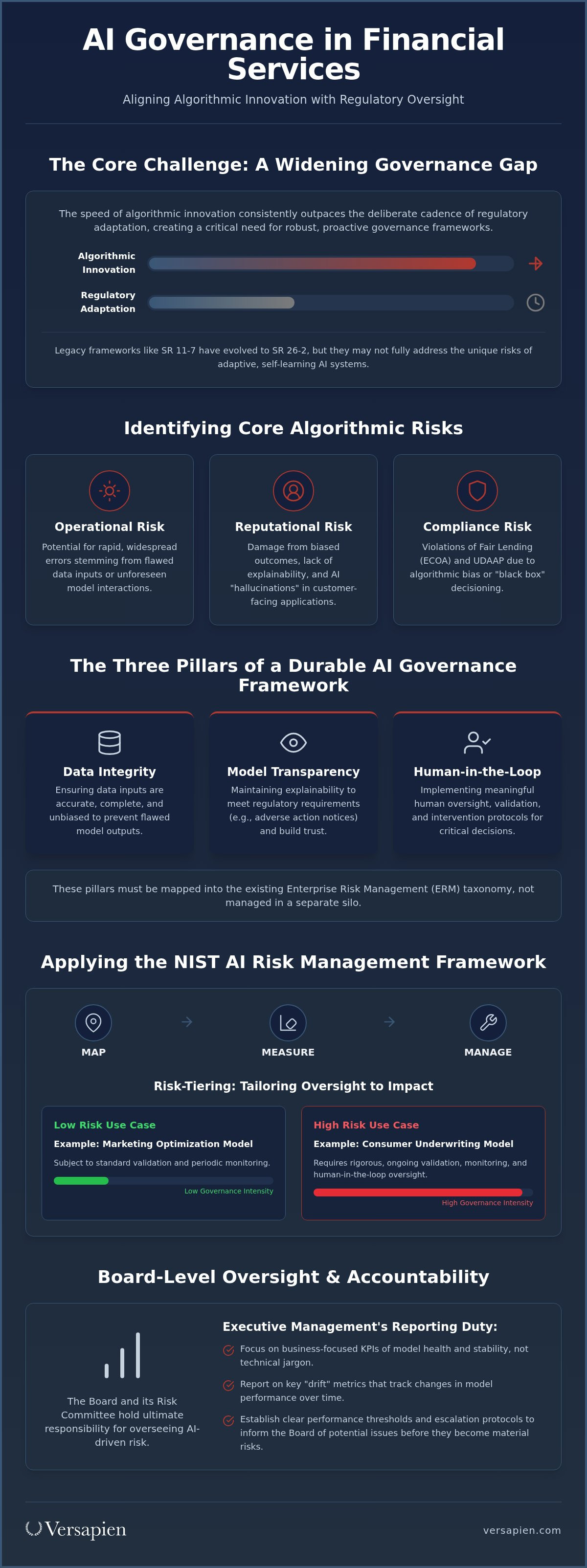
The core challenge in deploying artificial intelligence within financial services is not technological but structural: the speed of algorithmic innovation consistently outpaces the deliberate cadence of regulatory adaptation. AI governance emerges as the systemic framework of policies, controls, and oversight necessary to ensure these complex systems remain transparent, compliant, and aligned with an institution's risk appetite. While firms are rapidly adopting AI to improve decisioning and efficiency, guidance from the Office of the Comptroller of the Currency (OCC), the Federal Reserve, and the Consumer Financial Protection Bureau (CFPB) rightly prioritizes safety, soundness, and consumer protection. This creates a potential governance gap, where legacy model risk management (MRM) frameworks may not fully address the unique characteristics of adaptive, self-learning AI systems. For banks and fintechs, proactively aligning AI governance with established and emerging supervisory expectations is not merely a compliance exercise but a strategic advantage that fosters sustainable innovation.
The Evolution of Model Risk Management under SR 26-2
For years, the principles of SR 11-7 served as the bedrock for model oversight in banking. Today, that foundation has evolved. SR 26-2, which superseded SR 11-7, provides revised supervisory guidance on model risk management and emphasizes a risk-based approach tailored to a banking organization's model risk profile, size and complexity, and the purpose, use, materiality, and potential impact of individual models. This guidance is most relevant to banking organizations with more than $30 billion in total assets; institutions at or below that threshold generally remain subject to internal risk management and governance practices appropriate to their size and risk profile. The central governance challenge is determining how existing risk management frameworks should apply to AI systems whose performance, inputs, data, use, or risk profile may change over time. Effective regulatory compliance advisory must now fully encompass algorithmic transparency and the lifecycle management of these adaptive systems.
Identifying the Core Risks of Algorithmic Financial Services
The integration of AI introduces distinct operational, reputational, and compliance risks that extend beyond traditional model failures. Automated decisioning systems, if not properly governed, can create systemic vulnerabilities. Operational risks include the potential for rapid, widespread errors stemming from flawed data inputs or unforeseen model interactions. Reputational damage can arise from biased outcomes or a lack of explainability when communicating with customers. For instance, the risk of "hallucination"—where a generative AI model produces factually incorrect or nonsensical output—poses a significant threat in customer-facing applications like financial advice bots, potentially leading to poor customer outcomes and regulatory scrutiny.
The AI Governance Integration Matrix for Financial Institutions
A durable AI governance framework should establish clear accountability and integrate relevant risks, including data, model, technology, operational, compliance, cybersecurity, and third-party risks, into the institution's existing governance structure. Rather than creating a separate silo for AI risk, leading institutions map these risks directly into their existing Enterprise Risk Management (ERM) taxonomy. This requires establishing cross-functional committees that include leaders from legal, risk, data science, and business lines to ensure a holistic view of algorithmic risk. A key evolution in this process is the shift from purely periodic validation to an ongoing, risk-sensitive discipline in which the nature, frequency, and rigor of validation and monitoring are tailored to the model's characteristics, use, materiality, and potential impact. This ensures that the level of oversight is commensurate with the risk posed by each AI application.
Mapping AI to the NIST AI Risk Management Framework
The National Institute of Standards and Technology (NIST) AI Risk Management Framework (RMF) offers a valuable structure that complements traditional financial service safety and soundness standards. Its focus on mapping, measuring, and managing AI risks provides a common language for technical and non-technical stakeholders. Financial institutions can adapt the NIST AI RMF to create a practical decision matrix for categorizing AI use cases by risk level. For example, a low-risk marketing optimization model would be subject to a different level of governance than a high-risk underwriting model used for consumer lending. This risk-tiering process is a critical component of broader risk management consulting strategies, enabling firms to allocate oversight resources efficiently and effectively.
What Role Does the Board of Directors Play in AI Governance?
The Board and its relevant committees play an important oversight role with respect to material AI-related risks, while executive management remains responsible for establishing and operating the institution's governance, risk management, and control framework. To fulfill this duty, the board requires clear, concise, and business-focused reporting from executive management. The Chief Risk Officer’s presentation to the risk committee should move beyond technical jargon to focus on key performance indicators of model health and stability. This includes reporting on "drift" metrics, which track how a model's performance changes over time as underlying data patterns shift. Establishing clear performance thresholds and escalation protocols ensures that the board is informed of potential issues before they become material risks, reinforcing a culture of accountability that starts at the top. A deeper examination of this topic can be found in a guide on what boards and executive management should know about AI governance.
Addressing Fair Lending and UDAAP Risks in Automated Decisioning
The CFPB has signaled an increasing focus on algorithmic bias and the "black box" problem, particularly in consumer lending. A central concern is ensuring compliance with the Equal Credit Opportunity Act (ECOA), which requires creditors to provide specific and accurate reasons for adverse actions. This presents a direct challenge to certain complex, opaque AI models. The governance framework must address how the institution will satisfy these transparency requirements when an algorithm is a material part of a credit decision. This intersects with broader compliance efforts, including financial crime prevention, where algorithmic systems must be carefully designed to prevent unintended discriminatory outcomes against protected classes.
Mitigating Algorithmic Bias in Consumer Finance
An effective AI governance framework should establish robust processes for bias testing as a pre-deployment control for relevant models. A key methodology involves identifying "proxy variables"—data points that are not explicitly protected characteristics but are highly correlated with them and could lead to a disparate impact. For example, a model might use a variable that inadvertently serves as a proxy for race or national origin. Where potential fair lending risk is identified, sound practice involves documenting the search for less discriminatory alternatives (LDAs) that could achieve the legitimate business need with less adverse impact. This documentation is a critical component of a defensible compliance management system.
How Should Financial Institutions Document AI Explainability for Regulatory Exams?
The need for explainability is not universal but is acutely important for AI systems used to make or materially influence credit decisions that may result in adverse action. For these high-risk systems, institutions need to be able to provide specific and accurate reasons for their decisions as required by applicable law. For AI used in other parts of the credit lifecycle, or for purely operational purposes, the documentation requirements may be different. The principle extends to Unfair, Deceptive, or Abusive Acts or Practices (UDAAP) standards, which apply to AI-driven marketing and product recommendations. To meet consumer disclosure obligations and mitigate UDAAP risk, firms are increasingly exploring "explainable AI" (XAI) techniques that provide clear, understandable rationales for model outputs, ensuring that both customers and examiners can understand the basis for automated decisions.
Institutionalizing Responsible AI for Long-Term Stability
Viewing AI governance as a restrictive hurdle is a strategic misstep. When properly implemented, it becomes an enabler of innovation, providing the safety net required for rapid testing and deployment of new technologies. This reframes the conversation from "model validation as a barrier" to "governance as a strategic asset" that builds institutional durability and regulatory trust. Versapien’s approach to senior-led advisory helps institutions bridge the gap between technical implementation and board-level oversight, preparing them to meet supervisory expectations with confidence. The goal is to embed responsible AI principles into the organization’s culture, ensuring that growth is built on a foundation of sound risk management.
Preparing for the Next Generation of Regulatory Examinations
As AI use expands, institutions should expect supervisory discussions to consider not only individual models and systems, but also whether the institution has a coherent process for identifying, classifying, and managing AI-related risks. Institutions should maintain an appropriate inventory of AI use cases and systems, with models subject to the institution's model inventory and model risk management processes where they meet the applicable definition of a model. This inventory should document each model's purpose, data sources, owner, risk tier, and validation history, providing examiners with a clear picture of the institution's algorithmic footprint and the governance structures surrounding it.
Practical Actions for Senior Risk and Compliance Leaders
To assess and enhance AI governance maturity, senior leaders should consider several immediate actions. First, conduct a baseline inventory of all AI use cases within the organization to understand the current state and identify potential gaps in oversight. Second, review existing third-party risk management programs to ensure they adequately address the specificities of AI vendors, including data rights, model transparency, and performance monitoring. This is a critical area detailed in guidance on managing AI vendor risk. Finally, align AI governance milestones with the firm's broader digital transformation roadmap to ensure that risk management capabilities evolve in lockstep with technological innovation.


Comments