
Mortgage Servicing Compliance: Emerging Risks and Governance Priorities
Updated: Sep 22
Mortgage servicing compliance risk rarely resides in a single policy or regulatory requirement. It often emerges where processes, data, technology, employees, and third parties intersect, particularly in loss mitigation, borrower communications, error resolution, servicing transfers, and other activities where small operational failures can affect consumers and create regulatory exposure. Effective governance therefore requires more than maintaining procedures or responding to individual compliance issues. It requires management to understand where servicing risk is concentrated, whether controls are operating as intended, and how weaknesses are identified, escalated, and remediated. This article examines several governance priorities mortgage servicers should consider when strengthening their compliance programs, with particular attention to operational controls, third-party risk, model risk where applicable, and regulatory examination preparedness.
Table of Contents
Mortgage Servicing Compliance: Where Governance Risk Concentrates
Model Risk Management and SR 26-2
Governance, Monitoring, and Examination Readiness
Mortgage Servicing Compliance: Where Governance Risk Concentrates
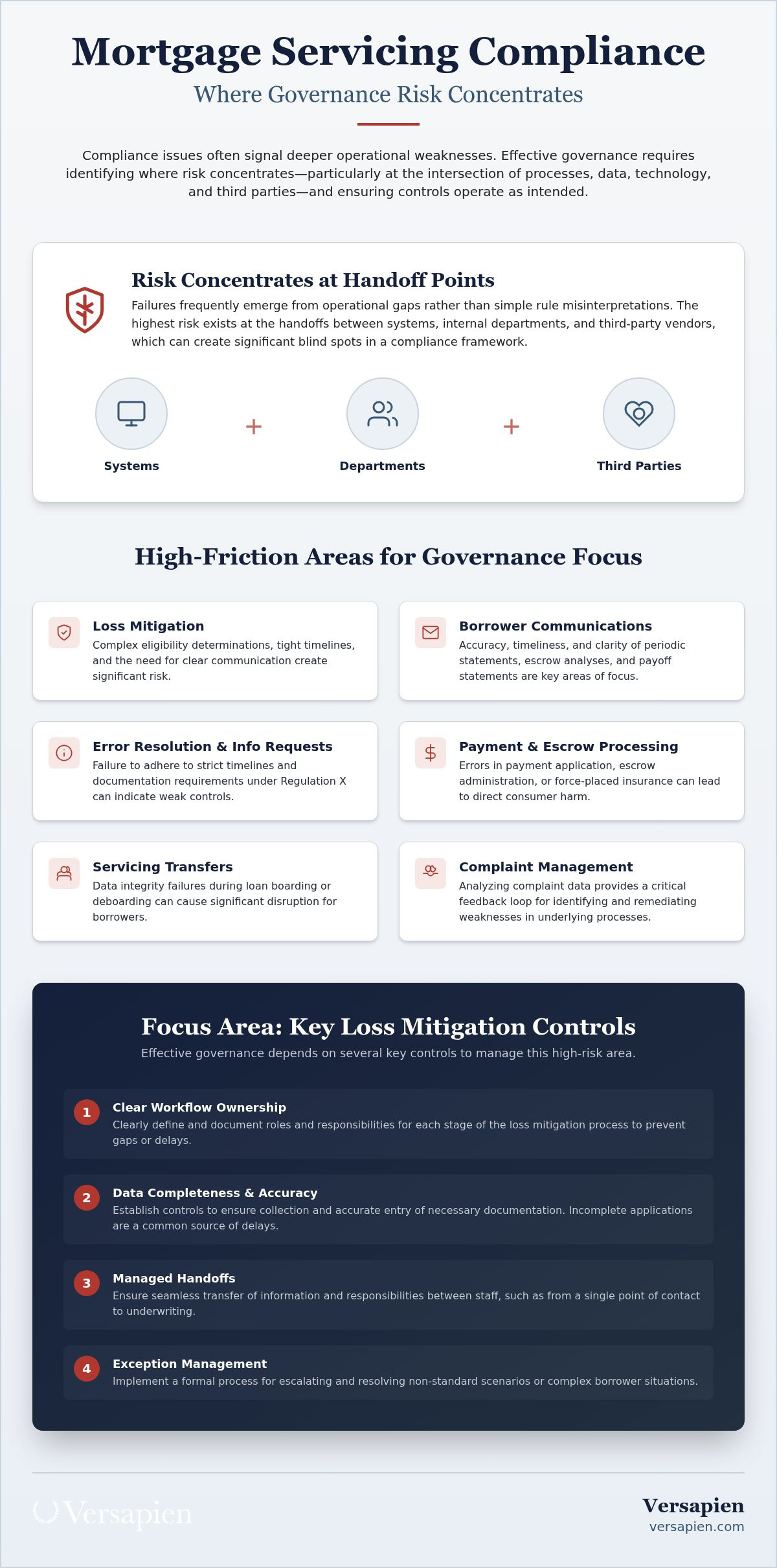
In mortgage servicing, compliance failures are frequently symptoms of deeper operational weaknesses rather than a simple misinterpretation of a rule. Risk concentrates at the handoff points between systems, departments, and third-party vendors. A fragmented Compliance Management System (CMS) can create blind spots, allowing minor process deviations to cascade into systemic issues affecting borrowers. Effective governance moves beyond regulatory checklists to scrutinize the integrity of the entire servicing lifecycle.
Management attention should focus on high-friction areas where operational complexity and regulatory sensitivity converge. These include:
Loss Mitigation: Complex eligibility determinations, tight timelines, and the need for clear communication create significant operational and compliance risk.
Borrower Communications: The accuracy, timeliness, and clarity of periodic statements, escrow analyses, and payoff statements are important areas of servicing compliance risk.
Payment and Escrow Processing: Errors in payment application, escrow administration, or force-placed insurance can lead to direct consumer harm and violations of Regulations X and Z.
Error Resolution and Information Requests: Failure to adhere to strict timelines and documentation requirements under Regulation X can indicate weak intake, routing, and case management controls.
Servicing Transfers: Data integrity failures during loan boarding or deboarding can cause significant disruption for borrowers and create compliance gaps.
Complaint Management: Analyzing complaint data provides a critical feedback loop for identifying and remediating weaknesses in underlying processes and controls.
A governance-led approach treats these functions not as isolated silos but as an interconnected ecosystem. It seeks to identify and address the root causes of compliance exceptions, be it inadequate training, flawed system logic, or unclear vendor oversight, to build a more durable and defensible servicing operation.
Loss Mitigation and Borrower Assistance
Loss mitigation and borrower assistance programs represent a significant concentration of operational and compliance risk. The processes involve intricate workflows, time-sensitive decisions, and direct engagement with borrowers in distress, making them a focal point for regulators. The Consumer Financial Protection Bureau (CFPB) continues to emphasize the importance of minimizing friction for borrowers seeking assistance.
For example, the CFPB’s proposed rule to streamline mortgage servicing, issued in July 2024, signals a continued focus on borrower-centric outcomes. While a proposed rule does not establish new requirements, it highlights the agency's priorities. The proposal’s attention to early intervention, continuity of contact, and evaluation of complete loss mitigation applications underscores the need for robust operational governance, regardless of the rule's final form.
Effective governance in this area depends on several key controls:
Clear Workflow Ownership: Roles and responsibilities for each stage of the loss mitigation process, from initial contact to final decision, should be clearly defined and documented to prevent gaps or delays.
Data Completeness and Accuracy: Controls should be in place to ensure all necessary documentation is collected and accurately entered into systems of record. Incomplete applications are a common source of delays and borrower frustration.
Managed Handoffs: The transfer of information and responsibilities between staff, such as from a single point of contact to an underwriting team, should be seamless and tracked to maintain accountability.
Exception Management: A formal process should exist for escalating and resolving non-standard scenarios or complex borrower situations, with clear criteria for management review.
Systematic Monitoring and Testing: Management should use ongoing monitoring and periodic testing to validate that loss mitigation workflows are executed consistently and in accordance with both regulatory requirements and internal procedures.
Regulation X Error Resolution and Information Requests
Regulation X §§ 1024.35 and 1024.36 establish specific requirements and timeframes for responding to qualifying notices of error (NOEs) and requests for information (RFIs). Effective governance requires controls that support accurate intake, routing, investigation, response, and documentation. Failures in this area are often viewed by examiners as direct evidence of a weak control environment. Governance over these processes is not merely about meeting deadlines; it is about ensuring the servicer has a systematic, auditable framework for receiving, investigating, and resolving borrower inquiries.
While the regulation provides specific acknowledgment and response timelines, these can be affected by exceptions and the nature of the inquiry. For example, the timeline for correcting an error and providing notification is generally 30 days, with a potential 15-day extension, but different timelines apply to requests concerning borrower identity or payoff statements. A robust governance framework connects these regulatory nuances to practical, day-to-day controls:
Intake and Logging: NOEs and RFIs should be captured and logged through a controlled intake process that records the applicable receipt date and supports timely routing and response. This includes date-stamping to establish the start of the regulatory timeline.
Routing and Assignment: A defined process is needed to route inquiries to the appropriate subject matter expert or department for research, with clear ownership assigned to each case.
Thorough Research: The investigation must be reasonably conducted and well-documented, demonstrating a good-faith effort to understand and address the borrower's issue.
Response Generation: Responses must be clear, directly address the borrower's inquiry, and comply with all content requirements outlined in the regulation.
Quality Assurance: A quality control function should review a sample of cases to ensure research was adequate, conclusions were sound, and responses were accurate and timely.
Documentation and Recordkeeping: All actions taken, from intake to final response, must be meticulously documented in the servicing system of record to create a complete audit trail for examiners.
Servicing Transfers, Data Integrity, and Third-Party Risk
Risk is magnified during the transfer of servicing rights and in relationships with subservicers, technology providers, and other vendors. Data integrity is a critical consideration, as mapping errors or incomplete data transfers can lead to immediate borrower harm, such as misapplied payments or incorrect escrow calculations. Governance in this domain requires a structured approach to third-party oversight and data management.
When managing servicing transfers, servicers should implement robust controls for data mapping, reconciliation, and pre- and post-transfer testing. This helps establish that critical data fields are accurately translated between systems and that trial balances are fully reconciled. For relationships with subservicers and other critical technology providers, oversight cannot be passive. A strong third-party risk management program establishes clear accountability, defines performance metrics, and outlines processes for incident escalation and monitoring.
When third parties use their own models, for example, for valuation or loss forecasting, the servicer’s validation activities should be risk-based. As reflected in interagency guidance, this does not mean vendor models must undergo the exact same validation processes as internal models. Instead, the validation should be appropriate for the model, its intended use, and its associated risk, ensuring the servicer understands its assumptions, limitations, and performance. For more on this topic, see our guide to third-party risk management for fintech and AI vendors.
Model Risk Management and SR 26-2
On April 17, 2026, the Federal Reserve, FDIC, and OCC issued interagency supervisory guidance on model risk management (SR 26-2). It is important to characterize this guidance accurately: it is risk-based, nonbinding, and does not create new legal obligations. The guidance is most relevant for Federal Reserve-regulated banking organizations with total assets over $30 billion, though it may also be relevant to smaller institutions with significant model risk exposure due to complex or non-traditional activities.
The guidance addresses models within its defined scope, generally involving quantitative methods, systems, or approaches that apply statistical, economic, or financial theories to process input data and produce quantitative estimates. It does not apply to every automated system. Simple arithmetic calculations, deterministic rules-based engines, and many other automated workflows are not considered models. Notably, generative and agentic artificial intelligence systems are explicitly outside the scope of SR 26-2, although they may be subject to broader institutional risk management practices.
For servicers where the guidance applies, key governance priorities include:
Effective Challenge: This is a critical process where qualified, independent staff review and challenge all aspects of a model. The governance framework should provide qualified reviewers with sufficient independence, expertise, and organizational standing to meaningfully challenge model use, assumptions, limitations, and performance.
Validation and Monitoring: Models should undergo a robust validation process to assess their conceptual soundness, review ongoing monitoring results, and analyze outcomes. This process should be appropriate for the risk and complexity of the model.
Governance and Documentation: The Board and senior management should establish a clear governance structure with defined roles and responsibilities. Comprehensive documentation of a model's design, assumptions, and limitations is essential for continuity and oversight. More information on this can be found in our discussion of model risk management in the age of artificial intelligence.
Governance, Monitoring, and Examination Readiness
Effective governance fosters a state of operational discipline and documentation that naturally supports examination readiness. This is not achieved through last-minute projects but through ongoing, embedded oversight practices. Clear roles and responsibilities are foundational, with business line owners accountable for compliant execution, and Compliance and Risk functions providing independent oversight and credible challenge. Where applicable, a Model Risk Management (MRM) function provides specialized oversight of model risk.
The role of Internal Audit is to provide independent assurance over the effectiveness of these functions. It evaluates the rigor of the first and second lines of defense; it does not duplicate their activities, such as re-performing model validation or compliance testing. This separation preserves its independence and value to the Board.
Senior management can use a variety of data sources to identify systemic weaknesses and assess the health of the servicing operation. A proactive governance and monitoring program integrates inputs from multiple sources, including:
Key Risk Indicators (KRIs): Tracking metrics like error resolution timeliness, call center wait times, or complaint volumes by category can provide early warnings of process degradation.
Compliance Testing Results: The results of periodic testing provide direct insight into whether controls are designed appropriately and operating effectively.
Complaint and Error Analysis: Systematically analyzing the root causes of complaints and identified errors helps management distinguish between isolated incidents and systemic control failures.
Remediation Tracking: Monitoring the status of corrective actions for previously identified issues ensures that weaknesses are addressed in a sustainable way.
By synthesizing this information, management and the Board can gain a holistic view of mortgage servicing compliance risk and direct resources toward the areas of greatest concern, turning past findings into sustainable improvements. For more on this, explore our guide on turning past findings into sustainable remediation.
Executive Takeaways
For Boards and senior management, strengthening mortgage servicing compliance requires a focus on governance and operational integrity. Key priorities should include:
Focus on Process Intersections. Acknowledge that significant compliance risk emerges from handoffs between systems, departments, and vendors. Direct oversight toward strengthening controls at these critical junctures.
Validate High-Risk Workflows. Prioritize appropriate testing and independent review of higher-risk operational areas, particularly loss mitigation and error resolution.
Scrutinize Third-Party and Data Risks. Ensure that governance over servicing transfers and third-party providers includes rigorous data validation, clear performance metrics, and defined accountability for compliance.
Characterize Model Risk Guidance Accurately. Understand that SR 26-2 is nonbinding supervisory guidance, not a regulation, with specific asset thresholds and scope limitations. Apply any model-risk practices in a manner proportionate to the institution's model-risk profile, size, complexity, and use of models.
Leverage Internal Data for Proactive Oversight. Use a combination of risk indicators, testing results, and complaint data to identify and remediate systemic weaknesses before they become examination findings.
Clarify Roles and Responsibilities. Support effective challenge and independent assurance through clear roles, appropriate expertise, and defined accountability.
How Versapien Can Help
Versapien helps mortgage servicers, banks, and fintechs strengthen their compliance governance frameworks. Led by senior advisors with Big Four consulting experience, we provide practical, implementation-focused guidance on developing and enhancing Compliance Management Systems, preparing for regulatory examinations, and remediating identified weaknesses. Our integrated approach helps clients align operational controls with regulatory expectations across consumer compliance, third-party risk management, and model risk management.


Comments