
Consumer Lending Compliance Risk Assessment: A Practical Framework for Financial Institutions
Updated: Sep 22
A consumer lending compliance risk assessment should help management understand where the institution is most exposed to consumer compliance risk, how effectively existing controls address those risks, and where additional attention may be warranted. The assessment should reflect the institution's products, customers, channels, business model, applicable legal and regulatory requirements, and significant changes in its operations. A useful assessment is not simply a catalog of regulations or a checklist of controls; it connects identified risks to the controls designed to address them and provides a basis for prioritizing management action. This article presents a practical framework for assessing consumer lending compliance risk across the credit lifecycle and translating the results into meaningful governance and risk-management decisions.
Table of Contents
The Strategic Architecture of a Consumer Lending Risk Assessment
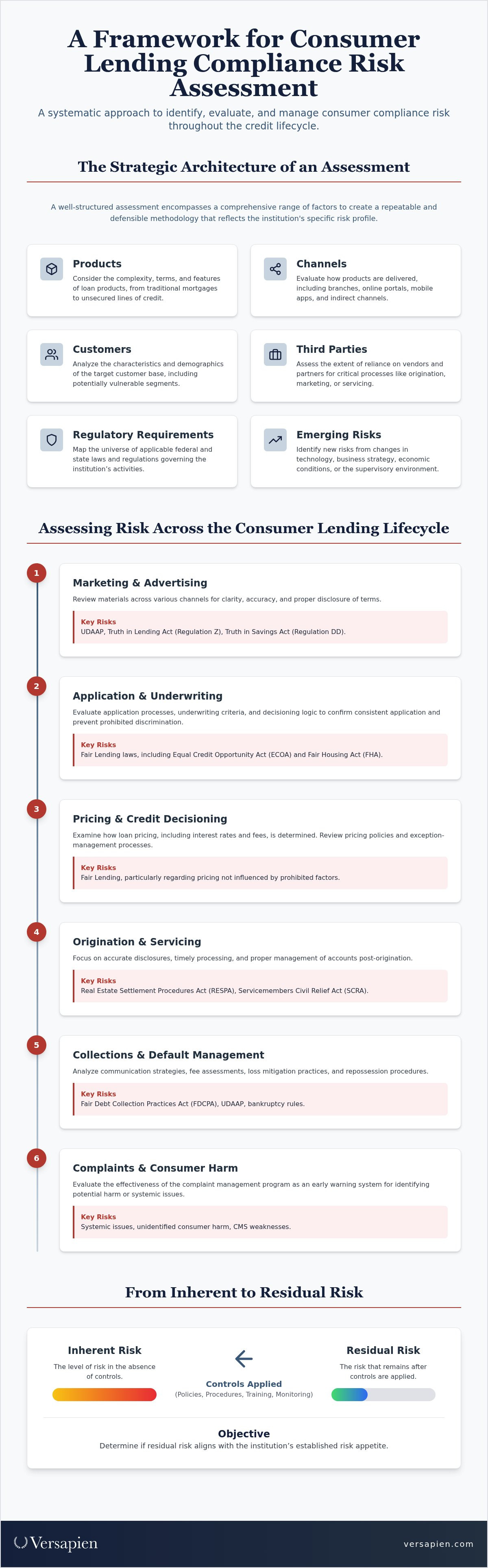
A well-structured consumer lending compliance risk assessment serves a clear purpose: to systematically identify inherent compliance risks, evaluate the effectiveness of corresponding controls, determine the level of residual risk, and prioritize management attention and resources. An effective framework moves beyond a static, check-the-box exercise and becomes a foundational component of the organization’s Compliance Management System (CMS). The scope of the assessment should be comprehensive, encompassing the full range of factors that can give rise to consumer compliance risk.
Key areas for consideration in the assessment’s design include:
Products: The complexity, terms, and features of loan products, from traditional mortgages and auto loans to unsecured installment loans and lines of credit.
Channels: How products are delivered, whether through branches, online portals, mobile applications, or indirect channels like auto dealerships or mortgage brokers.
Customers: The characteristics and demographics of the target customer base, including any focus on potentially vulnerable consumer segments.
Lifecycle Stages: The full credit lifecycle, from initial marketing and application through underwriting, servicing, and collections.
Third Parties: The extent of reliance on vendors, partners, and other third parties for critical processes, such as loan origination systems, marketing lead generation, or servicing platforms.
Regulatory Requirements: The universe of applicable federal and state laws and regulations governing the institution’s activities.
Emerging Risks: New risks introduced by changes in technology, business strategy, economic conditions, or the supervisory environment.
The goal is to create a repeatable and defensible methodology that reflects the specific risk profile of the institution. While some organizations with high-velocity digital originations may benefit from more frequent or dynamic assessments, the appropriate cadence and depth depend on the institution’s size, complexity, and risk appetite.
Assessing Risk Across the Consumer Lending Lifecycle
To be effective, a risk assessment must analyze compliance risk at each stage of a product’s life. This granular approach helps identify specific process weaknesses and control gaps that a higher-level review might miss. It is also critical to distinguish between risk indicators and conclusive evidence of a regulatory violation.
Marketing and Advertising
This stage should consider applicable consumer-protection and advertising requirements, including UDAAP and, where applicable, requirements under the Truth in Lending Act and Regulation Z. The assessment should review advertising materials across all channels for clarity, accuracy, and the proper disclosure of terms like Annual Percentage Rate (APR).
Application and Underwriting
Risks at this stage include compliance with the Equal Credit Opportunity Act (ECOA) and Regulation B and, for mortgage and other housing-related credit, applicable requirements under the Fair Housing Act. Following the CFPB's April 2026 amendments to Regulation B, institutions should assess compliance with the current requirements governing discrimination and discouragement in credit transactions, including the prohibition against discrimination on the bases specified by ECOA. The assessment should evaluate application processes, underwriting criteria, and decisioning logic—whether manual or automated—to confirm they are applied consistently and do not result in prohibited disparate treatment.
Pricing and Credit Decisioning
This area continues the focus on fair lending risk, examining how loan pricing, including interest rates and fees, is determined. The assessment should review pricing policies, exception-management processes, and the discretion afforded to loan officers to assess whether pricing policies, exceptions, and discretionary practices are designed and administered consistently with applicable fair-lending requirements.
Origination and Servicing
Once a loan is approved, risks shift to areas like accurate disclosures, timely and correct transaction processing, and proper management of escrow accounts under the Real Estate Settlement Procedures Act (RESPA). The assessment should also cover compliance with the Servicemembers Civil Relief Act (SCRA) and other rules governing ongoing account management.
Collections, Default Management, and Repossession
Here, relevant risks may include UDAAP, applicable requirements governing debt collection (including the FDCPA and Regulation F where the institution or its service providers fall within their scope) and applicable bankruptcy and state-law requirements. The assessment should analyze communication strategies, fee assessments, loss mitigation practices, and procedures for repossession to ensure they comply with applicable laws and treat consumers fairly.
Complaints and Consumer Harm
A systematic process for tracking, analyzing, and responding to consumer complaints is a key component of a strong CMS. The risk assessment should evaluate the effectiveness of the institution’s complaint management program as an early warning system for identifying potential consumer harm or systemic issues.
Evaluating Controls, Residual Risk, and Model/Technology Risk
After identifying inherent risks across the lifecycle, the next step is to evaluate the controls designed to mitigate them. This evaluation distinguishes between the design of a control (e.g., a documented policy) and its operating effectiveness (e.g., evidence the policy is followed in practice). Inherent risk is the level of risk in the absence of controls, while residual risk is the risk that remains after controls are applied. The objective is to determine if the residual risk aligns with the institution’s established risk appetite.
Automated Decisioning and Model Risk
For institutions that use automated decisioning systems or complex quantitative models, the risk assessment should incorporate considerations from model risk management. This involves evaluating the governance around how these systems are developed, validated, and monitored. The April 2026 interagency guidance on model risk management, transmitted by the Federal Reserve through SR 26-2, provides risk-based principles that may be relevant to institutions whose use of quantitative models creates material model risk.
It is important to apply this guidance accurately. The guidance is risk-based and nonbinding and is expected to be most relevant to banking organizations with more than $30 billion in total assets. It may also be relevant in certain circumstances to banking organizations with $30 billion or less in total assets that have significant exposure to model risk. Generative and agentic AI are outside the scope of the guidance. For more on this, see our guide to model risk management in the age of artificial intelligence.
The assessment should distinguish between different assurance activities:
Model Validation: An objective assessment of a model's conceptual soundness, inputs, performance, limitations, and other relevant characteristics, performed with a level of rigor appropriate to the model's risk and use.
Compliance Testing: A targeted review to determine if a specific process complies with regulatory requirements.
Monitoring: Ongoing tracking of model performance or process outcomes to detect anomalies or degradation.
Internal Audit: An independent evaluation of the overall effectiveness of the risk management and control framework.
Risk from third-party technology should be assessed proportionately based on the criticality of the function it supports and the level of control the institution retains.
Governance, Reporting, and Examination Readiness
A risk assessment’s value is realized when its findings are integrated into the institution’s governance and decision-making processes. This requires clear ownership from management and effective oversight from the Board of Directors. The assessment methodology, supporting documentation, significant findings, and remediation actions should be appropriately documented, governed, and escalated in accordance with the institution's risk-management framework.
Management Decisions and Board Oversight
The results of the assessment should provide a clear picture of the institution's consumer compliance risk profile. This enables management to make informed decisions about where to allocate resources, enhance controls, or provide additional training. Reporting to the board should be concise and strategic, translating technical findings into business implications and progress on remediation efforts. It should clearly articulate the highest residual risks and the actions being taken to address them.
Preparing for Regulatory Examinations
A well-documented risk assessment can support examination preparation by demonstrating how the institution identifies and evaluates consumer compliance risks, assesses its controls, and responds to significant findings. The CFPB's own examination process uses risk assessment to help inform examination planning and scope; an institution's assessment should not be viewed as a substitute for the examiner's independent assessment.
The assessment should be revisited when appropriate, including when significant changes in products, business activities, technology, risk profile, or applicable requirements occur.
Executive Takeaways
A consumer lending compliance risk assessment is a foundational governance tool, not just a regulatory checklist. Its primary purpose is to identify inherent risks, evaluate control effectiveness, and provide a basis for prioritizing management action.
The assessment should be comprehensive, analyzing risk across all products, channels, and stages of the credit lifecycle, from marketing and underwriting to servicing and collections.
Evaluating controls requires moving beyond policy documentation to test for operating effectiveness. The goal is to understand the level of residual risk that remains after controls are applied.
For institutions using complex models, the assessment should incorporate model risk management principles. For institutions whose model use makes it relevant, the nonbinding SR 26-2 guidance provides risk-based principles for model risk management. Its applicability, including the $30 billion distinction and exclusion of generative and agentic AI, should be evaluated based on the institution's circumstances.
The ultimate value of the risk assessment lies in its use. Findings should be translated into actionable remediation plans, drive resource allocation decisions, and be communicated effectively to senior management and the Board.
A well-supported risk assessment can help management demonstrate how consumer compliance risks are identified, evaluated, monitored, and addressed and can support preparation for regulatory examinations.
How Versapien Can Help
Versapien helps financial institutions design and implement robust consumer lending compliance risk assessment frameworks tailored to their specific products, technologies, and business models. Our senior-led teams provide practical, implementation-focused guidance to strengthen compliance management systems, prepare for regulatory examinations, and align risk management with strategic objectives.


Comments