
AI Implementation in Financial Services: From Pilot to Production
Updated: Sep 22
Financial institutions have moved quickly from experimenting with artificial intelligence to identifying opportunities for broader deployment. The challenge is no longer simply proving that an AI use case can work. It is determining how to move promising initiatives from isolated pilots into production while maintaining appropriate governance, risk management, security, data quality, human oversight, and operational resilience.
A successful transition requires more than selecting the right technology. Institutions need a repeatable implementation framework that connects business objectives with technical design and integrates risk and control considerations throughout the lifecycle. By establishing clear accountability, defining success criteria, testing before deployment, and monitoring performance after implementation, financial institutions can scale AI in a more disciplined and sustainable manner.
Table of Contents
From AI Experimentation to Enterprise Implementation
Many AI pilots encounter significant challenges when transitioning into production-level systems. A model that performs well in a controlled testing environment often encounters unforeseen obstacles when deployed at scale. These challenges are rarely technological alone; they are frequently rooted in operational, governance, and organizational friction. Production introduces a new level of complexity, including integration with legacy systems, adherence to enterprise data security standards, and the need for robust change management to ensure user adoption and process alignment.
The path from a successful proof-of-concept to an enterprise-grade solution requires a structured approach. Without a formal implementation lifecycle, institutions may experience inconsistent application of controls, duplicated effort, and limited visibility into aggregate AI-related risk. A disciplined framework helps ensure that operational, compliance, and reputational risks are identified and mitigated before a system impacts customers, operations, or financial decision-making.
Selecting and Prioritizing AI Use Cases
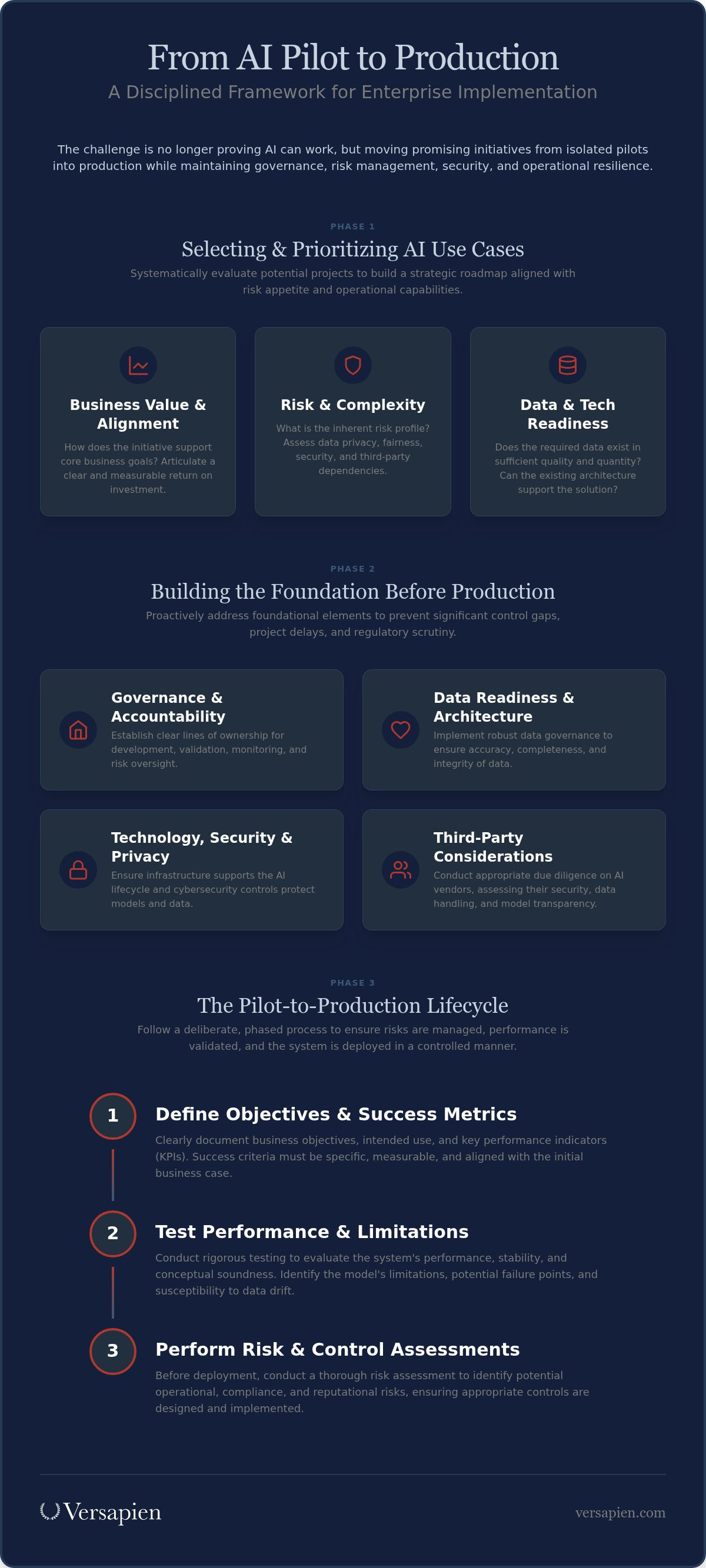
Not all potential AI applications deliver the same value or carry the same level of risk. A systematic selection and prioritization process enables an institution to focus its resources on initiatives with the greatest potential for strategic impact. This evaluation should balance business objectives with implementation feasibility and risk management capacity.
Management should assess potential use cases across several dimensions:
Business Value and Strategic Alignment: How does the initiative support core business goals, such as improving operational efficiency, enhancing customer experience, or strengthening risk detection? The expected return on investment should be clearly articulated and measurable.
Risk and Complexity: What is the inherent risk associated with the use case? A model used for internal process automation carries a different risk profile than one used for consumer credit underwriting. The assessment should consider data privacy, fairness, security, and third-party dependencies.
Data and Technology Readiness: Does the institution possess the required data in sufficient quality and quantity to develop and train the AI system? The evaluation should also consider the existing technology architecture and whether it can support the proposed solution's performance, security, and monitoring requirements.
By scoring and ranking potential projects against these criteria, an organization can build a strategic roadmap for AI implementation that aligns with its risk appetite and operational capabilities.
Building the Foundation Before Production
Before an AI system is moved into a production environment, a strong governance and operational foundation must be in place. Proactively addressing these foundational elements can prevent significant control gaps, project delays, and regulatory scrutiny later in the lifecycle. Key areas for management attention include:
Governance and Accountability: Clear lines of ownership must be established for each AI system. This includes defining roles and responsibilities for development, validation, ongoing monitoring, and risk oversight. An effective AI governance framework provides a structure for decision-making and ensures that senior management and the board have appropriate visibility into the institution's AI activities.
Data Readiness and Architecture: AI system performance and reliability depend heavily on the quality, relevance, and integrity of the data used to develop, train, and operate the system. Institutions should establish robust data governance practices to ensure the accuracy, completeness, and integrity of data used for training and operating AI systems. The data architecture must support secure data flows and protect sensitive information from unauthorized access or use.
Technology, Security, and Privacy: The technology infrastructure must be capable of supporting the entire AI lifecycle, from development to deployment and monitoring. Cybersecurity controls should be designed to protect models and data from internal and external threats, while privacy considerations must be embedded into the design process to ensure compliance with applicable laws and regulations.
Third-Party Considerations: When leveraging vendor-provided AI solutions, the institution’s third-party risk management program must be equipped to conduct appropriate due diligence. This includes assessing the vendor's security posture, data handling practices, and the transparency of its models.
Moving from Pilot to Production
The transition from a pilot program to a live production environment should follow a deliberate, phased process. This structured approach ensures that risks are managed, performance is validated, and the system is deployed in a controlled manner. A practical pilot-to-production lifecycle includes several distinct stages.
Define Objectives and Success Metrics: Clearly document the business objectives, intended use, and key performance indicators (KPIs) for the AI system. Success criteria should be specific, measurable, and aligned with the initial business case.
Test Performance and Limitations: Conduct rigorous testing to evaluate the system's performance, stability, and conceptual soundness. This process should identify the AI system's limitations and potential failure points, including performance degradation, data drift where applicable, security vulnerabilities, and other conditions that could affect its intended use.
Perform Risk and Control Assessments: Before deployment, conduct a risk assessment appropriate to the use case to identify potential operational, compliance, consumer, fairness, security, and reputational risks. The results inform the design of appropriate controls, such as accuracy thresholds, manual overrides, or escalation protocols. For certain quantitative applications, this may involve a formal model validation to ensure it is performing as intended.
Establish Human Oversight: Determine the appropriate level of human involvement and oversight for the system's decisions and outputs. For high-risk use cases, this may require a human-in-the-loop to review or approve automated recommendations before they are finalized.
Document and Deploy: Maintain comprehensive documentation covering the system's design, data sources, testing results, and approved uses. Deployment should be conducted in a controlled manner, potentially starting with a limited release to a small user group before a full rollout.
Monitor and Manage Change: Implement ongoing monitoring to track the system's performance against established KPIs and detect any degradation over time. A formal change management process should govern any modifications to the model, its underlying data, or its operating environment.
Integrating Risk and Regulatory Expectations
There is no single, comprehensive AI regulation governing implementation in financial services. Instead, institutions should expect that existing legal and regulatory frameworks will be applied to AI-enabled activities. Depending on the use case, this can include frameworks governing safety and soundness, risk management, consumer protection, data privacy, cybersecurity, and third-party relationships.
Supervisory expectations often focus on whether an institution can demonstrate a sound governance and control environment appropriate for the risk and complexity of its activities. For example, the revised interagency guidance on model risk management, SR 26-2, which supersedes SR 11-7 and SR 21-8, provides a useful reference for certain applications that fall within its scope. This guidance is most relevant to banking organizations with over $30 billion in total assets, though it may be informative for smaller institutions with significant model risk exposure from complex or non-traditional activities.
It is important to note that the guidance does not establish enforceable standards or prescriptive requirements, and noncompliance with the guidance alone does not result in supervisory criticism. Its scope is specific, applying to quantitative systems that use statistical or financial theory to generate estimates. It explicitly excludes deterministic rule-based software, simple calculations, and generative or agentic AI technologies. For institutions developing systems that fall within this definition, the principles of sound model risk management—including independent validation, ongoing monitoring, and effective governance—offer a well-established control structure.
Scaling AI Across the Enterprise
Scaling AI adoption beyond a few isolated projects requires a shift from a project-based mindset to an enterprise capability. This involves creating a portfolio-level governance structure and developing reusable assets that enable consistent, efficient, and well-controlled implementation across the organization. An effective scaling strategy helps avoid inconsistent risk management practices and allows teams to build upon institutional knowledge.
Key components of a scalable AI implementation framework include:
Reusable Governance Standards: Establish enterprise-wide policies, standards, and procedures for AI development, risk assessment, and validation. This creates a consistent baseline for managing AI risk across different business lines and functions.
Standardized Control Patterns: Develop reusable control patterns and implementation standards for common AI-related risks, such as data privacy, security, reliability, bias, and appropriate human oversight. These patterns can be adapted and applied to new use cases, accelerating development while ensuring consistent risk mitigation.
Centralized Portfolio Oversight: Maintain a comprehensive inventory of all AI systems in use or development. This central repository provides senior management with visibility into aggregate AI risk and helps identify interdependencies or concentrations.
Lessons-Learned Processes: Implement a formal process to capture and share lessons learned from each AI implementation project. This knowledge sharing helps refine the implementation framework and prevents teams from repeating past mistakes.
Workforce and Operating Model Evolution: Scaling AI effectively may require adjustments to the organization's operating model and investments in training and upskilling the workforce. This ensures the institution has the necessary talent to manage AI systems throughout their lifecycle.
Executive Takeaways
Financial institutions seeking to move AI from pilot to production should focus on several priorities:
Establish a Repeatable Implementation Framework: Define a consistent process for evaluating, testing, approving, deploying, monitoring, and modifying AI systems.
Prioritize Use Cases Based on Value and Risk: Evaluate potential AI initiatives based on strategic value, implementation feasibility, data and technology readiness, and the institution's risk appetite.
Build Governance Before Scaling: Establish clear ownership, accountability, and oversight before AI systems are deployed into production.
Integrate Existing Risk Frameworks: Apply relevant data governance, cybersecurity, privacy, consumer protection, third-party risk, model risk management, and other control frameworks based on the specific use case.
Scale Through Reusable Standards and Lessons Learned: Develop enterprise standards, reusable controls, centralized visibility, and processes for incorporating lessons learned as AI adoption expands.
How Versapien Can Help
Versapien helps financial institutions design and implement disciplined AI governance and risk management frameworks that align with business objectives and supervisory expectations. Led by professionals with extensive experience at top-tier consulting firms, our team provides practical, implementation-focused guidance for navigating the complexities of AI adoption. We assist clients in developing use case prioritization criteria, establishing robust governance structures, and integrating AI-related controls into existing enterprise risk management programs to support sustainable innovation.



Comments