
Auto Finance Compliance: Emerging Regulatory Risks and Governance
Updated: Sep 22
Auto finance compliance continues to evolve as lenders adapt to changes in products, technology, consumer expectations, and the legal and regulatory environment. For senior leadership, the challenge is to maintain governance and risk management practices that address consumer protection, fair lending, third-party, data, and operational risks while supporting responsible innovation.
This article examines several areas that can create significant compliance and governance challenges for auto finance companies, including UDAAP risk, fair lending considerations in automated credit systems, indirect lending and dealer relationships, and the role of an effective Compliance Management System (CMS).
Table of Contents
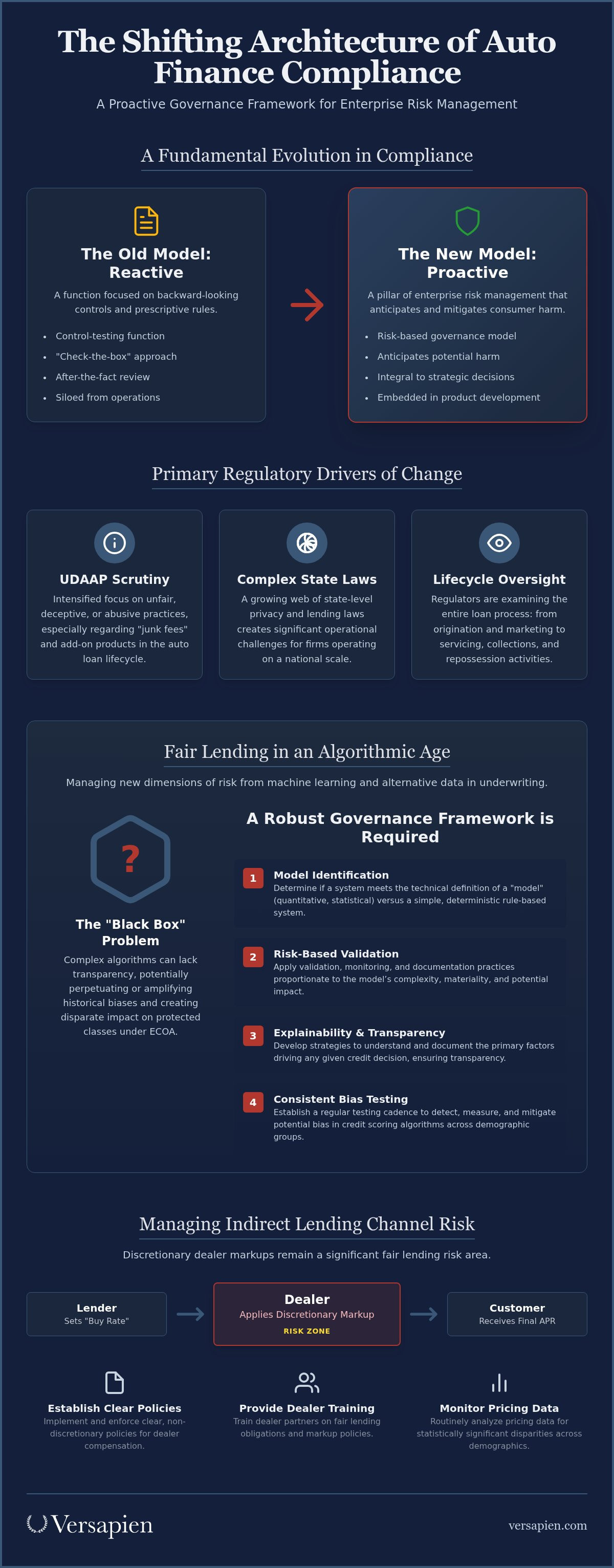
The Shifting Architecture of Auto Finance Compliance
Auto finance companies operate within a complex federal and state regulatory environment. Depending on their products and activities, significant compliance considerations may include fair lending, UDAAP, credit reporting, servicing, collections, disclosures, privacy, and third-party relationships. As institutions introduce new products, technologies, and delivery channels, governance and compliance processes should be capable of identifying and addressing the risks those changes may create.
Regulatory Pressures and UDAAP Implications
Regulators are closely examining the entire auto loan lifecycle, from origination and marketing to servicing and collections. Key areas of concern include the logic governing repossession activities, the accuracy of credit reporting, and the transparency of consumer disclosures in digital contracting environments. Weaknesses in these areas can create consumer protection, compliance, operational, and reputational risks and may warrant further review depending on the nature and significance of the issue.
The Intersection of Compliance and Operational Risk
In this interconnected environment, a compliance failure rarely remains isolated. Governance weaknesses, such as inadequate oversight of third-party dealer networks or poorly designed servicing protocols, can quickly escalate into significant operational, reputational, and financial risks. For executive management and the board, the critical task is to embed compliance considerations into the core operational fabric of the organization. This requires a framework where compliance is not an after-the-fact review but an integral component of strategic decision-making and product development. Such an integrated approach to strategic risk management is essential for sustainable growth.
Fair Lending and Algorithmic Oversight in Auto Credit
The adoption of machine learning and alternative data in underwriting has introduced new dimensions of risk to fair lending compliance. While these technologies offer the potential for more accurate risk assessment and expanded credit access, they also create the risk of perpetuating or even amplifying historical biases, leading to disparate impact on protected classes under the Equal Credit Opportunity Act (ECOA) and Regulation B.
Identifying and mitigating this risk requires a robust governance structure that extends beyond traditional compliance testing. For institutions using complex automated systems for underwriting or pricing, governance and risk management practices should be appropriate to the nature and risks of those systems. The April 2026 interagency model risk management guidance, including SR 26-2, provides a risk-based framework for models within its scope. The guidance is expected to be most relevant to banking organizations with more than $30 billion in total assets, although it may also be relevant to smaller banking organizations with significant exposure to model risk. It does not establish enforceable standards or prescriptive requirements, and non-compliance with the guidance alone will not result in supervisory criticism. Generative and agentic AI are outside its scope.
A critical first step is determining whether a particular system meets the technical definition of a “model”—a quantitative method applying statistical, economic, or financial theory to process data into estimates. Simple, deterministic rule-based systems are not considered models. For systems that do qualify, the institution should apply validation, monitoring, and documentation practices that are proportionate to the model’s purpose, materiality, complexity, and potential impact. This risk-based approach ensures that governance is rigorous but not unnecessarily burdensome. These model risk management practices are distinct from, and do not replace, the organization’s fundamental obligations to ensure compliance with fair lending and consumer protection laws.
Auditing Black-Box Credit Models
Advanced algorithms may present governance challenges when their design, limitations, or decision drivers are difficult to understand. Institutions using these systems should consider what information is necessary to understand the system's intended purpose, limitations, performance, and potential risks. The appropriate level of documentation, testing, monitoring, and independent challenge should be commensurate with the system's use, complexity, and potential impact.
Fair lending considerations should be addressed separately from model risk management. Institutions should assess whether their underwriting, pricing, data, and decisioning processes create potential fair lending risks, including whether seemingly neutral variables or processes may contribute to disparate outcomes. The methods and frequency of analysis should be appropriate to the institution's activities and risk profile.
Indirect Lending and Dealer Markup Risks
In the indirect auto lending channel, fair lending risk is magnified by discretionary dealer markups. When dealers have broad discretion to set the final interest rate above the lender’s buy rate, it creates a risk of pricing disparities that could be correlated with prohibited basis characteristics. Managing this risk requires a robust third-party risk management program that includes establishing clear policies, providing training to dealer partners, and implementing a monitoring framework to analyze pricing data for statistically significant disparities. The use of an indirect lending channel does not eliminate a lender's responsibility for complying with applicable fair lending requirements or for managing the risks associated with its dealer relationships.
Building a Regulator-Ready Compliance Management System (CMS)
An effective Compliance Management System provides a framework for managing applicable compliance risks. Depending on an institution's size, complexity, and activities, key components may include board and management oversight, policies and procedures, training, monitoring and testing, complaint management, issue management, oversight of relevant third parties, and independent assurance.
Compliance should be incorporated into business processes and significant changes, including new products and technology initiatives. Complaint data can also provide useful insight into consumer experience, recurring issues, and potential emerging risks.
Preparing for Regulatory Examinations
Examination priorities and scope may vary based on an institution's charter, regulator, products, risk profile, supervisory history, and other factors. Institutions can improve examination readiness by periodically assessing significant compliance and risk areas, maintaining appropriate documentation, tracking open issues and remediation, and ensuring that management understands material risks and control weaknesses. Depending on the circumstances, self-assessments or other readiness activities may help identify gaps before an examination. For more on this topic, see our guide on preparing for your next banking regulatory exam.
Strategic Imperatives for Auto Finance Leadership
For senior executives and boards of directors, the central challenge is to reframe compliance from a cost center to a strategic enabler. Effective governance can help organizations pursue innovation while identifying and managing the risks associated with new products, technologies, and business practices. By building a strong culture of compliance and accountability, organizations can enhance customer trust, strengthen their brand reputation, and create a durable competitive advantage.
Leveraging data analytics is key to this transformation. Just as analytics can optimize underwriting and marketing, it can also be used to predict regulatory shifts, identify operational bottlenecks, and provide the board with a more dynamic view of the firm’s risk profile. The role of the board is to provide effective challenge and ensure that management is dedicating sufficient resources to building and maintaining this forward-looking compliance infrastructure.
Executive Takeaways
Auto finance compliance risks extend across the full lending lifecycle and may include fair lending, UDAAP, servicing, collections, data, and third-party risks.
Automated underwriting and pricing can create additional governance challenges that should be assessed based on the system's purpose, complexity, and potential impact.
Indirect lending relationships require appropriate oversight of dealer practices and related fair lending risks.
An effective CMS should be tailored to the institution's size, complexity, products, and risk profile.
Management and the board should receive meaningful information about significant compliance risks, issues, trends, and remediation activities.
How Versapien Can Help
Versapien helps auto finance companies strengthen compliance governance and risk management capabilities across the lending lifecycle. We work with management and risk teams to assess Compliance Management Systems, evaluate fair lending and UDAAP risks, strengthen third-party oversight, improve governance and reporting, and address emerging risks associated with data, automation, and AI. Our approach is practical and risk-based, helping organizations identify meaningful gaps and develop implementation roadmaps that strengthen compliance capabilities without creating unnecessary complexity.



Comments