
Auto Finance Compliance: Managing Dealer and Third-Party Risk
Updated: Sep 22
Auto finance lenders operate through an extended network of dealers, technology providers, data vendors, and other third parties that can materially influence the consumer lending experience. Dealer pricing practices, add-on products, financing processes, vendor models, and data used in credit decisions can all create compliance and operational risks for the lender. Effective oversight therefore requires more than periodic vendor reviews or a written dealer agreement. It requires a risk-based framework that identifies where third-party activities can affect consumers, evaluates the effectiveness of controls, and uses data to identify emerging issues. This article examines practical approaches for managing dealer and third-party risk across the auto finance lifecycle, with particular attention to fair lending, UDAAP, consumer protection, model risk, data governance, and management oversight.
Table of Contents
The Dealer as a Critical Risk Extension of the Lender
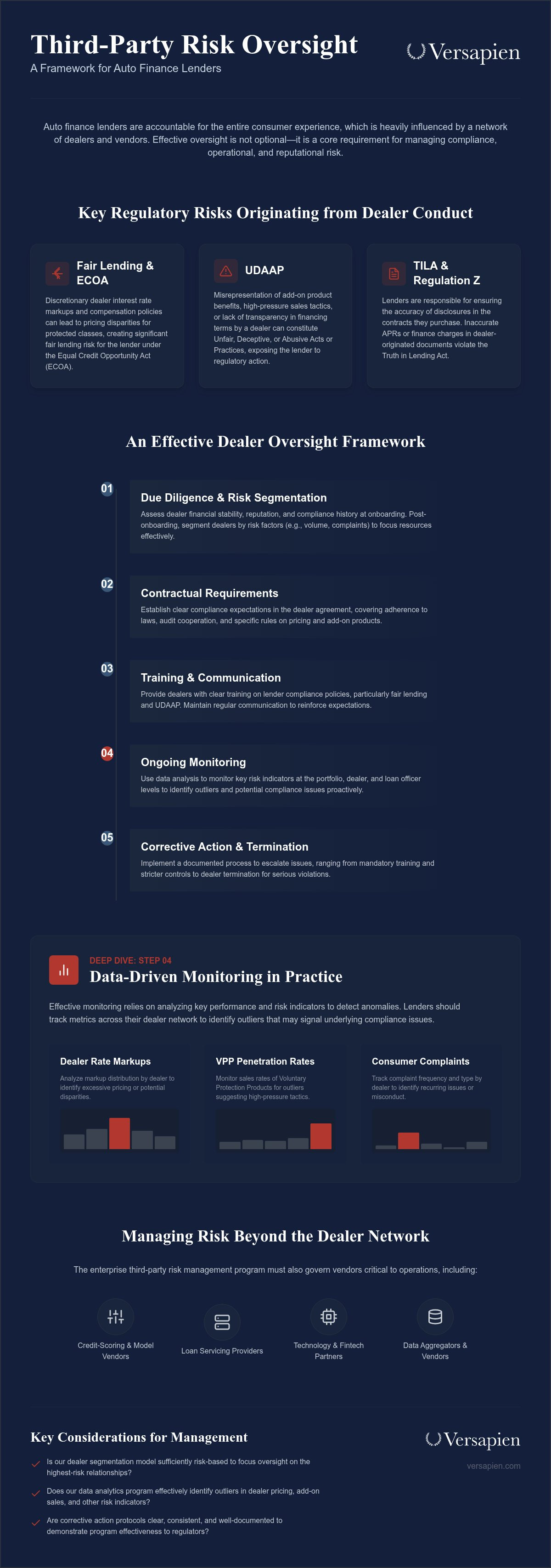
In indirect auto lending, the dealership is the primary point of contact with the consumer, but the lender retains significant compliance responsibility for the origination process. Dealers often have discretion over key aspects of the transaction, including interest rate markups, the sale of voluntary protection products (VPPs) or other add-ons, and the presentation of financing terms. This influence can create direct regulatory exposure for the lender, even when the dealer operates as an independent business.
Several key regulatory areas are implicated by dealer conduct:
Fair Lending and ECOA: Fair Lending and ECOA: The Equal Credit Opportunity Act (ECOA) and Regulation B prohibit discrimination in credit transactions on specified prohibited bases. In the auto finance context, lender policies and dealer compensation or pricing practices should be evaluated for compliance with applicable ECOA and Regulation B requirements. Where dealers have discretion over pricing or compensation, lenders should consider whether their policies and controls create risks of unlawful discrimination and should use appropriate monitoring and governance to identify and address potential concerns.
UDAAP: Unfair, Deceptive, or Abusive Acts or Practices (UDAAP) authority grants federal regulators broad discretion to address conduct that causes consumer harm. In the auto finance context, this can include misrepresentations about the cost or benefits of add-on products, pressure to purchase VPPs, or a lack of transparency in financing disclosures. While the FTC’s Combating Auto Retail Scams (CARS) Rule was withdrawn effective February 12, 2026, other federal and state consumer protection laws and regulations continue to apply to auto finance and vehicle sales activities
TILA and Regulation Z: The Truth in Lending Act (TILA) requires clear disclosure of key terms and costs in a credit transaction. Lenders involved in dealer-arranged financing should have processes appropriate to their role for ensuring compliance with applicable TILA and Regulation Z disclosure requirements, including requirements relating to APR and finance charges.
Because lenders purchase the retail installment sales contracts originated by dealers, they can be held accountable for compliance deficiencies embedded in those contracts. A lack of robust oversight can expose the lender to risks of consumer remediation, civil money penalties, and reputational damage.
Building an Effective Dealer Oversight Framework
A structured dealer oversight program provides the governance and controls needed to manage the risks associated with an indirect lending model. Rather than a one-size-fits-all approach, effective programs are risk-based, applying greater scrutiny to dealer relationships that present higher potential for consumer harm. The components of such a framework often include:
Due Diligence and Risk Segmentation: Before onboarding a dealer, lenders typically conduct due diligence to assess their financial stability, reputation, and compliance history. Post-onboarding, dealers can be segmented based on risk factors such as loan volume, product types, complaint levels, and performance metrics. This allows the lender to focus monitoring and training resources where they are most needed.
Contractual Requirements: The dealer agreement is a foundational control. It should clearly articulate compliance expectations, including adherence to all applicable federal and state laws, cooperation with lender audits, and specific requirements related to pricing, add-on products, and record-keeping.
Training and Communication: Lenders can mitigate risk by providing dealers with clear training on their compliance policies, particularly regarding fair lending, UDAAP, and any specific lender prohibitions or limitations on products and practices. Regular communication reinforces these expectations and provides a channel for addressing questions.
Ongoing Monitoring: Data analysis is central to modern dealer oversight. Lenders can monitor key indicators at the portfolio, dealer, and loan officer levels to identify outliers and potential risks. Common monitoring activities include analyzing dealer interest rate markups, VPP penetration rates and pricing, application exception rates, and the frequency and nature of consumer complaints.
Corrective Action and Termination: The framework should include a clear process for escalating and addressing identified issues. This may range from requiring additional training for a dealer to imposing stricter controls, demanding consumer remediation, or, in serious cases, terminating the relationship. Documenting these actions is critical to demonstrating a well-managed program.
Managing Other Third-Party Risk in Auto Finance
Beyond the dealer network, auto lenders rely on a wide array of other third parties. These relationships, while essential for operations, also introduce distinct compliance, operational, and reputational risks. Key third-party categories include credit-scoring and model vendors, loan servicing providers, technology platform providers, Banking-as-a-Service (BaaS) or fintech partners, and data aggregators.
An institution's enterprise-wide third-party risk management program should extend to all such relationships. This involves a lifecycle approach that includes rigorous initial due diligence, negotiation of contractual protections, and ongoing monitoring of performance and controls. Specific considerations include:
Data Integrity and Security: Lenders should assess a vendor’s ability to protect sensitive consumer data and ensure the accuracy and reliability of the data or services provided. This includes evaluating the third party's cybersecurity posture and data governance practices.
Operational Resilience: The lender is responsible for ensuring that its critical operations can continue even if a third-party provider experiences a disruption. This involves understanding the vendor’s business continuity and disaster recovery plans.
Contractual Protections: Agreements should clearly define roles and responsibilities, performance standards, data ownership and usage rights, audit rights, and liability in the event of a compliance failure or security breach.
It is important to distinguish third-party risk management (TPRM) from model risk management (MRM). TPRM is a broad framework for overseeing all vendor relationships. MRM, a distinct discipline, applies specifically to the governance of models, whether developed internally or by a third party. If a vendor provides a model, that relationship is subject to both the institution's TPRM and MRM frameworks.
Using Data and Analytics to Identify Emerging Risk
Manual audits and periodic reviews are often insufficient to identify systemic issues across a large portfolio of loans and dealer relationships. Data analytics enables lenders to move toward a more proactive and risk-based approach to compliance oversight.
Effective monitoring programs use data to detect anomalies and patterns that may indicate elevated risk. This analysis can focus on several levels:
Loan-Level Monitoring: Examining individual loan files for exceptions to underwriting policy, missing documentation, or unusual terms.
Dealer-Level Comparisons: Benchmarking dealers against their peers to identify outliers. For example, a dealer with significantly higher average interest rate markups or add-on product penetration rates than other dealers in the same geographic area may warrant further review.
Fair Lending Analysis: Using statistical methods, such as regression analysis, to test for disparities in pricing or underwriting outcomes between prohibited basis groups that are not explained by legitimate credit risk factors.
Complaint and Trend Analysis: Systematically tracking and analyzing consumer complaints by dealer, product, or issue can provide early warnings of UDAAP or other consumer protection risks.
The goal of monitoring is not necessarily to achieve "continuous" or "real-time" oversight of every transaction. Instead, a more effective strategy is to implement risk-based monitoring, where the frequency and depth of analysis are aligned with the level of risk presented by a particular dealer, product, or business practice. This allows compliance resources to be allocated efficiently to the areas of greatest potential concern.
Model Risk Management and AI: Applying Supervisory Guidance Precisely
As auto lenders increasingly use complex models for credit underwriting, pricing, and fraud detection, model risk management has become a critical component of a sound compliance framework. In April 2026, federal banking agencies issued updated interagency guidance on model risk management, which clarifies supervisory expectations for certain institutions.
It is essential to apply this guidance with precision:
Applicability: The guidance is expected to be most relevant to banking organizations with more than $30 billion in total assets. It may also be relevant to banking organizations with $30 billion or less in total assets that have significant exposure to model risk because of the prevalence or complexity of their models or activities outside the scope of traditional community banking. The guidance is risk-based and nonbinding; it does not establish a universal legal requirement for auto lenders.
Definition of "Model": The guidance defines a model as a complex quantitative method that applies statistical, economic, or financial theory to process input data into quantitative estimates. This definition intentionally excludes simpler tools like basic spreadsheets, deterministic rule-based software, and calculations not based on such theories.
Scope Exclusions: Generative and agentic artificial intelligence (AI) are explicitly excluded from the scope of this specific guidance. However, institutions using these technologies are still expected to have appropriate governance and risk management practices in place, consistent with general principles of operational and compliance risk management.
Vendor Models: Third-party models should be subject to model risk management practices appropriate to their use and risk profile. Depending on the circumstances, this may include due diligence, validation by internal or external parties, ongoing monitoring, outcome analysis, and an appropriate understanding of the model's methodology, assumptions, limitations, and performance. Reliance on a vendor's own validation should not substitute for the institution's responsibility to understand and manage the risks associated with its use of the model.
Effective Challenge: A core principle of the guidance is the need for "effective challenge" throughout the model lifecycle. Effective challenge involves critical analysis and questioning of model assumptions, limitations, performance, and use by objective, informed, and competent parties with sufficient authority and organizational standing to influence outcomes. The nature and extent of effective challenge should be appropriate to the model's risk, purpose, complexity, and potential impact.
Internal audit plays a distinct role in this framework. Its function is not to perform model validation itself but to independently assess the effectiveness of the institution's overall MRM framework, including the validation processes and governance structures.
Turning Dealer and Third-Party Risk Findings into Management Action
Identifying risks through monitoring and analysis is only the first step. A mature compliance program ensures that findings are escalated appropriately and translated into concrete management actions. This requires a strong governance structure that promotes accountability and a closed-loop remediation process.
Key elements of an effective governance and response structure include:
Clear Accountability: Roles and responsibilities for overseeing dealer and third-party risk should be clearly defined, from the business line to senior management and the Board of Directors.
Management Reporting: Risk-based reporting and dashboards can provide senior management and the Board with a concise view of the institution's third-party risk profile. Key risk indicators (KRIs) might include metrics on dealer performance outliers, the number of high-risk third parties, complaint trends, and the status of remediation efforts.
Remediation and Tracking: When issues are identified, there should be a formal process for developing a corrective action plan, assigning ownership, and tracking the plan to completion. This demonstrates to regulators that the institution is capable of self-identifying and correcting deficiencies.
Board Oversight: The Board provides oversight of the institution's risk management framework and should receive information sufficient to understand significant dealer and third-party risks and challenge management's approach where appropriate. It should receive regular reports on third-party risk and be prepared to challenge management on the effectiveness of the oversight program.
By connecting risk identification to a structured system of governance, reporting, and remediation, lenders can build a sustainable auto finance compliance program that effectively manages the risks inherent in a distributed, third-party-driven business model.
Executive Takeaways
Senior management and the Board should consider the following questions when evaluating the institution’s approach to dealer and third-party risk:
Does our dealer oversight framework use a risk-based approach to segment and monitor our dealer network, or do we apply a uniform standard to all relationships?
What data and analytics are we using to proactively identify potential fair lending or UDAAP risks arising from dealer pricing and add-on sales practices?
Is our third-party risk management program sufficiently robust to manage the operational and compliance risks associated with critical technology, data, and model vendors?
For models subject to our model risk management framework, are validation and other controls appropriately independent and commensurate with the model's risk, and how do we document effective challenge?
Is there a clear and accountable process for escalating identified issues, tracking corrective actions to completion, and reporting on the overall health of our third-party risk program to the Board?
How Versapien Can Help
Effectively managing third-party and dealer risk requires a holistic approach that integrates consumer compliance, operational resilience, and model governance. Versapien helps auto finance lenders design and implement risk-based oversight frameworks that strengthen compliance, risk management, and governance capabilities while supporting sustainable business practices. Our senior-led teams provide practical, implementation-focused guidance on building data-driven monitoring programs, strengthening compliance management systems, and aligning risk management with strategic objectives.



Comments