
BSA/AML Model Risk: Governance and Validation of Transaction Monitoring Systems
Updated: Sep 22
Transaction monitoring systems sit at the intersection of BSA/AML compliance, technology, data, and model risk management. Some systems rely primarily on deterministic rules and thresholds, while others incorporate statistical methods, machine learning, or other techniques that may meet an institution's definition of a model. The distinction matters because the nature and rigor of model-risk controls should be appropriate to the system's methodology, intended use, complexity, and risk. At the same time, model validation is only one component of a broader BSA/AML compliance framework. This article examines how financial institutions can distinguish transaction-monitoring models from other monitoring technologies, apply the principles of SR 26-2 where relevant, establish effective challenge and validation practices, and integrate model-risk oversight with their broader BSA/AML governance framework.
Table of Contents
Understanding Model Risk in Transaction Monitoring
An institution’s approach to BSA/AML model risk management begins with a foundational understanding of its transaction monitoring environment. A common misstep is to apply a monolithic governance structure to a diverse set of technologies, leading to either insufficient oversight for high-risk models or excessive validation for simple, rule-based systems. A precise classification of monitoring components is the first step toward a proportional and effective framework.
Transaction Monitoring Systems: Rules, Models, and Hybrid Approaches
A modern financial crime compliance function often employs a combination of technologies to detect potentially suspicious activity. It is critical to recognize that not every component of a transaction monitoring system is a “model” under supervisory definitions.
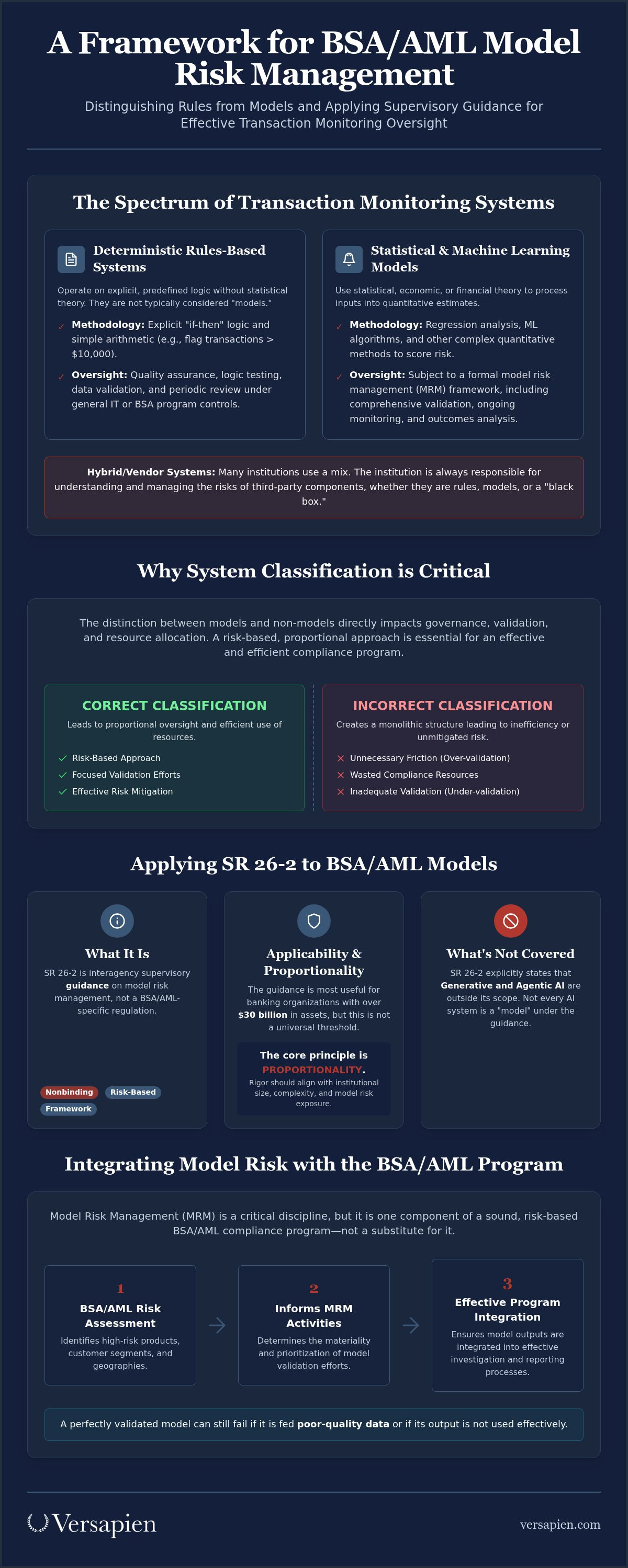
Deterministic Rules-Based Systems: These systems operate on explicit, predefined logic. For example, a rule that flags all transactions exceeding $10,000 is deterministic. It applies simple arithmetic and logic without relying on statistical or economic theory. While these rules require testing for logical and data integrity, they typically do not fall under the scope of model risk management guidance.
Statistical and Machine Learning Models: A system becomes a model when it uses statistical, economic, or financial theory to process inputs into quantitative estimates. This includes systems that use regression analysis, machine learning algorithms, or other complex quantitative methods to score transaction risk or predict the likelihood of suspicious behavior. These systems may fall within an institution's model risk management framework when they meet the institution's applicable definition of a model.
Hybrid and Vendor Systems: Many institutions use a hybrid approach, combining deterministic rules with more advanced models. Vendor-provided systems can further complicate the landscape, often functioning as a “black box” that may contain both rules and models. The institution remains responsible for understanding and managing the risks of these third-party components, regardless of their internal structure.
Why Classification Matters
The distinction between a model and a non-model system has direct consequences for governance, validation, and resource allocation. Treating a simple rules engine like a complex machine learning model creates unnecessary friction and diverts resources from higher-risk areas. Conversely, failing to identify a statistical system as a model can lead to inadequate validation and unmitigated risk.
Proper classification determines the required intensity of oversight:
Models call for a comprehensive validation process, including conceptual soundness, ongoing monitoring, and outcomes analysis, all conducted within a structured model risk management framework.
Non-Model Systems (like deterministic rules) still require quality assurance, including logic testing, data validation, and periodic review, but these activities may be addressed through appropriate technology controls, BSA/AML program testing, model-risk processes where applicable, or other risk-management practices.
By correctly categorizing each component of the monitoring environment, an institution can apply a risk-based approach, focusing its most rigorous validation efforts on the systems that present the greatest model risk.
Connecting Model Risk to BSA/AML Risk
Model risk management is a critical discipline, but it is not a substitute for a sound, risk-based BSA/AML compliance program. Model risk is one of several risks that can undermine the effectiveness of a BSA/AML program. A perfectly validated model can still fail if it is fed poor-quality data or if its output is not effectively integrated into the institution's investigation and reporting processes.
The institution’s BSA/AML risk assessment should inform the materiality and prioritization of its model risk management activities. A model used to monitor a high-risk product line or customer segment inherently carries more significance than one focused on a low-risk area. Effective governance connects these two disciplines so that model-risk management activities are appropriately aligned with the institution's overall financial crime risk profile.
Applying SR 26-2 to BSA/AML Models
On April 17, 2026, the Federal Reserve issued SR 26-2 transmitting the interagency ‘Supervisory Guidance on Model Risk Management’ issued by the Federal Reserve, FDIC, and OCC. It is important for institutions to understand the guidance’s scope, applicability, and intent to avoid misinterpreting its role within the broader regulatory landscape.
What SR 26-2 Covers
SR 26-2 is interagency supervisory guidance on model risk management, not a BSA/AML-specific regulation. It provides a framework for sound model risk management practices, including model development, validation, implementation, and governance. The guidance is explicitly nonbinding and risk-based; it does not establish enforceable or prescriptive requirements. Its purpose is to articulate supervisory expectations for sound risk management, not to create new legal obligations. Consequently, an institution's practices that differ from the guidance do not automatically trigger supervisory criticism.
Applicability and Proportionality
The guidance is expected to be most useful for banking organizations with more than $30 billion in total consolidated assets. However, the $30 billion asset size is not a universal applicability threshold. The guidance may also be relevant to smaller institutions with significant model risk exposure due to the complexity of their models or engagement in non-traditional activities. The central principle is proportionality. The rigor and formality of an institution's model risk management practices should align with its size, complexity, and overall model risk exposure. Validation intensity should vary based on a model's approach, use, materiality, and risk profile.
Generative and Agentic AI
SR 26-2 explicitly states that generative and agentic artificial intelligence are outside its scope. This exclusion does not imply that these technologies are without risk or exempt from oversight. Rather, it recognizes that these evolving technologies may require different risk management considerations than the traditional quantitative models the guidance addresses. Institutions deploying generative AI for any purpose, including within their BSA/AML programs, should manage the associated risks through broader institutional risk management and AI governance frameworks, even though they are not covered by this specific model risk guidance.
Effective Challenge, Validation, and Third-Party Models
A credible model risk management framework is built on rigorous, independent review and ongoing performance analysis. This includes a robust process for effective challenge, a structured validation lifecycle, and diligent oversight of vendor-provided systems.
Effective Challenge and Independent Review
Effective challenge is a critical and objective review of model risk by appropriately qualified individuals with sufficient independence, expertise, and organizational standing to provide meaningful challenge. It is not a universally prescribed process but a core principle that involves questioning assumptions, methodologies, and outcomes. Those performing the challenge, whether from a dedicated model risk management function or another independent area, should have the necessary expertise, stature, and authority to ensure their findings are taken seriously.
It is important to distinguish model validation from the independent testing of a BSA/AML program. The FFIEC BSA/AML Examination Manual calls for risk-based independent testing of the overall BSA/AML program, which includes evaluating suspicious activity monitoring systems. This is a broader compliance requirement focused on program effectiveness. Model validation, as described in SR 26-2, is a more focused, technical assessment of a model’s conceptual soundness and performance. While complementary, these are distinct oversight activities with different objectives. For more on this, see our article on testing BSA/AML program effectiveness.
Validation and Ongoing Monitoring
Validation generally occurs before a model's first use, although SR 26-2 recognizes that certain circumstances, such as an urgent business need, may require use before validation is complete. This pre-implementation validation assesses the model's design, underlying theory, and suitability for its intended purpose. In such circumstances, institutions should implement appropriate compensating controls, such as heightened monitoring and clear communication of the model’s limitations to users, until the validation can be finalized.
Validation is not a one-time event. Ongoing monitoring is essential to track model performance over time and identify any degradation. This includes analyzing the model’s outputs, assessing the stability of its underlying assumptions, and managing changes through a formal change-management process.
Vendor and Third-Party Models
Many institutions rely on third-party vendors for their transaction monitoring systems. The use of a vendor model does not transfer risk management responsibility. An institution should conduct a risk-based validation of vendor products, with the intensity of that validation tailored to the model's materiality, complexity, and risk. Vendor marketing materials or self-attestations, standing alone, may not provide sufficient information to support the institution's risk assessment and oversight.
Effective oversight of third-party models involves obtaining and reviewing key documentation on the model's methodology, assumptions, and internal testing. The institution should perform its own outcomes analysis to confirm the model is performing as expected within its specific operational environment. This due diligence is a core component of both model risk and third-party risk management.
Governance of Transaction Monitoring Model Risk
Effective governance integrates model risk management into the broader BSA/AML compliance and enterprise risk frameworks. It establishes clear lines of responsibility, ensures senior management and board oversight, and provides a holistic view of aggregate risk arising from the interplay of different systems and processes.
Model Inventory and Risk Classification
A comprehensive model inventory is the cornerstone of sound governance. This inventory should list all models used within the institution, including those for transaction monitoring. For each model, the inventory should document its purpose, methodology, data inputs, assumptions, limitations, and risk classification. This centralized repository provides transparency and enables management to understand individual and aggregate model risk.
Distinct responsibilities should be clearly defined. Business owners are typically responsible for a model's use and performance, the model development team for its design and construction, the model risk management function for independent validation and oversight, and BSA/AML Compliance for overseeing how the model's outputs are incorporated into the institution's broader suspicious-activity monitoring and reporting processes. Internal Audit, in turn, provides independent assurance over the effectiveness of the overall model risk management framework without duplicating validation activities.
Board and Management Oversight
The Board of Directors and senior management are responsible for overseeing the institution's model risk management framework. This oversight includes approving relevant policies, allocating sufficient resources, and understanding the aggregate model risk profile. Reporting should be transparent and concise, clearly communicating the performance and limitations of key models, the results of validation activities, and any remediation plans. This high-level view is essential for strategic decision-making and is a key component of effective BSA/AML governance.
Aggregate Risk and Independent Testing
Transaction monitoring does not operate in a vacuum. It is part of a larger ecosystem that includes customer risk rating models, alert generation systems, case management platforms, and SAR decisioning processes. A weakness in one area can create vulnerabilities across the entire chain. Governance should therefore consider aggregate risk—the combined risk from the interactions and dependencies among different models and systems.
Management can develop a comprehensive understanding of aggregate risk by synthesizing information from multiple sources. This includes combining model validation results with data from BSA/AML independent testing, customer complaints, error rates, alert-to-SAR conversion metrics, and remediation tracking. This integrated view allows leaders to identify systemic weaknesses and prioritize resources where they are most needed, strengthening the entire financial crime compliance program.
Executive Takeaways
Classify Monitoring Tools Accurately: Distinguish between deterministic rule-based systems and statistical models to apply a proportional level of validation and oversight, focusing resources on the highest-risk areas.
Apply SR 26-2 as Risk-Based Guidance: Understand that SR 26-2 is a nonbinding supervisory framework, primarily for institutions over $30 billion, that does not create new legal requirements or cover generative AI.
Delineate Oversight Functions: Maintain clear delineation of responsibilities between model validation, which assesses technical soundness, and broader BSA/AML independent testing, which evaluates overall program effectiveness.
Establish Robust Vendor Oversight: Implement a risk-based validation process for third-party models that goes beyond vendor assurances to include independent review of assumptions, data, and performance outcomes.
Synthesize Data for Aggregate Risk Views: Combine insights from model validation, compliance testing, and performance metrics to provide senior management and the Board with a holistic view of transaction monitoring risk.
How Versapien Can Help
Versapien helps financial institutions build defensible frameworks for financial crime compliance and model risk management. Our senior-led team provides independent effective challenge and model validation assessments grounded in deep regulatory and technical expertise. We assist clients in classifying their monitoring systems, aligning their governance practices with supervisory expectations, and integrating model risk oversight with their broader enterprise risk management programs.


Comments