
BSA/AML Program Effectiveness: How Financial Institutions Should Test Their Programs
Updated: Sep 22
Table of Contents
Introduction: What Does “Program Effectiveness” Mean?
BSA/AML program effectiveness is not measured solely by the number of alerts generated, investigations completed, or suspicious activity reports filed. A more meaningful question is whether an institution's program is reasonably designed to identify, assess, and manage the money laundering, terrorist financing, and other illicit finance risks associated with its products, customers, geographies, and activities. Testing is a critical part of answering that question. Effective testing should provide management and the board with meaningful insight into whether the program is operating as intended, where weaknesses exist, and whether changes are needed as risks, products,data, and technologies evolve.
The Evolving Focus on AML/CFT Program Effectiveness
BSA/AML examinations have long considered whether financial institutions maintain the required elements of a compliance program and whether those elements are implemented effectively. Increasingly, regulatory and policy discussions have also emphasized whether programs are appropriately designed to address an institution's specific illicit finance risks and produce meaningful results.
FinCEN's April 2026 proposed rule on AML/CFT programs reflects this direction by proposing a greater focus on risk-based, reasonably designed, and effective programs. Because the rule remains proposed, institutions should not treat its provisions as current regulatory requirements. Nevertheless, the proposal reinforces the importance of aligning program design, controls, and resources with an institution's particular risk profile.
Consequently, static, one-size-fits-all compliance programs are increasingly viewed as insufficient. A truly effective program is dynamic, adapting its controls, technologies, and resources as the institution’s risk landscape changes. Testing provides the mechanism to validate that this adaptation is occurring and that the program continues to function as a cohesive system for managing risk.
What Should Be Tested?
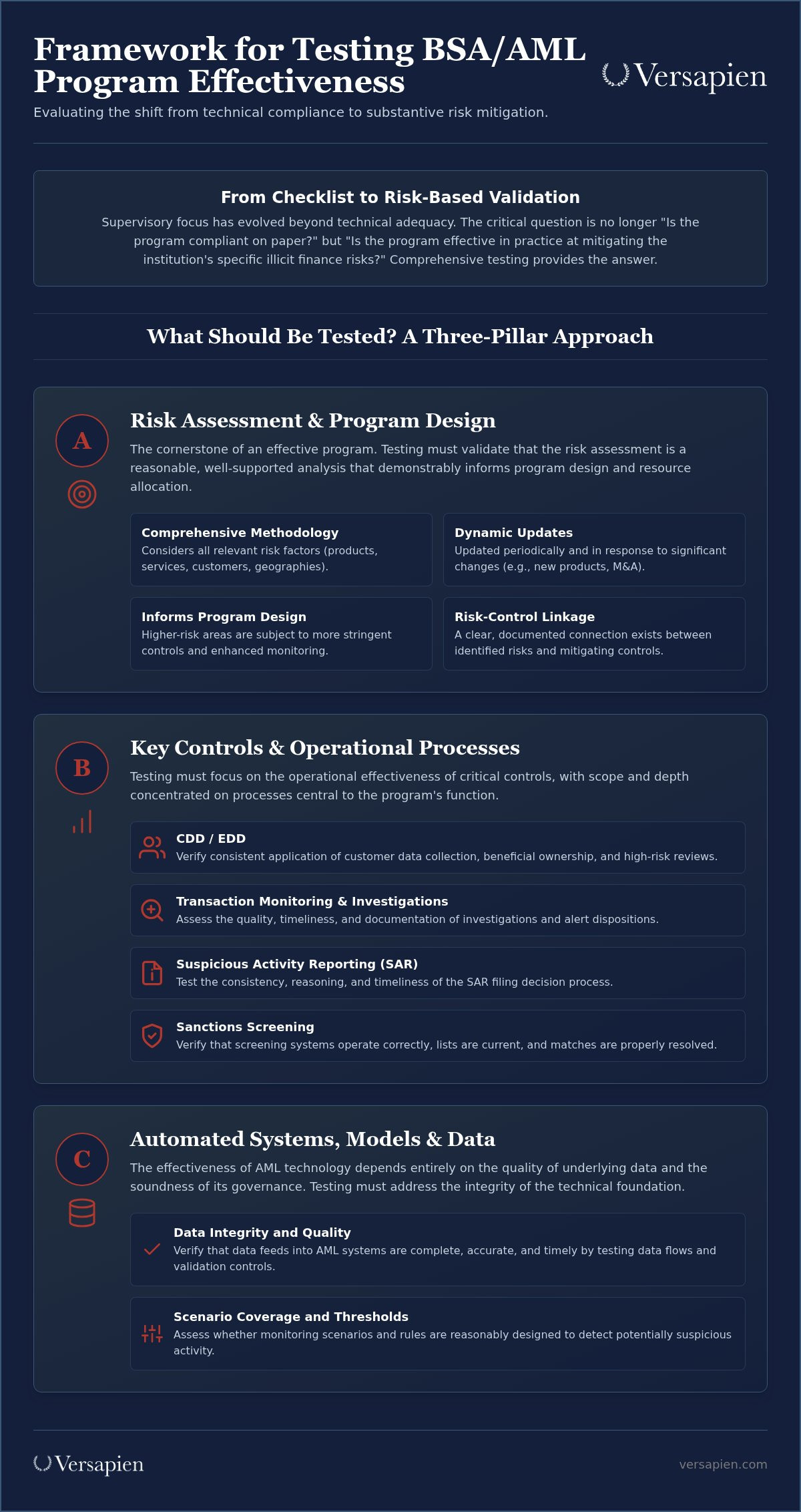
Comprehensive testing of BSA/AML program effectiveness extends beyond traditional file reviews. It involves a holistic assessment of the program’s design, the performance of its key controls, and the integrity of the systems and data that underpin its operations. A risk-based approach to testing allows an institution to direct its resources toward the areas that present the greatest potential for program failure.
A. Risk Assessment and Program Design
The enterprise-wide BSA/AML risk assessment is the cornerstone of an effective program. Testing should begin by evaluating whether the risk assessment provides a reasonable and well-supported analysis of the institution’s illicit finance risks. Key questions include:
Does the risk assessment methodology adequately consider the relevant risk factors, including products, services, customers, and geographic locations?
Is the assessment updated on a periodic basis and in response to significant changes, such as new product launches or mergers?
Do the results of the risk assessment demonstrably inform program design? For example, are higher-risk areas subject to more stringent controls, enhanced monitoring, and greater resource allocation?
Is there a clear and documented connection between the risks identified in the assessment and the specific controls implemented to mitigate them? For more on this, see our guide to building a defensible financial crime risk assessment framework.
Testing in this area assesses the strategic foundation of the AML program. A flawed or outdated risk assessment can lead to misallocated resources, control gaps, and an overall program that is not reasonably designed to address the institution’s primary vulnerabilities.
B. Key Controls and Operational Processes
Once the program’s design is evaluated, testing should focus on the operational effectiveness of its critical controls. The scope and depth of this testing should be risk-based, concentrating on processes that are central to the program’s function. Areas for review typically include:
Customer Due Diligence (CDD) and Enhanced Due Diligence (EDD): Assess whether policies and procedures for collecting and verifying customer information, including beneficial ownership, are followed consistently. For higher-risk customers, testing should confirm that EDD is performed and that risk profiles are periodically reviewed and updated.
Transaction Monitoring and Investigations: Review the process for identifying and investigating potentially suspicious activity. This includes evaluating the quality and timeliness of investigations, the consistency of documentation, and the rationale for closing alerts.
Suspicious Activity Reporting (SAR): Test the decision-making process for filing SARs to ensure it is consistent, well-reasoned, and timely. The review should also assess the quality and completeness of SAR narratives.
Sanctions Screening: Where applicable, testing should verify that sanctions screening systems (e.g., for OFAC) are operating correctly, that lists are current, and that potential matches are investigated and resolved according to established procedures.
Governance and Issue Management: Evaluate the processes for identifying, escalating, and remediating issues. This includes reviewing committee charters, meeting minutes, and the tracking of corrective actions to ensure that deficiencies are addressed in a timely and sustainable manner.
C. Automated Systems, Models, and Data
Financial institutions increasingly rely on automated systems and models for transaction monitoring, risk scoring, and sanctions screening. The effectiveness of these systems depends on multiple factors, including the quality and completeness of underlying data, the appropriateness of system design and configuration, and the effectiveness of governance and oversight. Testing should therefore address:
Data Integrity and Quality: Verify that data feeds into AML systems are complete, accurate, and timely. This involves testing the data flow from source systems to the AML platform and assessing data validation controls.
Scenario Coverage and Thresholds: Assess whether the transaction monitoring scenarios and rules are reasonably designed to detect potentially suspicious activity consistent with the institution’s risk profile. Testing should also evaluate the process for setting, reviewing, and tuning thresholds to ensure they are effective without creating an unmanageable volume of false positives.
Outcomes Analysis: Review the disposition of alerts to understand system performance. While simple metrics like alert-to-SAR conversion rates can be misleading in isolation, a deeper analysis of alert trends and investigation outcomes can provide valuable insights for system tuning and scenario refinement.
System Governance: Evaluate the governance framework for AML systems, including processes for managing changes, validating new models or scenarios before implementation, and documenting all system settings and modifications. Institutions looking to enhance their programs should consider a structured approach to BSA/AML program modernization beyond traditional monitoring.
Independent Testing, Validation, and Internal Audit
A common point of confusion is the distinction between independent BSA/AML testing, model validation, and internal audit. These are three distinct functions with different objectives, and they are not interchangeable. An effective governance framework clearly defines the roles and responsibilities of each.
Independent BSA/AML Testing is a regulatory requirement for a comprehensive program. This function is responsible for conducting a periodic, risk-based review of the overall BSA/AML program to assess its adequacy and effectiveness. Key elements include a defined testing scope, personnel with sufficient independence and competence, formal reporting of findings to management and the board, and a robust process for tracking the remediation of identified issues.
Model Validation is a specialized function focused on the governance of quantitative models used within the AML program, such as those for transaction monitoring or customer risk rating. It provides an independent and effective challenge to a model’s design, data inputs, processing, and outcomes. This function is particularly relevant in the context of interagency guidance on model risk management. SR 26-2, issued jointly by the Federal Reserve, FDIC, and OCC, superseded the 2011 model risk management guidance and the 2021 interagency statement addressing model risk management for systems supporting BSA/AML compliance. The revised guidance is risk-based and does not establish enforceable standards or prescriptive requirements. It is expected to be most relevant to banking organizations with more than $30 billion in total assets, although it may also be relevant to smaller banking organizations with significant exposure to model risk because of the prevalence or complexity of their models or activities outside the scope of traditional community banking.
Internal Audit provides independent assurance to the board and senior management on the effectiveness of the institution’s overall risk management, governance, and internal control processes. Internal Audit provides independent assurance regarding the effectiveness of the institution's governance, risk management, and internal control processes. Depending on the institution's organizational structure, Internal Audit may assess the design and effectiveness of independent testing, model validation, and other BSA/AML controls while maintaining appropriate independence from the activities it audits. Internal audit evaluates the rigor of the first and second lines of defense without duplicating their activities.
Measuring Results and Reporting to Management and the Board
Reporting on BSA/AML program effectiveness should move beyond simple volume metrics to provide senior management and the board with strategic insight into the institution’s risk posture and control environment. Effective reporting synthesizes a balanced set of quantitative and qualitative indicators tailored to the institution’s specific risk profile and program maturity.
Instead of focusing on a generic list of key performance indicators (KPIs), reporting should tell a story about program performance. This includes:
Analysis of Trends: Presenting data on alert volumes, investigation caseloads, and SAR filing trends over time can highlight shifts in risk or operational efficiency. For example, a sudden spike in alerts for a particular scenario may indicate a new money laundering typology or a need for system tuning.
Control Performance and Backlogs: Reporting on the timeliness of key processes, such as CDD reviews, alert investigations, and SAR filings, provides a clear view of operational health. Information on any backlogs and the plans to address them is critical for management oversight.
Data and Model Performance Issues: Summarizing significant data quality issues or model performance degradation (e.g., a sustained increase in false positives) allows leadership to understand the operational impact and approve necessary investments in remediation.
Significant Findings and Remediation Status: A consolidated view of significant findings from independent testing, model validations, internal audits, and regulatory examinations is essential. The report should include the status of corresponding remediation plans, highlighting any overdue or at-risk items. For more on this, see our perspective on preparing for regulatory exams and addressing common gaps.
Emerging Risks and Program Enhancements: The report should also be forward-looking, identifying emerging illicit finance risks and outlining management’s plan to enhance the program accordingly.
This approach transforms board reporting from a compliance exercise into a strategic management tool, enabling informed decision-making and effective governance.
Executive Takeaways
Evaluate Your Risk Assessment: Periodically assess whether the BSA/AML risk assessment remains current, appropriately reflects the institution's products, customers, geographies, and activities, and informs program design and resource allocation.
Delineate Governance Roles: Clearly define and document the distinct responsibilities of independent BSA/AML testing, model validation, and internal audit to ensure robust, multi-layered oversight without duplication of effort.
Test Data and System Integrity: Go beyond testing operational processes to include a thorough review of the data feeds, scenario logic, and governance frameworks that support your automated AML systems.
Refine Management Reporting: Shift board and senior management reporting from purely operational metrics to a balanced dashboard that includes trend analysis, control performance, remediation status, and emerging risks.
Assess Program Agility: Periodically challenge whether the program is sufficiently dynamic to adapt to changes in the business, such as new products or technologies, and to evolving illicit finance threats.
How Versapien Can Help
Versapien assists financial institutions in strengthening their financial crime compliance frameworks. Our senior-led teams provide independent, practical guidance tailored to each institution’s risk profile and strategic objectives. We can assist with BSA/AML program effectiveness assessments, the development and validation of financial crime risk assessments, independent testing, transaction monitoring and model governance, remediation of regulatory findings, and the enhancement of governance and board reporting.



Comments