
Consumer Lending Compliance: Preparing for Increased Regulatory Scrutiny
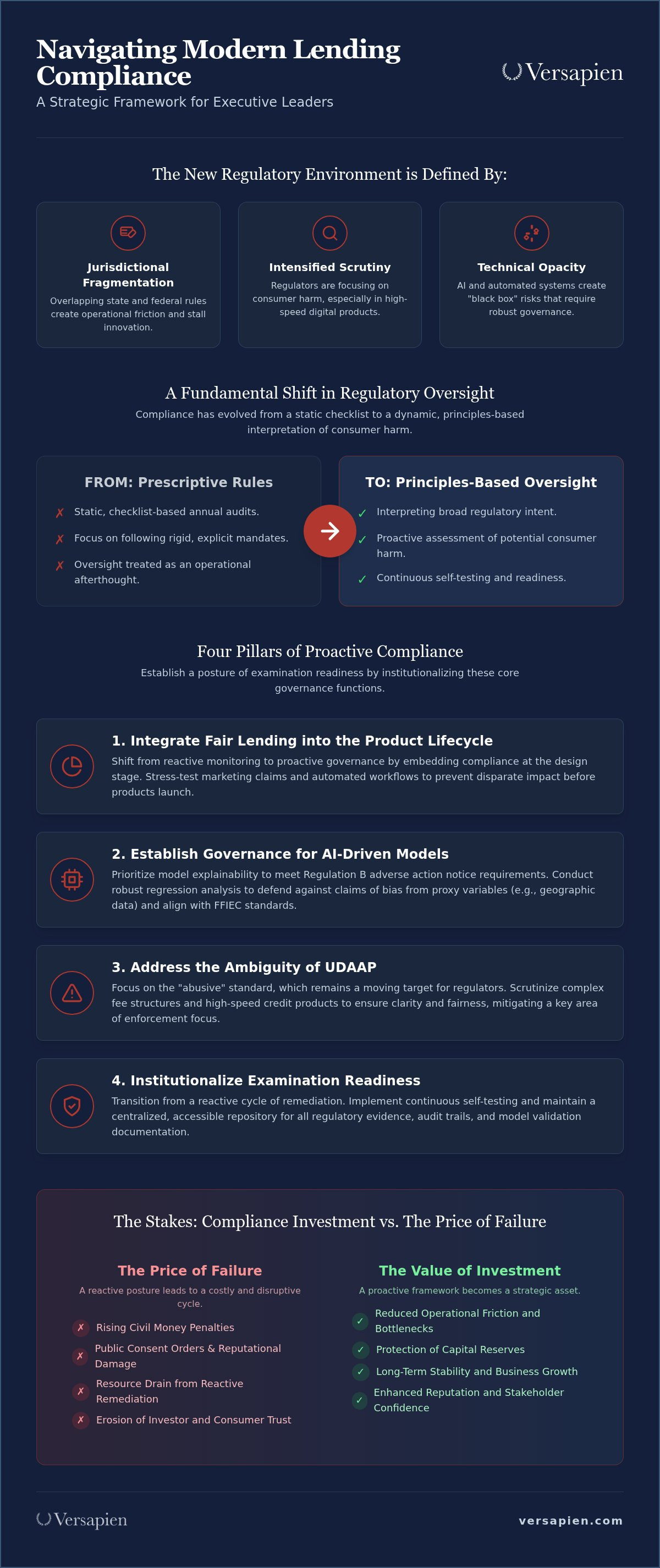
Fragmentation, scrutiny, and technical opacity now define the regulatory environment. The era of treating consumer lending compliance as a static annual audit has officially ended, replaced by a landscape where state and federal expectations increasingly collide. With the 2026 Regulation Z adjustments and the expansion of UDAAP authority through the New York FAIR Business Practices Act, senior leaders are tasked with reconciling traditional oversight with the rapid adoption of automated systems. These overlapping jurisdictions create a friction that can stall innovation, deplete capital, and erode trust if not managed with precision.
If you've felt the resource drain that follows a reactive response to examination findings, you know that this cycle of remediation often pulls focus from core business growth and long-term stability. This article provides a strategic framework designed to help senior executives navigate these pressures by integrating AI governance with traditional compliance programs. We'll examine how to mitigate the risks inherent in algorithmic credit decisioning and build a posture of examination readiness that satisfies both the CFPB and state-level regulators.
Table of Contents
The Modern Regulatory Landscape for Consumer Lending Compliance
Regulatory oversight has moved beyond the binary checklist. The CFPB and FDIC now prioritize broad principles over prescriptive mandates, forcing institutions to interpret regulatory intent rather than just follow rigid rules. This shift defines the Modern Regulatory Landscape, where the Dodd-Frank Act's legacy continues to shape rigorous expectations around consumer harm. For many digital lenders, the most persistent challenge lies in the ambiguity of UDAAP. While "unfair" and "deceptive" have established legal precedents, the "abusive" standard remains a moving target that regulators use to scrutinize high-speed credit products and complex fee structures.
Friction between state and federal authorities adds another layer of operational risk. Lenders must balance aggressive state-level interest rate caps with the technical nuances of federal preemption. This tension often creates bottlenecks for fintechs trying to scale across jurisdictions. Managing consumer lending compliance effectively requires an architectural approach to risk. It's about ensuring that every product feature aligns with local mandates while remaining resilient under overarching federal guidance.
Key Statutes Shaping Lending Operations
The Truth in Lending Act (Regulation Z) remains a cornerstone of the industry, yet its requirements for digital disclosures are increasingly scrutinized for clarity and timing. Similarly, the CARD Act continues to dictate fee structures and transparency, preventing the hidden costs that once characterized consumer credit. In the digital space, the Equal Credit Opportunity Act (ECOA/Reg B) is perhaps the most critical hurdle. Automated underwriting models must be rigorously tested. They can't produce disparate impact or violate fair lending standards through the use of non-transparent variables.
The Cost of Compliance vs. The Price of Failure
Enforcement trends suggest a hardening stance from federal agencies. Civil money penalties are rising, often accompanied by public consent orders that inflict lasting reputational damage. Institutions that view oversight as an afterthought often find themselves trapped in a cycle of reactive remediation. Conversely, a proactive regulatory compliance advisory framework reduces operational friction. It allows firms to identify systemic weaknesses before they escalate into formal findings, protecting the organization's long-term health and capital reserves.
Operationalizing Fair Lending and UDAAP Oversight
Operationalizing a Compliance Management System (CMS) within high-growth environments requires more than static policies; it is the cornerstone of modern consumer lending compliance. When innovation moves faster than oversight, institutions face heightened exposure to Fair Lending and UDAAP Oversight findings. Successful leaders embed compliance checkpoints at the design stage. This ensures that marketing claims and lead generation strategies don't inadvertently steer or deceive vulnerable populations. It's a shift from reactive monitoring to proactive governance.
Identifying systemic bias within these automated workflows often requires external validation. Engaging specialized risk management consulting allows firms to stress-test their assumptions against broader industry benchmarks. This proactive approach transforms compliance from a hurdle into a strategic moat. It protects the firm's reputation while maintaining operational velocity and investor confidence.
Disparate Impact in the Digital Age
Proxy variables in credit scoring present a significant risk in consumer lending compliance. Factors that seem neutral, such as geographic data or educational history, can mirror protected characteristics, leading to unintended disparate impact. Defending these models to regulators requires robust regression analysis to demonstrate that every decision is rooted in legitimate credit risk. Regular, anonymized data testing serves as a critical safeguard. It validates that the model's performance remains consistent and fair across all consumer segments without relying on prohibited bases.
Third-Party Risk in Lending Ecosystems
The rise of Banking-as-a-Service (BaaS) has expanded the surface area for regulatory scrutiny. Accountability doesn't end at the bank's firewall; it extends through the entire fintech partnership and loan servicing chain. Rigorous due diligence is non-negotiable. Senior leaders should verify that partners maintain audit trails and consumer protection standards equivalent to their own. If you're looking to refine your oversight of complex partnership structures, it may be beneficial to discuss your specific governance challenges with an advisor.
Governance Frameworks for AI and Automated Credit Models
Senior leaders often view AI as a purely technical enhancement, yet regulators treat it as a systemic risk factor. Aligning automated credit models with FFIEC and Federal Reserve supervisory standards requires a fundamental shift in governance perspective. Specifically, the necessity of 'Explainable AI' is driven by the strict requirements of Regulation B. If a model denies credit, the institution must provide clear, specific reasons for the adverse action. This is impossible with opaque systems that lack interpretability. As digital transformation continues to redefine the lending lifecycle, traditional audit trails must be reimagined to capture the logic behind every algorithmic decision. Consumer lending compliance now depends on the ability to reconstruct an automated decision months after the fact.
The Role of the Board in AI Oversight
Effective governance starts with informed leadership. Boards should establish reporting metrics that go beyond simple profitability to include algorithmic fairness and model performance stability. Executive sponsors must understand the inherent trade-offs between a model's predictive power and its transparency. A slightly more accurate model that cannot be explained to a regulator is often a liability rather than an asset. Key metrics for board review should include:
Disparate impact ratios across protected classes to detect hidden bias.
Stability indices measuring performance against historical training data.
Frequency and resolution of model overrides by human underwriters.
SR 11-7 Compliance for Modern Lenders
Model Risk Management (MRM) under SR 11-7 guidelines demands rigorous validation protocols that many fintechs struggle to implement. For modern lenders, this involves continuous monitoring to detect 'data drift,' where changing economic conditions render historical training data obsolete. Ongoing validation ensures the model remains fit for purpose and compliant with consumer lending compliance standards. It's not a one-time event but a perpetual cycle of testing, documentation, and refinement that proves the model's integrity under various economic stressors.
Regulatory Examination Readiness: A Proactive Strategy
Preparation, documentation, and evidence define the difference between a routine oversight cycle and a disruptive intervention. Far too often, institutions approach examinations as a seasonal scramble rather than an institutionalized discipline. This reactive posture often results in "Matters Requiring Attention" (MRAs) that drain resources and damage regulatory standing. To achieve sustainable consumer lending compliance, leaders must pivot toward a culture of continuous readiness. This involves maintaining a centralized document repository that serves as a single source of truth for examiners, ensuring that every policy, exception report, and audit trail is immediately accessible.
Remediating findings effectively requires more than a quick fix. It demands a structured approach. By applying formal project management principles to compliance remediation, firms can ensure that corrective actions are durable and integrated into the broader business strategy. This prevents the "whack-a-mole" cycle where the same systemic issues reappear in subsequent cycles, allowing the organization to focus on growth rather than constant damage control.
The Pre-Exam Health Check
A rigorous mock examination acts as a critical diagnostic tool. It identifies gaps in fair lending or BSA/AML programs before they're surfaced by the CFPB or FDIC. During this phase, senior leaders should review board minutes and policy exception reports for consistency. Discrepancies between stated policy and actual practice are often the first things an examiner will flag. Ensuring that governance documents accurately reflect operational reality is essential for maintaining credibility and demonstrating a commitment to consumer protection.
Strategic Takeaways for Senior Leadership
Navigating the complexities of modern oversight requires a shift in infrastructure and culture. Senior executives should consider the following strategic maneuvers to bolster their posture:
Establish a cross-functional risk committee that bridges legal, compliance, and product teams to ensure innovation doesn't outpace risk controls.
Invest in data infrastructure that allows for real-time compliance monitoring of lending patterns and model performance.
Engage senior-led advisory to validate the maturity of the compliance program and provide an objective view of examination readiness.
Versapien helps firms navigate these high-stakes environments by aligning strategic governance with technical implementation. By institutionalizing these practices, lenders can move through the regulatory landscape with confidence and structural integrity.
Recommended Actions for Implementation
Perform a Gap Analysis: Conduct a mock examination of your current Compliance Management System to identify inconsistencies between written policy and operational execution.
Review AI Governance: Audit automated credit decisioning models to ensure that adverse action reasons are explainable and meet the specific requirements of Regulation B.
Consolidate Examination Evidence: Establish a centralized document repository that maps internal controls directly to regulatory requirements for immediate retrieval during an exam.
Strengthen Board Reporting: Refine the metrics provided to the Board of Directors to include specific indicators of algorithmic fairness, data drift, and model risk.
Securing Strategic Resilience in Consumer Lending
Navigating today's regulatory environment requires a synthesis of technical precision, operational discipline, and strategic foresight. Firms that successfully move beyond simple rule-following to embrace a principles-based governance model are better positioned to sustain growth during periods of intense scrutiny. The integration of explainable AI and a proactive posture toward consumer lending compliance ensures that innovation doesn't come at the expense of regulatory certainty or consumer trust.
Versapien offers the steadying force of a seasoned strategic advisor in this high-stakes landscape. Our advisory is built on 30 years of Big-Four leadership experience and specialized expertise in AI governance for regulated finance. We focus on delivering practical, implementation-focused results that align your digital transformation with current supervisory standards.
Establishing a robust and defensible compliance program is a complex journey, yet it remains the most reliable way to secure your organization's future in an evolving market.
Frequently Asked Questions
What are the primary focus areas for a CFPB consumer lending examination?
Examiners prioritize the effectiveness of the Compliance Management System and its ability to prevent consumer harm. They look specifically for evidence of fair lending violations, UDAAP risks in marketing, and the quality of third-party risk management. The CFPB also scrutinizes how institutions handle consumer complaints and whether remediation plans are durable. A robust audit trail and board-level oversight are essential for demonstrating a proactive consumer lending compliance culture.
How does Regulation Z apply to digital-first lending platforms and fintechs?
Regulation Z requires digital-first lenders to provide clear and conspicuous disclosures regarding credit terms and costs. For fintechs, this means ensuring that mobile interfaces and web applications display APRs and finance charges at the correct point in the user journey. Compliance also extends to the technical accuracy of periodic statements and the handling of billing errors. Fintechs must ensure their digital architecture supports the timing requirements mandated by federal law.
What is the difference between disparate treatment and disparate impact in fair lending?
Disparate treatment occurs when a lender treats an applicant differently based on a prohibited characteristic like race or gender. In contrast, disparate impact happens when a seemingly neutral policy results in a disproportionately negative outcome for a protected group. While treatment involves intent, impact focuses on statistical outcomes. Regulators increasingly use sophisticated data analysis to identify impact in consumer lending compliance, even when no discriminatory intent is present.
How can AI-driven credit models comply with ECOA transparency requirements?
AI-driven models comply with ECOA by utilizing explainable AI techniques to generate specific reasons for credit denials. Under Regulation B, lenders must provide adverse action notices that identify the principal factors affecting a score. Institutions achieve this by mapping algorithmic variables to human-readable reasons. Maintaining a rigorous Model Risk Management framework ensures that these automated decisions remain transparent, consistent, and defensible during a regulatory examination.
Why is UDAAP considered the most significant risk in consumer financial services?
UDAAP is the most significant risk because its abusive standard allows regulators to challenge practices that don't violate specific technical rules. It functions as a catch-all for conduct that takes advantage of consumer lack of understanding. Because UDAAP is often defined through enforcement actions rather than prescriptive regulations, it creates a high degree of uncertainty. Lenders must continuously monitor marketing and product features to ensure they don't inadvertently mislead or exploit borrowers.


Comments