
Consumer Lending Compliance: Preparing for Increased Regulatory Scrutiny
Updated: Sep 22
Table of Contents
The Modern Regulatory Landscape for Consumer Lending Compliance
Effective consumer lending compliance is anchored in a complex framework of federal and state laws designed to ensure fairness, transparency, and consumer protection. Foundational statutes, including the Truth in Lending Act (TILA), the Equal Credit Opportunity Act (ECOA), and the prohibition on Unfair, Deceptive, or Abusive Acts or Practices (UDAAP), continue to define the core obligations of lenders. While supervisory approaches evolve, these statutory requirements provide a durable baseline for governance and risk management. The challenge for modern lenders is not a wholesale shift in regulatory philosophy but the application of these established principles to an increasingly digital and data-driven operating environment.
The proliferation of digital-first lending models, automated underwriting, and complex third-party partnerships introduces new dimensions to traditional compliance risks. The relative significance of UDAAP, fair lending, TILA, or state law compliance will vary based on an institution's specific products, marketing channels, and customer base. Consequently, a one-size-fits-all compliance program is insufficient. Instead, institutions need a dynamic and risk-based approach that connects regulatory obligations to the specific activities and technologies they deploy.
Key Statutes Shaping Lending Operations
The core legal framework for consumer lending remains consistent, though its interpretation and application adapt to new business models. Senior management and boards should maintain a clear understanding of how these statutes govern their institution's activities.
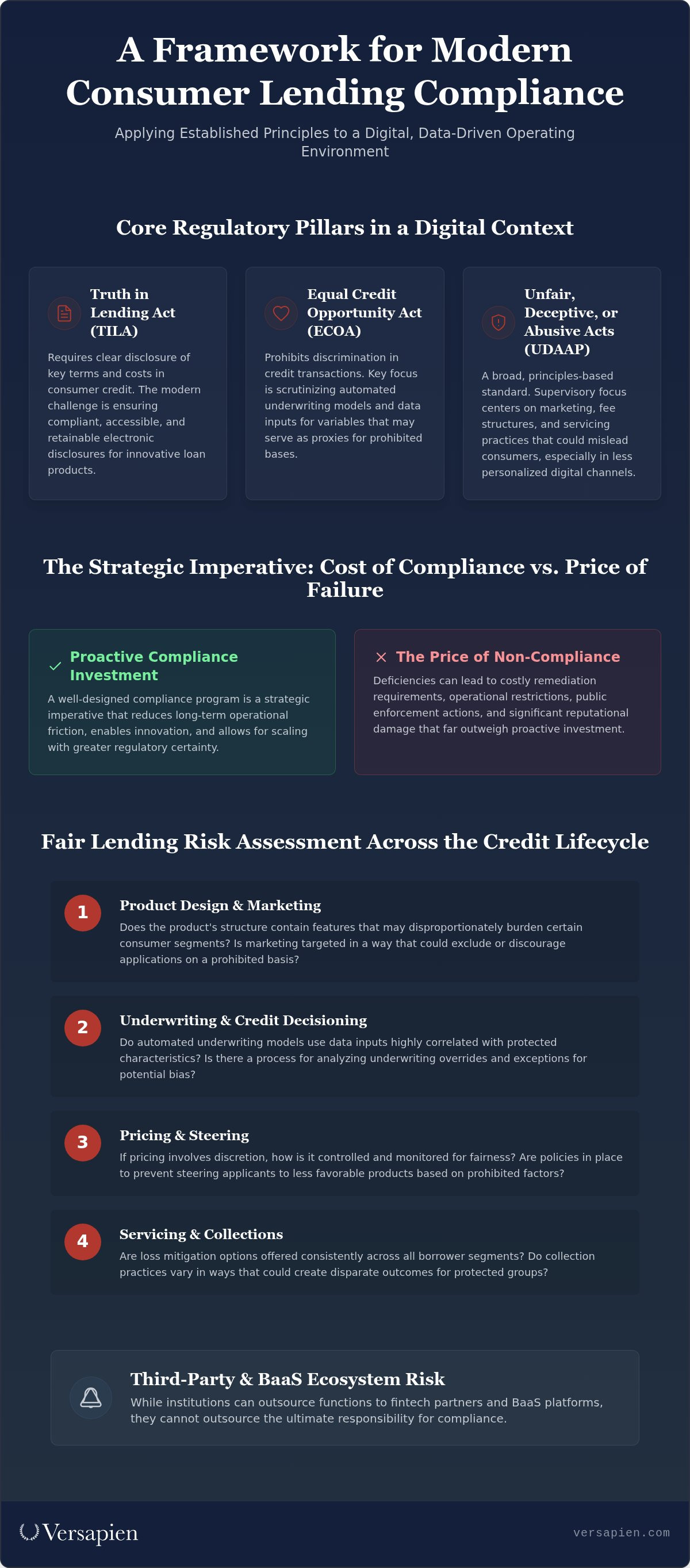
Truth in Lending Act (Regulation Z): TILA requires clear disclosure of key terms and costs in consumer credit transactions. For digital lenders, this includes ensuring that electronic disclosures are provided in a compliant manner, are easy for consumers to access and retain, and accurately reflect the terms of complex or innovative loan products.
Equal Credit Opportunity Act (Regulation B): ECOA prohibits discrimination in any aspect of a credit transaction. In the context of automated underwriting, institutions should assess whether their models, data inputs, and decisioning processes create potential fair lending risks, including the possibility that seemingly neutral variables may be correlated with prohibited bases and contribute to disparate outcomes.
Unfair, Deceptive, or Abusive Acts or Practices (UDAAP): The Dodd-Frank Act's prohibition on UDAAP serves as a broad, principles-based standard. Supervisory focus often centers on whether marketing materials, fee structures, or servicing practices could mislead consumers or take unreasonable advantage of their lack of understanding, particularly in digital channels where interactions are less personalized.
The Cost of Compliance vs. The Price of Failure
Investing in a robust compliance infrastructure is a strategic imperative for sustainable growth. Deficiencies identified during regulatory examinations can lead to remediation requirements, operational restrictions, and reputational damage that far outweigh the initial cost of proactive compliance management. A well-designed compliance program reduces long-term operational friction by embedding controls into business processes, enabling the institution to innovate and scale its lending operations with greater confidence and regulatory certainty.
Operationalizing Fair Lending and UDAAP Oversight
A sound consumer lending compliance program translates regulatory requirements into effective operational controls. The cornerstone of this effort is a well-structured Compliance Management System (CMS) that is tailored to the institution's size, complexity, and risk profile. For high-growth fintechs and banks leveraging new technologies, an effective CMS moves beyond a simple checklist, providing a framework for identifying, measuring, monitoring, and controlling risk throughout the product lifecycle. A strong CMS is foundational to building a compliance program that can scale with the business.
Integrating fair lending and UDAAP risk assessments directly into product development, marketing campaigns, and operational processes is critical. This proactive approach helps identify potential issues before they result in consumer harm or attract supervisory attention. This includes evaluating marketing and lead-generation activities for language or targeting that could raise UDAAP concerns or result in disparate treatment of prospective applicants.
A Framework for Fair Lending Risk Assessment
A structured, risk-based approach to fair lending helps institutions allocate resources effectively and demonstrate a thoughtful governance process to supervisors. Rather than assuming all activities carry equal risk, management should assess potential vulnerabilities across the credit lifecycle. The following framework outlines key areas for consideration.
Third-Party Risk in Lending Ecosystems
The increasing reliance on Banking-as-a-Service (BaaS) platforms, data aggregators, and fintech partners introduces significant third-party risk. While institutions may outsource functions to third parties, outsourcing does not eliminate their responsibility for managing the risks associated with those relationships or for complying with applicable legal and regulatory requirements. Effective oversight involves a risk-based due diligence process to evaluate a partner’s compliance posture before engagement. It also requires ongoing monitoring, clear contractual obligations for compliance and data sharing, and contingency planning. A well-defined approach to third-party risk management for fintech and AI vendors is essential for maintaining a defensible compliance program.
Governance Frameworks for AI and Automated Credit Models
The use of artificial intelligence (AI) and other complex automated models in credit underwriting presents both opportunities for efficiency and heightened governance challenges. Aligning these models with supervisory standards from agencies like the Federal Reserve and the FFIEC is a key task for risk and compliance functions. A central compliance issue stems from ECOA (Regulation B), which requires creditors to provide applicants with specific, principal reasons for adverse actions, such as a credit denial. When a complex "black box" model is used, it can be difficult to isolate the precise factors driving a decision, complicating the ability to generate a compliant adverse action notice.
To address these challenges, institutions are developing robust Model Risk Management (MRM) frameworks. These frameworks can establish governance, validation, and monitoring practices that are commensurate with the models' use, complexity, materiality, and potential impact. As institutions undergo digital transformation, traditional audit trails may prove inadequate, necessitating new approaches to data lineage and decision-making documentation.
The Role of the Board in AI Oversight
Board-level oversight is critical for ensuring that the use of AI in lending aligns with the institution's risk appetite. The board's role is not to validate models but to challenge management and ensure a sound governance framework is in place. This includes defining clear reporting metrics that track not only model performance and accuracy but also fairness outcomes. Executive sponsors of AI initiatives should be able to articulate to the board the trade-offs between a model's predictive power, its complexity, and its transparency, ensuring that business objectives do not override compliance obligations. This level of oversight is a core component of a mature AI governance program.
Model Risk Management Guidance
In April 2026, the federal banking agencies issued updated, non-binding guidance on model risk management. This guidance is most relevant for banking organizations with over $30 billion in assets but may also be relevant to smaller banking organizations with significant exposure to model risk. It emphasizes a risk-based approach and does not create prescriptive legal requirements. Key elements include:
Model Validation: Validation is a critical component of MRM, intended to assess whether a model is performing as intended and is suitable for its proposed use. This process is generally performed before a model is first used, though the guidance acknowledges that in limited circumstances, such as an urgent business need, use may precede full validation if appropriate controls and limitations are in place.
Vendor Models: Oversight and controls for models developed by third parties should be commensurate with the level of risk and the model's use. This includes understanding the model's assumptions, limitations, and data inputs.
Ongoing Monitoring: Institutions should establish monitoring practices appropriate to a model's use and risk profile to assess whether it continues to perform as intended and remains suitable for its intended purpose. This is particularly important for credit models, where performance can degrade due to changes in the economic environment or shifts in the underlying consumer population, a phenomenon known as "model drift."
Regulatory Examination Readiness: A Proactive Strategy
Preparing for a regulatory examination is not a last-minute exercise but the result of a continuous and well-maintained compliance program. Examination readiness is demonstrated through sufficient governance, clear documentation, robust evidence of controls, and a structured issue management process. The goal is to show supervisors that management has a comprehensive understanding of the institution's risks and has implemented a commensurate system of controls to mitigate them.
Depending on the institution's risk profile and governance structure, self-testing, monitoring, and independent reviews can help identify and remediate weaknesses before they are identified through an examination or other external review to identify and remediate weaknesses before examiners do. Maintaining a centralized repository of key documents—such as policies, risk assessments, committee minutes, training records, and monitoring results—streamlines the examination process. When issues are identified, whether internally or by examiners, a disciplined process for responding to findings with sustainable, well-documented remediation plans demonstrates effective governance.
The Pre-Exam Health Check
Institutions can benefit from conducting periodic "health checks" or mock examinations to assess their readiness. These reviews can identify potential gaps in high-risk areas like fair lending or UDAAP compliance before a scheduled examination. This process should include a review of board and committee minutes to ensure that risk issues are being appropriately escalated and discussed, and a review of policy exception reports to confirm that deviations from policy are properly documented, approved, and monitored for potential systemic issues. A comprehensive review can help identify common compliance gaps before they become examination findings.
Strategic Takeaways for Senior Leadership
An effective consumer lending compliance program requires active engagement from senior leadership and appropriate board oversight. The program should support safe and sustainable growth by helping management identify emerging risks, make informed decisions, and respond effectively when issues arise. Depending on the institution's size, complexity, and risk profile, cross-functional governance forums and improved data and reporting capabilities may help provide more integrated oversight across compliance, legal, risk, product, and technology functions.
Executive Takeaways
Assess Your CMS for Scalability: Review your existing Compliance Management System to ensure it can support planned business growth, new product launches, and the integration of new technologies without compromising control effectiveness.
Integrate Compliance into Innovation: Embed compliance and fair lending risk assessments into the earliest stages of the product development lifecycle, rather than treating them as a final check before launch.
Calibrate Third-Party Oversight: Evaluate your third-party risk management program to confirm that due diligence, contracting standards, and ongoing monitoring are risk-based and tailored to the criticality and complexity of each vendor relationship, particularly in BaaS or fintech partnerships.
Question Your AI Models: Challenge technology and business teams to explain how automated underwriting models work, how fairness is tested, and how the institution generates compliant adverse action notices for credit denials.
Stress-Test Examination Readiness: Conduct periodic mock examinations or targeted reviews of high-risk areas to identify and remediate documentation gaps or control weaknesses before your next supervisory exam.
How Versapien Can Help
Versapien provides senior-led advisory services to help banks and fintechs strengthen their consumer lending compliance programs. Our expertise spans the development and assessment of Compliance Management Systems, the design of fair lending and UDAAP risk management frameworks, and the establishment of robust governance for AI and automated models. We assist clients in enhancing third-party oversight, preparing for regulatory examinations, and executing remediation plans to address supervisory findings, helping them balance innovation with effective governance, risk management, and compliance.


Comments