
Critical Vendor Failure: Building a Practical Exit and Business Continuity Strategy
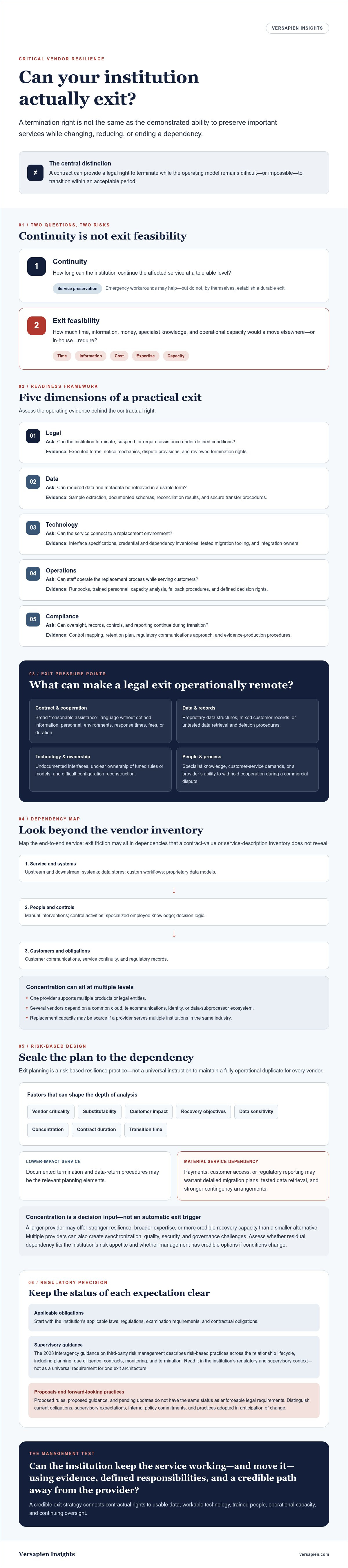
A critical vendor exit strategy is not simply a termination clause, a list of alternative providers, or an annual discussion about what might happen after a service failure. It is the institution's demonstrated ability to preserve important services while changing, reducing, or ending a dependency. That distinction matters because a contract can provide a legal right to terminate while the operating model remains difficult or impossible to transition within an acceptable period.
For a bank, fintech, or digital asset company, a third-party relationship may be sufficiently important to warrant enhanced exit planning when it supports payments, account servicing, customer authentication, transaction monitoring, lending decisions, custody, communications, data storage, or another process with material customer, regulatory, financial, or safety implications. The risk is not limited to an outage. A provider's financial distress, security incident, control failure, material performance deterioration, ownership change, sanctions concern, regulatory action, pricing change, or inability to support a strategic requirement can also create a credible reason to reassess the relationship.
Part 1: Critical Vendor Exit Risk
Vendor failure creates two related resilience questions. First, how long can the institution continue to provide the affected service at a tolerable level? Second, how much time, information, money, specialist knowledge, and operational capacity would be required to move the service elsewhere or bring it in-house? The first question concerns continuity. The second concerns exit feasibility. A plan that addresses only the first may describe emergency workarounds without establishing a durable path away from the failed provider.
Contractual termination is different from practical transition ability
Termination rights generally address the legal relationship: notice periods, termination for cause or convenience, insolvency provisions, suspension rights, data return, intellectual property, and post-termination assistance. Practical transition ability concerns the operating details behind those rights. It includes whether the institution can retrieve complete and usable data, reconstruct configurations, obtain documentation, identify dependencies, train replacement personnel, migrate historical records, validate interfaces, and maintain customer service during the change.
Common gaps appear when a contract refers broadly to “reasonable assistance” without defining the information, personnel, environments, response times, fees, or duration involved. Other gaps include proprietary data structures, undocumented application programming interfaces, unclear ownership of tuned rules or models, customer records mixed across tenants, untested deletion procedures, and a provider's ability to withhold cooperation during a commercial dispute. A legally available exit may therefore remain operationally remote.
Concentration and operational lock-in
Concentration risk can exist at several levels. An institution may depend on one provider for multiple products, several legal entities may depend on the same provider, or multiple vendors may rely on a common cloud, telecommunications, identity, or data-subprocessor ecosystem. A provider may also be concentrated across an industry, making replacement capacity scarce precisely when several customers are seeking the same solution.
Operational lock-in is narrower but often more difficult to see. It can arise from custom workflows, proprietary data models, embedded decision logic, specialized employee knowledge, long implementation cycles, high switching costs, or a vendor's control over a business process that no internal team can immediately perform. A vendor inventory that records only contract value and service descriptions may not reveal these dependencies. Exit analysis benefits from mapping the end-to-end service, including upstream and downstream systems, manual interventions, data stores, control activities, customer communications, and regulatory records.
Concentration does not automatically mean that a relationship should be terminated. A larger provider may offer stronger resilience, broader expertise, or more credible recovery capacity than a smaller alternative. Likewise, maintaining multiple providers may introduce synchronization, quality, security, and governance challenges. The relevant question is whether the residual dependency fits the institution's risk appetite and whether management has credible options if conditions change.
Proportionality and regulatory precision
Exit planning is a risk-based resilience practice, not a universal instruction to maintain a fully operational duplicate for every vendor. The depth of analysis can reflect the vendor's criticality, the service's substitutability, customer impact, recovery objectives, data sensitivity, concentration, contract duration, and the time required to transition. A low-impact service may need documented termination and data-return procedures. A service supporting payments, customer access, or regulatory reporting may justify detailed migration plans, tested data retrieval, and stronger contingency arrangements.
Applicable laws, regulations, examination requirements, and contractual obligations remain the starting point for each institution. Supervisory guidance can explain how agencies expect firms to approach third-party risk without creating a new statute. The 2023 interagency guidance on third-party risk management is an example of supervisory guidance that describes risk-based practices across the relationship lifecycle, including planning, due diligence, contracts, ongoing monitoring, and termination. It should be read together with the institution's applicable regulatory framework and supervisory context rather than treated as a universal requirement for one particular exit architecture.
As of September 2026, the federal banking agencies have also proposed revised third-party risk management guidance that would replace the existing guidance. The proposal emphasizes tailoring third-party risk management to the reasonably assessed risks of individual relationships and to the institution's size, complexity, and risk profile. The proposal remains nonbinding and subject to comment, so it should not be treated as a current replacement for the 2023 guidance.
Proposed rules, proposed guidance, and other pending updates can be useful indicators of supervisory direction, but they do not have the same status as an enforceable legal requirement. Management reporting can distinguish current obligations, supervisory expectations, internal policy commitments, and forward-looking practices adopted in anticipation of change. That distinction improves credibility and prevents an exit program from relying on overstated regulatory claims.
Part 2: Exit and Transition Strategy Design
An effective strategy begins before a termination decision. It defines the conditions that trigger assessment, the information required to make a decision, the transition paths that could be used, and the controls that protect customers and the institution while the change occurs. The strategy can sit within the broader third-party risk framework described in risk-based vendor inventory and tiering practices.
Set criteria and triggers for an exit assessment
An exit assessment is a decision process, not an automatic instruction to terminate. Triggers may be quantitative, qualitative, event-based, or strategic. Examples include repeated or severe service-level breaches; material control deficiencies; unresolved audit or examination issues; significant security or privacy events; financial distress; a change in ownership or subcontracting; loss of required licenses or capabilities; unacceptable price or contract changes; a material increase in concentration; or a change in the institution's product strategy.
Triggers can also reflect declining transition readiness. If data extraction repeatedly fails, a provider stops maintaining a required interface, key documentation becomes unavailable, or the replacement market materially changes, management may need to reassess the relationship even when current service levels appear acceptable. The institution's governance framework should identify who reviews the event, the expected timing of the assessment, what evidence is gathered, and which decision maker or committee has authority to approve remediation, contingency activation, renegotiation, or termination.
Service triggers: define the severity, duration, recurrence, and customer or regulatory effect of performance failures rather than relying only on an aggregate uptime measure.
Control triggers: identify material weaknesses in security, privacy, resiliency, compliance, model governance, records, or incident management.
Counterparty triggers: monitor financial, ownership, legal, reputation, sanctions, and strategic signals relevant to the relationship.
Dependency triggers: track changes in subcontractors, shared infrastructure, data location, interfaces, staffing, and other services that affect concentration or portability.
Strategic triggers: reassess when a product, market, risk appetite, or operating model changes the importance of the vendor.
Build transition requirements into the contract
Contract drafting cannot eliminate every transition risk, but it can reduce ambiguity. Provisions can address termination events, notice periods, continued service during an orderly transition, emergency assistance, data formats, metadata, audit trails, configuration information, documentation, export frequency, secure transmission, retention and deletion, subcontractor cooperation, intellectual property, personnel support, testing rights, fees, and dispute escalation.
Data portability deserves particular attention. “Return of data” may be insufficient if the export omits timestamps, identifiers, relationships, decision history, attachments, audit logs, model versions, rule configurations, encryption information, or records needed to reproduce a control. The institution can define a data dictionary, acceptable file or interface formats, reconciliation expectations, encryption standards, chain-of-custody evidence, and a process for testing an export before a crisis.
Transition assistance can also be scoped in stages. A provider may support discovery and extraction first, then parallel processing, defect correction, knowledge transfer, and final decommissioning. Defined service-level targets for each stage can provide greater operational clarity than a general promise of cooperation. The commercial model should be understood in advance, including ordinary termination assistance, emergency rates, pass-through costs, storage fees, and charges for specialized personnel. Legal review can consider whether disputed invoices or termination claims could impede access to data and assistance.
Evaluate replacement providers and insourcing
Alternative-provider analysis should examine more than product functionality. Relevant dimensions include implementation time, capacity during industry-wide demand, security and resilience, regulatory and contractual compatibility, data location, integration effort, control transparency, financial viability, subcontractor dependence, customer experience, and the provider's willingness to support testing. A second provider that cannot accept the institution's data volume or required control evidence is not a credible contingency.
Insourcing can provide control but also transfers responsibilities to the institution. The analysis can include staffing, specialist knowledge, technology acquisition, support coverage, cyber controls, facilities, recovery capability, licensing, records, quality assurance, and ongoing costs. A hybrid approach may be appropriate, such as retaining a specialized provider for infrastructure while bringing a control-sensitive process, data stewardship activity, or customer communication function in-house.
For each option, management can document assumptions, dependencies, decision criteria, estimated transition duration, minimum viable service, and conditions that would cause the option to be rejected. This creates a decision record rather than a preferred-vendor list that has never been validated.
Protect customers, regulators, and other stakeholders
A transition can create compliance and conduct risk even when the replacement technology works. Customer records may be duplicated or delayed, notices may be inconsistent, fees or product terms may be displayed incorrectly, complaint handling may be interrupted, and decisions may not be explainable in the same way. Critical controls such as transaction monitoring, sanctions screening, fraud detection, access management, record retention, adverse-action processes, and regulatory reporting require explicit mapping during the change.
The transition plan can identify customer segments at heightened risk, define communications and support channels, establish complaint and error escalation, and specify reconciliation before and after cutover. Regulatory and contractual notification requirements can be assigned to named owners. Where an incident or material service disruption is involved, communications should be coordinated with legal, compliance, information security, business continuity, and public affairs teams as appropriate. The plan can also state when management will pause migration because customer harm, data integrity, or control performance has crossed an agreed threshold.
Exit decision and transition pathway
Signal: a service, control, counterparty, concentration, or strategic event is identified and recorded with evidence.
Assessment: the accountable business owner evaluates impact, duration, substitutability, contractual rights, customer exposure, and available capacity.
Decision: management determines whether remediation, renegotiation, heightened monitoring, contingency activation, partial migration, or termination is appropriate within delegated authority.
Preparation: teams confirm data scope, system dependencies, people, communications, regulatory obligations, control mapping, and cutover criteria.
Transition: the institution executes extraction, transformation, testing, parallel operation, customer protection, and defect resolution.
Stabilization: performance and control evidence are monitored, residual issues are accepted or remediated, and the former provider's access and data are closed out.
Part 3: Testing and Operational Readiness
A plan is more credible when testing demonstrates that people, technology, data, contracts, and decision rights work together. A tabletop exercise can reveal assumptions and decision-making gaps, but it rarely tests whether an institution can retrieve a complete data set, reconstruct configurations, process transactions through a replacement, or maintain customer support during a prolonged transition. Testing can therefore be tiered according to criticality and can increase in realism as unresolved risks or material changes emerge.
A tiered testing model
Not every vendor requires every level. A low-criticality provider may be appropriately covered through a documented walkthrough and sample data return. A provider supporting a critical customer or financial process may warrant technical migration and parallel processing. The rationale for the selected level, including accepted limitations, can be approved by the accountable risk owner.
Design scenarios that expose transition friction
Scenarios can combine events rather than treating failure as a clean, isolated outage. For example, a provider may experience a cyber incident while its support staff are unavailable, its subcontractor is also affected, and the institution is approaching a reporting deadline. Another scenario may involve a contract dispute, incomplete data export, a failed transformation, and customers receiving inconsistent status information. Scenario design can include degraded service, loss of personnel, delayed cooperation, inaccurate records, and an alternative provider that has less capacity than expected.
Exercises should identify who can authorize data access, emergency spending, customer communications, temporary manual processing, control exceptions, or migration reversal. They can also test whether legal and compliance teams can distinguish an operational incident from a termination decision, and whether the board or senior management receives information at the point when a decision is still useful.
Use measurable evaluation criteria
Evaluation should move beyond attendance and completion status. Useful measures can include:
Time to identify the accountable decision maker and activate the playbook.
Time to obtain complete data, documentation, configurations, and required provider support.
Percentage of records reconciled, including exceptions, missing fields, duplicates, and rejected transactions.
Migration duration compared with the stated recovery or transition objective.
Number and severity of defects affecting customers, financial balances, controls, records, or reporting.
Manual effort, specialist dependency, overtime, and capacity required during parallel operation.
Control performance across access, security, monitoring, screening, approvals, retention, and evidence production.
Accuracy and timeliness of customer, management, contractual, and regulatory communications.
Time to reverse, pause, or safely complete the transition when acceptance criteria are not met.
Metrics are most useful when paired with thresholds and owners. A ninety-nine percent reconciliation rate may be acceptable for one data set and unacceptable for another. The test record can explain the population, threshold, materiality rationale, exceptions, and approval of any residual risk. This prevents a high completion percentage from masking a small number of critical failures.
Track remediation and retest deliberately
Every material finding can have a risk statement, accountable owner, target date, interim control, dependency, and evidence requirement. Findings can be prioritized according to customer harm, regulatory impact, data integrity, transition delay, and likelihood of recurrence. “Plan updated” is not sufficient closure evidence where the original problem involved untested data, an unavailable interface, or an unclear decision right.
Retesting can occur in stages. A document correction may receive a desktop validation, while a failed data reconciliation may require a repeat export and migration. A major defect can require an independent review or an expanded scenario before closure. Senior management reporting can distinguish open findings, overdue actions, accepted residual risks, and items that have been validated through retesting. The process described in sustainable issue closure is relevant because exit readiness depends on evidence that remediation continues to work under changed conditions.
Part 4: Governance and Lifecycle Management
Exit planning spans procurement, business operations, technology, information security, privacy, legal, compliance, finance, records, customer service, and internal audit. Governance is effective when responsibilities are explicit and when escalation reaches a decision maker before a transition window has narrowed.
Clarify lines of defense
First line: the business owner and operational teams understand the service, maintain the dependency map, monitor performance, own the exit plan, coordinate testing, and escalate trigger events. Technology and security teams contribute technical and cyber evidence rather than treating the plan as a procurement document.
Second line: risk, compliance, privacy, information security oversight, and related control functions set standards, challenge assumptions, assess regulatory and customer impact, review risk acceptance, and monitor whether the relationship remains within policy and risk appetite.
Third line: Internal Audit may provide independent assurance over aspects of governance, risk assessment, controls, testing, issue management, and management reporting based on its risk assessment and audit plan. Its role is distinct from operating or approving the transition.
Legal, procurement, finance, and vendor-management teams may support all three layers without replacing accountable ownership. Responsibility matrices can identify who recommends a decision, who approves it, who executes it, who is consulted, and who receives notice. This is particularly important when a vendor supports several business lines or legal entities.
Report what senior management and the board can use
Board and senior management reporting can focus on decision-relevant information rather than a long inventory of vendor facts. A dashboard may show critical vendors by tier; concentration by service, provider, geography, and common infrastructure; current exit readiness; last test and next test; open high-risk findings; data portability status; estimated transition time; customer and regulatory impact; and approved residual risk.
Reporting can also show trend information. A deteriorating readiness score, increasing manual workaround, growing dependence on a single specialist, or repeated failure to complete data retrieval may be more significant than a single static rating. Where management relies on an assumption such as “a replacement is available,” the report can identify whether that assumption has been validated, by whom, and when it was last tested.
The board's role is oversight rather than operational execution. It can challenge whether the portfolio of dependencies fits the institution's risk appetite, whether management has funded credible options, whether known weaknesses are being accepted transparently, and whether escalation thresholds are understood. Senior management can translate that direction into owners, resources, sequencing, and timely decisions.
Maintain the plan through material change
A fixed annual review may leave the plan stale. Maintenance can be triggered by a material contract amendment, new product, merger, acquisition, technology migration, vendor ownership change, new subcontractor, data-location change, incident, examination finding, test failure, service redesign, or change in recovery objective. The review can confirm that system diagrams, contacts, data fields, interfaces, credentials, staffing, customer communications, and regulatory obligations remain accurate.
Version control and evidence retention support accountability. The institution can retain the approved plan, test scenario, participant list, results, exceptions, remediation records, retest evidence, risk acceptance, and decision approvals. Sensitive information such as credentials and security architecture can be managed through appropriate access controls rather than embedded indiscriminately in a general plan.
Tailor the program to vendor criticality
A tiered program avoids spending equal effort on unequal dependencies. Criticality criteria can include the importance of the service, number and vulnerability of affected customers, time sensitivity, legal or regulatory significance, data sensitivity, substitutability, concentration, recovery requirements, and the institution's ability to perform the process internally.
For the highest tier, the institution may maintain a detailed transition strategy, tested data portability, documented alternatives, stronger contractual assistance, executive escalation, and a more realistic technical exercise. A lower tier may rely on a current inventory, termination and data-return terms, contact validation, and proportionate monitoring. The approach can be adjusted when a lower-tier vendor becomes embedded in a critical process or when a critical vendor's service is replaced by a less concentrated design.
Lifecycle control loop
Plan: classify the service, map dependencies, define tolerances, contract for portability, and identify plausible transition paths.
Monitor: track performance, control evidence, financial and strategic signals, concentration, incidents, subcontractors, and changes in substitutability.
Challenge: conduct risk-based testing, compare actual results with thresholds, investigate assumptions, and record residual risk.
Improve: assign remediation, fund capability gaps, update contracts or architecture, and retest material weaknesses.
Decide: assess and escalate when defined triggers are met, and determine whether remediation, renegotiation, diversification, insourcing, or an orderly exit is appropriate.
Executive Takeaways
A termination right is not the same as a workable transition. Readiness depends on usable data, documented dependencies, capable people, tested technology, and decision authority.
Concentration and lock-in should inform proportional planning, not lead automatically to termination or redundant duplication.
Contracts can define data, assistance, timing, security, fees, and testing expectations in terms that operations can actually use.
Testing can progress from walkthroughs to data retrieval, migration, parallel processing, and live-failover exercises when the vendor's criticality justifies the effort.
Metrics, remediation owners, evidence, and retesting provide a stronger basis for readiness claims than exercise attendance or a completed checklist.
Board and senior management reporting is most valuable when it shows concentration, transition time, unresolved blockers, customer impact, and accepted residual risk.
Exit plans benefit from lifecycle maintenance tied to material operational, contractual, technological, and regulatory changes.
How Versapien Can Help
Versapien provides senior-led risk management and regulatory strategy advisory to regional banks, fintechs, and digital asset companies. Our team, led by seasoned professionals with Big Four leadership experience, assists organizations in designing tailored third-party risk frameworks, critical vendor exit plans, and operational testing protocols. We focus on practical implementation, including dependency mapping, governance design, control assessment, remediation tracking, and evidence development aligned with an institution's specific risk appetite.
Learn more about our risk management and regulatory compliance services.


Comments