
Digital Asset Risk Management: Integrating Crypto Activities Into Enterprise Risk
Updated: Sep 22
Digital asset activities can introduce new technologies and business models, but they do not eliminate the fundamental risk management disciplines financial institutions already use to govern complex products and activities. As institutions explore cryptocurrency, tokenization, stablecoins, custody, and other digital asset services, the challenge is to identify where these activities create new or modified risks and integrate those risks into the existing enterprise risk management framework.
A sustainable approach requires more than technical expertise or standalone crypto controls. Institutions should establish clear accountability, assess the full risk profile of each activity, align risk management and control activities with their risk appetite, and provide senior management and the Board with meaningful visibility into emerging exposures. By integrating digital asset activities into established governance, risk, compliance, cybersecurity, and operational frameworks, institutions can pursue innovation without creating disconnected risk-management silos.
Table of Contents
I. Digital Assets as an Enterprise Risk Management Issue
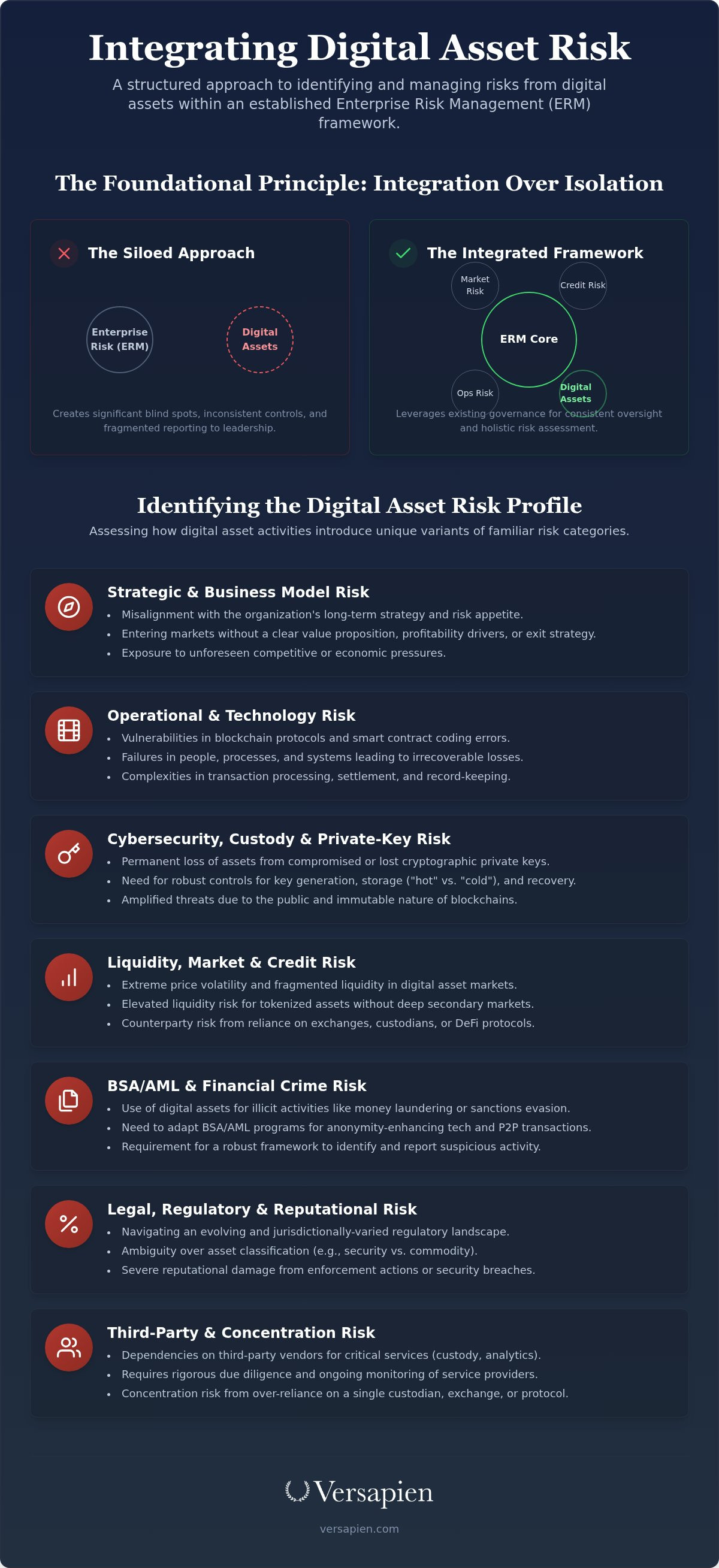
Treating digital asset risk as a purely technical or siloed function separate from enterprise risk management (ERM) can create significant blind spots. A standalone program, often housed within an innovation lab or technology department, may excel at identifying cryptographic vulnerabilities but may not fully address the broader institutional implications for capital, liquidity, reputation, and regulatory compliance. When digital asset activities are not governed by the same standards as traditional financial products, institutions risk developing inconsistent risk appetites, duplicative control structures, and fragmented reporting to senior management and the Board.
Effective digital asset risk management is an extension of, not a replacement for, established ERM principles. Integrating these activities into the enterprise framework ensures that the associated risks are identified, measured, monitored, and controlled with the same rigor applied to other complex products. This approach allows the organization to leverage existing governance structures, such as risk committees, policy management frameworks, and internal audit functions, to provide consistent oversight. It also facilitates a more holistic assessment of aggregate risk, enabling leadership to understand how digital asset exposures interact with traditional market, credit, and operational risks across the enterprise.
II. Identifying the Digital Asset Risk Profile
A comprehensive risk identification process is the foundation of a sound framework. Instead of creating an entirely new risk taxonomy, institutions should assess how digital asset activities introduce unique variants of familiar risk categories. This ensures that new risks are mapped to existing governance and control owners.
Strategic and business model risk
Institutions should evaluate whether a proposed digital asset activity aligns with the organization's long-term strategy and stated risk appetite. Misalignment can lead to pursuing ventures that the institution is not equipped to manage, damaging its brand or exposing it to unforeseen competitive or economic pressures. A key risk is entering a market without a clear understanding of the underlying value proposition, long-term profitability drivers, or exit strategy.
Operational and technology risk
This category includes risks arising from failures in people, processes, and systems. For digital assets, this extends to blockchain protocol vulnerabilities, smart contract coding errors that could lead to irrecoverable losses, and network finality issues. Operational risks also include flaws in transaction processing, settlement, and record-keeping, which can be more complex in a distributed ledger environment compared to traditional systems.
Cybersecurity, custody, and private-key risk
The security and governance of cryptographic private keys are critical considerations for institutions that control or have responsibility for digital asset wallets or custody arrangements. The loss or compromise of private keys can result in the permanent loss of assets. Institutions must develop robust controls around key generation, storage, usage, and recovery, distinguishing between the security protocols for "hot" wallets (online) and "cold" storage (offline). Cybersecurity threats are amplified by the public and often immutable nature of blockchains, making prevention and resilience critical.
Liquidity, market, credit, and counterparty risk
Digital asset markets can exhibit extreme price volatility and fragmented liquidity, creating significant market risk. Liquidity risk may be elevated for tokenized assets that lack deep, established secondary markets. Credit and counterparty risks arise from lending activities or from reliance on digital asset exchanges, custodians, or decentralized finance (DeFi) protocols that may lack the robust credit and operational standing of traditional financial intermediaries.
BSA/AML, sanctions, fraud, and financial crime risk
Digital assets can be used for illicit activities, including money laundering, terrorist financing, and sanctions evasion. Institutions engaging in digital asset activities subject to applicable BSA/AML requirements should assess whether their financial crime compliance programs appropriately address the unique characteristics and risks associated with those activities, such as the use of anonymity-enhancing technologies and peer-to-peer transactions. A robust financial crime risk management framework is essential for identifying and reporting suspicious activity in this environment.
Legal, regulatory, and reputational risk
The legal and regulatory landscape for digital assets is evolving and varies by jurisdiction. Ambiguity regarding whether a specific asset is a security, commodity, or other instrument creates significant legal and compliance risk. Enforcement actions, security breaches, or association with illicit finance can cause severe reputational damage, eroding customer and investor confidence.
Third-party and concentration risk
Many institutions rely on third-party vendors for critical digital asset services, including custody, exchange access, and blockchain analytics. This creates dependencies that require rigorous due diligence and ongoing monitoring. Concentration risk can emerge from over-reliance on a single custodian, exchange, or blockchain protocol, creating a single point of failure. Effective third-party risk management practices are critical to mitigating these exposures.
III. Building the Risk and Control Framework
Once the risk profile is understood, institutions can adapt their existing control frameworks to address the specific nuances of digital assets. This involves mapping identified risks to established risk taxonomies and ensuring that policies, procedures, and controls are updated accordingly. Rather than creating an entirely separate risk management structure, institutions can build on their existing ERM framework and may draw on recognized frameworks, such as COSO or ISO 31000, where appropriate.
The process begins by aligning the digital asset strategy with the institution's formal risk appetite statement. This statement should be updated to include specific, measurable limits and tolerances for digital asset exposures. Existing control inventories can then be enhanced to address unique risks. For example, access controls may be updated to include specific protocols for private key management, and business continuity plans may be revised to address blockchain-specific failure scenarios like a 51% attack.
A core component of a strong framework is the principle of "effective challenge," where qualified, independent parties review and challenge the assumptions, designs, and performance of risk-taking and control functions. For digital assets, this may include having appropriately qualified personnel independently assess significant assumptions, technology and security risks, control design, and other material aspects of a proposed activity or solution. Issue management and testing processes should also be adapted, with internal audit and compliance testing teams developing specific scripts to validate the effectiveness of digital asset controls.
IV. Integrating Digital Assets Into Enterprise Governance
Clear ownership and accountability are essential for effective governance. Integrating digital asset oversight into the existing three-lines-of-defense model ensures that responsibilities are well-defined and aligned with established enterprise roles.
First Line (Business/Operations): The business units and technology teams that engage in digital asset activities are the first line of defense. They are responsible for identifying, owning, and managing the risks associated with their daily operations, from trade execution to technology implementation.
Second Line (Risk/Compliance): Functions like Risk Management, Compliance, and Information Security form the second line. They provide independent oversight, establish risk management frameworks and policies, and provide effective challenge to the first line. This includes functions like the Chief Risk Officer (CRO) and teams focused on financial crimes, which are responsible for setting the standards for digital asset risk management and monitoring adherence.
Third Line (Internal Audit): Internal Audit provides independent assurance to executive management and the Board that the overall risk management framework is well-designed and operating effectively. Its role is not to perform first- or second-line activities but to evaluate their rigor and effectiveness.
Executive management is responsible for managing digital asset activities within the institution's governance framework, while the Board provides oversight consistent with its responsibilities and the institution's governance structure. Senior management should ensure that the Board receives clear, concise reporting on the aggregate digital asset risk profile, material exposures, and the effectiveness of the control environment. This reporting should translate technical risks into business and financial impacts, enabling the Board to provide strategic direction and hold management accountable.
V. Managing Third-Party, Technology, and Model Dependencies
Institutions rarely conduct digital asset activities in isolation. They often depend on a complex ecosystem of third-party vendors, open-source technologies, and quantitative models. The oversight of these dependencies should be risk-based and proportionate to their criticality.
Vendors such as custodians, exchanges, blockchain analytics providers, and wallet providers introduce significant third-party risk. The institution should conduct thorough due diligence before engagement and perform ongoing monitoring to ensure vendors continue to meet contractual and performance expectations. Where an institution relies on smart contracts or other blockchain-based automated processes, it should assess the associated technology, operational, security, legal, and third-party risks and establish controls appropriate to the activity and its risk profile.
Where institutions use quantitative models, for example, for pricing complex tokenized assets or for transaction monitoring, sound model risk management practices are prudent. While supervisory guidance such as SR 11-7 and the more recent SR 26-2 on model risk management is non-binding and advisory, its principles offer a sound framework. This guidance is primarily directed at banking organizations with over $30 billion in assets but may also be relevant to smaller institutions with significant model risk exposure. A risk-based approach suggests that complex pricing engines may warrant independent validation before use, and that vendor-provided models should be subject to a level of validation and monitoring consistent with their materiality and risk. Where applicable, institutions should maintain an appropriate inventory of models and other material technology dependencies, together with governance, documentation, validation, and monitoring practices proportionate to their risk and materiality.
VI. Regulatory Readiness and Sustainable Scaling
As institutions move from pilot programs to full-scale digital asset offerings, the ability to demonstrate a well-governed and appropriately documented risk management framework can be an important component of regulatory exam readiness. Depending on the institution, its activities, and the applicable supervisory framework, examiners may assess documentation supporting risk assessments, governance decisions, control design, monitoring, and remediation.
Documentation should be a byproduct of a well-functioning governance process, not an afterthought. This includes minutes from risk committee meetings where digital asset strategies were challenged, records of third-party due diligence, and results from independent control testing. It is important to remember that regulatory expectations are not static or uniform; they depend on the institution's charter, the specific activities undertaken, and the applicable state and federal laws and regulations.
Sustainable scaling requires a proactive approach to risk identification. Instead of waiting for regulatory findings or market incidents, institutions should have processes to identify and assess emerging risks. A well-integrated ERM framework provides the structure for this foresight, enabling the institution to adapt its controls and strategies as the digital asset landscape evolves.
VII. Executive Takeaways
Senior management and Boards overseeing digital asset activities should focus on several priorities:
Integrate Rather Than Isolate Risk: Digital asset activities should be incorporated into the institution's existing enterprise risk management framework rather than managed solely as a technology or innovation initiative.
Define the Risk Profile: Assess how each proposed activity affects strategic, operational, technology, cybersecurity, custody, liquidity, market, credit, counterparty, financial crime, legal, regulatory, reputational, and third-party risks.
Establish Clear Accountability: Define first-line ownership, second-line oversight and challenge, and independent assurance responsibilities in a manner consistent with the institution's governance model.
Manage Critical Dependencies: Apply risk-based oversight to custodians, exchanges, blockchain analytics providers, wallet providers, smart contracts, technology providers, and other material dependencies.
Maintain Board-Level Visibility: Provide senior management and the Board with meaningful reporting on material exposures, emerging risks, control effectiveness, and significant incidents or issues.
Build for Sustainable Scaling: As digital asset activities expand, update governance, risk assessments, controls, monitoring, and reporting to reflect changes in the institution's products, technology, dependencies, and risk profile.
VIII. How Versapien Can Help
Versapien provides senior-led advisory services to help financial institutions integrate digital asset activities into their enterprise risk and compliance frameworks. With a team that carries Big Four consulting pedigree, we offer practical, implementation-focused recommendations designed to withstand regulatory scrutiny while supporting business objectives. Our integrated approach helps organizations build sustainable governance structures that connect emerging technology risk with traditional domains like financial crime compliance, third-party risk management, and model governance, turning effective oversight into a strategic advantage.



Comments