
Financial Crime Risk Assessments: Five Mistakes That Weaken the Framework
Updated: Sep 22
A financial crime risk assessment should do more than document an institution's exposure to money laundering and other illicit finance risks. When designed effectively, it can help management understand how the institution's customers, products, services, geographies, delivery channels, and other activities contribute to its risk profile and whether its control environment is appropriately aligned with those risks. However, common weaknesses in methodology, data, governance, and execution can reduce the usefulness of the assessment and make it more difficult to use as a meaningful management tool. This article examines five mistakes that can weaken a financial crime risk assessment framework and practical considerations for addressing them.
Table of Contents
Mistake #1: Treating the Risk Assessment as a Static Compliance Exercise
Mistake #2: Using an Inconsistent or Insufficient Risk Methodology
Mistake #3: Relying on Incomplete, Inconsistent, or Poor-Quality Data
Mistake #4: Failing to Assess New Products, Technologies, and Emerging Risks
Mistake #5: Failing to Translate Results into Management Action and Effective Governance
Mistake #1: Treating the Risk Assessment as a Static Compliance Exercise
A common pitfall is viewing the financial crime risk assessment as a point-in-time project, completed to satisfy an audit or examination request and then archived until the next cycle. This approach treats the assessment as a historical record rather than a dynamic management tool. An institution’s risk profile is not static; it evolves with every new product launch, market expansion, or change in customer behavior. A risk assessment that no longer reflects the institution's current activities and risk profile may provide limited insight for management and may not provide an accurate foundation for evaluating financial crime risks.
A sound practice is to establish a framework for keeping the assessment current. This does not necessarily mean continuous, real-time updates. Instead, it involves a disciplined process for periodic reviews, supplemented by event-driven updates when material changes occur. Management should define clear triggers that prompt a reassessment, which could include:
Launching a new product or service with a different risk profile.
Entering a new geographic market, particularly one with higher country risk.
Completing a merger or acquisition that introduces new customer bases or business lines.
Implementing new technologies or delivery channels that alter how the institution interacts with customers.
Significant changes in the institution’s customer base or transaction patterns.
Updated regulatory guidance or identification of new financial crime typologies relevant to the business.
A process that includes periodic review and reassessment when material changes occur can help keep the institution's understanding of financial crime risk aligned with its strategic and operational activities.
Mistake #2: Using an Inconsistent or Insufficient Risk Methodology
Without a well-defined and consistently applied methodology, a financial crime risk assessment can produce subjective and indefensible results. If different business units or assessors use varying criteria, the aggregated enterprise-wide view of risk becomes incoherent. This lack of a systematic approach makes it difficult to compare risks across the organization, prioritize resources effectively, or demonstrate a reasonable and repeatable process to examiners.
Developing a robust methodology is foundational to a credible assessment. This involves more than selecting a scoring system; it requires defining the core components of the risk analysis. A defensible framework typically includes clear definitions and evaluation criteria for:
Inherent Risk: The level of risk that exists before the application of any controls. The methodology should identify the specific risk factors to be assessed, such as customer types, products and services, geographic locations, and delivery channels.
Control Effectiveness: The quality and performance of the mitigating controls designed to manage inherent risks. This evaluation should consider both the design adequacy of the controls (are they designed correctly?) and their operational effectiveness (do they work in practice?).
Residual Risk: The risk that remains after controls are applied. The methodology should clearly articulate how inherent risk levels and control effectiveness ratings are combined to determine the final residual risk score.
There is no single required approach; institutions may use qualitative, quantitative, or hybrid models. The key is that the chosen methodology is logical, documented, and applied consistently across the enterprise. A well-structured methodology can provide a sound basis for consistent, risk-based decision-making.
Mistake #3: Relying on Incomplete, Inconsistent, or Poor-Quality Data
The credibility of a financial crime risk assessment is contingent upon the quality of the data used to support it. When assessments are based on assumptions, anecdotal evidence, or incomplete data sets, their conclusions are easily challenged. Common data-related weaknesses include relying on information from a single department, using inconsistent data definitions across business lines, or failing to validate the completeness and accuracy of key inputs. The result is a skewed risk profile that can lead to a significant misallocation of compliance resources.
An effective assessment process begins with a deliberate approach to data aggregation and governance. This requires identifying authoritative data sources across the enterprise for the key risk drivers. For example:
Customer Risk: Data may come from customer relationship management (CRM) systems, account opening platforms, and Know Your Customer (KYC) files to segment the customer base by risk-relevant attributes.
Product and Service Risk: Information from core processing systems and product management can provide data on product usage, transaction volumes, and specific features that may elevate risk.
Geographic Risk: Transaction data, customer information, and other relevant sources may help an institution understand and assess its exposure to geographic risks, including higher-risk jurisdictions where relevant to its activities.
Institutions should implement reasonable validation procedures to confirm the integrity of the data. This could involve reconciling data from different systems or performing sample testing to verify accuracy. Overcoming internal data silos is often a significant challenge, but it is essential for developing a comprehensive and accurate understanding of the institution's financial crime risk profile.
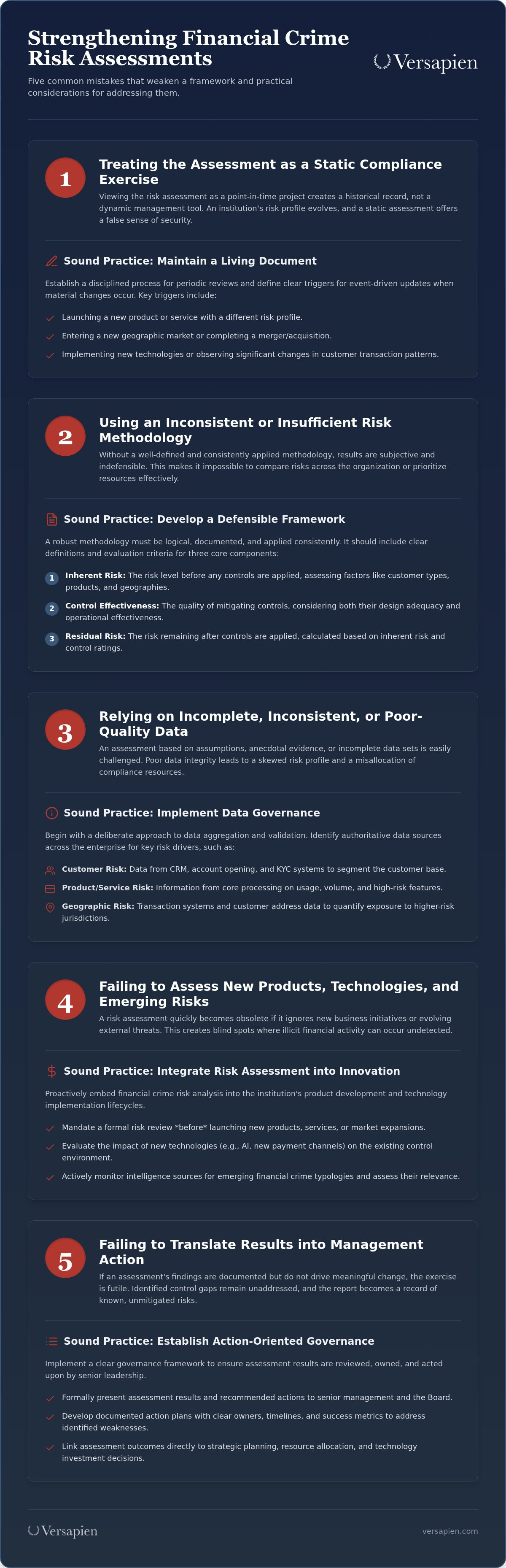
Mistake #4: Failing to Assess New Products, Technologies, and Emerging Risks
Many risk assessments focus excessively on established products and well-understood risks, creating a blind spot for emerging threats associated with innovation. For institutions introducing new products, technologies, or business activities, a risk assessment process that does not consider material changes and emerging risks may fail to capture important elements of the institution's evolving risk profile. Risks associated with artificial intelligence (AI) in compliance processes, the nuances of digital asset transactions, or increasingly sophisticated fraud schemes may not be captured by traditional assessment frameworks.
A forward-looking risk assessment should explicitly consider how new initiatives alter the institution's risk profile. When evaluating new technologies, management should ask targeted questions:
For Digital Assets: How does the institution assess risks related to counterparty anonymity, sanctions evasion, and the use of privacy-enhancing technologies? What tools and expertise are required to monitor on-chain and off-chain activity effectively? Understanding these digital asset compliance and governance considerations is critical.
For Artificial Intelligence: For Artificial Intelligence: If AI is used in transaction monitoring, fraud detection, or other financial crime processes, how are the system's purpose, performance, limitations, and associated risks understood and governed? Not every AI system is necessarily a model subject to model risk management practices. The April 2026 interagency model risk management guidance, including SR 26-2, is risk-based and nonbinding and is expected to be most relevant to banking organizations with more than $30 billion in total assets, although it may also be relevant in certain circumstances to smaller banking organizations with significant exposure to model risk. Generative and agentic AI are outside the scope of that guidance. Governance should be appropriate to the specific use and risk of the system and may involve model, operational, technology, data, cybersecurity, or compliance risk management processes, as appropriate.
For New Payment Channels: How do new payment rails or Banking-as-a-Service (BaaS) partnerships change the institution's exposure to third-party risk and money laundering typologies?
By integrating a process for evaluating emerging risks, the financial crime risk assessment becomes a tool that enables innovation safely, rather than an exercise that only documents the past.
Mistake #5: Failing to Translate Results into Management Action and Effective Governance
Perhaps the most significant weakness is when a well-executed risk assessment fails to drive action. If the results are not considered in program governance, risk management, or decision-making, the assessment may provide limited practical value beyond its documentation. The assessment can provide greater value when its findings inform management decisions regarding risk mitigation, program priorities, resource allocation, and strategic activities.
An effective governance process ensures that the assessment's results are not an end in themselves but a critical input for the risk management lifecycle. This process should include clear accountability for:
Review and Challenge: The results should be reviewed through an appropriate management governance process with sufficient authority to challenge findings and determine necessary actions.
Action Planning: For risks identified as outside the institution’s risk appetite, management should determine whether action plans or other risk responses are appropriate, with clear ownership and timelines where remediation is required.
Informing Program Strategy: The assessment results should directly inform the priorities of the BSA/AML program, influencing decisions about technology investments, staffing levels, training programs, and the scope of compliance testing and audits.
Reporting: Summarized results and corresponding management actions should be reported to senior management and, as appropriate, the board of directors or a committee thereof. This provides leadership with a clear view of the institution’s financial crime risk profile and the effectiveness of its management.
While direct board approval of every risk assessment may not be required or practical, the board has a responsibility to oversee the risk management framework. The assessment is a key tool that enables them to execute that oversight effectively.
Executive Takeaways
Management should consider the following actions to strengthen their financial crime risk assessment framework:
Establish Clear Triggers: Define and document the specific business or environmental changes that will prompt an update to the risk assessment outside of its normal periodic cycle.
Formalize the Methodology: Ensure the risk assessment methodology is clearly documented, subject to appropriate governance and review, and consistently applied across the organization, defining key terms like inherent risk, control effectiveness, and residual risk.
Strengthen Data Governance: Identify authoritative data sources for key risk inputs and implement reasonable validation processes to ensure the data used in the assessment is accurate and complete.
Integrate Emerging Risks: Incorporate a forward-looking process to assess risks from new products, technologies like AI and digital assets, and evolving financial crime typologies.
Create an Action-Oriented Governance Process: Implement a formal process for management to review assessment results, approve action plans for identified gaps, and use the findings to inform the strategic direction of the compliance program.
How Versapien Can Help
Versapien provides specialized advisory services to help financial institutions design and execute effective financial crime risk assessments. Our senior-led teams assist clients in developing and refining risk methodologies, evaluating the design and effectiveness of risk and control frameworks, and improving data aggregation and governance processes. We help organizations assess emerging risks associated with digital assets and AI, and we work with management to translate assessment findings into practical remediation roadmaps and effective governance reporting.


Comments