
Generative AI Use Cases in Banking: A Risk-Tiering Method for Prioritizing Oversight
Two banking use cases built on the same generative AI model may warrant very different oversight. An internal tool that summarizes approved policies presents a different exposure from a system that drafts customer advice or informs a credit decision. That is the central question in generative AI risk tiering in banking: how should oversight reflect what a use case can affect, not just the technology behind it?
Generic model-risk categories may not capture these differences, while broad escalation rules can leave business teams unsure when stronger review is warranted. SR 26-2, issued April 17, 2026, is nonbinding interagency guidance on model risk management. Generative and agentic AI are outside its scope, and the guidance does not prescribe how banks should tier these use cases. Institutions should nevertheless establish governance and controls appropriate to each use case's purpose, materiality, and risk profile.
This article sets out a practical method for classifying use cases by potential impact, exposure, and control environment, then linking each tier to decisions and oversight. It also explains how to reassess a tier when the use case, its users, or its operating context changes.
Table of Contents
I. Why Generative AI Risk Tiering in Banking Must Start With Use and Impact
A single “generative AI” label does not tell a governance committee whether a use case can affect a customer, shape a decision, expose sensitive information, or simply help an employee organize routine work. Classifying by technology alone obscures the deployment choices that determine risk. The same model capability can have different implications depending on who uses it, what information it receives, where its output goes, and how much people rely on it.
For that reason, generative AI risk tiering in banking should begin with the use case, not a static label attached to a model or vendor. Record the intended task, user group, data sources, affected parties, downstream decisions, and human review. Reassess the classification if those conditions change. A tool that moves from drafting internal meeting notes to generating customer-facing decision support has changed in purpose and exposure, even if the underlying system has not.
What makes a generative AI use case higher consequence?
Assess potential customer or operational impact and the degree to which the output could influence a decision. Then consider data sensitivity, deployment scale, human review, and reversibility. A draft that an employee checks before internal use generally differs from output presented to customers or used to guide a consequential decision. The distinction depends on the controls and actual reliance, not the label “human in the loop.”
Risk tiering is the use-case-based prioritization of governance and controls according to potential impact, exposure, and the reliability of safeguards. It is a practical governance tool for directing review and escalation, not a regulatory classification or a determination that a use case complies with applicable law. A tier can inform risk-management decisions, but it does not replace analysis of relevant legal, compliance, privacy, or operational obligations. Effective risk management practices keep the rationale tied to the deployment and revisit it when the use, users, data, or reliance changes.
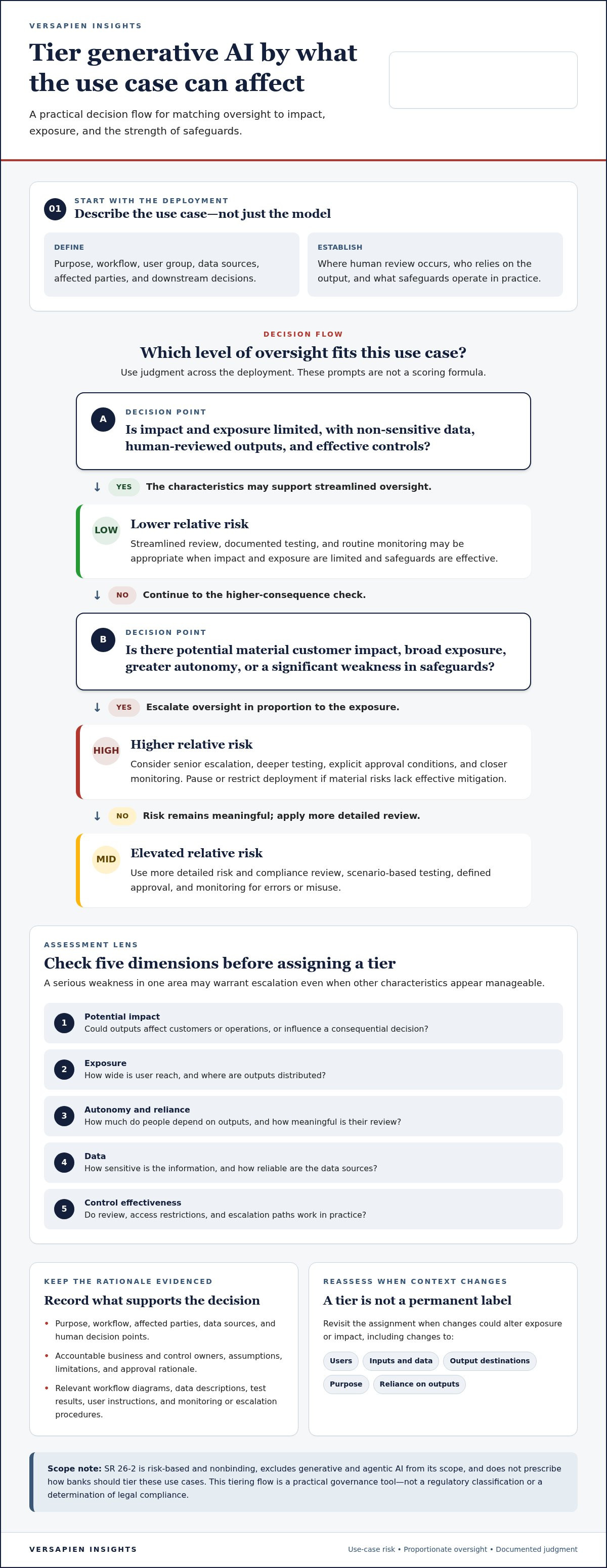
II. A Practical Banking Framework for Assessing Generative AI Risk Tiers
A usable tiering method turns assessment into decisions. Treat the five dimensions and the three tiers below as prompts for judgment, not a mandatory regulatory standard or mathematical scoring formula. A serious weakness in one area may warrant escalation even when other characteristics appear manageable. This illustrative framework should be adapted to the institution’s risk appetite, existing controls, governance, and the use case.
Lower relative risk: Limited impact and exposure, human-reviewed outputs, non-sensitive data, and effective controls may support streamlined review, documented testing, and routine monitoring.
Elevated relative risk: Wider deployment, sensitive data, or outputs that influence employee actions may warrant more detailed risk and compliance review, scenario-based testing, clearly defined approval responsibilities, and monitoring for errors or misuse.
Higher relative risk: Potential material customer impact, broad exposure, greater autonomy, or weak safeguards warrant senior escalation, deeper testing, explicit approval conditions, and closer monitoring. Consider restricting or delaying deployment when material risks have not been adequately mitigated.
Apply five dimensions: potential impact on customers or operations; exposure, including user reach and output distribution; autonomy and reliance on outputs; data sensitivity and source quality; and control effectiveness, including review, access restrictions, and escalation paths. For example, when assessing a generative AI tool that summarizes information for AML investigators, consider the sensitivity and quality of the source information, whether investigators independently verify the output, and how errors or omissions of material information are identified and addressed.
To make the assessment operational, map each tier to specific governance decisions. For example, specify who approves the use case, what testing is required before deployment, who reviews performance or incidents, and which changes trigger reassessment. If teams cannot tell what a tier changes in practice, the categories are unlikely to guide consistent decisions.
What evidence should support a tier assignment?
Keep a concise record of the use case’s purpose, workflow, affected parties, data sources, human decision points, and accountable business and control owners. Document assumptions, limitations, approval rationale, and review triggers, including changes to users, inputs, output destinations, or reliance. Reassess when those changes could alter exposure or impact. Institutions should establish who has authority to approve a tier change and determine whether the change requires renewed testing, risk review, or approval before implementation.
Useful supporting evidence may include workflow diagrams, data descriptions, test results, user instructions, approval records, and monitoring or escalation procedures. The evidence should make clear how the use case works in practice, not just how it was described at approval. For example, if staff routinely accept generated recommendations with little review, the tier rationale should reflect that reliance.
Controls should be commensurate with a use case’s risk, purpose, complexity, and potential impact. The three relative-risk tiers and five assessment dimensions are illustrative governance tools, not a fixed score, mandatory regulatory standard, or regulatory endorsement.
III. Executive Takeaways
A tier has value when it changes a decision. Senior leaders can use these takeaways to connect classification with accountable ownership, review, and ongoing oversight. This practical approach is part of broader enterprise governance, not a substitute for it. The Bank Policy Institute’s AI Risk Management Frameworks in Banking also discusses applying enterprise risk frameworks to emerging AI risks.
Assign an accountable business owner. Name the person responsible for the use case, its stated purpose, and the accuracy of the information submitted for review.
Retain the basis for the tier. Document relevant exposure, impact, assumptions, control rationale, and the approval decision so reviewers can understand how the classification was reached.
Match oversight to risk. Scale review, testing, monitoring, and escalation to the use case’s purpose, complexity, controls, and potential impact rather than applying a uniform process.
Set review triggers and decision rights. Reassess when users, data, workflow, output destinations, or reliance change. Establish who can approve a tier change and whether renewed testing, risk review, or approval is required before implementation. A tier should describe the current deployment, not become a permanent label.
Keep regulatory analysis distinct. SR 26-2 is nonbinding, risk-based interagency guidance on model risk management, and generative and agentic AI are outside its scope. It does not prescribe a basis for assigning generative AI risk tiers. Integrate use-case tiering with the institution's broader AI governance, enterprise risk management, and applicable regulatory compliance processes.
IV. How Versapien Can Help
Versapien advises financial institutions on AI risk assessments, governance frameworks, implementation roadmaps, and model governance. This work can help clarify how use-case tiers connect to existing risk and compliance responsibilities, with decisions grounded in evidence and human judgment.


Comments