
How AI Is Transforming BSA/AML Compliance—and the Governance Challenges That Follow
Updated: Jul 21
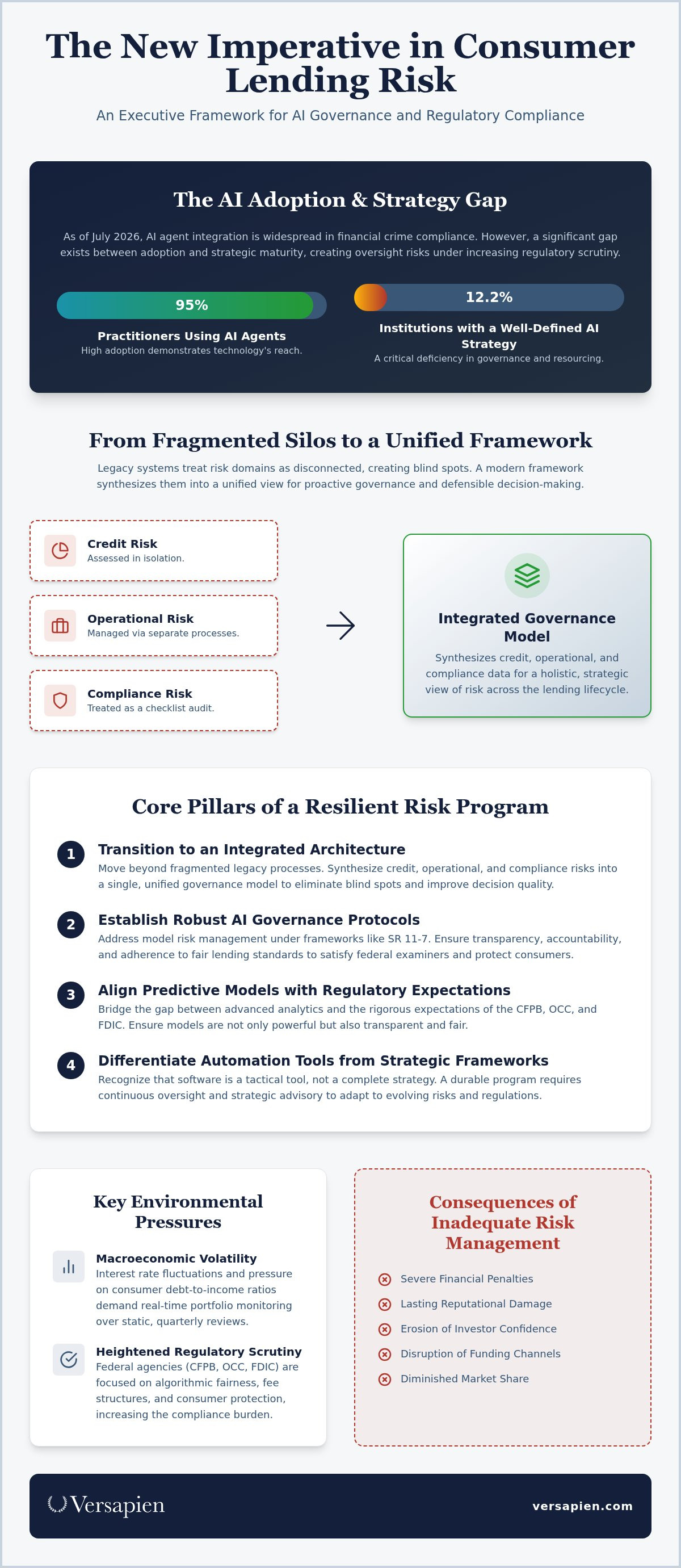
While 95% of financial crime compliance practitioners have integrated AI agents into their workflows as of July 2026, only 12.2% of institutions describe their AI strategy as well-defined and adequately resourced. This disparity creates a significant oversight gap at a time when the CFPB and federal regulators are increasing their scrutiny of automated credit decisions. Precision, transparency, and accountability are no longer optional features of a modern compliance program; they're the fundamental requirements for institutional stability. To manage these complexities, firms are increasingly seeking sophisticated consumer lending risk management services that bridge the gap between advanced predictive modeling and rigid regulatory expectations.
Inefficient manual underwriting and legacy transaction monitoring can't keep pace with the current volume of digital transactions. This article provides a strategic framework to help you navigate the transition from experimental AI adoption to a mature, compliant governance model. We'll examine the specific challenges of model risk management under SR 11-7, the implications of recent OCC and FDIC guidance on credit risk, and the path toward a scalable digital transformation of your lending operations that reduces losses while satisfying federal examiners.
Table of Contents
The Evolution of Consumer Lending Risk Management in 2026
The current lending environment demands a departure from static, siloed risk assessments. In 2026, modern risk management has matured into a multi-dimensional discipline that integrates credit performance, operational integrity, and regulatory compliance into a single strategic view. This evolution centers on three core themes: resilience, transparency, and growth. While legacy models relied heavily on historical snapshots, today's leaders recognize that these metrics often fail to capture the speed of market shifts. Relying on traditional credit scores alone is no longer sufficient for holistic risk assessment because they lack the granularity to predict behavior in a fragmented economy where alternative data and real-time cash flow analysis provide superior predictive power. Organizations are pivoting toward more comprehensive consumer lending risk management services to ensure their frameworks can withstand sudden shifts in consumer liquidity and market sentiment. Beyond consumer lending, these data-driven frameworks are also enabling businesses to explore Revenue-Based Financing, providing a more flexible path to capital based on real-time performance.
Macroeconomic Pressures and Credit Volatility
Persistent interest rate fluctuations continue to pressure consumer debt-to-income ratios, making debt serviceability a moving target for many households. These shifts require a transition from quarterly reviews to real-time portfolio monitoring that can identify emerging delinquency trends before they crystallize into significant losses. The inability to adjust to these macro pressures often results in skewed risk pricing and capital inefficiency, which can hinder long-term profitability. Dynamic risk tolerance is defined as the continuous calibration of lending thresholds based on real-time economic indicators and internal portfolio health. By maintaining this agility, institutions can protect their margins while continuing to serve viable segments of the market that legacy systems might mistakenly overlook.
Heightened Regulatory Scrutiny and Consumer Protection
Federal oversight has moved beyond simple checklist audits to a deep analysis of algorithmic fairness and fee structures. The CFPB's current focus on eliminating junk fees and ensuring that AI-driven credit decisions don't result in disparate impact has raised the stakes for every lender, regardless of their size. Proactive regulatory governance now requires institutions to demonstrate that their models comply with the Bank Secrecy Act (BSA) and consumer protection laws through every stage of the lending lifecycle. Transitioning to integrated consumer lending risk management services is essential to avoid the severe consequences of insufficient risk management. These risks include not only heavy financial penalties from the OCC or FDIC but also lasting reputational damage that can erode investor confidence, disrupt funding channels, and diminish overall market share.
Core Pillars of an Integrated Risk Management Framework
A robust risk architecture rests on three critical pillars: credit risk, operational risk, and compliance. Legacy systems often fail because they treat these domains as disconnected silos, creating blind spots where data is fragmented and decision-making remains reactive. This lack of cohesion leads to inconsistent risk pricing and regulatory gaps that are easily exploited in high-speed digital environments. By contrast, an integrated framework synthesizes these elements into a unified view, allowing leaders to manage the entire lending lifecycle with greater clarity. Establishing such a system requires more than just software; it requires an AI-native operating system like Trinity One that harmonizes machine operations with people management, alongside a disciplined focus on data integrity and measurable outcomes. When data is accurate, granular, and accessible, it forms the foundation of a defensible risk posture that can withstand rigorous scrutiny from the CFPB and other federal examiners.
Achieving measurable results in risk mitigation isn't an accident of technology; it's a product of structural intent. Organizations must move beyond the 'set and forget' mentality that often accompanies new software deployments. Instead, they should prioritize continuous oversight and the regular calibration of risk models. For institutions aiming to bridge the gap between legacy limitations and modern requirements, utilizing professional risk management consulting provides the necessary strategic engine to ensure these pillars remain stable under pressure. This approach transforms risk management from a cost center into a driver of long-term institutional health.
Credit Portfolio Optimization and Underwriting
Traditional underwriting models often miss the nuances of modern consumer behavior, leading to missed opportunities or unpriced risk. Incorporating alternative data sources, such as rent payments or utility history, improves predictive accuracy while helping to satisfy fair lending standards. Modern consumer lending risk management services emphasize the importance of stress testing these portfolios against various economic scenarios, including sudden inflation spikes or regional employment shifts. While automated underwriting increases speed, maintaining a human 'in the loop' is essential for complex cases that require nuanced judgment. This balanced approach ensures that growth remains sustainable even as market conditions evolve.
Operational Resilience and Internal Controls
Manual loan servicing and default prevention are often plagued by systemic inefficiencies that slow originations and increase loss severity. These bottlenecks don't just affect the bottom line. They create operational risks that can lead to UDAAP violations and regulatory fines. Streamlining these processes through active-voice remedies, such as automated document verification and real-time delinquency alerts, reduces friction and enhances protection. Project management excellence ensures that these risk programs remain on track and aligned with broader business objectives. By integrating these controls, firms can achieve a level of transparency that was previously unattainable through manual oversight alone. Effective consumer lending risk management services provide the roadmap for this transition, ensuring that operational resilience is built into the fabric of the organization.
Evaluating Risk Management Solutions: Advisory vs. Automated Systems
Many institutions mistakenly treat software procurement as a comprehensive risk strategy. While automation provides necessary speed, it lacks the contextual judgment required to manage shifting regulatory expectations and complex portfolio dynamics. Software remains a tactical tool; advisory serves as the strategic engine. The "set and forget" mentality common in automated deployments often leads to a gradual decay in model performance and significant governance gaps. Organizations that rely solely on generic platforms find themselves exposed when unique market conditions or specific regulatory inquiries arise. A disciplined approach to consumer lending risk management services involves continuous oversight and the regular recalibration of frameworks by seasoned professionals who understand the nuances of the current landscape.
Boutique advisory firms offer a distinct advantage over one-size-fits-all solutions by providing tailored strategies that reflect an institution's specific risk appetite and operational constraints. Instead of forcing a business into a pre-defined software workflow, a strategic advisor acts as a navigator through difficult technical and regulatory environments. This partnership ensures that the risk posture is both defensible and durable. By prioritizing structural integrity over temporary technical fixes, leaders can build a program that supports long-term growth while maintaining a high degree of professional gravity in the eyes of examiners.
The Limitations of Pure Automation in Lending
Automated bias represents a significant threat to institutional stability. When models are trained on historical data without rigorous oversight, they can inadvertently create systemic Fair Lending violations that are difficult to detect until an exam occurs. The "black box" problem remains a primary concern for the CFPB and OCC; if a model's logic cannot be clearly explained to a regulator, it's effectively indefensible. Veteran experts are required to interpret complex data signals that algorithms might misclassify, ensuring that automated outputs align with the institution's actual risk tolerance and legal obligations.
The Strategic Value of Boutique Advisory Services
Specialized firms like Versapien bring deep-seated competence to high-stakes environments. Their focus on sectors such as auto finance and digital assets allows for a level of precision that larger, generalized consultancies often lack. Project-based consulting offers an efficient way to solve specific compliance gaps, such as refining model risk management under SR 11-7 or updating AI governance policies. Retainer-based support provides long-term benefits by ensuring that risk programs evolve alongside new regulations. This consistent partnership builds institutional memory and structural integrity, allowing firms to move through a difficult landscape with confidence and success.
Tactical software requires a strategic engine to remain effective.
Advisors act as navigators, providing the tools to move through complex landscapes safely.
Boutique firms provide the specialized focus necessary for high-stakes financial environments.
Implementing AI and Fair Lending Safeguards for Growth
Growth, efficiency, and scale. These three objectives drive the current move toward AI integration in the credit lifecycle. While the fear of unmanageable compliance risks often slows adoption, a disciplined approach allows for innovation without compromising structural integrity. By 2026, firms that fail to adopt machine learning will likely find themselves unable to compete on pricing or speed. A sustainable AI strategy centers on transparency, ensuring that every automated decision is traceable and defensible. Utilizing specialized consumer lending risk management services helps bridge the gap between technical capability and regulatory expectation, transforming AI from a liability into a competitive engine.
Establishing a methodical approach to AI innovation requires aligning technical development with the specific scrutiny of the CFPB and other federal bodies. The challenge is not the technology itself but the governance framework surrounding it. When transparency is prioritized, models become assets that provide deeper insights into consumer behavior. This shift from opaque "black box" systems to explainable models is the hallmark of a mature risk program. For organizations seeking to implement these safeguards, AI and digital transformation services provide the necessary oversight to ensure growth remains compliant and sustainable.
Governing AI in Credit Decisions
AI governance has emerged as a distinct sub-discipline of risk management, focusing specifically on algorithmic accountability and model risk. To satisfy CFPB requirements for model explainability, institutions should utilize a rigorous auditing process. A standard checklist for auditing machine learning models for disparate impact includes:
Variable sensitivity analysis to identify and eliminate hidden proxies for protected classes.
Regular disparate impact testing against control groups to detect unintended bias.
Periodic validation of adverse action reason codes to ensure they accurately reflect model logic.
Comprehensive documentation of the model's decision-making architecture for regulatory review.
These steps ensure that consumer lending risk management services remain grounded in fairness while leveraging the predictive precision of modern analytics.
Fair Lending Risk Assessment: A Data-Driven Roadmap
A data-driven roadmap for Fair Lending risk assessment identifies vulnerabilities before they trigger regulatory action. Modern analytics allow for the identification of key risk indicators (KRIs) that signal potential consumer protection issues, such as statistically significant disparities in pricing or approval rates. Identifying these KRIs early allows for proactive remedies, including the refinement of data inputs or the adjustment of threshold parameters. Implementing these remedies within the lending lifecycle protects the institution from UDAAP violations and reputational damage. By maintaining a continuous feedback loop between data analysis and policy adjustment, firms can achieve a level of compliance that supports aggressive market expansion.
Partnering with Versapien for Strategic Risk Oversight
Stability, reliability, and precision. These three attributes define a risk program capable of navigating the increasingly aggressive federal scrutiny of 2026. While fragmented compliance efforts often lead to regulatory friction and operational drift, a disciplined advisory framework provides the necessary steadying force. Organizations must move beyond a state of reactive uncertainty to one of quiet confidence. Achieving this transition requires a partner who understands the intricacies of a difficult landscape and provides the necessary tools to move through it successfully. Versapien serves as this trusted navigator, positioning your institution to maintain structural integrity while pursuing aggressive growth objectives.
Our Boutique Consulting Approach
Working with a disciplined, modern, and highly organized firm offers advantages that generic, large-scale consultancies cannot match. Specialized consumer lending risk management services require a synthesis of technical specialist expertise and visionary architectural oversight. We bridge the gap between these two domains, ensuring that complex AI-driven solutions are governed by sound strategic principles. Our expertise in specialized sectors, such as auto finance and digital assets, allows us to address the unique pressures of these high-stakes environments with surgical precision. To accommodate the diverse needs of our clients, we offer the flexibility of both project-based and retainer-based advisory models, ensuring that high-level strategy remains accessible throughout every stage of institutional maturity.
Delivering Sustainable Compliance and Risk Results
Success in high-stakes financial environments is measured by the durability of the system rather than the speed of a temporary fix. Our commitment to your organization’s long-term health is reflected in our focus on delivering measurable, high-value outcomes in a streamlined manner. By integrating program and project management excellence into our advisory frameworks, we ensure that digital transformations remain on track and aligned with regulatory expectations. This proactive approach secures your future growth by building a defensible risk posture that withstands the scrutiny of the OCC, FDIC, and CFPB. Versapien provides the strategic engine necessary to transform your compliance function into a cornerstone of institutional stability.
Strategic Takeaways for Executive Leadership:
Prioritize the establishment of a formal AI governance sub-discipline to manage model risk and algorithmic accountability.
Transition from siloed risk functions to an integrated architecture that synthesizes credit, operational, and compliance data.
Utilize alternative data and real-time portfolio monitoring to calibrate risk pricing against macroeconomic volatility.
Ensure transparency in all automated credit decisions to satisfy the "black box" concerns of federal examiners.
Engage specialized consumer lending risk management services to bridge the gap between technical capability and regulatory foresight.
Securing Institutional Durability through Strategic Oversight
The transition toward an AI-driven compliance model is no longer a matter of choice; it's a requirement for institutional durability in the 2026 regulatory environment. Success in this landscape depends on the integration of credit, operational, and compliance risks into a unified architectural framework. Fragmented legacy systems often result in oversight gaps and regulatory friction. By contrast, a disciplined approach to governance ensures that every automated decision is explainable, defensible, and aligned with your firm's long-term risk appetite. Achieving this level of precision requires the support of specialized consumer lending risk management services that prioritize structural integrity over temporary technical fixes.
Versapien serves as a trusted navigator for organizations moving through these complex digital transformations. Our boutique focus on delivering measurable, sustainable results provides the stability necessary to scale operations safely. With deep-seated competence in AI, digital assets, and consumer finance, our veteran advisors offer the strategic foresight required to satisfy federal examiners while pursuing market growth. Secure your lending operations with Versapien's strategic risk management services. By prioritizing professional gravity and analytical rigor, your institution can move forward with a sense of quiet confidence and long-term health.
Strategic Guidance: Frequently Asked Questions
What are the primary consumer lending risks to monitor in 2026?
Algorithmic bias, credit volatility, and data privacy represent the primary risks to monitor in 2026. These pressures require a transition from static quarterly reviews to real-time portfolio monitoring that can identify emerging delinquency trends. While legacy models focus on historical snapshots, modern frameworks must account for the 2026 CFPB Personal Financial Data Rights Rule and shifting interest rates that impact consumer debt serviceability.
How do boutique risk management services differ from large-scale consulting firms?
Boutique firms provide specialized focus, surgical precision, and senior-level engagement that larger consultancies often struggle to maintain. Large firms frequently deploy junior staff to manage complex consumer lending risk management services, leading to a generalized approach that lacks institutional depth. A boutique firm acts as a visionary architect, tailoring strategies to specific sectors like auto finance or digital assets to ensure structural integrity.
Can AI be used in consumer lending without violating Fair Lending regulations?
AI can be integrated into lending without violating Fair Lending regulations through rigorous model explainability and continuous disparate impact testing. Transparency, documentation, and oversight are the fundamental requirements for a compliant program that satisfies federal examiners. By utilizing explainable models instead of opaque systems, institutions can satisfy CFPB scrutiny while leveraging the predictive precision of modern analytics.
What is the role of alternative data in modern credit risk management?
Alternative data provides the granular insights necessary to assess creditworthiness in a fragmented and fast-moving economy. Cash-flow analysis, rent history, and utility payments offer superior predictive power compared to traditional credit scores. This data is particularly valuable for thin-file consumers, allowing lenders to expand their reach through sophisticated consumer lending risk management services without increasing their overall risk profile.
How often should a financial institution conduct a Fair Lending risk assessment?
Financial institutions should conduct a Fair Lending risk assessment at least annually, though high-volume digital lenders benefit from quarterly or continuous monitoring. Regular reviews allow for the early identification of key risk indicators before they escalate into systemic issues or regulatory fines. This proactive cadence ensures that underwriting models remain aligned with the latest OCC, FDIC, and Federal Reserve guidance.
What are the benefits of a retainer-based advisory model for compliance?
Retainer-based advisory models offer institutional memory, proactive calibration, and cost predictability for high-stakes environments. Unlike project-based engagements that solve temporary gaps, a retainer ensures that your risk program evolves alongside shifting regulations and market conditions. This partnership-oriented approach provides the stability required to manage a complex landscape while maintaining a high degree of professional gravity.
How does Versapien support digital transformation for traditional retail banks?
Versapien supports digital transformation by bridging the gap between technical capability and regulatory foresight. We help traditional retail banks integrate advanced digital workflows that streamline originations while maintaining the structural integrity required by federal examiners. Our focus is on delivering measurable, high-value outcomes that transform compliance from a cost center into a cornerstone of institutional stability.
What are the regulatory expectations for AI governance in financial services?
Regulatory expectations for AI governance center on transparency, model risk management, and adherence to SR 11-7 standards. FinCEN and other bodies encourage responsible experimentation but demand that institutions maintain a defensible audit trail for every automated decision. A mature governance framework must demonstrate that AI-driven decisions don't result in disparate impact, UDAAP violations, or unmanaged third-party risks.


Comments