
Mortgage Loss Mitigation Controls: How to Test Whether Borrowers Receive Consistent Evaluations
Updated: Sep 22
Evaluating mortgage loss mitigation applications requires balancing intricate regulatory timelines with rigid investor guidelines. When borrowers experience financial distress, servicing compliance functions face a clear operational challenge: verifying that similarly situated borrowers undergo fair, predictable, and consistent evaluations. Inconsistent evaluations can create compliance risk under applicable RESPA/Regulation X requirements and, depending on the circumstances, may raise consumer-protection or fair-lending concerns.
Consistency does not mean offering identical outcomes to every applicant. Rather, an institution achieves consistency when it systematically applies objective eligibility criteria, applies the applicable evaluation criteria and investor or program requirements, respects investor requirements, and enforces documented exception governance across every borrower file. Establishing robust controls to test this consistency requires moving beyond routine checklists and implementing disciplined, comparative testing methodologies.
Table of Contents
Defining Consistency in Mortgage Loss Mitigation Compliance
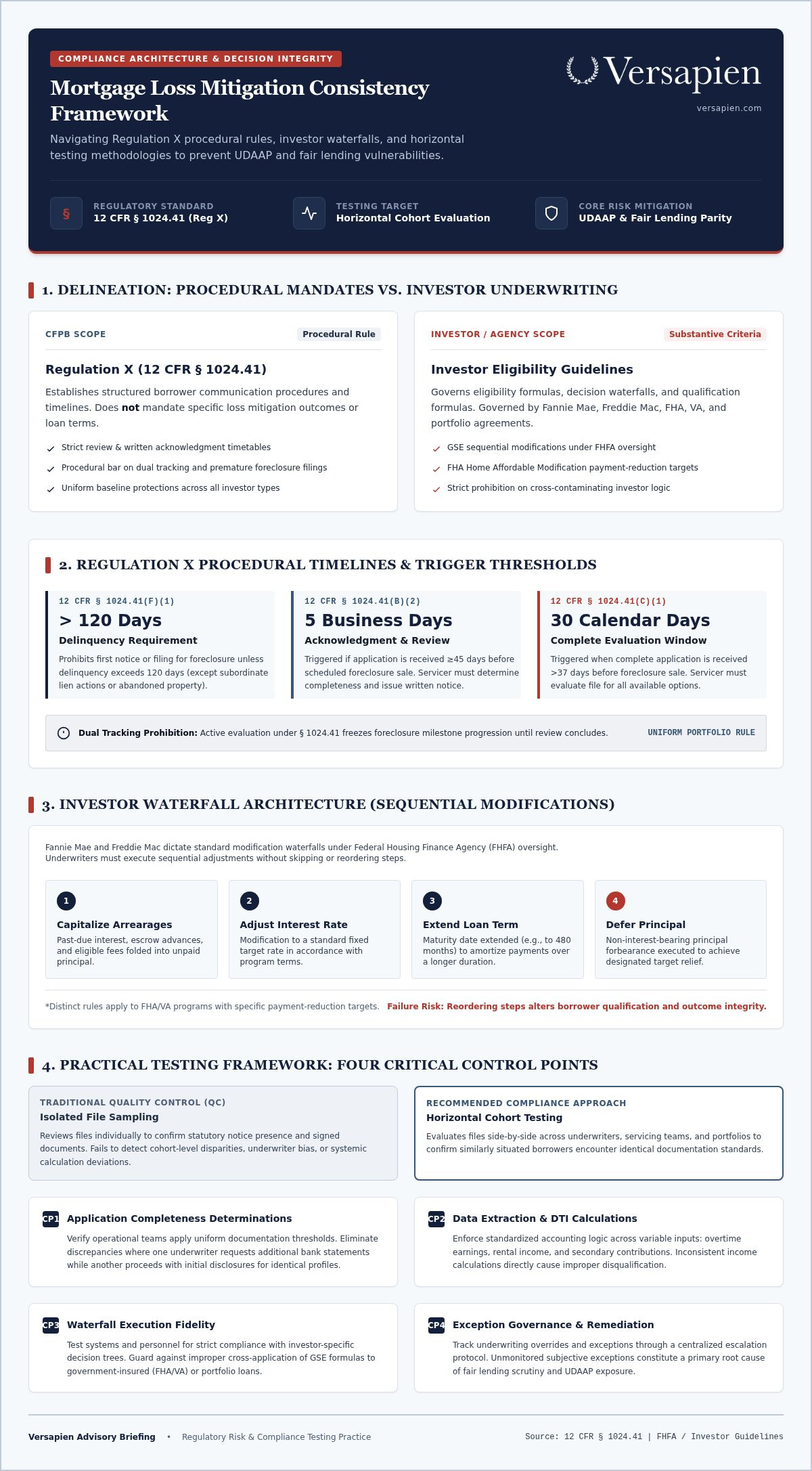
Servicing organizations frequently struggle with operational variation across their loss mitigation operations. One loss mitigation underwriter may interpret undocumented income differently than a peer, or separate operational units may apply distinct standards to incomplete application notices. Such variances erode the integrity of an institution's compliance management system. To address these operational discrepancies, compliance and internal audit teams must first delineate between federal procedural requirements and investor-specific underwriting rules.
Procedural Mandates Under Regulation X
The Consumer Financial Protection Bureau (CFPB) enforces mortgage servicing procedures primarily through Regulation X (12 CFR § 1024.41). A critical compliance distinction is that Regulation X establishes evaluation procedures rather than mandating specific loss mitigation outcomes. The rule does not require a servicer to provide any specific modification or forbearance program to a delinquent borrower; instead, it prescribes rigorous timelines, communication standards, and foreclosure protections.
Under § 1024.41(b)(2), if a servicer receives a loss mitigation application 45 days or more before a scheduled foreclosure sale, the servicer must review the submission within five business days (excluding legal public holidays, Saturdays, and Sundays) and determine whether the application is complete or incomplete. The servicer must provide written notice acknowledging receipt and, if incomplete, state the additional documents necessary to complete the file.
When an institution receives a complete loss mitigation application more than 37 days before a foreclosure sale, § 1024.41(c)(1) mandates that the servicer evaluate the borrower for all available loss mitigation options within 30 days. Furthermore, the servicer must adhere to the procedural protections that restrict dual tracking. Under § 1024.41(f)(1), a servicer is prohibited from making the first notice or filing for foreclosure unless a borrower’s mortgage payment is more than 120 days delinquent, except in specific scenarios involving foreclosure on a subordinate lien or property abandonment. Testing should assess whether these procedural requirements are applied consistently across applicable portfolios while accounting for differences in investor, product, and program requirements.
Investor Guidelines and Program Rules: GSEs, Agencies, and Portfolio Overlays
While Regulation X governs procedural handling, investor guidelines govern eligibility and decisioning criteria. Servicers handle mixed portfolios where evaluation logic changes depending on whether a loan is backed by Fannie Mae, Freddie Mac, the Federal Housing Administration (FHA), the Department of Veterans Affairs (VA), or a private-label portfolio investor. Applicable investor and program requirements can establish different eligibility criteria, evaluation processes, and loss-mitigation options.
For Government-Sponsored Enterprise (GSE) loans, Fannie Mae and Freddie Mac establish investor-specific servicing and loss-mitigation requirements for loans they own or guarantee. These waterfalls prioritize payment relief through specific sequential adjustments: capitalizing arrearages, adjusting interest rates, extending terms, or deferring principal. Conversely, government agency programs, such as FHA Home Affordable Modification programs, employ distinct payment-reduction targets and relief structures.
Compliance testing must confirm that loss mitigation personnel apply the correct investor rules without cross-contaminating criteria. A frequent compliance failure arises when operational teams mistakenly apply GSE qualification formulas to portfolio or government-insured loans, creating systemic evaluation errors across borrower cohorts. For a broader perspective on institutional oversight across servicing operations, review our insights on mortgage servicing compliance emerging risks and governance priorities.
A Practical Testing Framework for Loss Mitigation Decision Integrity
Standard Quality Control (QC) reviews often evaluate files in isolation, assessing whether a specific borrower file contains required notices and executed agreements. While isolated sampling confirms baseline procedural compliance, it fails to detect comparative inconsistency across the servicing portfolio. A disciplined testing framework examines control points horizontally across similar cohorts of delinquent borrowers.
Critical Control Points Across the Lifecycle
To detect inconsistent outcomes, compliance reviews must test four distinct control points:
Application Completeness Determinations: Reviewing whether personnel apply identical documentation standards when deeming an application complete. Inconsistencies occur when one underwriter demands supplemental bank statements while another moves forward with initial disclosures for borrowers in identical employment arrangements.
Financial Data Extraction and Debt-to-Income Calculations: Verifying that calculated debt-to-income (DTI) ratios, surplus income figures, and housing expense ratios follow standardized accounting rules. Discrepancies in how overtime, rental income, or secondary household contributions are treated can improperly disqualify a borrower from an interest rate reduction or term extension.
Waterfall Execution: Testing whether underwriters execute loss mitigation options in the precise sequence specified by the governing investor guide. Skipping or reordering waterfall steps directly alters borrower eligibility and repayment terms.
Manual Overrides and Exceptions: Scrutinizing operational decisions to bypass automated waterfall recommendations. Any manual departure from standard guidelines must follow documented delegation of authority guidelines and carry specific, verifiable business justifications.
The Practical Loss Mitigation Evaluation Testing Matrix
Compliance and internal audit functions can utilize the following practical framework to evaluate whether loss mitigation decisions remain defensible and consistent across servicing cohorts.
Comparative Sampling and Fair Servicing Implications
Compliance teams must supplement randomized testing with comparative sampling. This entails identifying pairs or cohorts of borrowers with closely matched financial profiles (such as similar delinquency duration, unpaid principal balances, combined loan-to-value ratios, and verifiable gross income) across different geographic territories, branch operations, or demographic indicators.
Comparative sampling reveals subtle operational drift that individual audits miss. If borrowers with identical credit parameters receive payment deferrals in one operational center while receiving denials and short-sale referrals in another, management must investigate the disparity. Unexplained differences across comparable borrower groups may warrant further fair-lending analysis, particularly where differences correlate with protected characteristics or other relevant risk factors.
Automated Waterfalls and Third-Party Servicing Governance
Modern loss mitigation operations rely heavily on automated systems to manage intake, document classification, and waterfall calculations. While automation reduces calculation errors, it can propagate systemic compliance non-compliance if rule sets are improperly designed or tested. Similarly, relying on subservicers or specialized third-party vendors requires rigorous oversight to maintain evaluation consistency across an institution's entire servicing portfolio.
Technology Governance: Deterministic Engines vs. Quantitative Models
Compliance and risk managers must maintain precision when categorizing technology infrastructure. Most loss mitigation decision engines are deterministic business rules engines (BREs). These systems follow hard-coded sequential logic: if gross monthly income equals $X and unpaid principal balance equals $Y, then term extension equals $Z. Deterministic systems require comprehensive configuration testing, change management verification, and input-output validation rather than complex statistical calibration.
If an institution uses a quantitative system that meets its applicable definition of a model, model risk management practices may be relevant. The April 2026 interagency Revised Guidance on Model Risk Management (SR 26-2) is risk-based and nonbinding and supersedes SR 11-7 and the prior interagency model-risk guidance. It is expected to be most relevant to banking organizations with more than $30 billion in assets regulated by the Federal Reserve, while recognizing that it may also be relevant to smaller banking organizations with significant model risk. SR 26-2 specifically excludes deterministic rule-based processes and software that do not rely on statistical, economic, or financial theories. Generative AI and agentic AI models are also outside its scope.
Subservicer and Vendor Oversight Controls
Outsourcing default servicing or operational processing to a subservicer does not relieve the primary servicer of regulatory responsibility. Regulators evaluate the master servicer based on the performance and compliance of its designated agents. When subservicers perform loss-mitigation activities on a servicer's behalf, the servicer should maintain appropriate oversight of the activities and associated compliance risks.
Effective third-party oversight requires structured, recurring control validation, including:
Independent Data Extraction Testing: Regularly extracting servicing logs from the subservicer’s system of record to independently test whether 5-day acknowledgment notices and 30-day evaluation determinations meet Regulation X deadlines.
Side-by-Side Waterfall Audits: Running subservicer application inputs through the primary servicer’s shadow calculation engine to detect discrepancies in investor waterfall execution.
Exception Volume Tracking: Monitoring the rate of manual overrides exercised by subservicer personnel. Unusually high exception rates typically signal that operational staff are working around flawed software configurations or ambiguous policy directives.
Coordinated Change Management: Establishing change-management review when investor or program requirements change, with the scope of review appropriate to the nature and risk of the change.
When changes occur to third-party workflows, fees, or decisioning criteria, compliance teams must assess downstream risks to avoid consumer harm. For detailed review protocols, see our guide on UDAAP change management when products, fees, or decisioning change.
Governance, Exception Management, and Remediation
When testing uncovers inconsistent loss mitigation evaluations, financial institutions require an organized governance structure to remediate consumer impact, address operational flaws, and prevent recurrence. Ad hoc remediation or informal adjustments leave the institution vulnerable to supervisory enforcement actions and civil liability.
Exception Classification and Root-Cause Analysis
Every identified inconsistency must undergo systematic root-cause analysis to determine whether the issue is isolated or programmatic. Inconsistent outcomes generally fall into four operational categories:
Input and Data Entry Errors: The underwriter or automated optical character recognition (OCR) system incorrectly extracted financial figures from borrower tax returns, bank records, or hardship affidavits, resulting in an inaccurate debt-to-income calculation.
Policy Misinterpretation: Servicing personnel misapplied investor eligibility rules, such as confusing Fannie Mae flex modification rules with legacy modification programs.
System Configuration Flaws: The decision engine contained outdated waterfall logic, erroneous rate floors, or inaccurate rounding rules that affected an entire batch of borrower applications.
Discretionary Drift: Individual underwriters deviated from established guidelines without appropriate secondary review or documented justification.
Root-cause classification directs the scope of corrective action. An isolated data entry error requires individual file correction and underwriter coaching. In contrast, a system configuration flaw or widespread policy misinterpretation requires comprehensive retrospective sampling across the entire affected cohort.
Remediation Protocols and Executive Reporting
Once management confirms that borrowers received improper or inconsistent evaluations, the institution must initiate formal remediation protocols. If testing identifies an improper evaluation, management should assess the affected borrower's current status, applicable foreclosure protections, and available remedies and determine whether re-evaluation, corrective action, borrower outreach, or other remediation is appropriate.
If the error led to improper fee assessments, late charges, or foreclosure legal fees, those costs must be reversed or refunded to the borrower. Servicers must also review credit bureau reporting; if an incorrect evaluation contributed to erroneous derogatory reporting, the servicer should assess whether any resulting credit reporting is inaccurate and take appropriate corrective action consistent with applicable credit-reporting requirements and furnishing procedures.
Management reporting should communicate material loss-mitigation testing results, exception trends, and remediation status to the appropriate senior management or Board-level governance forum in accordance with the institution's governance framework. Executive reporting should clearly present:
Volume and trends of complete and incomplete loss mitigation applications evaluated across portfolios.
Comparative consistency scores and exception rates across underwriters, product types, and subservicers.
The status of all manual overrides, ensuring that departures from standard waterfall logic remain within acceptable risk appetite limits.
Progress on root-cause remediation projects and the status of borrower restitution efforts.
Presenting clear, quantitative compliance data to senior leadership demonstrates that the institution actively manages operational and consumer protection risk across its mortgage servicing enterprise.
Executive Takeaways
Differentiate Regulatory Procedures from Investor Waterfalls: Recognize that Regulation X § 1024.41 establishes binding procedural timelines and foreclosure protections, whereas GSE, FHA, and private investor guidelines dictate substantive eligibility and waterfall execution. Consistency requires strict adherence to both domains.
Implement Comparative, Cross-Sectional Testing: Move beyond isolated file sampling to comparative testing of similarly situated borrowers. Comparing evaluation outcomes across underwriters, servicing sites, and demographic cohorts helps detect subtle operational drift and fair lending exposure.
Validate Automated Waterfall Logic Regularly: Treat automated decisioning engines as critical operational controls. Conduct rigorous input-output testing and change management reviews whenever investor guidelines change to ensure automated waterfalls execute sequential relief accurately.
Distinguish Deterministic Rules from Advanced Models: Apply formal model risk governance when systems utilize statistical forecasts or predictive scoring, referencing supervisory frameworks like SR 26-2 where applicable to institutional size, while maintaining rigorous software quality controls over deterministic business rules engines.
Maintain Continuous Subservicer Oversight: Enforce structured oversight over third-party subservicers through shadow calculation testing, manual exception tracking, and routine audit trail extractions to confirm evaluation consistency across external operations.
Establish Formal Root-Cause Remediation Governance: When inconsistencies arise, classify identified issues, assess the affected population and applicable borrower protections, determine appropriate remediation, and provide management and Board-level reporting consistent with the institution's governance framework.
How Versapien Can Help
Versapien is a boutique advisory firm led by experienced former Big Four leaders, specializing in enterprise risk management, regulatory compliance, and operational governance for mortgage lenders, regional banks, and consumer financial services firms.
Our team helps institutions strengthen their loss mitigation controls and governance through:
Compliance Program and Control Assessments: Conducting independent evaluations of mortgage servicing workflows, testing adherence to Regulation X procedural requirements, investor waterfalls, and UDAAP controls.
Comparative Testing Framework Design: Developing customized testing methodologies and sampling frameworks to evaluate whether automated and manual decisioning systems treat similarly situated borrowers consistently.
Third-Party and Subservicer Risk Oversight: Building vendor monitoring programs, oversight matrices, and shadow-audit protocols to manage compliance risks arising from outsourced servicing relationships.
Regulatory Examination Readiness and Remediation: Assisting management teams in preparing for supervisory reviews, evaluating legacy findings, and implementing sustainable, auditable remediation programs that withstand regulatory review.
Executive and Board Governance Advisory: Structuring executive reporting, risk appetite frameworks, and operational governance mechanisms that provide executive leadership and Boards with defensible visibility into consumer compliance risks.
To evaluate your institution’s servicing oversight and testing frameworks, consider engaging with our regulatory compliance advisory practice or exploring our broader risk management consulting services.


Comments