
New-Product Financial Crime Risk: Embedding AML and Sanctions Sign-Off Before Launch
Updated: Sep 22
New products can change an institution's financial crime risk profile in ways that are difficult to identify after a product has been designed and launched. Changes in customer segments, transaction flows, delivery channels, geographic exposure, counterparties, or technology can create risks that existing AML and sanctions controls were not designed to address.
The challenge for financial-services leaders is therefore not simply to determine whether Compliance has reviewed a proposed product. It is to establish whether the institution has identified the relevant financial crime risks, determined whether existing controls are sufficient, addressed material gaps, and documented the rationale for proceeding with the launch.
A formal AML and sanctions sign-off can provide an effective governance mechanism when it is integrated into the product-development process and supported by a risk-based assessment. It should not, however, be treated as a universal regulatory requirement or reduced to a binary checklist. The substance of the review matters more than the label attached to the approval.
This article presents a practical framework for embedding financial crime risk assessment and AML/sanctions review into new-product governance. It focuses on identifying product-specific risks, mapping those risks to controls, evaluating residual risk, documenting appropriate challenge and approval, and establishing post-launch monitoring and reassessment.
Table of Contents
Defining the Role of Financial Crime Review in New-Product Governance
Integrating financial crime compliance into the product development lifecycle is not a check-the-box exercise that occurs just before launch. Instead, it is a strategic function that protects the institution by ensuring innovation occurs within a defined and understood risk perimeter. Effective governance can help institutions integrate financial crime considerations into product design and provide a documented basis for management decision-making and regulatory review.
Why New Products Create Distinct Financial Crime Risk
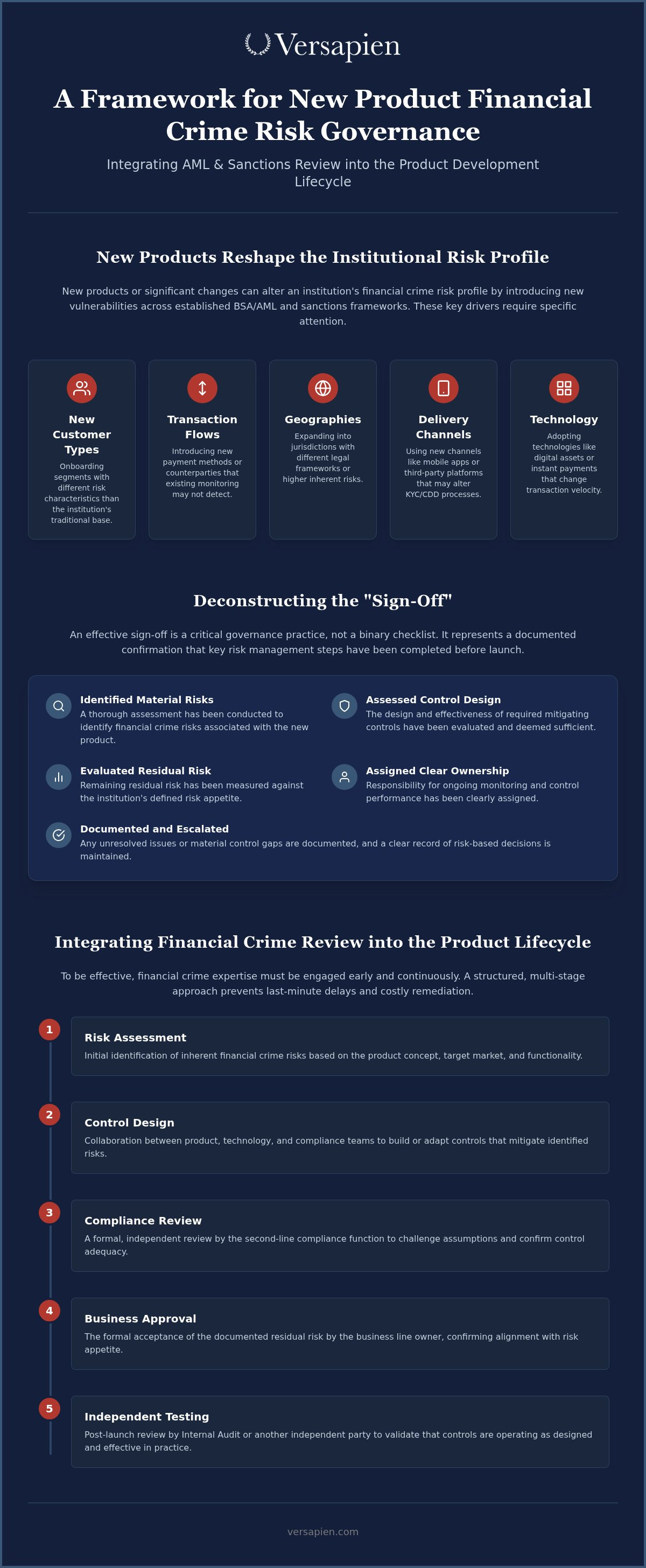
New products or significant changes to existing ones can alter an institution’s financial crime risk profile by introducing new vulnerabilities. Rather than creating a separate regulatory risk category of “product risk,” these changes affect the institution's established BSA/AML and sanctions risk profile. Key drivers include:
New Customer Types: Onboarding customer segments with different risk characteristics than the institution’s traditional base.
Transaction Flows: Introducing new payment methods, counterparties, or settlement mechanisms that existing monitoring systems may not be calibrated to detect.
Geographies: Expanding into new jurisdictions with different legal frameworks or higher corruption, money laundering, or sanctions risks.
Delivery Channels: Utilizing new channels, such as mobile applications or third-party platforms, that may alter KYC/CDD processes or introduce anonymity risks.
Technology: Adopting emerging technologies like digital assets or instant payments that change the velocity and nature of transactions.
What "Sign-Off" Should Mean
The term "sign-off" can be misleading if interpreted as a universal, legally mandated approval. It is better understood as a critical governance practice. A formal financial crime sign-off represents a documented review and confirmation that key risk management steps have been completed before launch. It attests that the institution has:
Identified the material financial crime risks associated with the new product.
Assessed the design and effectiveness of required controls.
Evaluated the remaining residual risk against the institution's risk appetite.
Assigned clear ownership for ongoing monitoring and control performance.
Documented and escalated any unresolved issues or material control gaps.
This process creates a clear record of the risk-based decisions made during development, providing a defensible position during subsequent audits or regulatory examinations.
Integrating Financial Crime Into Product Development
For the review to be effective, financial crime subject matter experts should be engaged early in the product development lifecycle. When compliance input is sought only at the final stage, it can lead to launch delays or the discovery of fundamental design flaws that are costly to remediate. A structured integration distinguishes between key stages:
Risk Assessment: Initial identification of inherent risks based on the product concept.
Control Design: Collaboration between product, technology, and compliance teams to build or adapt controls that mitigate identified risks.
Compliance Review: A formal, independent review by the second-line compliance function to challenge assumptions and confirm control adequacy.
Business Approval: Appropriate management approval and, where applicable, acceptance of residual risk in accordance with the institution’s governance framework.
Independent Testing: Post-launch review by Internal Audit or another independent party to validate that controls are operating as designed.
Identifying Financial Crime Risks Created by the Product
A systematic analysis of a new product’s architecture is essential for identifying its inherent financial crime vulnerabilities. This analysis should deconstruct the product into its component parts to understand how it could be exploited for money laundering, terrorist financing, sanctions evasion, or fraud.
Customer, Product, Channel, Geographic, and Transaction Risks
The assessment should begin by evaluating the traditional pillars of a BSA/AML risk assessment as they apply to the new product. Management should ask targeted questions across these domains:
Customers: Who are the target customers? Do they present a different risk profile than the institution's current base?
Jurisdictions: In which geographies will the product be offered or used? Does this create new cross-border or sanctions-related exposures?
Transaction Types and Velocity: What types of transactions will the product support? What are the expected volumes, values, and speeds of settlement?
Funding and Settlement: How are funds moved into and out of the product? Which payment rails and counterparties are involved?
Delivery Channels: How will customers access the product? Does the channel obscure identity or complicate monitoring?
Use Cases: What are the intended uses of the product? What are the plausible, unintended use cases for illicit activity?
AML Risks and Required Controls
Once the product's risk profile is understood, the next step is to determine whether existing BSA/AML program controls can adequately mitigate those risks. This involves a gap analysis of the current control environment, including Customer Identification Program (CIP) and Customer Due Diligence (CDD) procedures, transaction monitoring systems, and suspicious activity reporting (SAR) processes. The institution should confirm that its systems and procedures can capture the necessary data, apply appropriate logic, and generate meaningful alerts for the new product's specific transaction patterns.
Sanctions Risks and Required Controls
New products can introduce significant sanctions risk, particularly if they involve cross-border payments, new technologies, or non-traditional counterparties. The assessment should evaluate the effectiveness of sanctions screening controls for customers, counterparties, and transactions. It is useful to align this review with the five core components of a risk-based sanctions compliance program identified in OFAC's guidance: management commitment, risk assessment, internal controls, testing/auditing, and training. Key considerations include the ability to screen all relevant parties and payment messages, identify geographic exposures, and escalate potential sanctions concerns effectively.
Third-Party and BaaS Dependencies
In modern financial services, particularly within Banking-as-a-Service (BaaS) arrangements, critical financial crime controls are often performed by external parties. When assessing a new product, it is crucial to identify which controls are performed by the institution versus a fintech partner, payment processor, or other third party. For each dependency, the institution must define its oversight requirements, including the information, monitoring, escalation paths, testing rights, and contractual obligations needed to manage the associated risk. Clear allocation of control ownership is important to effective oversight of fintech-bank partnerships. For more on this, see our guide on obtaining evidence of partner control effectiveness.
A Practical Framework for Pre-Launch Review and Sign-Off
A structured, repeatable process for pre-launch review can promote consistency in assessing new product financial crime risk and documenting related decisions. This five-step framework provides a practical methodology for moving from inherent risk identification to documented sign-off.
Step 1 — Assess Inherent Risk
The first step is to document the financial crime risks the proposed product creates before considering the impact of any mitigating controls. This baseline assessment establishes the inherent risk profile by systematically analyzing the product’s features against known financial crime typologies. It should consider the expected customer base, transaction patterns, geographic reach, delivery channels, and counterparties. The output is a clear articulation of the specific AML, sanctions, and fraud risks the product introduces.
Step 2 — Map Risks to Controls
With a clear view of the inherent risks, the next step is to identify and map the controls designed to mitigate them. This involves evaluating existing controls such as KYC systems, transaction monitoring rules, and sanctions screening lists to determine if they are sufficient for the new product. This analysis should identify any gaps in systems, data availability, staffing, procedures, or third-party performance. Where gaps are found, the institution should determine whether remediation, compensating controls, or other risk responses are appropriate.
Step 3 — Evaluate Residual Risk and Escalate
After accounting for the mitigating effects of proposed controls, the institution can assess the remaining residual risk. This evaluation determines whether the product, with its control environment, falls within the institution's approved risk appetite and tolerance levels. It is critical to establish clear criteria for escalating decisions. Material control gaps, unresolved issues with third parties, or a residual risk profile that exceeds established thresholds should trigger a formal escalation to senior management or a designated risk committee for review and approval.
Step 4 — Document Financial Crime Sign-Off
The sign-off itself is the formal documentation of the review process. It should be more than a simple signature. The documentation should clearly define what the BSA/AML and sanctions reviewers are confirming. A comprehensive sign-off record includes the material risks identified, a summary of the control environment, any identified gaps or weaknesses, key assumptions and dependencies, compensating controls, designated owners, and evidence of necessary approvals. This creates an auditable record of the due diligence performed.
Step 5 — Establish Post-Launch Monitoring
The risk assessment does not end at launch. The final step is to establish a process for post-launch monitoring to validate the assumptions made during the pre-launch review. This involves comparing actual product activity such as transaction volumes, customer demographics, and alert rates against the initial projections. The institution should define specific triggers that would prompt a formal reassessment of the product's risk profile. Triggers could include material changes in transaction patterns, unexpected use in high-risk geographies, or poor performance of a key control.
Governance, Challenge, and Ongoing Oversight
A robust new product approval process is supported by a clear governance structure that defines roles, ensures independent challenge, and provides for ongoing oversight by senior management and the Board.
Roles and Accountability
Effective governance requires clearly defined roles and responsibilities across the three lines of defense. While the specific structure should be tailored to an institution's size, complexity, and risk profile, accountability should be clearly assigned:
First Line (Product/Business Management): Owns the product, is responsible for identifying and managing its risks, and accepts the residual risk.
Second Line (BSA/AML, Sanctions Compliance, Risk Management): Provides independent expertise, sets policy, reviews and challenges the first line's risk assessments, and oversees control effectiveness.
Third Line (Internal Audit): Provides independent assurance through post-launch testing that the governance process and control environment are effective.
Legal and technology departments may also play important advisory and implementation roles depending on the product.
Independent Challenge and Testing
It is important to distinguish between the second line's pre-launch compliance review and the third line's independent testing. The compliance review provides "effective challenge" during the development process. Independent testing, typically performed by Internal Audit, is a required element of a BSA/AML program. As noted in FFIEC guidance, the scope of independent testing should be risk-based and should consider new products and services to validate that controls are working as intended post-launch.
Board and Senior Management Reporting
Reporting to the Board and senior management should be focused and strategic, avoiding operational minutiae. Where new products warrant Board or Board-committee reporting under the institution’s governance framework, reports should focus on material financial crime risks. This can provide leadership with information needed to exercise its applicable governance and oversight responsibilities.
Post-Launch Feedback and Reassessment
The governance framework should include a feedback loop where actual experience informs and refines the risk assessment process. Post-launch monitoring should produce metrics and qualitative insights that are reviewed periodically. This review can confirm that the product is performing as expected or indicate the need for a reassessment. A reassessment may be triggered by predefined thresholds or by material changes in product functionality, customer populations, or the external threat environment, helping keep the risk management framework aligned with the institution’s evolving risk profile.
Executive Takeaways
Integrate Early: Embed financial crime review at the beginning of the product development lifecycle to influence design and prevent costly remediation or launch delays. Treating compliance as a final gatekeeper is inefficient and increases risk.
Define "Sign-Off" as a Governance Practice: Frame the AML/sanctions sign-off not as a regulatory mandate but as a critical internal governance function that documents risk identification, control design, and residual risk acceptance.
Distinguish Inherent from Residual Risk: Structure the risk assessment to first identify a product’s inherent risks before considering controls. This provides a clear baseline to measure control effectiveness and evaluate residual risk against the institution's appetite.
Clarify Third-Party Dependencies: For products involving fintech partners or BaaS arrangements, explicitly map which entity is responsible for each financial crime control and establish the oversight mechanisms required to manage that dependency.
Establish Post-Launch Triggers: The risk assessment is not static. Define specific metrics and qualitative triggers (e.g., unexpected transaction patterns, high alert volumes) that would prompt a formal reassessment of the product’s risk profile after launch.
Focus Board Reporting on Materiality: Ensure reports to senior management and the Board are strategic, focusing on material risks, significant control gaps, policy exceptions, and the rationale for accepting the final residual risk.
How Versapien Can Help
Versapien provides boutique advisory services to help banks, fintechs, and digital asset firms strengthen their new product governance and financial crime risk management frameworks. Led by advisors with senior experience at Big Four consulting firms, we offer practical, implementation-focused guidance. Our services include developing and enhancing new product risk assessment methodologies, assessing the adequacy of AML and sanctions controls for innovative technologies, and preparing organizations for regulatory examinations.


Comments