
OCC Examination Readiness: What Risk and Compliance Leaders Should Prepare
Updated: Sep 22
Table of Contents
Preparing for an OCC Examination: A Framework for Risk and Compliance Leaders
Effective OCC examination readiness is not simply a last-minute effort to assemble documents. It is supported by sound governance, effective risk management, and clear, accessible documentation maintained as part of the institution's normal operations. It is the result of a disciplined, ongoing commitment to sound governance, robust risk management, and clear, accessible documentation. For risk and compliance leaders, preparing for an examination involves demonstrating that the institution’s risk management framework is not merely a set of policies on a shelf but an active, integrated component of daily operations and strategic decision-making.
The objective is to provide examiners with a clear, evidence-based narrative of how the institution identifies, measures, monitors, and controls its key risks. This requires a structured approach that moves beyond periodic reporting and focuses on the fundamental components of a defensible compliance and risk management program. This article outlines a practical framework for OCC examination readiness, focusing on governance, model risk, operational alignment, and remediation oversight.
Foundations of Examination Readiness: Governance, Documentation, and Risk Assessment
An institution’s ability to navigate an OCC examination successfully is directly tied to the quality and organization of its governance framework and supporting evidence. Examiners expect to see a coherent system where policies are implemented, controls are tested, and issues are remediated in a timely manner. Preparation, therefore, begins with ensuring these foundational elements are in place and functioning as intended.
Understanding the Risk Profile and Examination Scope
A critical first step is maintaining a current and comprehensive understanding of the institution’s risk profile. This involves regularly updated enterprise-wide risk assessments that accurately reflect the products, services, customers, and geographies of the business. Management should be prepared to articulate the top risks facing the institution and explain the governance structures in place to manage them. Anticipating the examination scope, whether it is a full-scope safety and soundness exam or a targeted review of areas like BSA/AML, consumer compliance, or IT risk, allows leaders to focus preparatory resources effectively.
Maintaining Accurate and Accessible Documentation
During an examination, the institution should be prepared to provide examiners with accurate, complete, and accessible documentation supporting its risk management and control environment. Examiners will request and review a significant volume of documentation, and the ability to produce it promptly and in an organized fashion demonstrates a well-controlled environment. Key documentation includes:
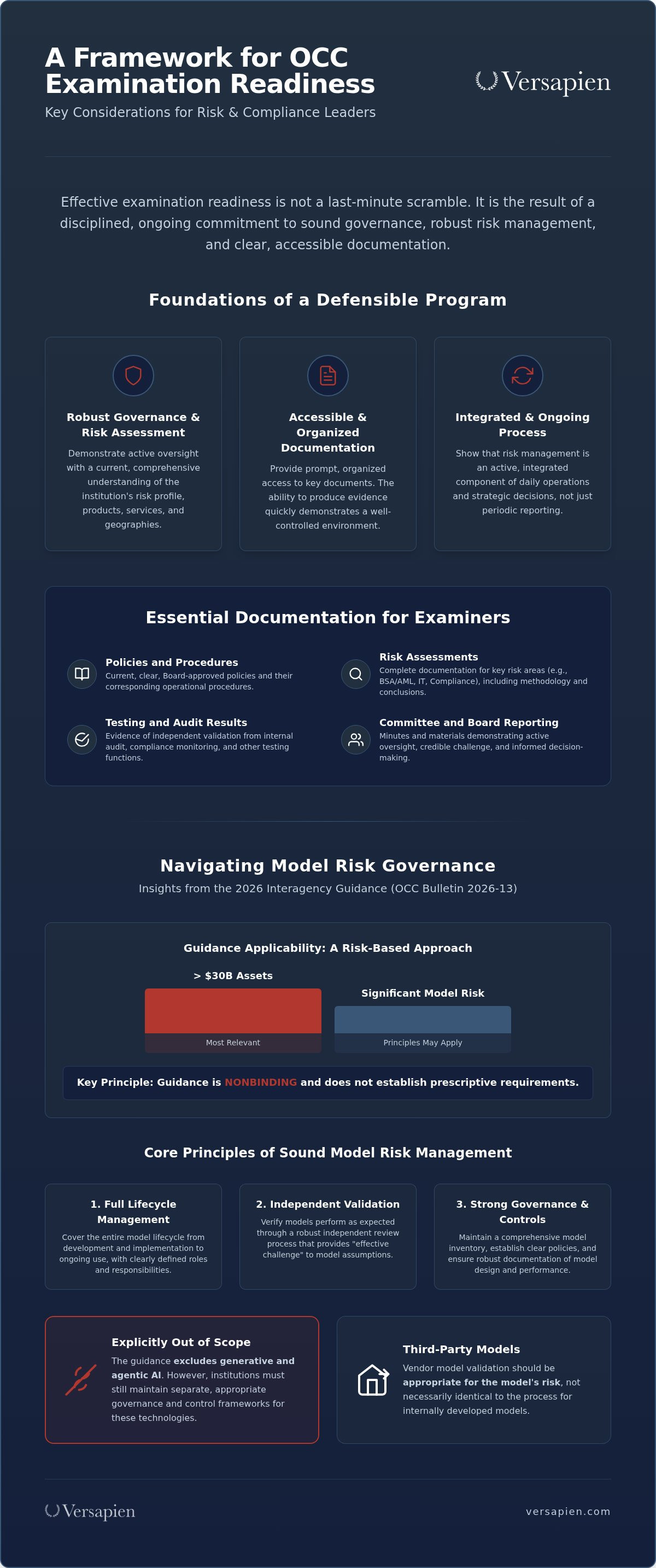
Policies and Procedures: Board-approved policies and the operational procedures that implement them should be current, clear, and readily available.
Risk Assessments: Documentation of risk assessments for key areas (e.g., BSA/AML, compliance, operational risk, IT) should be complete, including the methodology, data sources, and conclusions.
Testing and Audit Results: Records of independent testing, internal audit reviews, and compliance monitoring can provide evidence regarding the design and operating effectiveness of the control environment, as appropriate to the activity and applicable governance framework.
Committee and Board Reporting: Minutes and materials from risk, compliance, and audit committees, as well as the Board of Directors, should demonstrate active oversight and credible challenge.
Organizing this information in a central repository or through a coordinated process before the examination begins can significantly streamline the review process and reduce the burden on business lines during the exam.
Model Risk Governance Under the 2026 Interagency Guidance
In April 2026, the federal banking agencies, including the OCC, issued revised interagency guidance on model risk management (issued by the OCC as Bulletin 2026-13). This guidance, which aligns with the Federal Reserve’s SR 26-2, provides a risk-based framework for banking organizations. For institutions whose model use makes the guidance relevant, understanding its applicability and risk-based principles can be an important consideration in examination preparation.
The guidance is nonbinding and does not establish enforceable or prescriptive requirements. It is intended to be most relevant to banking organizations with more than $30 billion in total assets. However, its principles may also be relevant to smaller organizations with significant exposure to model risk, depending on the complexity of their models and business activities. The OCC states that the guidance is applicable to all community banks, subject to the limitations discussed in the guidance.
Core Principles of Sound Model Risk Management
The 2026 guidance emphasizes a risk-based approach, where the rigor of model risk management practices is proportionate to the institution’s size, complexity, and the extent of its model use. Key components include:
Model Development, Implementation, and Use: The framework should cover the entire lifecycle of a model, from its initial design and data sourcing to its implementation and ongoing use, with clear roles and responsibilities.
Validation and Monitoring: The guidance discusses model validation and monitoring as components of risk-based model risk management. The nature and extent of validation should be commensurate with the institution's model risk profile, model use, and other relevant circumstances. It involves a set of processes and activities intended to verify that models are performing as expected and are appropriate for their intended use. This independent review provides an "effective challenge" to the model’s assumptions and limitations.
Governance and Controls: A strong governance framework includes maintaining a comprehensive model inventory, establishing clear policies, and ensuring robust documentation of model design, assumptions, and performance.
The guidance explicitly excludes generative and agentic AI models from its scope. Institutions using these technologies should nevertheless consider governance and controls appropriate to the nature, use, and risks of those technologies, including applicable safety-and-soundness, technology, data, cybersecurity, compliance, and other risk-management considerations.
Applying a Risk-Based Approach to Third-Party Models
The guidance recognizes that institutions increasingly rely on models developed by third-party vendors. The expectation is not that vendor models are subject to an identical validation process as internally developed ones, but that the validation is appropriate for the model's risk and use. The nature and extent of validation activities may vary based on the circumstances. An institution should perform sufficient analysis to understand the vendor model’s methodology, assumptions, and limitations, and it should not rely solely on vendor-provided information. Proper third-party risk management for fintech and AI vendors is essential to this process.
Aligning Operations with Regulatory Expectations
Examination readiness extends beyond policies and documentation; it requires demonstrating that risk management and compliance are embedded in the institution's operational fabric. This is particularly relevant as banks undergo digital transformation and adopt new technologies. Examiners will look for evidence that innovation is accompanied by commensurate enhancements in governance and controls.
Integrating Compliance into the Product Lifecycle
A robust Compliance Management System (CMS) is a critical element of examination readiness. An effective CMS is not a standalone function but is integrated into business operations, particularly in the development and launch of new products and services. As part of an examination, the institution should be prepared to demonstrate how its Compliance Management System addresses, as appropriate to its size, complexity, products, and risk profile:
Board and management oversight of compliance risk.
Comprehensive policies and procedures.
Ongoing training for relevant personnel.
Monitoring and testing to assess the effectiveness of controls.
A structured process for taking corrective action when deficiencies are identified.
For institutions leveraging technology, this means ensuring that compliance considerations, such as UDAAP and fair lending risks, are addressed during the design and implementation of automated systems, not after they are deployed.
Checklist for Management and Board Alignment
Senior management and the Board play a crucial role in setting the tone for a culture of compliance. Before an examination, leadership should be prepared to answer key questions about the institution's risk and control environment:
Does our Board and management reporting provide a clear and accurate picture of our key risks and the effectiveness of our controls?
Can we readily demonstrate how significant issues identified by internal audit, compliance testing, or prior examinations have been remediated?
Are our strategic initiatives, including digital transformation projects, subject to a formal risk and compliance assessment before implementation?
Is our third-party risk management program sufficiently rigorous, particularly for vendors providing critical services or technologies?
Strategic Remediation and Program Oversight
How an institution responds to previously identified issues is a key indicator of the strength of its governance. A reactive or disorganized approach to remediation can signal underlying weaknesses in management oversight and accountability. A strategic approach, in contrast, demonstrates a commitment to sustainable risk management.
Executing and Tracking Remediation Programs
Effective remediation begins with a clear understanding of the root cause of an issue. Once identified, a formal remediation plan should be developed with specific, measurable, and achievable deliverables assigned to accountable owners. A central tracking mechanism is essential for monitoring progress, identifying potential roadblocks, and ensuring that milestones are met. This structured process provides a clear narrative for examiners on how the institution manages its open issues, from identification through to validation and closure. For a deeper look at this process, explore how to turn past findings into sustainable remediation.
A Practical Framework for Examination Preparation
Institutions can structure their readiness activities around a logical flow that mirrors an examiner’s perspective. This framework helps organize efforts and ensures all critical components of a sound risk management program are addressed:
Risk Profile: Begin with a clear articulation of the institution’s inherent risks based on its business model, products, and strategy.
Governance & Documentation: Map the governance structures, policies, and procedures designed to manage those risks. Ensure documentation is complete and accessible.
Control Effectiveness: Assemble evidence from testing, monitoring, and audits to demonstrate that controls are functioning as intended.
Issues & Remediation: Maintain a comprehensive inventory of open and closed issues, with clear documentation of remediation plans, owners, and validation of closure.
Management/Board Reporting: Collate reporting packages that show how risk information is escalated and used by senior leadership and the Board for oversight and decision-making.
Examination Preparation: Consider conducting a pre-examination readiness assessment or other appropriate preparation activities to identify gaps and prepare key personnel for discussions with examiners.
By following this framework, risk and compliance leaders can build a comprehensive and defensible case that the institution has a sound, well-managed, and effective program for managing its risks.
Executive Takeaways
Focus on Fundamentals: OCC examination readiness is supported by strong corporate governance, current risk assessments, well-documented policies, and evidence that key controls are appropriately designed and operating effectively.
Demonstrate Proactive Oversight: Examiners expect to see a clear line of sight from risk identification to Board-level reporting, demonstrating that leadership is actively engaged in overseeing the institution’s risk profile.
Organize Documentation Before the Exam: The ability to produce requested documents in a timely and organized manner is a key indicator of a well-controlled environment. A proactive approach to document management reduces examination friction.
Understand the 2026 Model Risk Guidance: For institutions with significant model use, understanding the nonbinding, risk-based principles of OCC Bulletin 2026-13 is crucial, particularly its scope, validation concepts, and governance expectations.
Treat Remediation Strategically: A structured, well-documented approach to remediating issues from audits or prior exams demonstrates management’s commitment to addressing deficiencies and strengthening the control environment.
Prepare Management for Engagement: Senior management and subject matter experts should be prepared to clearly articulate the institution's risk appetite, control framework, and the rationale behind key strategic and risk-related decisions.
How Versapien Can Help
Versapien assists financial institutions in preparing for regulatory examinations by providing independent assessments of risk and compliance frameworks. Our services include conducting examination-readiness reviews, evaluating the design and effectiveness of compliance management systems, and supporting the development of structured remediation programs to address outstanding issues. We work with management and Boards to strengthen governance, enhance documentation, and prepare personnel for productive engagement with regulators.


Comments