
OFAC Screening Effectiveness: How Financial Institutions Should Test Name Matching and Sanctions List Updates
Updated: Sep 22
OFAC screening effectiveness cannot be measured by alert volume or false-positive rates alone. A screening system can generate fewer alerts without necessarily improving sanctions risk detection, particularly when matching thresholds, exclusions, data quality, or system changes reduce the likelihood that relevant potential matches are identified.
Effective testing therefore requires financial institutions to look beyond operational efficiency and assess whether their screening processes are functioning as intended. This includes evaluating name-matching logic, identifying information and data quality, sanctions-list updates, system synchronization, tuning and exclusions, and the treatment of potential matches. It also requires considering whether testing methods are appropriately aligned with the institution's sanctions risk profile, products, customers, and transaction activity.
This article examines a practical, risk-based approach to testing OFAC screening effectiveness, with particular attention to name matching, list-update controls, data quality, tuning, testing methodology, and governance. It also addresses how institutions can use testing results to identify weaknesses, strengthen controls, and provide meaningful information to management and the Board.
Table of Contents
Defining OFAC Screening Effectiveness
An effective sanctions screening program reliably identifies potential matches against relevant sanctions lists while aligning with the institution’s defined risk appetite. This definition moves beyond a narrow focus on operational metrics, such as the false-positive rate, and centers on the program's ability to identify and mitigate sanctions risk in a manner appropriate to the institution's risk profile.
Moving Beyond False-Positive Rates
While a high volume of false-positive alerts creates operational strain, a low volume is not an automatic indicator of effectiveness. Overly aggressive tuning to reduce alerts can create significant gaps in detection, allowing true matches to go undetected. Effectiveness is ultimately about identifying potential sanctions risk, not simply minimizing analyst workload. The goal is to find a sustainable equilibrium where the system is sensitive enough to detect potential sanctions concerns without creating an unmanageable operational burden.
Name-Matching Sensitivity and Precision
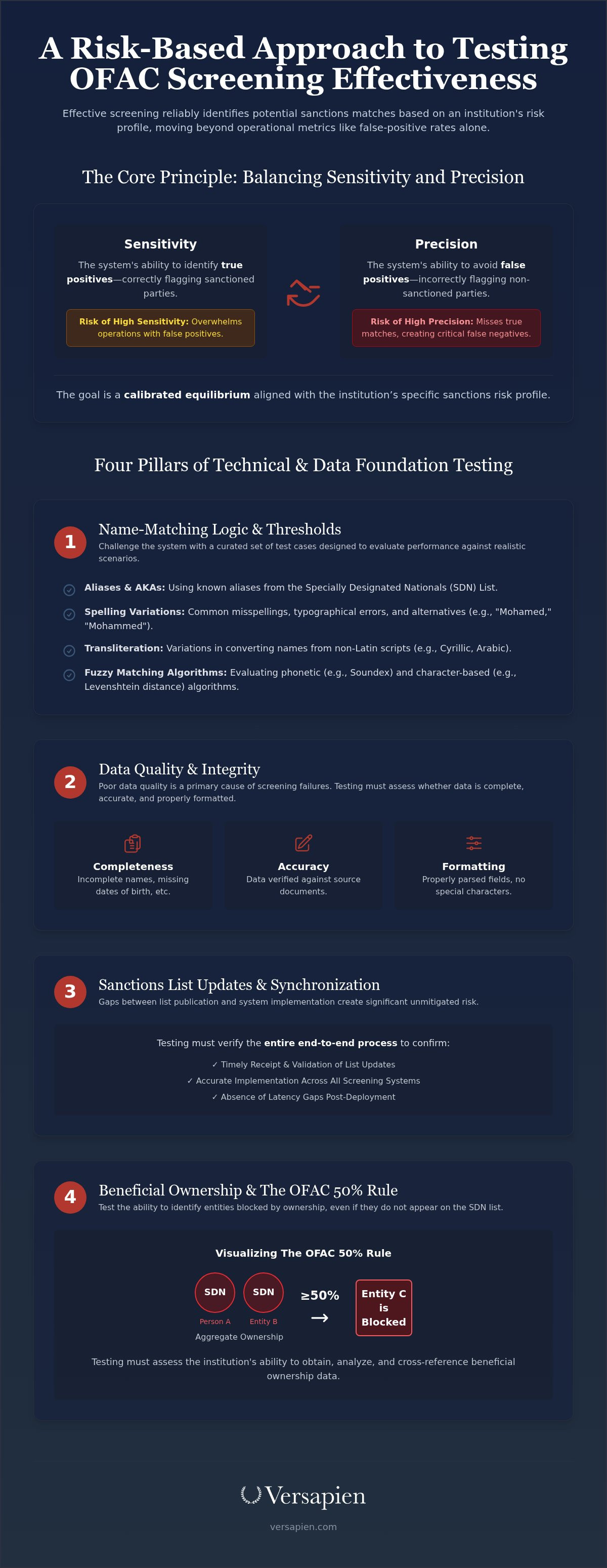
Screening effectiveness depends on the calibrated balance between sensitivity and precision. Sensitivity refers to the system’s ability to identify true positives (correctly identifying a sanctioned party), while precision refers to its ability to avoid false positives (incorrectly flagging a non-sanctioned party). An overly sensitive system may use very loose fuzzy matching logic, generating a high number of alerts that are mostly false positives. Conversely, a system tuned for high precision may use strict matching logic that misses legitimate variations in names, aliases, or transliterations, increasing the risk of false negatives.
Aligning Screening Performance With Risk
There is no universal standard for screening thresholds or false-positive rates. An appropriate calibration depends entirely on the institution’s specific sanctions risk profile. Factors that influence this profile include the institution’s customer base, geographic footprint, products and services, and transaction types. For example, an institution with significant exposure to high-risk jurisdictions or complex international trade finance may accept a higher false-positive rate as a trade-off for more sensitive screening logic. A well-defined risk management framework should document the rationale for these tuning decisions.
Testing the Technical and Data Foundations
The performance of any OFAC screening program rests on its technical configuration and the quality of the data it processes. Flaws in either area can undermine the entire framework, regardless of how well-designed the surrounding governance is. Rigorous testing of these foundational elements is a prerequisite for demonstrating effectiveness.
Name-Matching Logic and Thresholds
Testing name-matching logic involves challenging the system with a curated set of test cases designed to evaluate its performance against realistic scenarios. This testing should go beyond simple name matches and include:
Aliases and AKAs: Using known aliases from the Specially Designated Nationals and Blocked Persons (SDN) List.
Spelling Variations: Common misspellings, typographical errors, and alternative spellings (e.g., "Mohamed," "Mohammed," "Muhamad").
Transliteration: Variations in converting names from non-Latin scripts (e.g., Cyrillic, Arabic) into Latin characters.
Word Order and Initials: Testing scenarios where names are inverted (last name, first name) or include initials.
Fuzzy Matching Algorithms: Evaluating how phonetic (e.g., Soundex) and character-based (e.g., Levenshtein distance) algorithms perform with different name types and at various thresholds.
Data Quality, Transliteration, and Identifying Information
Poor data quality is a primary cause of screening failures. Testing should assess whether customer and transactional data is complete, accurate, and properly formatted. Key areas for review include incomplete names, missing dates of birth, improperly parsed addresses, and the presence of special characters or titles within name fields. Inconsistent data entry practices can create systemic weaknesses that prevent the screening engine from making logical connections, leading to false negatives.
Sanctions List Updates and System Synchronization
OFAC and other authorities update sanctions lists frequently. An effective program includes a timely and accurate process for receiving, validating, and implementing these updates across all relevant screening systems (e.g., customer onboarding, transaction monitoring, wire processing). Testing should verify the end-to-end process, from the point of list receipt to its successful deployment in production environments. This can include assessing whether relevant systems receive and implement updates appropriately and whether any implementation delays could create sanctions risk.
Beneficial Ownership and the OFAC 50 Percent Rule
Identifying entities subject to sanctions under OFAC's 50 Percent Rule presents a distinct challenge that goes beyond standard name matching. The rule states that any entity owned 50 percent or more, in the aggregate, by one or more blocked persons is itself blocked, regardless of whether it appears on the SDN List. Testing the effectiveness of controls around this rule involves assessing the institution’s ability to obtain and analyze beneficial ownership information. Depending on the institution's products, customers, and available information, this may involve analyzing beneficial ownership information in addition to routine name screening. The approach an institution takes may depend on its risk profile and the complexity of its client relationships.
Measuring and Testing Screening Performance
Once the technical foundations are validated, institutions can measure program performance through a structured, risk-based testing methodology. This involves not only reviewing the alerts the system generates but also actively searching for potential weaknesses, gaps, and scenarios the system may have missed.
Risk-Based Testing and Sampling
A risk-based testing approach focuses resources on the areas of highest potential sanctions risk. The testing methodology should use risk-based sampling that prioritizes scenarios related to high-risk jurisdictions, complex ownership structures, products susceptible to sanctions evasion, and customer types identified in the institution's financial crime risk assessment. The sampling logic should be documented to demonstrate to auditors and examiners that the testing program is thoughtfully designed to address the institution's specific risk profile.
Testing Tuning, Exclusions, and “Below-the-Line” Scenarios
Effective testing evaluates not only what the system caught but also what it was configured to ignore. This is often referred to as "below-the-line" testing. It involves analyzing transactions or customer records that did not generate an alert to determine if they should have. This process is essential for validating the appropriateness of suppression rules, exclusion lists (e.g., "good guy" lists), and fuzzy matching thresholds. Where tuning or suppression decisions could create a risk of missed matches, testing scenarios that fall outside the system's alert population can help identify potential gaps.
Measuring Outcomes and Identifying Weaknesses
Institutions can use a variety of metrics to measure performance, but these numbers require context to be meaningful. Key performance indicators (KPIs) can include the true-match rate, false-positive rate, alert aging, and the number of exceptions identified during testing. These metrics are most powerful when analyzed over time and benchmarked against the institution’s risk appetite.
A practical tool for this analysis is a Sanctions Screening Effectiveness Matrix, which helps visualize the relationship between technical configuration and risk outcomes. This framework allows compliance and risk leaders to map detection capabilities against data integrity and tuning sophistication, identifying areas that require remediation or further investment.
Independent Testing and Documentation
An institution’s sanctions compliance program benefits from periodic independent review, conducted by internal audit or a qualified third party. OFAC’s A Framework for OFAC Compliance Commitments identifies testing and auditing as an important component of a sanctions compliance program. The scope of this testing should be appropriate for the institution’s risk profile and program sophistication. Thorough documentation of all testing activities (including the methodology, scope, test scripts, results, and remediation plans for any identified issues) is fundamental to demonstrating program integrity to management, the Board, and regulators.
Governance, Automation, and Management Oversight
A technically sound screening system is only effective if it operates within a robust governance framework. Clear ownership, disciplined change management, and meaningful oversight are necessary to maintain performance and adapt to evolving risks and regulatory expectations.
Change Management and Technology Governance
Clear accountability should be established for managing the screening system, including ownership of the matching logic, tuning thresholds, list updates, and testing processes. Any changes to the system’s configuration, such as adjusting fuzzy logic thresholds or adding new suppression rules, should be subject to a formal change management process. Depending on the nature and risk of the change, this may include pre-implementation testing, impact analysis, documented review, and appropriate approval. For institutions where a screening tool meets the institution's applicable definition of a model, model risk management practices may apply. Where SR 26-2 is applicable, its risk-based principles can inform the nature and rigor of model risk management based on the model's risk, purpose, complexity, and use.
Human Review and Automated Screening
Technology, including artificial intelligence, can significantly enhance the efficiency of the screening process, but it operates within a framework of human oversight. The alert review and disposition process relies on the judgment of trained analysts to investigate potential matches and make informed decisions. The governance framework should define escalation paths, quality assurance procedures, and training programs to support consistent and accurate decision-making by human reviewers.
Management and Board Reporting
Reporting to senior management and the Board should translate technical testing results into meaningful business and risk insights. Instead of focusing solely on operational metrics like alert volumes, reporting should highlight trends in true-match rates, the outcomes of below-the-line testing, the status of remediation efforts, and the overall alignment of screening performance with the institution's risk appetite. This level of reporting enables senior leaders to exercise effective oversight and make strategic decisions about resource allocation and risk management priorities.
Examination and Issue Management
The results of internal testing, independent audits, and regulatory examinations provide critical feedback for program enhancement. A formal issue management process should be in place to track identified weaknesses, assign ownership for remediation, and validate that corrective actions are completed and effective. Proactively identifying and addressing issues through testing can strengthen the sanctions compliance program and better position management to respond to audit and regulatory examination inquiries.
Executive Takeaways
Effectiveness is about risk detection, not alert volume. A low false-positive rate can be a sign of overly permissive tuning that creates significant detection gaps. A key measure of effectiveness is the ability to identify potential sanctions risk in a manner appropriate to the institution's risk profile.
Data quality is the foundation of screening performance. Even the most sophisticated matching algorithms cannot compensate for incomplete, inaccurate, or poorly structured customer and transaction data. Testing data integrity is as important as testing the screening logic itself.
"Below-the-line" testing is essential for identifying hidden gaps. A robust, risk-based testing program can evaluate not only generated alerts but also relevant scenarios that fall outside the alert population because of thresholds, suppression rules, exclusions, or other system logic.
The 50 Percent Rule requires a distinct control process. Relying on name matching alone is insufficient to address the risk of entities owned by blocked persons. Institutions should assess their ability to obtain and analyze beneficial ownership data as a separate control.
Governance translates technical outputs into risk management outcomes. Strong governance, including documented tuning rationale, formal change control, and risk-based reporting, is what makes a screening system defensible to auditors and regulators.
How Versapien Can Help
Versapien helps financial institutions, fintechs, and digital asset firms strengthen their financial crime compliance programs. We provide independent assessments of sanctions screening systems, help develop risk-based testing methodologies, and design governance frameworks that align with institutional risk appetite and support engagement with auditors and regulators. Our senior-led advisory services focus on providing practical, implementation-focused recommendations to enhance program effectiveness and support board-level oversight.


Comments