
Operational Risk Management in an AI-Enabled Financial Institution
Updated: Sep 22
Table of Contents
The Evolution of Operational Risk: Beyond Process Failures to Strategic Resilience
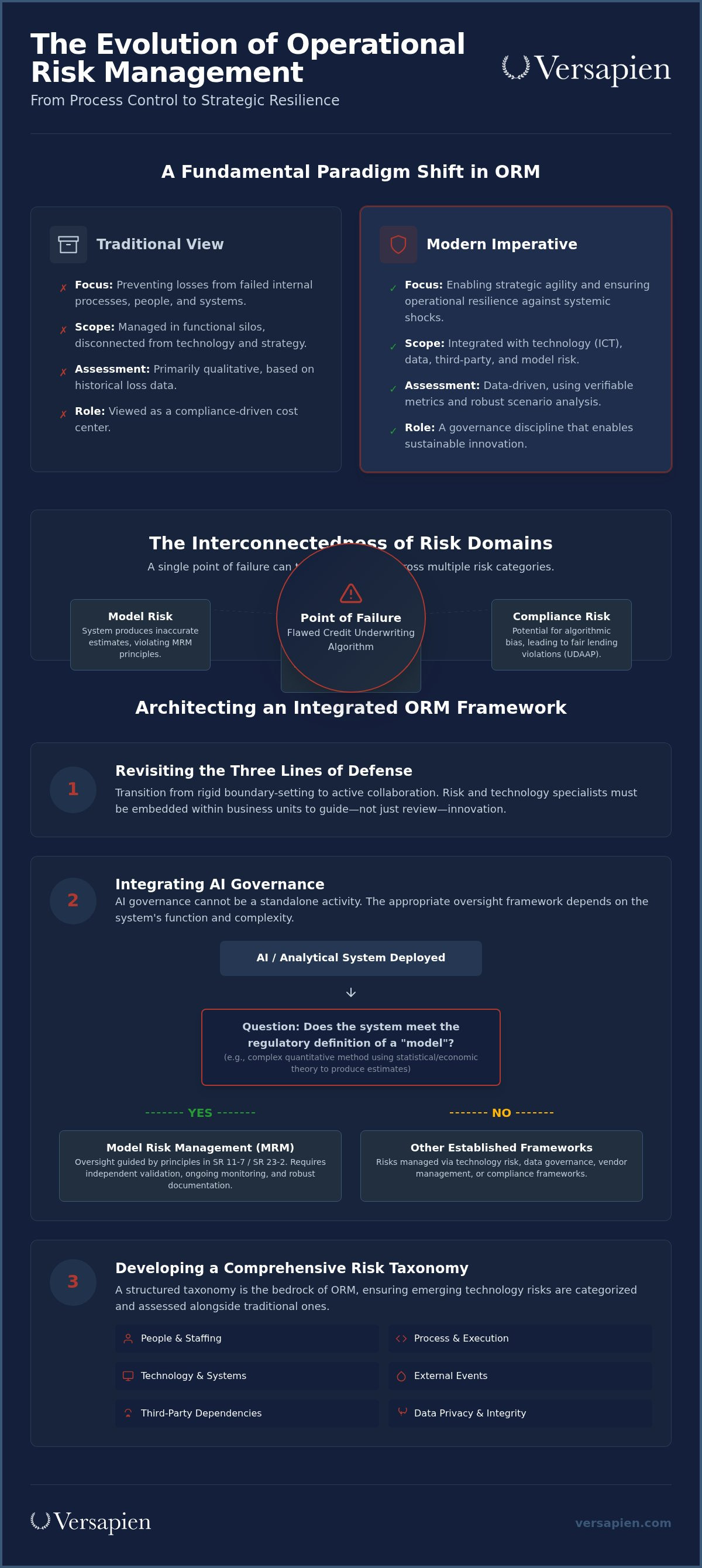
The traditional definition of operational risk (i.e., losses arising from inadequate or failed internal processes, people, and systems, or from external events) remains relevant, but the operational risk environment has become more complex. As financial institutions increasingly rely on advanced analytics, cloud infrastructure, and third-party technology, operational risk is more closely interconnected with technology, cybersecurity, data, third-party, model, and consumer compliance risks. Regulatory and industry frameworks addressing operational risk and operational resilience increasingly emphasize these interdependencies and the need for integrated risk management.
The Interconnectedness of Risk Domains
Operational risk can no longer be managed in a silo. A flawed credit underwriting algorithm, for example, is simultaneously a source of model risk, potential consumer compliance risk (e.g., fair lending), and operational risk. The failure originates in a system, but its impact crosses into the credit domain. Similarly, third-party risk management (TPRM) has emerged as a primary driver of operational volatility. An institution’s operational integrity is now inextricably linked to the security posture, performance, and financial health of its critical third-party vendors, from core processing providers to specialized AI developers.
Architecting an Integrated Operational Risk Framework
A modern ORM framework must be architected for integration, connecting disparate risk functions under a cohesive governance structure. This involves moving beyond legacy models and embracing a more dynamic, collaborative approach that reflects the technological realities of the modern financial institution.
Key pillars of this architecture include:
Revisiting the Three Lines of Defense: The traditional model of the Three Lines of Defense often creates adversarial relationships and slows down innovation. A contemporary approach reframes it from rigid boundary-setting to active collaboration. The first line (business units) must own its operational risks, the second line (risk and compliance) must provide effective challenge and credible advice, and the third line (internal audit) must offer independent assurance on the framework’s effectiveness. In an AI-enabled environment, this means risk and technology specialists must be embedded within business units to guide development, not just review it after the fact.
Integrating AI Governance: Governance of artificial intelligence cannot be a standalone activity. It must be woven into the enterprise-wide operational risk framework. The approach to governing an AI system depends on its nature and use case. For systems that meet the applicable definition of a “model”, typically a complex quantitative method applying statistical or financial theory to produce estimates, the principles of model risk management (MRM) apply. For other analytical systems, governance may fall more directly under technology, data, or compliance risk frameworks.
Developing an Operational Risk Taxonomy: A clear and comprehensive risk taxonomy is the bedrock of an effective ORM program. Firms need a structured way to categorize and assess emerging technology risks alongside traditional process-related risks. A visual decision matrix can be a powerful tool, helping teams map new initiatives (e.g., deploying a new AI tool) against specific risk categories (e.g., data privacy, algorithmic bias, third-party dependency) and control requirements. This ensures that a comprehensive risk assessment, rather than a narrow compliance check, is performed.
Model Risk and AI Oversight
Establishing responsible guardrails for AI requires a nuanced, risk-based approach to oversight that extends beyond a single policy. The central challenge is determining the appropriate governance framework for each system. While the broader ORM program provides the umbrella, specific controls and oversight are dictated by the system's function, complexity, and potential impact.
For AI or analytical systems that meet the revised guidance's definition of a “model” (a complex quantitative method, system, or approach that applies statistical, economic, or financial theories to process input data into quantitative estimates) the principles of model risk management may be relevant. The April 2026 interagency guidance, including SR 26-2, is expected to be most relevant to banking organizations with more than $30 billion in total assets, although it may also be relevant to smaller banking organizations with significant exposure to model risk. The guidance is risk-based and does not establish enforceable standards or prescriptive requirements. Generative and agentic AI models are outside its scope, while deterministic rule-based processes and software without underlying statistical, economic, or financial theories are also excluded.
For AI systems that do not meet the model definition, risks must be managed through other established frameworks. A customer service chatbot, for instance, may pose operational risks related to data privacy and consumer compliance (UDAAP), which would be governed through technology, cybersecurity, and compliance controls rather than a formal MRM structure.
Effective human oversight is a critical control, scaled in intensity and design according to the system's potential impact, complexity, and degree of automation, particularly for high-stakes decisions like credit adjudication. The level of intervention and monitoring should be proportionate to the risk, ensuring that governance enables rather than inhibits responsible innovation.
Operationalizing Risk: From Self-Assessment to Strategic Transparency
An elegant framework is meaningless without effective execution. Operationalizing risk means embedding risk management activities into the daily rhythm of the business, transforming it from a periodic, check-the-box exercise into a source of strategic insight.
The Evolution of the Risk and Control Self-Assessment (RCSA): Traditional RCSAs are often annual, subjective, and backward-looking. Institutions should periodically assess whether their RCSA processes provide timely, meaningful insight into changing risks and control effectiveness. For some organizations, greater use of data and more frequent monitoring may improve the usefulness of the process. By integrating data from internal systems, such as IT incident logs, complaint databases, and transaction monitoring alerts, institutions can replace subjective assessments with objective evidence of control effectiveness.
Key Risk Indicators (KRIs) that Matter: Many institutions focus on lagging indicators of loss, such as historical fraud rates or system downtime. While useful, these metrics only describe past failures. A mature ORM program identifies leading indicators that signal potential weaknesses before a loss event occurs. Examples include a rising rate of policy exceptions, an increase in unresolved internal audit findings, or a spike in manual workarounds for an automated process.
The Challenge of "Risk Culture": A sophisticated governance framework will fail without executive-level accountability and a culture that encourages transparency. When employees are hesitant to escalate potential issues for fear of reprisal, risks fester. This tone is set at the top, requiring clear communication from senior leadership and board-level reporting that frames operational risk not as a series of isolated failures but as a critical component of strategic execution. For practical guidance on third-party oversight, institutions should review best practices for managing AI vendor risk.
Board-Level Reporting and Governance
The Board Risk Committee requires information that connects technical operational risks to strategic business impacts. Instead of presenting a simple list of open audit findings, risk leaders should translate these issues into potential consequences for revenue, reputation, and regulatory standing. Using structured scenario analysis and stress testing can be highly effective. For example, modeling the financial and reputational impact of a prolonged cloud-provider outage helps the board understand the tangible value of investments in resilience and recovery capabilities.
Data Integrity in Risk Reporting
The "garbage in, garbage out" problem plagues many operational loss databases, which are often incomplete or inconsistently populated. This undermines the credibility of risk modeling and reporting. To overcome this, leading institutions are leveraging AI-driven solutions for real-time anomaly detection in their internal control environments. These tools can identify deviations from expected patterns in transactional data or user activity, flagging potential control breakdowns for investigation long before they result in a material loss.
Transitioning ORM from a Cost Center to an Innovation Enabler
When properly implemented, a robust operational risk management framework does not stifle growth; it accelerates it. By creating clear, predictable, and efficient processes for identifying and mitigating risk, ORM can streamline the "approval to launch" process for new fintech products. A well-defined risk appetite and taxonomy allow innovation teams to understand the guardrails from the outset, building controls into their products rather than attempting to retrofit them before launch.
This proactive approach can also strengthen an institution's ability to respond effectively to regulatory examinations, internal audit reviews, and other external oversight. Clear governance, reliable risk information, and disciplined issue management can help organizations demonstrate how they identify, assess, and address operational risks while reducing the need for reactive remediation. Ultimately, risk management should not be viewed as a brake on innovation, but as a mechanism for establishing clear guardrails that support responsible growth.
Executive Takeaways
Senior leadership and board members should consider the following actions to assess and enhance their organization's operational risk management posture:
Conduct a risk-based assessment of the existing ORM framework to determine whether it adequately addresses evolving technology, ICT, third-party, data, and AI-related risks and their interdependencies. Does your current framework adequately address the convergence of ICT risk, third-party dependencies, and AI governance under a single, cohesive structure?
Review the integration of AI and ICT risk into the enterprise-wide risk taxonomy. Are new technology initiatives assessed through a comprehensive risk lens, or are they siloed within IT and business units with limited oversight from the second line?
Evaluate the quality and strategic value of board-level risk reporting. Does reporting translate technical risks into clear business impacts and facilitate strategic decisions on risk appetite and control investment?
How Versapien Can Help
Versapien helps financial institutions strengthen operational risk management frameworks to address the evolving risks associated with technology, AI, third-party dependencies, data, and business transformation. We work with leadership and risk teams to assess existing capabilities, clarify governance and accountability, strengthen risk taxonomies and reporting, improve RCSA and issue management processes, and develop practical roadmaps for implementation.
Our approach is risk-based and execution-focused, helping organizations integrate emerging risks into existing enterprise risk management frameworks without creating unnecessary complexity or bureaucracy. From ORM framework assessments and governance design to AI and third-party risk integration, Versapien helps financial institutions build more resilient and scalable risk management capabilities.



Comments