
Regulatory Exam Readiness: Turning Past Findings Into Sustainable Remediation
Updated: Sep 22
Financial institutions often treat regulatory examinations as cyclical emergencies, triggering resource-intensive “fire drills” to assemble documentation and prepare for supervisory review. This reactive posture, however, frequently fails to address the underlying issues that attract regulatory scrutiny in the first place. Past examination findings, internal audit issues, and Matters Requiring Attention (MRAs) should not be viewed simply as isolated events to be resolved. They can provide important insights into potential weaknesses in governance, risk management, and internal controls.
A more durable approach to regulatory exam readiness involves transitioning from a project-based mindset to a state of continuous governance. This requires a disciplined process for turning past findings into sustainable remediation—one that focuses on identifying and correcting root causes rather than surface-level symptoms. For senior management and the Board, this transforms compliance from a defensive necessity into a strategic function that validates the integrity of the institution’s operating model.
Table of Contents
Systemic Friction: Why Traditional Regulatory Exam Readiness Fails
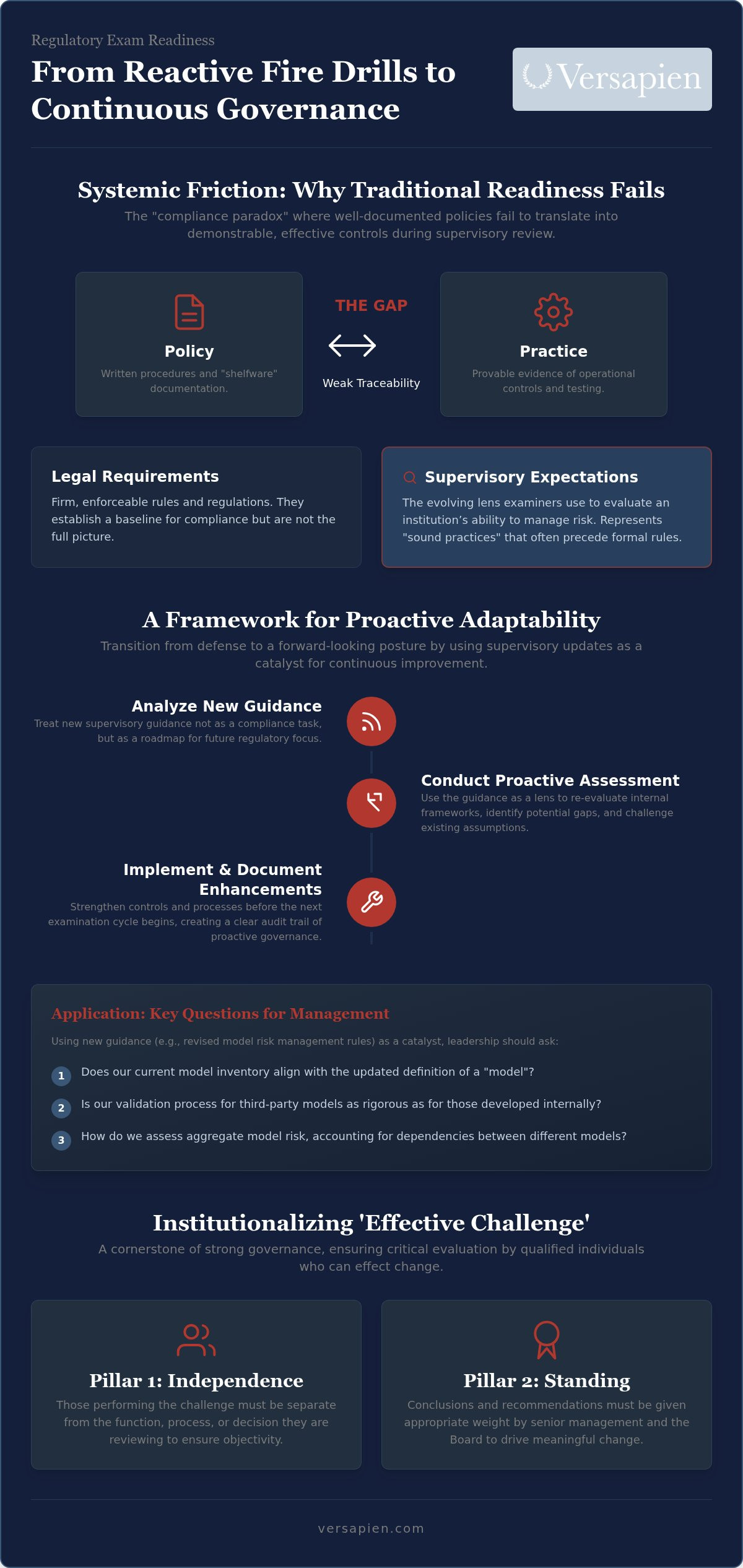
Many organizations experience a “compliance paradox” where well-documented policies and procedures fail to translate into demonstrable evidence of effective operational controls. This gap between policy and practice creates significant risk during a deep-dive examination, as examiners may assess whether an institution can demonstrate traceability and the ability to connect applicable requirements, policies, and procedures to corresponding controls, testing, and performance reporting. When policies exist only as “shelfware,” they offer little defense against supervisory criticism.
The cost of this reactive approach extends beyond a negative examination report. It diverts critical resources from strategic initiatives, contributes to employee burnout, and can introduce reputational friction with regulators. The alternative is to embed readiness into the institution’s governance fabric, aligning day-to-day business execution with a clear understanding of supervisory expectations. This requires moving beyond simply meeting the letter of the law and embracing the sound practices examiners use as a lens to evaluate institutional safety and soundness.
The Gap Between Policy and Practice
A common weakness in compliance management systems is the disconnect between what an institution says it does and what it can demonstrate through operational evidence. During an examination, regulators test this connection by selecting transactions, reviewing customer complaints, or assessing control-testing results. If operational evidence is weak, inconsistent, or contradicts written policies, the entire governance framework may be called into question. Establishing clear traceability from a regulatory requirement to its execution and monitoring is fundamental to demonstrating effective management.
Supervisory Expectations vs. Legal Requirements
It is essential for management to distinguish between enforceable laws and the broader “sound practices” expected by examiners. While laws and regulations establish enforceable requirements, supervisory guidance and other supervisory expectations may inform how examiners assess an institution's risk management, governance, and control environment. These expectations often evolve more quickly than formal regulations, requiring institutions to maintain a governance framework that is both compliant and adaptable. For example, as new technologies are adopted, supervisors will expect risk and control frameworks to evolve accordingly, even before specific rules are issued.
Responding to Evolving Supervisory Guidance: A Framework for Adaptability
A key component of continuous readiness is the ability to analyze and integrate evolving supervisory guidance into the institution’s governance framework. New guidance often signals a shift in regulatory focus and provides a roadmap for how examiners will assess risk in a particular area. A proactive institution uses these updates to re-evaluate its own practices, identify potential gaps, and implement necessary enhancements before its next examination cycle.
For example, the revised interagency guidance on model risk management issued in April 2026 illustrates this dynamic. The guidance, which supersedes SR 11-7 and SR 21-8, is expected to be most relevant to banking organizations with over $30 billion in assets, though it may also apply to smaller institutions with significant model risk exposure. It is important to note that this guidance is advisory and non-binding; it does not establish enforceable standards, and non-compliance alone does not result in supervisory criticism. However, it provides a clear articulation of modern supervisory expectations for sound model risk management.
A prepared institution would not simply file this guidance away. Instead, it would use it as a catalyst to review its own model risk framework, asking critical questions:
Does our current model inventory align with the updated definition of a “model,” which focuses on methods applying statistical, economic, or financial theory?
Is our validation process for third-party models as rigorous as it is for those developed internally?
How do we assess aggregate model risk, accounting for dependencies and interactions between different models?
This process of proactive assessment, driven by new guidance, allows an institution to strengthen its framework and demonstrate to examiners that it maintains a forward-looking approach to risk management. This same disciplined approach can be applied to any emerging area of supervisory focus, from third-party risk management for fintech vendors to digital asset compliance.
Institutionalizing ‘Effective Challenge’: A Framework for Readiness
An important component of many risk management and governance frameworks is the concept of “effective challenge.” This is the critical evaluation of processes, decisions, and outcomes by independent, qualified individuals who have the standing to effect change. It is not a check-the-box exercise but an active, ongoing dialogue that helps identify weaknesses, question assumptions, and prevent complacency. Effective challenge generally depends on appropriate independence, relevant expertise, and sufficient organizational standing: those performing the challenge must be separate from the function they are reviewing, and their conclusions must be given appropriate weight by senior management.
Internal audit plays a key role in this ecosystem by evaluating the rigor and effectiveness of the institution’s risk management and compliance practices, including the challenge functions within the first and second lines of defense. To be effective, internal audit must remain independent and avoid duplicating risk-management activities, focusing instead on providing objective assurance to the Board.
The Regulatory Readiness Maturity Framework
Institutions can assess their readiness by plotting their current state on a maturity spectrum. This structured approach helps identify specific areas for improvement and provides a roadmap for advancing governance capabilities.
Reactive: The institution prepares for exams in an ad-hoc, project-based manner. Remediation focuses on fixing specific findings without addressing root causes, leading to recurring issues.
Defined: Policies, procedures, and controls are documented, but their implementation is inconsistent. Readiness is a recognized goal, but ownership is siloed and cross-functional collaboration is limited.
Integrated: Governance is embedded into business-as-usual activities. Risk and compliance functions work collaboratively, and there is a clear process for identifying, escalating, and remediating issues. The institution uses a structured framework for validating new technologies and models before implementation.
Optimized: The institution uses data analytics and forward-looking metrics to anticipate potential issues before they materialize. Lessons learned from remediation activities are systematically fed back into the governance framework to drive continuous improvement. Readiness is viewed as a strategic advantage that enables responsible innovation.
Executive Oversight: From Remediation to Sustainable Governance
Achieving this requires a structured remediation lifecycle that moves beyond tactical fixes. This process should be governed with the same rigor as any other critical business initiative and includes several key stages:
Root-Cause Analysis: Moving beyond the immediate finding to understand the breakdown in people, processes, or technology that allowed the issue to occur.
Ownership and Accountability: Assigning a clear owner for the remediation plan who is responsible for its successful and timely execution.
Comprehensive Remediation Plans: Developing detailed plans with credible milestones, resource requirements, and success metrics.
Control Redesign and Implementation: Designing and implementing new or enhanced controls that directly address the identified root cause. This must include evidence of implementation, such as updated procedures, training records, or system configuration changes.
Independent Validation: Having an appropriately independent function validate that the remediation was implemented as intended and that the relevant controls are operating effectively. Internal audit may provide independent assurance regarding the effectiveness of the overall remediation and issue management framework, consistent with its role and independence requirements.
Sustainability Testing: After a period of time, re-testing the new controls to ensure they remain effective and have not degraded.
Management and Board Reporting: Providing transparent reporting on the status of remediation efforts, including any delays or challenges.
When executed properly, this process transforms remediation from a reactive burden into a strategic opportunity. By correcting foundational weaknesses, institutions can improve business performance, reduce operational risk, and build a more resilient governance framework that is prepared for future regulatory examinations.
Executive Takeaways
Shift from Project to Process: Treat regulatory exam readiness as a continuous state of governance, not a cyclical project. Embed readiness activities into business-as-usual operations.
Use Findings as a Diagnostic Tool: Analyze past examination findings, MRAs, and internal audit issues to identify systemic root causes related to governance, controls, or culture.
Embrace a Structured Remediation Lifecycle: Implement a formal process for remediation that includes root-cause analysis, clear ownership, independent validation, and sustainability testing to ensure fixes are durable.
Distinguish Between Rules and Expectations: Understand that examiners evaluate institutions based on both enforceable regulations and broader supervisory expectations for sound risk management. Proactively adapt to evolving guidance.
Foster ‘Effective Challenge’: Ensure that appropriately independent and qualified personnel have the authority and standing to critically evaluate risk-taking, significant decisions, and control effectiveness, consistent with the institution's governance model and lines of responsibility.
Demand Traceability: Require clear, demonstrable evidence that connects written policies to operational execution. Examiners will test this link, and a breakdown can undermine confidence in the entire compliance management system.
How Versapien Can Help
Versapien is a senior-led boutique advisory firm that helps financial institutions build and maintain a state of continuous regulatory exam readiness. Our team, which has extensive Big-Four consulting and industry experience, works with Boards and senior management to assess regulatory findings, conduct credible root-cause analysis, and strengthen remediation governance. We help clients design and implement durable corrective actions, validate their effectiveness and sustainability, and integrate lessons learned into their enterprise risk and compliance frameworks to reduce supervisory friction and support long-term growth.


Comments