
Regulatory Issue Closure: How to Prove a Remediated Issue Is Actually Sustainable
Financial institutions frequently dedicate substantial capital, executive attention, and operational effort to remediating supervisory findings, only to encounter skepticism when presenting their completed work to regulators. This friction typically does not stem from bad faith or lack of effort. Rather, it arises from a fundamental misalignment between project execution and supervisory expectations: managing a remediation plan to project completion is fundamentally different from proving that a corrective action has resolved the underlying deficiency and will remain durable over time.
When supervisory agencies, such as the Office of the Comptroller of the Currency (OCC), the Federal Reserve Board, the Federal Deposit Insurance Corporation (FDIC), or the Consumer Financial Protection Bureau (CFPB), issue examination findings, they focus on the breakdown of governance, risk management, or operational controls. Consequently, supervisory teams evaluate closures not by reviewing a checklist of completed project tasks, but by assessing whether the institution has eliminated the root cause and established sustainable operating controls. Achieving a defensible regulatory issue closure validation requires an evidence-based approach that demonstrates both the design adequacy and the operational durability of the remediated process before supervisory re-examination.
Table of Contents
Defining Sustainable Regulatory Issue Closure
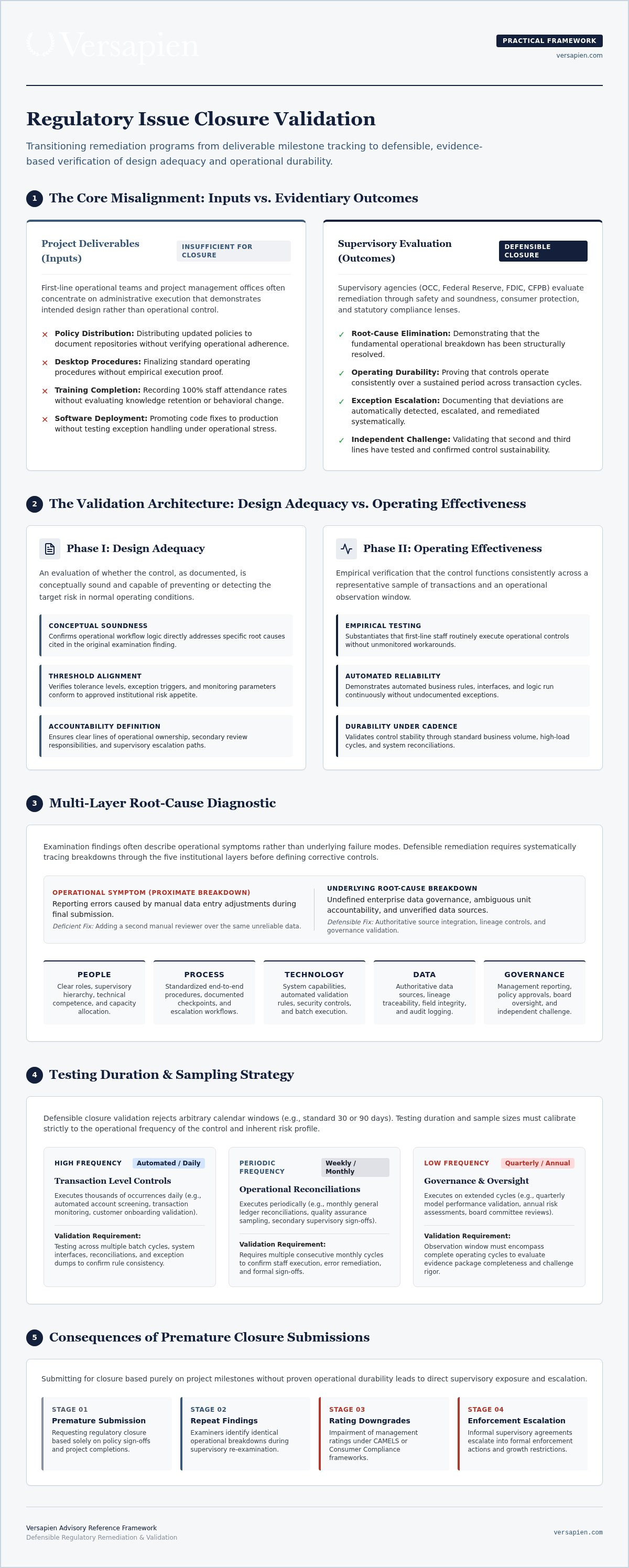
A recurring challenge in supervisory remediation is the tendency to conflate milestone completion with control effectiveness. First-line operational teams and project management offices typically structure remediation efforts around deliverable roadmaps: updating policies, drafting desktop procedures, delivering staff training, or deploying software enhancements. While these milestones are necessary interim steps, they represent inputs rather than outcomes. A revised policy demonstrates an intended change in operational design; it does not demonstrate that personnel consistently follow the policy, that exceptions are identified and escalated, or that the control functions effectively during periods of operational stress.
Supervisory agencies evaluate remediation through the lens of safety and soundness, consumer protection, and statutory compliance. For example, agency-specific supervisory guidance, such as the OCC and FDIC frameworks governing Matters Requiring Attention (MRAs), defines supervisory findings in the context of deficient risk management, noncompliance with laws or regulations, or practices that could develop into unsafe or unsound conditions if left unaddressed. These agency issuances outline expectations for corrective action plans, but they do not serve as a universal, prescriptive checklist for closure validation. Instead, supervisory teams determine the depth and rigor of their closure reviews based on the severity of the deficiency, the institution's overall risk profile, and the nature of the control environment.
Premature closure can create additional supervisory concern if follow-up testing identifies that the underlying deficiency has not been adequately addressed. Repeat findings may receive heightened supervisory attention, particularly when they reflect ineffective remediation, insufficient management responsiveness, or material deficiencies.
Sustainable closure requires institutions to differentiate between design adequacy and operating effectiveness:
Design Adequacy: An assessment of whether the control, as documented in policies, technical architectures, and operating procedures, is conceptually sound and capable of preventing or detecting the target risk. This review confirms that responsibilities are defined, thresholds are aligned with risk tolerance, and workflow logic addresses the specific root causes cited in the original examination finding.
Operating Effectiveness: Empirical verification that the control functions as designed across a meaningful volume of transactions and over an operational period sufficient to demonstrate consistency. Operating effectiveness requires proof that staff execute controls as intended, technical automations run without unmonitored exceptions, and supervisory review occurs systematically.
Documentation alone cannot substantiate operating effectiveness. An updated policy that sits in a document repository without operational implementation provides zero evidentiary value during closure validation. Sustainable remediation requires objective proof that the process operates correctly in the routine cadence of business.
Building an Evidence-Based Closure Framework
To establish a defensible validation record, institutions must move beyond task tracking and implement an evidence-based closure methodology. This methodology begins with rigorous root-cause analysis. Examination findings often describe the operational symptom of a failure, such as inaccurate adverse action notices, delayed secondary reviews, or incomplete customer due diligence profiles. If remediation targets only the symptom, the underlying breakdown remains unaddressed.
For example, if an institution experiences errors in regulatory reporting, the proximate cause may be manual data entry by first-line staff. However, the root cause may involve undefined data governance, lack of authoritative data sources, ambiguous accountability between business units, or inadequate second-line monitoring. A remediated control that merely adds a second manual review over the same unreliable data source does not resolve the design defect. Thorough risk management requires tracing the breakdown through people, process, technology, data, and governance layers before defining corrective controls.
Once corrective controls are established, validation teams must structure testing to verify operational sustainability. Rather than relying on arbitrary, rigid calendar rules, such as standard 30-day or 90-day assumptions, testing duration and sampling strategies should reflect the operational frequency of the control and the inherent risk of the underlying activity. A high-frequency, automated control executing thousands of transactions daily may generate sufficient evidence within a shorter operational window, provided it is tested across multiple batch cycles and system reconciliations. Conversely, a low-frequency control, such as a quarterly model performance review or an annual risk assessment, requires an observation window that encompasses complete operating cycles.
Institutions must also test controls under variable operational conditions. Evaluating a control only during calm periods with low transaction volumes and full staffing can produce misleading results. Robust validation evaluates how the control performs during volume surges, staff turnover, manual system workarounds, and operational edge cases. If a control fails or experiences unauthorized overrides when transaction queues spike, the remediation is not yet sustainable.
The following pre-submission validation matrix outlines the evidentiary distinctions between design adequacy and operating effectiveness across critical operational dimensions.
Pre-Submission Regulatory Issue Closure Validation Matrix
When packaging closure documentation, institutions must maintain a clear, auditable evidentiary chain. Documentation must allow an independent reviewer or bank examiner to trace a transaction from its inception through the control execution, exception identification, and final supervisory resolution without relying on unrecorded verbal explanations.
Governance, Independent Challenge, and Regulatory Validation
A defensible validation process relies on independent, objective evaluation across the lines of defense. While operational structures vary by institution size and charter type, governance frameworks generally distinguish between those who execute remediation and those who assess its effectiveness.
The first line of defense owns the underlying risk and operational processes. Operational managers are responsible for identifying root causes, designing the remediation plan, implementing controls, and establishing internal quality control mechanisms to verify that the new process functions day to day. However, because first-line teams face project delivery deadlines and operational resource constraints, self-assessments alone lack the objectivity required to substantiate sustainable closure to regulators.
The second line of defense, typically encompassing independent compliance and operational risk management, provides credible challenge to the remediation design and its ongoing execution. Second-line professionals evaluate whether the proposed corrective actions align with regulatory expectations, industry practices, and the institution's enterprise risk appetite. They review the adequacy of policy revisions, challenge testing methodologies, and assess whether performance metrics accurately capture emerging risk. Institutions often incorporate structured regulatory compliance consulting to support second-line teams in stress-testing closure readiness and identifying control blind spots before regulatory submission.
The third line of defense, internal audit, provides independent assurance to the Board of Directors and the Audit Committee. For major supervisory findings, such as formal enforcement actions or severe MRAs, regulatory agencies often expect internal audit to conduct an independent validation of the remediation before the institution submits a formal request for supervisory closure. However, internal audit validation is not universally mandated by law as the sole closure mechanism for every operational deficiency or low-risk supervisory recommendation. The level of required independent assurance is risk-based, scaling with the severity of the original finding and the complexity of the remediated environment.
Before submitting a formal closure request to supervisory authorities, senior leadership, including the Chief Risk Officer, Chief Compliance Officer, and relevant executive committees, should conduct a formal challenge session. Executive decision-makers should evaluate the following questions:
Has testing confirmed that the root causes of the issue—including organizational, technical, and governance factors—have been fully resolved, rather than merely treating the symptoms identified in the examination report?
Were the sample populations and testing windows selected based on the control's operating frequency, transaction volume, and risk profile, rather than an arbitrary calendar deadline?
Did validation testing identify exceptions or control failures, and if so, were those exceptions thoroughly investigated, traced to root causes, and re-tested to confirm resolution?
Has the remediated process operated under normal and peak transaction volumes without relying on extraordinary, non-scalable manual interventions by project teams?
Are ongoing monitoring metrics, key risk indicators, and managerial escalation pathways fully operational within the business line to prevent remediation drift?
If executive management cannot answer these inquiries with verifiable evidence, management should consider whether additional testing, documentation, or remediation is appropriate before requesting closure. Postponing submission to allow for extended operational testing is far preferable to presenting an incomplete remediation that fails supervisory scrutiny.
Sustaining Remediation After Closure
The validation of an issue and its subsequent acceptance by supervisory authorities marks the conclusion of the remediation project, but it represents the beginning of the control's life in the ongoing governance framework. The most critical operational risk following closure is "remediation drift", which is the gradual deterioration of control discipline as project oversight winds down, dedicated project budgets expire, and operational focus shifts to new commercial priorities.
This generally involves integrating the remediated controls into the institution's applicable compliance, risk management, and business-as-usual processes. Where appropriate, control execution should become part of the first line's routine supervisory procedures, operating tools, and management oversight.
Second-line compliance monitoring and operational risk testing programs should consider whether the newly remediated controls warrant incorporation into ongoing monitoring or testing based on their risk and governance frameworks. Aligning post-closure monitoring with comprehensive regulatory exam readiness ensures that control testing does not lapse once examiners complete their initial review. Ongoing surveillance should focus on leading indicators that signal operational distress before a complete control failure occurs. Useful early-warning indicators include:
Exception Volume and Override Spikes: An increase in the frequency of operational exceptions, manual overrides, or secondary approval requests suggests that the underlying business process may have changed or that staff are encountering friction with control requirements.
Processing Backlogs and Turnaround Times: Expanding queues or delayed processing times within operational workflows often indicate that control execution is constrained by transaction volume or insufficient staffing.
Operational and Personnel Turnover: High attrition among personnel responsible for executing or reviewing the control introduces operational risk, particularly if onboarding and training programs do not adequately cover the remediated procedures.
Upstream System and Policy Modifications: Technology releases, core banking system patches, or changes to customer-facing digital applications can inadvertently disrupt automated control feeds, validation rules, or reconciliation logic.
Institutions must establish explicit re-escalation triggers. If routine monitoring detects an adverse trend in control effectiveness, the business line should not wait for an internal audit cycle or the next regulatory examination to address it. A defined governance protocol should establish appropriate escalation thresholds for material control degradation, with escalation to relevant management or risk governance forums as warranted.
By establishing rigorous root-cause remediation, disciplined testing methodologies across the lines of defense, and proactive post-closure monitoring, financial institutions can demonstrate to regulatory examiners that their controls are not merely theoretically sound, but sustainably effective.
Executive Takeaways
Distinguish Milestones from Operational Effectiveness: Completing project tasks, such as publishing policies, configuring tools, or conducting training, does not prove remediation sustainability. Regulatory closure validation requires empirical evidence that the control functions consistently during live operations.
Structure Testing Based on Risk and Frequency: Avoid rigid calendar assumptions. Determine validation sample sizes and observation windows based on control frequency, transaction volume, and operational complexity, ensuring controls are evaluated under both normal conditions and periods of operational stress.
Delineate Responsibilities Across the Lines of Defense: First-line teams own the remediation and day-to-day execution, second-line risk management provides critical challenge and policy alignment, and internal audit provides independent assurance commensurate with the severity of the issue.
Investigate and Document Material Testing Exceptions: A defensible validation package documents the testing methodology, sample selection, relevant exceptions, root-cause analysis where appropriate, and the results of re-testing or corrective action.
Establish Ongoing BAU Controls to Prevent Drift: Once supervisory closure is achieved, transition the control from project status into routine compliance monitoring, implement early-warning indicators for operational stress, and define clear governance triggers for re-escalation.
How Versapien Can Help
Versapien is a boutique advisory firm that assists regional banks, fintechs, mortgage lenders, and consumer financial services companies with complex regulatory compliance and risk management challenges. Our team, led by senior professionals with extensive Big Four consulting experience, provides strategic support across regulatory examination readiness, remediation management, and governance frameworks.
We work collaboratively with Chief Risk Officers, Chief Compliance Officers, Chief Audit Executives, and Board Risk Committees to conduct independent pre-submission validation reviews, perform rigorous root-cause analyses, and evaluate whether remediation artifacts substantiate design adequacy and operational effectiveness. By applying disciplined testing methodologies and practical implementation models, Versapien helps financial institutions strengthen their internal control environments, enhance governance transparency, and navigate supervisory interactions with clarity and confidence.


Comments