
Risk Appetite Calibration: Turning Board-Approved Risk Appetite Into Actionable Management Limits
Executive leadership teams and boards of directors frequently encounter a fundamental operational disconnect: the risk appetite approved in the boardroom bears little practical resemblance to the daily transactional decisions executed across business lines. Boards routinely approve qualitative declarations expressing an aversion to excessive volatility or an intolerance for compliance breakdowns. However, translating those broad intentions into calibrated operational boundaries, actionable indicators, and enforceable delegations of authority remains a persistent challenge for financial institutions.
A formal risk appetite framework articulates the aggregate risk an institution is willing to assume within its risk capacity. When properly designed, it functions as an operational bridge between high-level strategic objectives and ground-level exposure management. Rather than serving as an inert regulatory artifact, an effective framework establishes concrete boundary conditions across both financial exposures, such as credit concentration and liquidity vulnerability, and non-financial domains, including operational resilience, third-party reliance, and regulatory compliance.
Bridging this divide requires calibrating measurable management limits, designing informative key risk indicators, and embedding clear escalation protocols directly into business workflows. Doing so enables organizations to protect capital and liquidity reserves while providing frontline managers with unambiguous operational boundaries.
Table of Contents
From Board Risk Appetite to Management Limits: Core Architecture
Constructing a functional risk appetite framework requires conceptual precision regarding the foundational terms of Enterprise Risk Management. In many institutions, confusion arises when capacity, appetite, tolerance, and limits are treated as interchangeable synonyms. Blurring these distinctions obscures accountability and impedes effective governance.
A sound risk architecture aligns with established supervisory expectations, such as the principles published by the Financial Stability Board and domestic banking agencies, while remaining proportionate to an institution’s asset size, operational complexity, and business model. A framework designed for a multijurisdictional banking organization will necessarily incorporate different structural complexities than one built for a mid-tier regional bank, consumer lender, or fintech entity.
Deconstructing Capacity, Appetite, Tolerance, and Limits
The hierarchy of risk governance extends from existential financial boundaries down to granular transactional parameters:
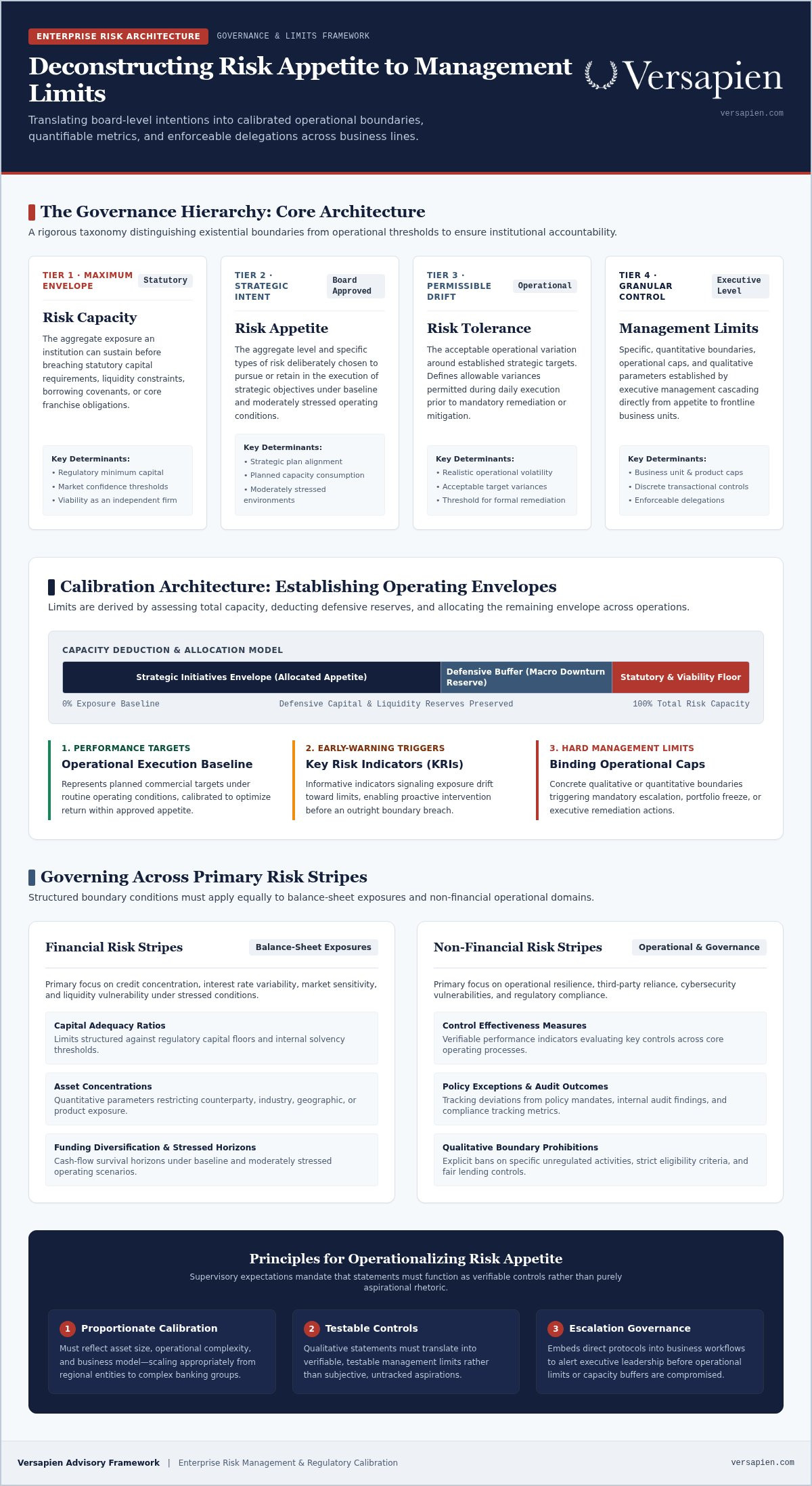
Risk Capacity: The aggregate level of risk an institution can absorb, given its available financial, operational, and other resources and applicable constraints, before its ability to achieve its objectives or maintain safe and sound operations would be materially impaired. Capacity is not determined solely by the boundary of accounting insolvency; it encompasses regulatory minimums, market confidence thresholds, and operational constraints that, if breached, would threaten an institution's ongoing viability as an independent business.
Risk Appetite: The aggregate level and specific types of risk that an institution deliberately chooses to pursue or retain in the execution of its strategic objectives. Approved by the board, appetite reflects the level and types of risk the institution is willing to assume in pursuit of its strategic objectives, consistent with applicable constraints and the institution's risk-management capacity.
Risk Tolerance: The acceptable operational variation around established strategic targets. Tolerance recognizes that practical operations cannot always run precisely at baseline targets. It defines the acceptable variance an organization permits itself while executing daily operations, prior to requiring formal remediation or risk-mitigation measures.
Management Limits: Specific, quantitative boundaries, operational caps, and qualitative parameters established by executive management to control discrete exposures. Limits cascade directly from board-level appetite to individual portfolios, business units, products, legal entities, and operational processes.
Categorizing Primary Risk Stripes Across Financial and Non-Financial Domains
An enterprise framework addresses all material risk stripes, establishing measurable governance for both balance-sheet and non-financial domains. Historically, financial institutions calibrated quantitative boundaries almost exclusively for balance-sheet exposures, leaving operational, compliance, and strategic risks relegated to subjective narrative statements. Non-financial exposures can also be governed through structured boundary conditions, using quantitative measures where appropriate and qualitative criteria where they provide a more meaningful basis for risk oversight.
For financial risks—such as credit, interest rate, market, and liquidity exposures—appetite is typically calibrated against capital adequacy ratios, asset concentrations, funding diversification, and cash-flow horizons under stressed conditions. In contrast, operational and compliance risks involve different governance mechanics. An institution cannot easily calculate a balance-sheet limit for fair lending compliance or cybersecurity vulnerabilities; instead, it establishes structural boundaries using verifiable performance metrics, control effectiveness measures, policy exceptions, audit outcomes, and compliance tracking metrics.
Importantly, supervisory guidance does not mandate that every qualitative board appetite statement possess an artificial quantitative ratio. For certain non-financial risks, qualitative boundaries—such as explicit prohibitions against engaging in specific unregulated activities or strict product eligibility criteria—provide sound governance. Where qualitative boundary conditions are used, institutions should establish appropriate controls, indicators, or escalation criteria that allow management to monitor whether the stated appetite is being observed.
Calibrating Limits, Key Risk Indicators, and Escalation Thresholds
Establishing practical risk limits is an exercise in management judgment informed by empirical models, balance-sheet dynamics, earnings stability, and capital preservation objectives. Limits should not be derived solely from single-scenario capital depletion models, nor should they be established arbitrarily to match historical operating levels.
A rigorous calibration process considers available capacity, capital and liquidity buffers, business strategy, historical experience, stress scenarios, and the nature and materiality of the risks being managed. The resulting limits should provide meaningful constraints without creating unnecessary operational rigidity. This process balances three operational mechanisms: performance targets, early-warning triggers, and hard management limits.
Versapien Insights: Risk Calibration and Governance Boundary Matrix
Source: Versapien Insights enterprise risk governance structure. Calibrations must reflect proportional firm complexity.
Developing Actionable Key Risk Indicators (KRIs)
Key Risk Indicators (KRIs) serve as the operational instrumentation of a risk appetite framework. Many institutions falter by tracking Key Performance Indicators (KPIs) or lagging outcomes and mislabeling them as risk indicators. While a quarterly default rate or realized fraud loss provides valuable retrospective insight, lagging metrics do not provide adequate time to take corrective action before a boundary is exceeded.
Effective limit monitoring pairs lagging performance indicators with forward-looking leading metrics. For instance, in an auto finance or mortgage portfolio, tracking credit score migration, early payment defaults (such as first-payment defaults), or shifts in debt-to-income distributions provides early warnings of portfolio deterioration long before 90-day delinquency figures materialize.
Similarly, for compliance and operational risks, leading indicators might examine staff turnover rates in critical compliance functions, open remediation actions past due, customer complaint velocity regarding fee transparency, or third-party service level degradations. Establishing these indicators requires defining clear data lineage, calculation methods, and updating cadences so that risk committees review verified data.
Designing Tiered Thresholds and Escalation Triggers
To avoid sudden, uncoordinated reactions when boundaries are approached, organizations frequently implement tiered early-warning structures. While many institutions illustrate this with a Green/Amber/Red taxonomy, the visual format is secondary to the underlying escalation governance.
Tiered thresholds establish a predictable sequence of managerial responses:
Target (Normal Operating Band): Operations proceed under delegated frontline authorities. Exposures reflect planned business execution well within appetite parameters.
Early-Warning Trigger (Amber Threshold): Indicates statistical drift, rapid growth, or emerging macro deterioration toward a boundary. An early-warning trigger does not constitute a policy violation; rather, it prompts managerial inquiry. Frontline leadership prepares an explanation of the trend and formulates a plan to stabilize exposure before reaching the hard limit.
Management Limit (Red Threshold): Represents the hard boundary established by management policy. Crossing this boundary constitutes a limit breach. It should be documented and escalated in accordance with the institution's governance framework, with remediation or other risk responses determined based on the nature and materiality of the breach.
Breach Exceptions: In dynamic operating conditions, temporary breaches can occur. The framework must detail who possesses the authority to approve temporary exceptions (such as an Executive Risk Committee or designated risk executive), what documentation is required, and the mandatory timetable for bringing exposure back into compliance.
Crucially, escalation channels must be defined within the institution's specific governance charter rather than applying rigid, generic rules. Not every minor operational trigger requires escalating to the Chief Risk Officer or the Board of Directors; doing so overwhelms executive oversight with operational noise and obscures significant enterprise vulnerabilities.
Embedding Risk Limits Into Decisions and Operating Governance
A risk appetite framework provides no governance value if it exists only as an executive-level policy manual. It must actively shape daily decision-making where transactions originate, credits are underwritten, and operational changes are enacted. Cascading high-level boundaries into frontline operations involves translating portfolio-wide limits into discrete delegated authorities, underwriting criteria, product parameters, and partner onboarding requirements.
Cascading Decision Rights and Frontline Underwriting Parameters
To operationalize portfolio boundaries, management must deconstruct aggregate appetite statements into tangible limits that frontline underwriters, product managers, and technology leaders can apply in day-to-day work:
Transactional Approval Grids: Where appropriate, portfolio concentration caps and other management limits can be incorporated into credit underwriting systems, delegated authority matrices, or other decision processes. Individual underwriters need clearly defined approval limits, above which transactions require secondary approvals from regional credit heads or central credit committees.
Product Boundaries and Exclusions: Qualitative statements regarding unapproved business activities should be formalized into explicit product approval gates. If the board determines that the organization has low appetite for complex derivative exposures or specific high-risk lending structures, the New Product Approval (NPA) process must mandate formal second-line confirmation of alignment with appetite before product development proceeds.
Third-Party and Vendor Constraints: Operational appetite must govern external engagements. Limits on operational concentrations or data vulnerabilities must translate into concrete vendor due diligence criteria, required service level agreements, and minimum cyber defense standards before contracts can be executed. Instituting an effective risk-based vendor inventory and tiering framework ensures that third-party partnerships remain consistent with organizational tolerance.
Incentive Alignment: Compensation frameworks should not incentivize volume in direct conflict with calibrated risk boundaries. When executive and frontline performance appraisals incorporate adherence to risk limits alongside revenue targets, management sends an unambiguous signal that sustained risk governance takes precedence over short-term growth.
Operating Lines, Independent Oversight, and Assurance
The operationalization of limits relies on clearly delineated roles across operational units and control functions. Many financial institutions structure this governance using the Three Lines model, though the exact design should reflect the institution's scale and operational profile rather than a rigid template.
The first line of defense, consisting of business units, commercial lending officers, product engineers, and operational staff, directly owns exposure generation. The first line is responsible for operating within established limits, monitoring daily volumes against capacity, and executing corrective adjustments when early-warning triggers are tripped.
The second line of defense, comprised of an independent risk management function and corporate compliance, provides objective oversight and effective challenge. The second line does not manage portfolios or approve standard business transactions; instead, it establishes measurement methodologies, evaluates the appropriateness of proposed limits, independently monitors limit utilization, and oversees the remediation of breaches. When non-financial exposures cross early-warning lines, the second line assesses whether corrective action plans are credible.
Internal Audit, operating as the third line, provides independent assurance to the board and audit committee regarding the design integrity and operating effectiveness of the entire framework. Internal audit does not set limits, approve exceptions, or manage risk metrics. Its role is independent and evaluative rather than operational, with the scope of assurance determined through its audit planning and governance responsibilities.
Board Oversight, Stress Testing, and Ongoing Framework Recalibration
Board oversight of a risk appetite framework must emphasize substance over volume. Directors are not served by voluminous operational dashboards containing hundreds of uncurated metrics. Instead, the Board Risk Committee requires focused reporting that highlights material risks, aggregate limit utilization, emerging trends, and the status of corrective remediation plans.
Effective reporting presents clear comparisons between actual exposure, calibrated management limits, and broad appetite thresholds. When management reports metrics in an amber or red state, the board should expect a transparent narrative explaining the underlying driver, the projected time horizon to return to normal operating bands, and the specific operational actions being taken to resolve the issue.
Integrating Forward-Looking Scenarios and Event-Driven Recalibration
A static framework calibrated solely against benign economic conditions provides a false sense of security. To ensure limits remain durable during operational or financial disruption, calibration should consider forward-looking scenario analysis and, where relevant, capital and liquidity stress testing.
Stress testing evaluates whether the simultaneous draw on multiple limits during an adverse event would deplete capital or liquidity beyond approved capacity. For example, severe macroeconomic stress often causes credit line drawdowns to surge concurrently with collateral value declines, counterparty rating downgrades, and deposit run-off. Linking stress testing directly to limit calibration ensures that management limits remain prudent under non-linear market shocks.
Furthermore, framework recalibration should not be viewed merely as an annual compliance check-the-box exercise. While an annual governance review is a customary practice, risk appetite must be responsive to external and internal change. The governance framework should include clear criteria for event-driven reassessments, triggered by developments such as:
Material corporate actions, including mergers, acquisitions, balance-sheet divestitures, or entries into new product markets;
Significant changes in statutory capital standards, supervisory expectations, or broader economic conditions;
Systemic operational disruptions, material cyber breaches, or significant internal control breakdowns that reveal unmodeled vulnerabilities; or
Strategic shifts where the board deliberately increases capital allocation to expand higher-yield business activities.
Supervisory Evaluation and Examination Preparedness
During supervisory examinations, regulatory agencies, including the OCC, Federal Reserve, FDIC, and state banking authorities, evaluate whether an institution's risk governance is genuine and operational. Examiners routinely assess whether an institution's risk appetite framework is actively embedded in decision-making or merely serves as theoretical documentation. Examiners may assess how an institution establishes, monitors, communicates, and responds to risk limits, including the management of material exceptions and breaches.
Depending on the institution and examination scope, examiners may review risk reporting, governance records, limit exceptions, and other evidence to assess whether the risk appetite framework is appropriately implemented and monitored. Institutions seeking guidance on structuring defensible oversight programs often engage specialized regulatory compliance advisory teams to review their escalation procedures, review cadences, and internal reporting mechanisms prior to formal examination cycles.
When preparing for supervisory scrutiny, such as an upcoming prudential review or targeted risk examination, executive leadership should ensure that limit structures, board approvals, and escalation records form an unbroken chain of documentation. Maintaining alignment with standard examination readiness principles demonstrates to regulators that the institution operates within clear boundaries and maintains proactive control over its risk profile.
Executive Takeaways
Distinguish Architecture Components: Maintain clear functional distinctions between risk capacity (absolute operating ceiling), risk appetite (board-approved strategic exposure), risk tolerance (allowable operational variation), and management limits (frontline operational boundaries).
Calibrate Based on Multiple Factors: Avoid relying solely on retrospective metrics or single capital models. Calibrate quantitative and qualitative limits using stress testing, earnings capacity, leading risk indicators, and informed management judgment.
Govern Non-Financial Risks with Verifiable Boundaries: Recognize that while non-financial risks may not always require numerical balance-sheet limits, they require verifiable operational boundary conditions, objective KRI tracking, and clear policy controls.
Embed Appetite into Frontline Decision Rights: Translate board appetite into specific transactional underwriting authorities, new product approval criteria, and vendor tiering gates, backed by aligned executive compensation structures.
Preserve Clear Oversight and Assurance Roles: Maintain clear role separation where the first line manages exposure, the second line independently monitors and challenges limit utilization, and Internal Audit strictly provides independent assurance regarding framework integrity.
Treat Recalibration as an Active Process: Supplement scheduled board review cadences with event-driven recalibrations when macroeconomic conditions, strategic acquisitions, or material internal control events alter the institution's operational environment.
How Versapien Can Help
Versapien assists financial institutions, regional banks, fintechs, and consumer lenders in designing, calibrating, and operationalizing comprehensive enterprise risk governance frameworks. Our senior advisory team brings extensive consulting experience from major advisory firms, partnering directly with Boards of Directors, Chief Risk Officers, Chief Compliance Officers, and Audit Committees.
We work collaboratively with executive management to evaluate risk capacity, establish meaningful leading risk indicators, design defensible limit escalation protocols, and integrate risk appetite parameters into daily underwriting and operating workflows. Whether establishing a new framework or modernizing existing risk architecture to withstand thorough supervisory examination, Versapien provides structured, implementation-focused advisory support tailored to the scale, risk profile, and strategic objectives of your institution.


Comments