
SAR Decisioning Governance: Testing Whether Closed Alerts Are Being Disposed Consistently
Updated: Sep 22
Closed alerts and decisions not to file a Suspicious Activity Report (SAR) can provide important insight into the effectiveness of an institution's suspicious activity monitoring and decision-making processes. The objective, however, is not to eliminate judgment or require identical outcomes for similar cases. SAR decisions are inherently judgmental, and an effective program should provide a consistent, well-defined process for evaluating facts, documenting decisions, escalating appropriate matters, and addressing weaknesses identified through testing.
The governance challenge is therefore to determine whether closed alerts are being researched and disposed of in accordance with the institution's policies, procedures, risk assessment, and applicable regulatory requirements. This includes testing whether decisions are supported by relevant information, whether documentation explains the rationale for filing or not filing, and whether patterns of inconsistent decisioning indicate weaknesses in the broader program.
This article examines a practical, risk-based approach to testing SAR decisioning, with particular attention to closed alerts, negative determinations, documentation, escalation, quality assurance, and management oversight.
Table of Contents
Understanding SAR Decisioning Risk
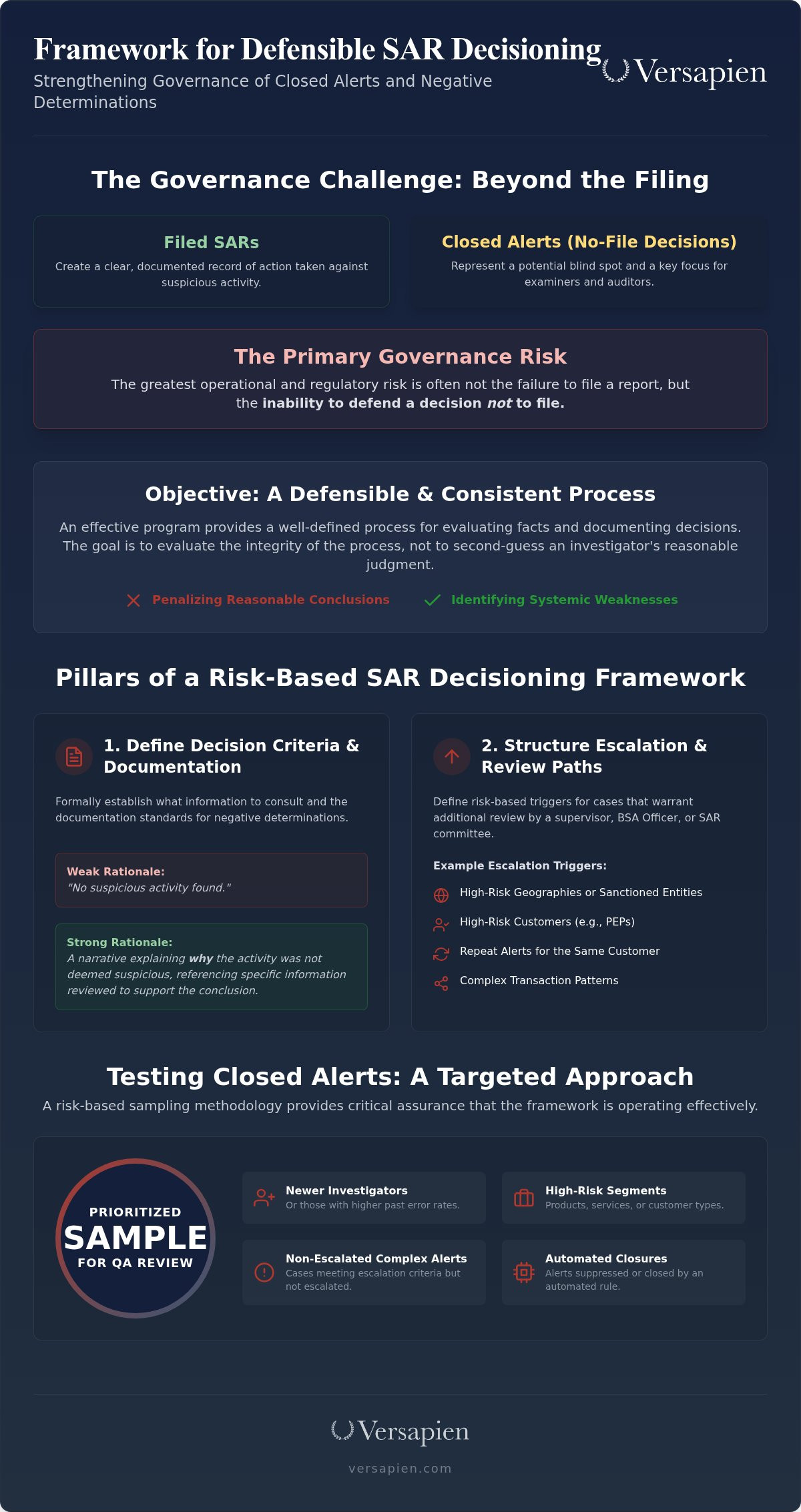
For many financial institutions, the greatest operational and regulatory risk within the SAR lifecycle is not the failure to file a report but the inability to defend a decision not to file. While filed SARs create a clear record of action, closed alerts and negative determinations represent a potential blind spot. Examiners and independent testing functions may review closed alerts and individual SAR decisions as part of evaluating the effectiveness of the institution’s suspicious activity monitoring, reporting, and decision-making processes. An unsupported or poorly documented negative determination can be interpreted as a failure of the institution's monitoring and reporting process.
The goal of robust SAR decisioning governance is not to force investigators into a rigid box that eliminates professional judgment. Instead, it is to ensure that judgment is applied consistently within a well-defined and defensible framework. Two investigators reviewing similar, but not identical, fact patterns may reasonably arrive at different conclusions. The critical question is whether both followed the institution's established process for research, analysis, and documentation.
Process Effectiveness vs. Second-Guessing Decisions
Effective testing of a SAR decisioning process distinguishes between evaluating the integrity of the process and second-guessing an individual investigator's judgment. The objective is to identify systemic issues, not to penalize reasonable conclusions. For example, a quality assurance (QA) review might find that an investigator’s decision was sound but that the supporting narrative was too brief. This points to a potential weakness in documentation standards or training, which is a correctable process flaw. Conversely, finding that multiple investigators are failing to review relevant customer due diligence (CDD) information before closing alerts indicates a more significant breakdown in procedural adherence that requires immediate remediation.
Establishing a Risk-Based SAR Decisioning Framework
A defensible SAR decisioning program is built on a framework that is formally documented, approved by management, and tailored to the institution's specific risk profile, complexity, and organizational structure. It provides investigators and supervisors with clear, actionable guidance for handling alerts from initial detection to final disposition. While components may vary, a sound framework typically articulates the following elements.
Defining Decision Criteria and Documentation Expectations
The framework should clearly define the criteria for evaluating suspicious activity. This includes outlining what information sources an investigator should consult, such as transaction history, customer risk profiles, beneficial ownership data, and relevant enhanced due diligence (EDD) where applicable. It also establishes the documentation standards for both SAR filings and negative determinations. A common weakness is allowing investigators to close alerts with generic rationales like "no suspicious activity found." A sound framework should provide for documentation of the specific rationale for filing or not filing a SAR, using a level and form of documentation appropriate to the institution’s processes and the circumstances of the case.
Structuring Escalation and Review Paths
Not all decisions carry the same level of risk. The framework should define clear escalation paths for cases that warrant additional review. Triggers for escalation are risk-based and may include:
Transactions involving high-risk geographies or sanctioned entities.
Activity related to politically exposed persons (PEPs) or other high-risk customers.
Complex transaction patterns that are difficult to interpret.
Repeat alerts for the same customer or counterparty.
Cases where an investigator is uncertain or recommends a SAR filing.
The final decision-making authority may rest with a designated individual, such as the BSA Officer, or a formal SAR committee. There is no universal regulatory expectation for a committee structure; the appropriate model depends on the institution's size and governance culture. The decision-making process should provide for appropriate escalation, review, and challenge for complex or higher-risk matters, consistent with the institution’s governance structure. For more information on structuring program oversight, see our guide to building effective BSA/AML governance.
Testing Closed Alerts and Negative Determinations
Risk-based testing of closed alerts can provide management and the Board with useful insight into whether the SAR decisioning process is operating in accordance with the institution’s policies, procedures, and risk profile. Testing may be performed through quality assurance, compliance testing, independent testing, Internal Audit, or another appropriately qualified function, depending on the institution’s governance structure and the nature of the testing. It should be distinct from the formal model validation process applied to transaction monitoring systems, though its findings can inform model performance assessments.
A Risk-Based Sampling Methodology
Because reviewing every closed alert is impractical, institutions should develop a risk-based sampling methodology. Rather than relying on purely random selections, a targeted approach can yield more valuable insights. Sampling criteria could prioritize:
Alerts closed by newer investigators or those with higher error rates in past reviews.
Alerts related to high-risk products, services, or customer segments.
Complex alerts that were not escalated for higher review.
Alerts that were automatically suppressed or closed by an automated system.
Core Testing Attributes
Each sampled case should be evaluated against a consistent set of attributes to measure the quality and consistency of the decision-making process. Key questions to address include:
Completeness of Research: Did the investigator consider relevant information available to the institution, including applicable CDD/EDD information, prior SAR filings, and other appropriate internal or external sources?
Reasonableness of Decision: Based on the information documented, is the "no-file" decision logical, well-reasoned, and consistent with the institution's risk appetite and policies?
Procedural Adherence: Was the institution's defined process for alert review, escalation, and disposition followed correctly?
Documentation Quality: Does the written narrative adequately support the rationale for closing the alert? Does the documentation adequately explain the rationale for the disposition and support subsequent management, testing, or examination review?
Issue Analysis and Remediation
The output of the testing process is more than just an error rate. Each identified issue should be subjected to a root-cause analysis to determine the underlying driver. A poorly documented rationale, for example, could stem from inadequate training, unclear procedural guidance, or unrealistic productivity expectations. Once the root cause is understood, a corrective action plan can be developed, which might include targeted training, policy clarifications, or technology enhancements. Analyzing these findings for broader trends helps the institution move from fixing individual errors to improving the systemic health of its financial crime compliance program.
Management and Board Oversight
Effective SAR decisioning governance extends to senior management and the Board of Directors, who are responsible for overseeing the health of the BSA/AML program. This oversight depends on receiving meaningful reporting that moves beyond simple volume metrics to provide insight into the quality and risk associated with the decisioning process.
Reporting Meaningful Trends
Instead of focusing solely on the number of SARs filed, reporting to management and the Board should include qualitative metrics and trends that illuminate program performance. Key performance indicators (KPIs) and key risk indicators (KRIs) could include:
Disposition Patterns: Analysis of "file" vs. "no-file" rates by alert type, business line, or investigator.
QA Findings: Error rates, trend analysis of issue types (e.g., documentation, research), and the status of remediation efforts.
Escalation and Override Trends: The frequency of escalations and the rate at which senior reviewers or a committee override initial recommendations.
Alert Aging: The average time taken to disposition alerts, which can indicate resource constraints or process inefficiencies.
Repeat Activity: Metrics on alerts generated for customers who have been the subject of prior alerts or SARs.
Clarifying Roles and Responsibilities
A clear governance structure defines the roles of different functions. A clear governance structure should define the responsibilities of the BSA Officer, business and operations personnel, compliance or other oversight functions, and Internal Audit or other independent testing resources, as applicable. The specific allocation of responsibilities should reflect the institution’s organizational structure, risk profile, and governance model.
Governance of Automated Decisioning Tools
As institutions increasingly use artificial intelligence (AI) and other automated tools to manage alert volumes, specific governance considerations apply. The first step is for the institution to determine whether a particular tool meets its internal definition of a "model." If it does, model risk management practices may apply where the tool meets the institution’s applicable definition of a model, with the nature and rigor of those practices aligned to the model’s risk, purpose, complexity, and use.
It is important to understand the evolving regulatory landscape. For example, the interagency guidance on model risk management (SR 26-2, which superseded SR 21-8) provides a nonbinding, risk-based framework for banking organizations, but it does not apply a universal validation requirement to all automated systems and explicitly excludes most generative and agentic AI from its scope. Similarly, FinCEN's April 2026 proposal on AML/CFT program effectiveness is a proposed rule, not a final requirement. Institutions should ensure their governance over these tools is risk-based and aligned with current, applicable guidance and regulations.
Executive Takeaways
SAR decisioning governance is primarily concerned with the consistency of the process, not with forcing identical outcomes for every case. The goal is to ensure that investigator judgment is exercised within a defined, documented, and defensible framework.
Closed alerts and decisions not to file a SAR can provide useful insight into the effectiveness of the institution’s suspicious activity monitoring and decision-making process. A robust testing program focused on these negative determinations is a critical component of a mature BSA/AML program.
The decision-making framework should be tailored to the institution's risk profile and may involve an individual decision-maker (e.g., the BSA Officer) or a committee; a committee structure is not a universal requirement.
Effective testing evaluates the completeness of research, the reasonableness of the decision, adherence to procedures, and the quality of the supporting documentation.
Board and senior management reporting should focus on qualitative trends—such as QA findings, disposition patterns, and escalation rates—rather than relying solely on SAR filing volumes.
Governance for automated decisioning tools should be risk-based, starting with a determination of whether a tool meets the institution’s definition of a model and applying relevant risk management practices accordingly.
How Versapien Can Help
Versapien helps financial institutions, fintechs, and digital asset firms strengthen their financial crime risk management programs. Our team provides independent assessments of SAR decisioning frameworks, helps design and implement risk-based quality assurance and testing programs, and advises management and boards on effective oversight and reporting practices to enhance program effectiveness and examination readiness.


Comments