
Self-Identified vs. Examiner-Identified Issues: What the Ratio Says About Risk Management Maturity
Table of Contents
Understanding Self-Identified vs. Examiner-Identified Issues
Within financial institutions, the relationship between self-identified compliance deficiencies and those uncovered by regulatory agencies serves as a primary operational indicator of risk management maturity. When compliance monitoring, quality control, internal audit, and business-line oversight operate effectively, an institution detects control breakdowns internally long before an examination team arrives on site. Conversely, a pattern where prudential regulators or the Consumer Financial Protection Bureau (CFPB) consistently identify substantive compliance violations before internal mechanisms register them indicates latent control weaknesses.
However, viewing this dynamic through a simplistic numerical ratio misrepresents both operational realities and supervisory methodologies. Regulatory agencies have not established formal quotas, percentage targets, or statutory thresholds for self-identified issues versus examiner-identified findings. Supervisory teams do not evaluate risk governance purely through a mathematical calculation. Instead, the ratio represents an operational indicator that prompts qualitative inquiries into how an institution identifies operational deficiencies, escalates emerging compliance risks, and executes sustainable corrective action.
Mechanisms of Self-Identification vs. External Discovery
To evaluate how internal controls function, risk leaders must differentiate between self-identified regulatory issues and those surfaced through external impetuses. A self-identified issue originates strictly through an institution’s established internal oversight mechanisms. These mechanisms typically include first-line quality assurance testing, second-line compliance monitoring, risk assessments, automated surveillance systems, and independent internal audit reviews. When these internal functions detect an operational error, a statutory breach, or a control gap, the finding qualifies as an internal discovery generated through the institution's Compliance Management System (CMS).
In contrast, discoveries prompted by external pressures do not carry the same operational weight. If an institution uncovers an operational breakdown only after receiving a consumer complaint, an inquiry from an enforcement body, a third-party litigation subpoena, a whistleblower report, or an examination entry letter from a supervisory authority, regulators generally treat that discovery as externally driven. The presence of external triggers suggests that internal preventive and detective controls failed to capture the anomaly during the normal course of business operations.
This distinction carries practical consequences. While external discovery does not automatically eliminate all potential supervisory mitigation, examiners assess an institution's proactive capabilities far more favorably when detection occurs organically. An institution that catches a data-mapping error in its disclosures through routine second-line transaction testing demonstrates that its CMS functions as designed. If that same error surfaces only because a regulatory examination team sampled loan files during an annual supervisory cycle, the narrative shifts from proactive governance to systemic oversight failure.
Supervisory Treatment and Agency Discretion
Federal regulatory agencies maintain established guidelines outlining how self-identification influences supervisory determinations. In the FDIC Consumer Compliance Examination Manual, for example, supervisory guidance addresses non-citation criteria for self-identified violations. The manual specifies that violations self-identified and fully corrected prior to the start of an examination generally may not be cited on the FDIC’s formal Report of Examination, provided specific conditions are met. These conditions typically include proving that the violation was not willful, that comprehensive remediation and root-cause correction occurred, and that appropriate consumer remediation, such as financial restitution where applicable law dictates, was executed.
While the FDIC outlines specific procedural parameters for non-citation, leaders must recognize that supervisory policies are agency-specific and discretionary. The Office of the Comptroller of the Currency (OCC), the Board of Governors of the Federal Reserve System, and the CFPB each apply their own examination manuals, supervisory rating systems (such as the Uniform Interagency Consumer Compliance Rating System), and enforcement guidelines. Institutions preparing for supervisory oversight should review relevant agency standards, such as those detailed in practical guides on OCC examination readiness, rather than assuming an FDIC manual standard automatically binds another banking agency.
Furthermore, external identification does not eliminate all supervisory mitigation. When examiners surface a deficiency during a routine supervisory event, an institution’s immediate response still influences the eventual supervisory disposition. Rapid acknowledgment, immediate containment, and the execution of a credible, well-resourced corrective action plan demonstrate institutional capacity. While proactive internal detection can provide evidence of effective risk management maturity, prompt and effective remediation of externally identified findings can still be viewed positively in supervisory assessments.
Interpreting Issue-Identification Patterns Beyond the Raw Ratio
A common governance misstep among executive teams and oversight committees is evaluating issue metrics in isolation. Boards often look at a high proportion of self-identified issues, such as an 85% internal discovery rate, and assume the compliance environment is robust. Without granular operational context, however, raw numbers can obscure significant vulnerabilities or distort healthy institutional performance.
Context determines the credibility of internal detection metrics. A high volume of self-identified issues may reflect a rigorous, independent monitoring program operating across complex business units. Conversely, that same high volume could indicate widespread operational instability, pervasive control failures, or inadequate systems integration following an acquisition or core conversion. Similarly, a low number of self-identified issues might indicate exceptionally clean operational execution, or it could reflect an understaffed compliance department lacking the resources, data analytics, or mandate required to execute meaningful transaction testing.
Contextual Drivers: Growth, Testing Scope, and Taxonomy Shifts
Issue capture rates fluctuate according to specific organizational and operational variables. Evaluating internal identification performance requires risk professionals to normalize data against several environmental factors:
Expansion into New Products or Delivery Channels: Deploying new consumer lending products, implementing third-party partnerships, or expanding automated decisioning platforms introduces novel operational risks. A temporary spike in self-identified issues within these new units often demonstrates that pre-implementation and post-launch reviews are capturing early control gaps.
Expansion of Testing Scope and Depth: When a compliance function upgrades its testing capabilities, such as moving from manual ten-file sampling to continuous, automated population testing across entire loan portfolios, the volume of self-identified exceptions inevitably rises. This increase reflects enhanced detective capability rather than a deteriorating control environment.
Standardized Risk Taxonomies: In mature organizations, minor operational anomalies are distinguished from formal regulatory compliance deficiencies. If an institution aggregates every internal administrative error into its compliance issue registry, its self-identified metric expands artificially. Establishing a clear, risk-based taxonomy ensures that tracking captures meaningful control breakdowns rather than low-level operational noise.
Prioritizing Root-Cause Depth Over Issue Volume
Examiners routinely look past total issue counts to evaluate whether an institution diagnoses the underlying systemic drivers of compliance breakdowns. Superficial remediation, often referred to as treating the symptom, leaves an institution vulnerable to repeat findings during subsequent supervisory cycles. True risk maturity requires distinguishing between isolated technical glitches and broader programmatic breakdowns.
Consider an issue involving inaccurate disclosures delivered to mortgage applicants. An immature compliance program might log the issue, adjust the individual disclosures, reimburse the impacted borrowers, and close the finding as resolved. A mature program conducts rigorous root-cause analysis to determine why the error occurred in the first place. Did a software release alter a fee calculation field? Did a line-of-business manager modify business rules without submitting the revision through formal change management? Or did front-line operations lack sufficient training on recent regulatory amendments? As outlined in frameworks on turning past findings into sustainable remediation, corrective actions that do not address the systemic cause can increase the risk of repeat deficiencies.
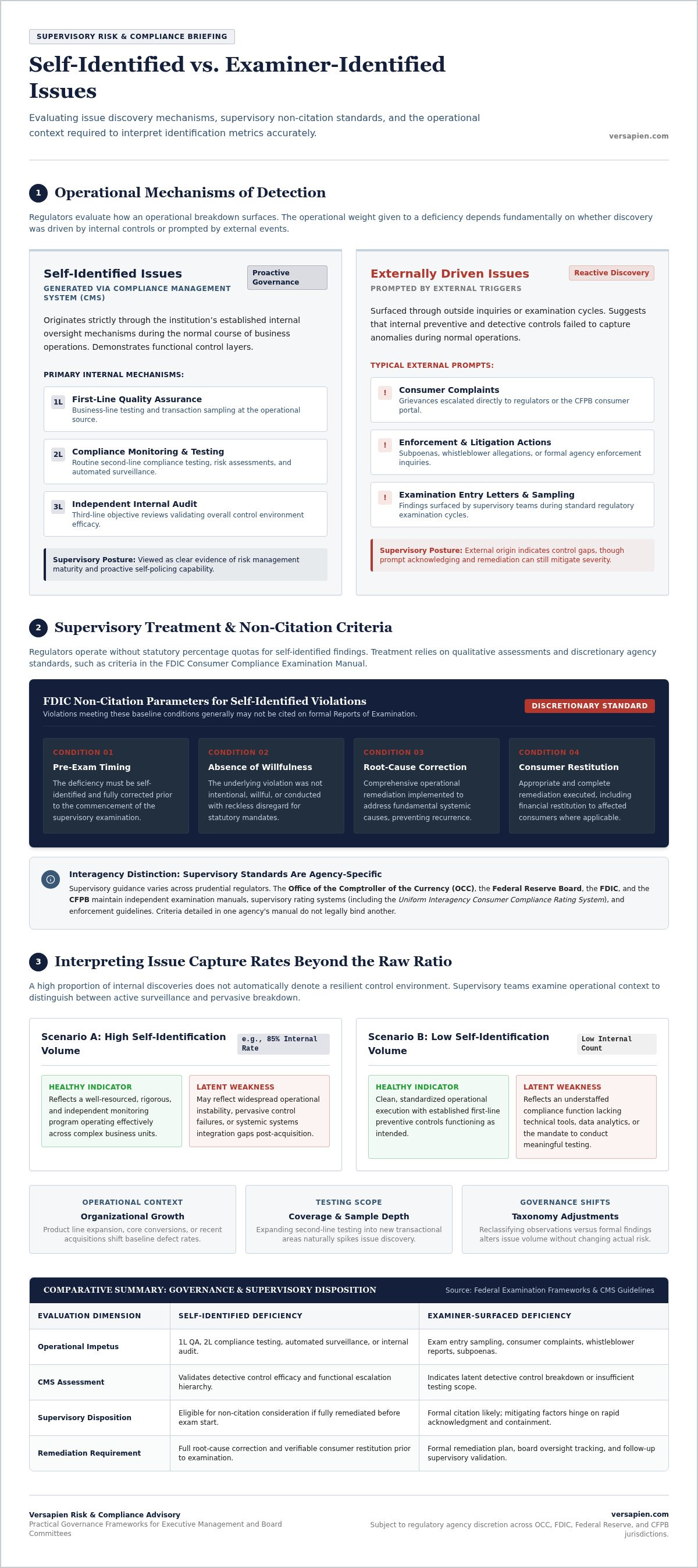
Diagnostic Decision Framework: Evaluating Issue Discovery & Response
To establish defensible governance, institutions must apply structured criteria to evaluate how deficiencies are identified, analyzed, and remediated. The following decision matrix contrasts proactive compliance management detection against reactive supervisory discovery across key operational dimensions.
Building an Escalation and Governance Framework Across Control Functions
Sustaining a favorable issue-identification posture requires deliberate coordination across organizational control functions. While many institutions align their operating structures with the Three Lines Model, governance leaders should recognize that this specific structure is not a universally mandated regulatory standard. Different organizational sizes, business models, and charter types employ diverse governance structures to achieve supervisory expectations. Regardless of structural design, an effective control architecture requires distinct roles for detection, monitoring, escalation, and independent verification.
When communication breaks down between operational units and oversight bodies, regulatory blind spots emerge. Front-line personnel frequently encounter operational anomalies, system errors, or customer friction points. If these teams view these anomalies as purely technical glitches, they may implement informal workarounds without alerting compliance officers. Establishing clear, non-punitive internal reporting mechanisms ensures that potential statutory or regulatory violations are flagged and assessed before they compound across significant transaction volumes.
Detection, Monitoring, and Independent Review Roles
Operational stability depends on clearly differentiating the responsibilities of each oversight function:
First-Line Operational Controls: Business units and operations teams own the daily execution of consumer-facing activities. Their mandate involves embedding preventive controls, such as automated system logic, validation scripts, and standardized checklists, into daily workflows, supported by routine quality assurance to catch non-compliance in real time.
Second-Line Compliance Oversight: The centralized compliance department operates with independent oversight authority. This function is responsible for establishing enterprise compliance policies, monitoring business-line adherence, executing targeted transaction testing, and challenging first-line risk assessments. Integrating these workflows through comprehensive regulatory compliance advisory protocols ensures consistent risk identification across disparate divisions.
Independent Review and Audit: Internal audit or qualified external review functions evaluate whether first- and second-line controls operate effectively. Crucially, this function must provide independent validation that closed corrective actions have eliminated underlying vulnerabilities and that remediation remains sustainable over time.
A critical stage in this governance framework is proving that remediation has achieved permanence. Without appropriate validation or other evidence of operating effectiveness, institutions may close issues before establishing that the underlying weakness has been adequately addressed. Establishing formal testing protocols, as examined in our guide to regulatory issue closure and sustainability, prevents internal findings from resurfacing during subsequent regulatory examinations.
Elevating Board and Risk Committee Reporting
Executive management and Board Risk Committees have limited visibility into the institution’s risk trajectory when issue reporting consists solely of high-level volume metrics or filtered summary statements. Reporting frameworks must convey the operational health and risk trajectory of the institution through meaningful risk dimensions.
Effective board-level reporting abandons vanity metrics and focuses on underlying trend lines. Directors and senior executives require transparency regarding issue severity classifications, aging schedules, and remediation progress against stated target dates. Tracking how long an issue remains open, whether milestone commitments are met, and whether identical control failures recur in related operational areas provides the board with an unvarnished assessment of management’s responsiveness to compliance risk.
Furthermore, escalation governance should establish clear criteria for evaluating when an internally discovered issue may warrant notification to a regulatory agency. This determination involves evaluating whether an issue involves systemic non-compliance, extensive consumer financial injury, potential intentional misconduct, or exposure to formal public enforcement. Executive leadership, General Counsel, and the Chief Compliance Officer must coordinate closely to evaluate agency disclosure expectations against specific statutory requirements.
Measuring Risk Management Maturity: A Practical Evaluation Framework
To assess risk maturity accurately, institutions should transition away from tracking the raw ratio of self-identified to examiner-identified findings as a standalone KPI. Instead, organizations benefit from establishing a balanced issue-maturity dashboard that tracks multiple qualitative and quantitative operational indicators.
This balanced approach recognizes that an institution identifying dozens of issues is not necessarily failing, nor is an institution with zero findings necessarily succeeding. Risk maturity reflects an organization's velocity of detection, the depth of its causal analysis, and the enduring sustainability of its remediation efforts.
Balanced Metrics for Issue Governance
A mature compliance dashboard incorporates four core metrics to provide senior management and board risk committees with actionable intelligence:
Time-to-Detection (Detection Velocity): The duration elapsed between the actual operational inception of a non-compliant event (such as an improper system deployment or fee change) and its formal identification by an internal control function. A decreasing time-to-detection metric demonstrates that monitoring controls are identifying breakdowns near real time, significantly limiting potential consumer impact.
Remediation Aging and Milestone Adherence: Tracking open findings against established aging thresholds (e.g., 30, 60, 90, 180 days) and monitoring milestone slippage. Persistent extensions of targeted completion dates signal inadequate capital allocation, poor project management, or operational resistance from line-of-business leaders.
Recurrence Rate (Repeat Findings): The percentage of closed issues that re-emerge within 12 to 24 months across identical or adjacent operational processes. A high recurrence rate may indicate that root-cause analysis or corrective action did not fully address the underlying drivers.
Validation Pass Rate: The proportion of corrective actions that successfully pass independent second-line or third-line post-closure validation on the first attempt. A low initial pass rate may indicate that corrective actions were closed before sufficient evidence of sustainable operating effectiveness was established.
By monitoring these balanced indicators alongside comprehensive risk management consulting protocols, executive teams can demonstrate to regulatory examination teams that the institution's self-identification posture represents genuine operational control rather than reactive compliance maintenance.
Executive Takeaways
The Issue Ratio Is an Operational Indicator, Not a Supervisory Quota: Regulatory agencies have not established formal percentage targets or numeric mandates for self-identified versus examiner-identified issues. Regulators evaluate the operational maturity, independence, and effectiveness of an institution's detection and remediation processes rather than a single ratio.
Context Governs Numerical Analysis: Raw issue volumes must be interpreted alongside business expansion, system modernizations, testing scope expansions, and risk taxonomy definitions. Elevated internal discoveries often indicate enhanced detective capabilities rather than deteriorating internal controls.
Discretionary Mitigation Requires Rigorous Remediation: While guidance such as the FDIC Consumer Compliance Examination Manual outlines specific criteria for non-citation of self-identified violations, supervisory discretion varies across agencies. Securing favorable supervisory treatment depends on conducting thorough root-cause analysis, implementing sustainable corrective actions, and executing customer restitution when legally applicable.
Supervisory Mitigation Extends Beyond Internal Discovery: Although self-identification demonstrates proactive governance, an institution that rapidly acknowledges, contains, and remediates findings surfaced by external examiners can still achieve meaningful supervisory mitigation compared to an institution that disputes or delays corrective action.
Board Reporting Must Focus on Velocity, Aging, and Recurrence: Executive leadership and Board Risk Committees should evaluate compliance maturity through balanced indicators—including detection velocity, remediation aging, repeat finding rates, and post-closure validation results—rather than aggregate issue counts.
How Versapien Can Help
Versapien delivers specialized advisory services designed to help financial institutions strengthen their compliance management systems and establish defensible governance frameworks. Our advisory leadership draws on decades of senior-level professional services experience across banking, consumer lending, and fintech environments.
We assist institutions in structuring end-to-end issue management lifecycles, establishing objective root-cause analysis frameworks, designing balanced risk dashboards for executive committees, and preparing comprehensive evidentiary workpapers for supervisory review. Versapien works closely with executive leadership, Chief Risk Officers, and General Counsel to evaluate control effectiveness, enhance inter-line escalation procedures, and support defensible remediation programs across complex operational environments.



Comments