
Third-Party Risk Management for AI and Fintech Vendors
Complexity, velocity, and exposure now define the modern financial ecosystem. As institutions integrate sophisticated AI models and fintech partnerships, the traditional boundaries of the enterprise have effectively dissolved. Many organizations continue to rely on static, annual assessments that fail to capture the dynamic operational shifts inherent in high-risk AI supply chains. A robust third-party risk management framework must instead operate as a continuous governance engine, aligning technical oversight with the rigorous expectations of the OCC, FDIC, and the EU AI Act.
Fragmented oversight of BaaS models and fintech vendors creates significant blind spots for the board. It's no longer enough to treat vendor oversight as a secondary compliance task. This analysis provides an executive-level roadmap for modernizing these strategies, focusing on financial crime integration and regulatory alignment. We will examine how to build a regulator-ready framework that moves beyond compliance checkboxes to deliver strategic insights on vendor concentration and operational resilience.
Table of Contents
The Evolution of Third-Party Risk Management in Regulated Environments
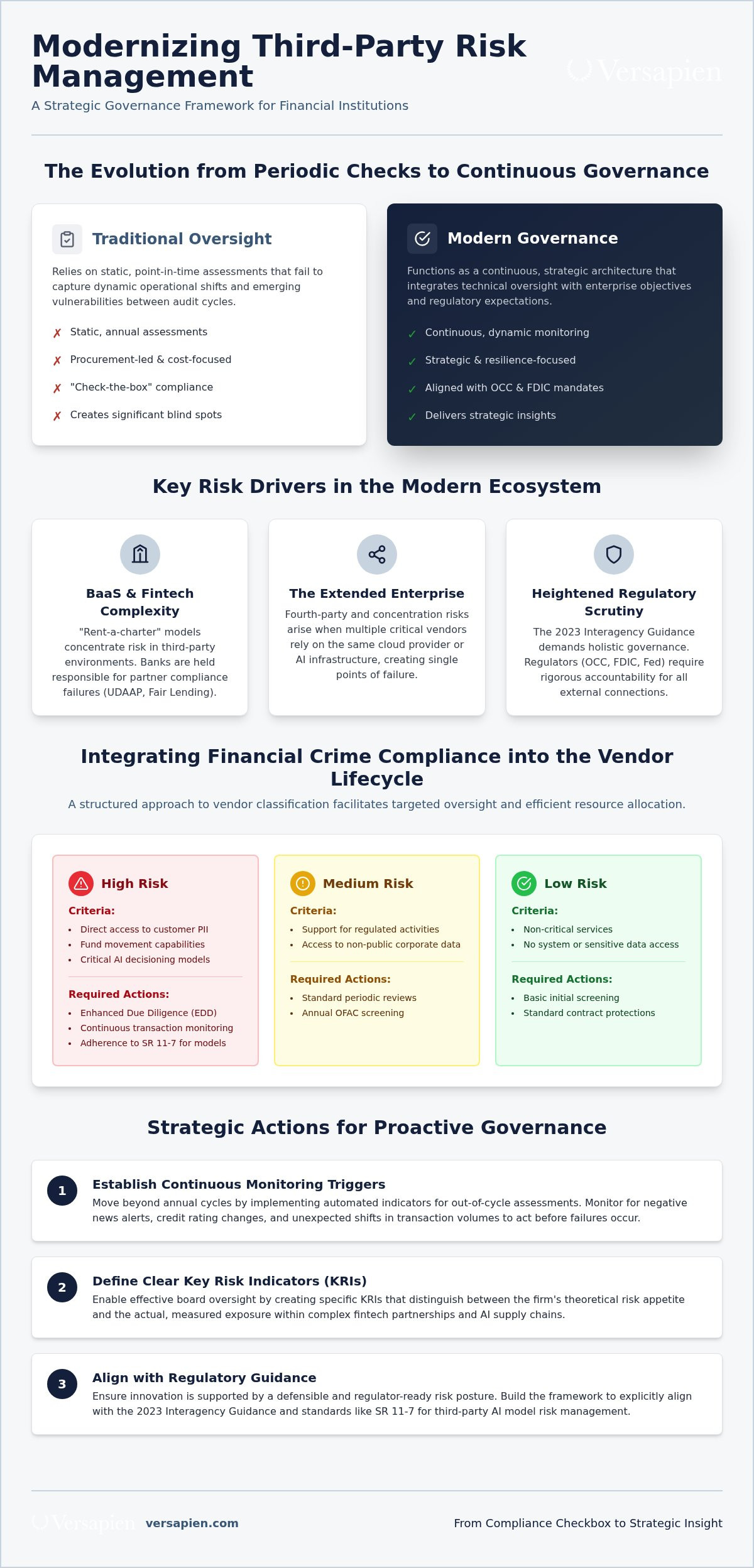
The 2023 Interagency Guidance on Third-Party Relationships marked a fundamental shift in regulatory expectations, moving beyond traditional vendor oversight to a more holistic governance model. Financial institutions now face a landscape where the Federal Reserve, FDIC, and OCC demand rigorous accountability for every external connection. This environment exposes the inadequacy of procurement-led models that prioritize cost over structural integrity. Modern third-party risk management functions as a strategic governance architecture that integrates technical oversight with enterprise objectives rather than acting as a transactional procurement function.
The Rise of Banking-as-a-Service (BaaS) Risk Profiles
The proliferation of BaaS and "rent-a-charter" models has introduced unprecedented complexity into downstream oversight. While these partnerships drive rapid growth, they also concentrate risk within third-party environments that may lack institutional-grade controls. Regulators like the CFPB and OCC increasingly hold banks responsible for the compliance failures of their fintech partners, particularly concerning fair lending and UDAAP violations. Organizations must treat fintech partners as extensions of their own operational footprint, requiring deep visibility into the partner’s internal control environment to maintain regulatory compliance.
Shifting from Periodic to Continuous Monitoring
Static, annual due diligence cycles are increasingly obsolete in a market defined by rapid AI deployment and fintech volatility. A "check-the-box" approach fails to identify deteriorating financial health or security vulnerabilities that emerge between audit cycles. Resilience requires a shift toward continuous monitoring, utilizing dynamic triggers such as negative news alerts, credit rating changes, or unexpected shifts in transaction volumes. By establishing these automated indicators, risk officers can initiate out-of-cycle assessments before a vendor’s operational failure impacts the bank’s stability. This proactive stance is essential for effective risk management in high-stakes environments.
The concept of the "Extended Enterprise" now forces boards to look past direct contracts to address fourth-party and concentration risks. If multiple critical vendors rely on the same cloud provider or AI infrastructure, a single point of failure can paralyze the institution. Senior leadership must evaluate these systemic dependencies to ensure that concentration risk doesn't exceed the firm's established appetite.
Integrating Financial Crime Compliance into Third-Party Risk Frameworks
Identity, activity, and intent form the core of effective financial crime oversight, yet these elements often remain isolated from the broader third-party risk management lifecycle. While procurement teams prioritize operational uptime and cost efficiency, risk officers require granular visibility into the beneficial ownership and transactional integrity of fintech partners. Integrating financial crime compliance directly into the vendor lifecycle ensures that sanctions screening and BSA/AML protocols encompass the entire technology supply chain. The Federal Reserve's guide to third-party risk management highlights that the intensity of due diligence should align with the complexity and risk of the partnership.
A structured approach to vendor classification facilitates targeted oversight. Implementing a risk tiering matrix allows for the efficient allocation of compliance resources:
High Risk: Vendors with direct access to customer PII, fund movement capabilities, or critical AI decisioning. These relationships require enhanced due diligence (EDD) and continuous transaction monitoring.
Medium Risk: Support functions for regulated activities or access to non-public corporate data. These require standard periodic reviews and annual OFAC screening.
Low Risk: Non-critical services with no system access. These are managed through basic screening and standard contract protections.
AI Governance and Third-Party Technology Risk
Assessing third-party AI models requires adherence to SR 11-7 standards for model risk management. Many fintech providers utilize proprietary algorithms that operate as "black boxes," complicating the bank's ability to validate model performance or identify potential drift. Establishing AI governance in compliance requires vendors to provide technical documentation on data provenance and algorithmic transparency to meet regulatory expectations.
Addressing UDAAP and Fair Lending in Vendor Relationships
Consumer-facing algorithms managed by third parties are under intense CFPB scrutiny for potential bias and fair lending violations. Organizations must monitor vendor communications and automated decisioning logic to identify potential UDAAP risks before they manifest as regulatory findings. If you require assistance in aligning your vendor oversight with these complex requirements, consider how a senior-led advisory approach can strengthen your framework.
Evaluating Third-Party Risk Management Consulting Partners
Technical depth, regulatory mastery, and implementation focus define the selection criteria for a high-stakes advisory partner. Many institutions find that large consultancies often prioritize project scale over specialized expertise, frequently deploying junior staff to execute standardized templates. This approach fails to address the nuanced risks inherent in complex fintech ecosystems. A senior-led boutique model ensures that the professionals conducting the assessment possess the deep-seated competence required to evaluate AI models and anticipate examiner scrutiny. Effective programs must evolve beyond static checklists to address the specific, dynamic risk profiles of the institution.
Effective third-party risk management requires an advisor who can move seamlessly from identifying gaps to executing regulator-ready remediation. This necessitates the integration of financial crime compliance expertise directly into the oversight strategy. By aligning vendor onboarding with rigorous AML and sanctions protocols, firms transform a procurement task into a robust defensive layer that protects the institution from downstream vulnerabilities.
The Importance of Regulatory Examination Mastery
An advisor's value is often measured by their ability to understand the "mind of the regulator," particularly during OCC, FDIC, or Federal Reserve examinations. This mastery isn't gained through textbooks but through years of direct interaction with regulatory bodies and a proven track record in remediation. A consultant should demonstrate the ability to translate complex exam findings into sustainable, audit-ready control environments that satisfy both internal auditors and external examiners. This depth is essential when defending high-risk partnerships or complex AI deployments during intensive regulatory reviews.
Strategic Alignment: Choosing a Navigator, Not Just a Vendor
Institutions require a navigator who can help them move through a difficult landscape safely and successfully. Moving beyond off-the-shelf frameworks allows for the development of bespoke enterprise risk management strategies that reflect the firm's specific risk appetite and operational reality. A partner who understands the friction between traditional banking stability and rapid fintech innovation provides the foresight necessary to manage growth without compromising structural integrity.
Strategic Actions: Transitioning to a Proactive Governance Model
Transitioning to a proactive model requires more than a policy update. It demands a shift toward quantified oversight through Key Risk Indicators (KRIs) that measure third-party performance against institutional thresholds. Leadership should prioritize metrics that track model drift in AI vendors, KYC refresh backlogs in fintech partners, and the frequency of security patches. These data points allow the board to distinguish between theoretical risk appetite and actual exposure, facilitating more informed capital allocation and strategic planning. Effective third-party risk management relies on this move from subjective assessment to data-driven governance.
A phased implementation roadmap provides a structured path toward modernization. Initial efforts should focus on high-impact areas, such as critical vendor remediation and the integration of financial crime compliance protocols, before expanding to enterprise-wide automation. Versapien serves as a strategic partner for senior leaders seeking this level of clarity, providing the technical depth and regulatory foresight required to modernize risk frameworks while maintaining operational agility.
Executive Takeaways: Immediate Considerations
Immediate stability often relies on addressing legacy gaps in the vendor portfolio. Organizations should consider the following actions to ensure current relationships meet evolving standards:
Audit the current inventory: Identify fintech and BaaS relationships that fall outside the scope of the 2023 Interagency Guidance to prioritize remediation efforts.
Review third-party contracts: Ensure agreements include robust "right to audit" clauses and data protection requirements that align with the EU AI Act's 2026 mandates.
Validate AI documentation: Confirm that high-risk AI vendors have provided sufficient technical documentation to satisfy SR 11-7 and model risk management expectations.
Update board reporting: Refine reporting templates to move beyond volume metrics and focus on concentration risk and residual exposure levels.
Building Long-Term Resilience
Resilience is the byproduct of a mature governance culture. When third-party risk management is integrated into the broader organizational fabric, it ceases to be a friction point and becomes a catalyst for sustainable, measurable growth. With the average cost of a US data breach reaching a record $11.5 million in 2026, the financial incentive for structural integrity has never been higher. By treating governance as an enabling force, institutions can pursue rapid innovation with the confidence that their operational foundations are secure and regulator-ready.
Strengthening the Enterprise Through Strategic Oversight
Modernizing your third-party risk management framework is no longer a matter of simple compliance; it's a strategic necessity for institutions operating at the intersection of AI and fintech. This evolution requires the seamless integration of financial crime protocols and AI governance into a single, cohesive oversight engine. By shifting from static, periodic reviews to a model defined by continuous monitoring and clear Key Risk Indicators, leadership can effectively navigate the complexities of the 2023 Interagency Guidance. This proactive stance ensures that innovation remains supported by a defensible and regulator-ready risk posture.
Success in this high-stakes environment depends on the quality of the insights driving your decisions. Versapien provides the senior-led depth and Big Four experience required to move beyond generic templates and deliver practical, implementation-focused results. Focusing on specialized expertise in AI governance and financial crime compliance ensures that your governance architecture remains durable in the face of rapid technological change. A disciplined approach to vendor oversight doesn't just protect the firm; it provides the stability necessary for long-term growth.
Building a resilient governance model is a methodical process that yields significant dividends in operational integrity and regulatory confidence. We look forward to supporting your efforts in navigating this complex landscape.
Strategic Directives for Regulatory and Operational Resilience
Navigating the 2026 Regulatory Landscape
The regulatory environment in 2026 is defined by the full application of the EU AI Act and intensified scrutiny of fintech partnerships by US agencies. This landscape requires a shift from passive compliance to active, documented governance of high-risk systems. Institutions now need to provide technical documentation and undergo independent audits for AI-driven processes to satisfy the evolving expectations of the OCC and FDIC. Maintaining this level of readiness ensures that the firm remains resilient as global standards for digital assets and AI continue to mature.
Extending Oversight to Fourth-Party Environments
Effective third-party risk management now requires visibility into the sub-service providers utilized by primary vendors, particularly where these entities handle sensitive customer data or critical financial functions. This intersection with BSA/AML requirements is vital, as downstream weaknesses can create significant sanctions or fraud exposure. Establishing clear contractual rights to audit these fourth-party relationships allows for a more holistic view of the technology supply chain. By identifying these dependencies, risk officers can better manage concentration risks that might otherwise remain hidden within the fintech ecosystem.
Distinguishing Strategic Governance from Vendor Management
A strategic governance framework differs fundamentally from a traditional vendor management program by focusing on risk architecture rather than transactional efficiency. While procurement-led programs prioritize cost and service levels, a governance-first approach treats external partnerships as integral components of the enterprise risk framework. This distinction is critical during regulatory examinations, where the Federal Reserve and the FDIC evaluate the depth of senior-level oversight. Utilizing senior-led advisory from Versapien provides the technical mastery needed to move beyond off-the-shelf templates and deliver a regulator-ready implementation that supports sustainable innovation.


Comments