
AI Governance Maturity: A Roadmap for Financial Institutions
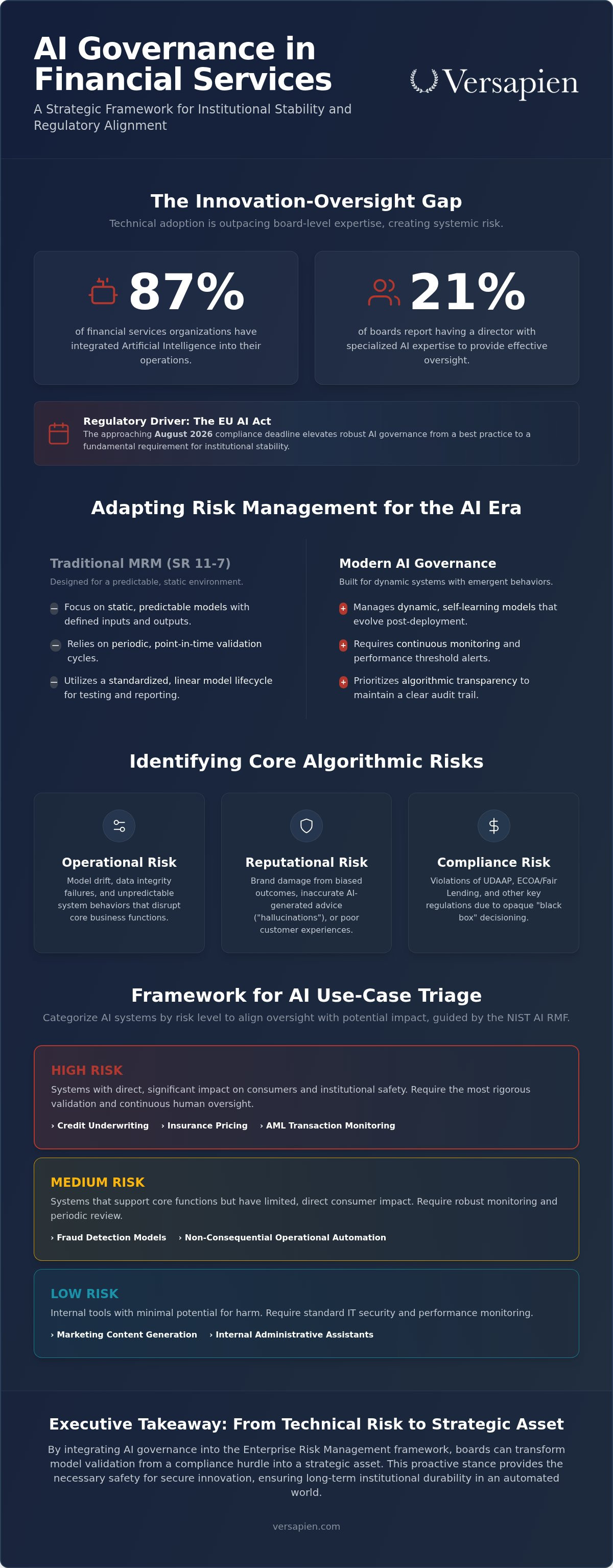
Technical complexity, regulatory ambiguity, and systemic risk define the modern banking environment. While 87% of financial services organizations have integrated artificial intelligence into their operations, approximately 21% of boards report having a director with specialized AI expertise. This disconnect creates a systemic vulnerability where technical innovation outpaces institutional oversight. Establishing effective AI governance in financial services is a fundamental requirement for maintaining institutional stability as the August 2026 EU AI Act compliance deadlines arrive.
It's difficult to apply traditional SR 11-7 standards to non-deterministic models while attempting to translate granular algorithmic risks into actionable board-level reporting. The fear of UDAAP or fair lending violations remains a significant barrier to the deployment of agentic AI systems. This article provides a strategic framework for integrating artificial intelligence governance into existing enterprise risk management structures. We'll examine a roadmap for maturing oversight, moving from reactive compliance to a proactive, integrated model of risk supervision that secures digital transformation.
Table of Contents
The Convergence of Artificial Intelligence and Regulatory Oversight
Friction, fragmentation, and uncertainty. These challenges define the current governance gap where legacy Model Risk Management (MRM) structures often fail to account for the non-deterministic nature of self-learning models. While financial institutions have accelerated adoption to capture efficiencies, the regulatory guidance from the OCC and Federal Reserve moves at a more deliberate pace. Establishing robust AI governance in financial services provides a systemic framework of policies and controls that keep automated systems transparent. Proactive alignment with FFIEC standards and the evolving global AI regulation landscape isn't just a compliance exercise; it's a strategic advantage that ensures institutional durability.
The Evolution of Model Risk Management under SR 11-7
Standardization, validation, and documentation form the core of SR 11-7, yet its traditional focus on static models is under pressure. Dynamic models that evolve after initial validation challenge the standard lifecycle of model testing and reporting. Modern regulatory compliance advisory must now prioritize algorithmic transparency to satisfy examiners who expect a clear audit trail for every automated decision. By treating AI as a living system, institutions can bridge the gap between rapid innovation and systemic safety.
Identifying the Core Risks of Algorithmic Financial Services
Operational, reputational, and compliance. These categories capture the risks unique to automated decisioning that traditional frameworks aren't equipped to manage. For instance, customer-facing advice bots carry the risk of hallucination, where systems generate plausible but inaccurate financial guidance. These errors lead to immediate UDAAP violations or brand erosion. Managing AI governance in financial services requires a shift from periodic audits to continuous monitoring, ensuring technical risks are translated into board-level strategy.
The AI Governance Integration Matrix for Financial Institutions
Integrity, transparency, and oversight. These pillars form the foundation of a resilient governance architecture that addresses the unique challenges of machine learning. Siloed oversight often creates systemic blind spots that legacy structures cannot resolve. Effective AI governance in financial services requires technical risks to be mapped directly into the existing Enterprise Risk Management (ERM) taxonomy. Cross-functional committees involving legal, risk, and data science teams must facilitate this integration, moving the organization away from isolated technical reviews toward a unified risk posture.
Mapping AI to the NIST AI Risk Management Framework
The NIST AI RMF complements traditional safety and soundness standards by providing a structured methodology for risk characterization. Institutions should utilize a decision matrix to categorize AI use cases by risk level:
Low Risk: Marketing content generation and internal administrative assistants.
Medium Risk: Fraud detection and non-consequential operational automation.
High Risk: Credit underwriting, insurance pricing, and AML transaction monitoring.
This classification is a central element of modern risk management consulting. Such frameworks are vital for managing the complex overlap between AI and fair lending regulations.
Establishing Board-Level Accountability and Reporting
Boards require strategic clarity rather than raw technical data. The Chief Risk Officer should present concise drift metrics and performance thresholds that signal when a model's behavior deviates from its initial validation parameters. Transitioning from periodic, point-in-time validation to continuous monitoring allows the Risk Committee to supervise high-risk AI applications with the same rigor applied to liquidity or credit risk. This approach ensures that algorithmic performance is viewed through the lens of fiduciary responsibility and long-term stability. For leaders aiming to formalize these oversight protocols, a consultation on governance architecture can provide the necessary structural integrity.
Addressing Fair Lending and UDAAP Risks in Automated Decisioning
The Consumer Financial Protection Bureau (CFPB) has intensified its scrutiny of automated decisioning, particularly regarding the inherent opacity of black box models. Traditional credit scoring relies on linear variables, but modern machine learning often utilizes thousands of non-linear data points that can obscure the logic behind a credit denial. Under the Equal Credit Opportunity Act (ECOA), institutions must provide specific and accurate reasons in adverse action notices. Reliance on a model's complexity as an excuse for vague disclosures is no longer acceptable. Integrating financial crime compliance with fair lending oversight ensures that models designed for fraud detection don't inadvertently create discriminatory outcomes for protected classes.
Mitigating Algorithmic Bias in Consumer Finance
Bias testing is a mandatory pre-deployment control for any lending model. Risk teams should focus on identifying proxy variables, such as zip codes or certain behavioral patterns, that correlate with protected characteristics and lead to disparate impact. A U.S. GAO report on AI in financial services highlights that federal oversight is increasingly focused on these hidden correlations. Documenting the search for less discriminatory alternatives (LDA) is essential for demonstrating a good-faith effort to maintain equity and institutional stability.
Transparency Requirements and Consumer Protection Standards
UDAAP standards now apply to the entire lifecycle of AI-driven marketing and product recommendations. Explainable AI (XAI) isn't just a technical preference; it's a regulatory necessity for meeting consumer disclosure obligations and avoiding allegations of unfair practices. If an algorithm targets specific demographics for high-interest products without a clear, non-discriminatory basis, it risks severe reputational damage and regulatory fines. Comprehensive AI governance in financial services requires that every automated output remains defensible, traceable, and understandable to both the consumer and the regulator.
Institutionalizing Responsible AI for Long-Term Stability
Structure, discipline, and foresight. These qualities transform AI governance in financial services from a reactive compliance hurdle into a proactive strategic asset. Rather than viewing model validation as a restrictive barrier, senior leaders should recognize it as the necessary safety net for rapid, secure testing. This shift in perspective allows for the institutionalization of responsible AI, where governance provides the structural integrity required for long-term innovation and institutional stability.
Preparing for the Next Generation of Regulatory Examinations
Regulatory expectations for the 2026-2027 examination cycle will likely center on the maturity of model inventories and the rigor of lifecycle monitoring. FDIC and OCC examiners expect a comprehensive accounting of every machine learning application, including departmental tools that often bypass traditional IT oversight. Maintaining a centralized, auditable inventory is a fundamental requirement for examination readiness. Versapien provides a bridge during these high-stakes reviews, leveraging deep regulatory experience to ensure that technical frameworks satisfy the most stringent supervisory standards.
Practical Actions for Senior Risk and Compliance Leaders
Executing a successful transition to mature oversight requires immediate, methodical steps. Leaders should focus on these core areas to assess and improve their current posture:
Conduct a baseline inventory of all AI and machine learning use cases to identify potential gaps in existing Model Risk Management.
Review third-party risk management (TPRM) programs to ensure AI vendor contracts include specific requirements for data lineage and algorithmic explainability.
Align AI governance milestones with the firm's broader digital transformation roadmap to prevent compliance debt from accumulating.
This structured approach establishes a steadying force within a complex environment, ensuring the institution's long-term health is protected while innovation continues at pace. By integrating these controls early, organizations don't just satisfy examiners; they build a more resilient foundation for the future of automated finance.
Securing Institutional Durability Through Algorithmic Oversight
Integration, transparency, and durability. These pillars define the path toward a mature model of AI governance in financial services. Transitioning from isolated technical reviews to a unified enterprise risk framework ensures that high-risk models remain compliant with evolving FFIEC and CFPB expectations. By institutionalizing these controls early, organizations don't just protect their reputations; they build a foundation for institutional health while maintaining the momentum of their digital transformation initiatives.
Navigating this intricate landscape requires a partner who understands the technical nuances of machine learning and the gravity of regulatory examinations. Versapien operates as a senior-led boutique, leveraging Big Four experience and specialized AI knowledge. It's a combination of strategic architect and technical specialist that provides the necessary tools to move through high-stakes environments successfully.
Establishing a rigorous oversight structure today ensures your institution remains a steadying force within an increasingly complex and automated financial ecosystem.
Strategic Perspectives on AI Risk Supervision
Sustaining Conceptual Soundness in Dynamic Environments
Validation, documentation, and supervision. These elements remain central to the regulatory expectations for automated systems. Maintaining conceptual soundness in a dynamic environment necessitates a shift from periodic reviews to a continuous assessment of model integrity. This approach ensures that the mathematical foundations of the system remain aligned with the institution's risk appetite and strategic objectives while preserving systemic resilience.
Addressing the Nuances of Generative AI Oversight
Generative systems introduce unique risks related to probabilistic outputs that standard frameworks are not equipped to supervise. Effective AI governance in financial services requires the incorporation of specialized controls for content accuracy and data provenance. Establishing these guardrails allows for the secure deployment of sophisticated models while minimizing the potential for operational failures or unintended reputational consequences.
Documentation Standards for Algorithmic Explainability
Regulatory transparency depends on the ability to translate complex technical behavior into understandable business logic. Documentation includes a comprehensive record of feature selection and the results of rigorous sensitivity analyses. Providing a clear audit trail for every automated decision helps satisfy examiner expectations for transparency and demonstrates a commitment to operational integrity throughout the model lifecycle.


Comments