
AI Records Retention and Explainability: Preserving Evidence for High-Impact Decisions
When an AI system influences a credit decision, fraud investigation, customer interaction, or other consequential financial activity, an explanation generated after the fact may not be enough. An institution needs reliable evidence showing what information was available, how the system was used, which model or configuration was in operation, and how the output informed the final decision.
Effective AI records retention and explainability are connected disciplines. Retaining the right evidence helps institutions investigate unexpected outcomes, respond to customer disputes, support independent reviews, and demonstrate compliance with applicable requirements. Yet retaining every prompt, output, and technical artifact indefinitely is neither necessary nor appropriate. Records must be selected and protected according to the use case, legal obligations, privacy considerations, and operational needs.
This article explains how financial institutions can define an evidence standard for high-impact AI decisions, maintain decision-specific records, evaluate the quality of explanations, and establish retention and retrieval practices that support accountable governance.
Table of Contents
Why Evidence and Explainability Matter for High-Impact AI Decisions
Explainability matters whenever an AI-supported decision affects a customer, transaction, or control. Records are what allow an institution to substantiate the explanation it gives.
Decision Transparency and Accountability
Decision transparency means being able to reconstruct how an AI system informed a particular outcome. Institutions need to separate the model's contribution from the final determination made by people or by the institution's own rules.
That separation matters when a notice cites one reason while the decision workflow records another. Reviewers then need to investigate the inconsistency, and only retained decision evidence makes that possible. For related guidance, see Adverse Action Notices and Decisioning Controls.
Regulatory and Business Context
Recordkeeping and notice requirements depend on the institution, the activity, the record type, and the applicable rules. There is no universal AI retention schedule for U.S. financial services.
For credit decisions, the Equal Credit Opportunity Act (ECOA), 15 U.S.C. § 1691(d), requires a creditor taking adverse action to provide the specific reasons for that action, subject to the statute's scope. Regulation B implements related adverse-action notice requirements for creditors in 12 CFR § 1002.9 and establishes record-retention requirements, with category-specific periods and exceptions, in 12 CFR § 1002.12. The Fair Credit Reporting Act (FCRA) imposes separate adverse-action notice duties under 15 U.S.C. § 1681m when adverse action is based in whole or in part on information in a consumer report. These provisions do not create a universal AI retention period, and a model explanation does not by itself establish compliance with the applicable notice or recordkeeping requirement.
Other sources differ in legal status and scope. Broker-dealers subject to Exchange Act Rule 17a-4 must preserve specified records, including certain business communications under 17 CFR § 240.17a-4(b)(4), and investment advisers subject to Advisers Act Rule 204-2 must retain specified records, including certain written communications under 17 CFR § 275.204-2(a)(7). The SEC withdrew its July 2023 predictive-analytics proposal in June 2025. The proposal did not become an effective requirement. The CFTC staff advisory issued December 5, 2024, provides nonbinding guidance on the use of AI by CFTC-regulated entities and emphasizes that existing obligations continue to apply when those entities use AI. The NAIC AI Model Bulletin is insurance-specific and operates as a model regulatory approach for jurisdictions and insurers where adopted or otherwise used by state insurance regulators. None of these sources should be generalized to every financial institution.
What Evidence Should Institutions Retain?
The right record set depends on the use case. A practical approach separates evidence tied to individual decisions from records that describe the system's governance and lifecycle.
Decision-Level Evidence
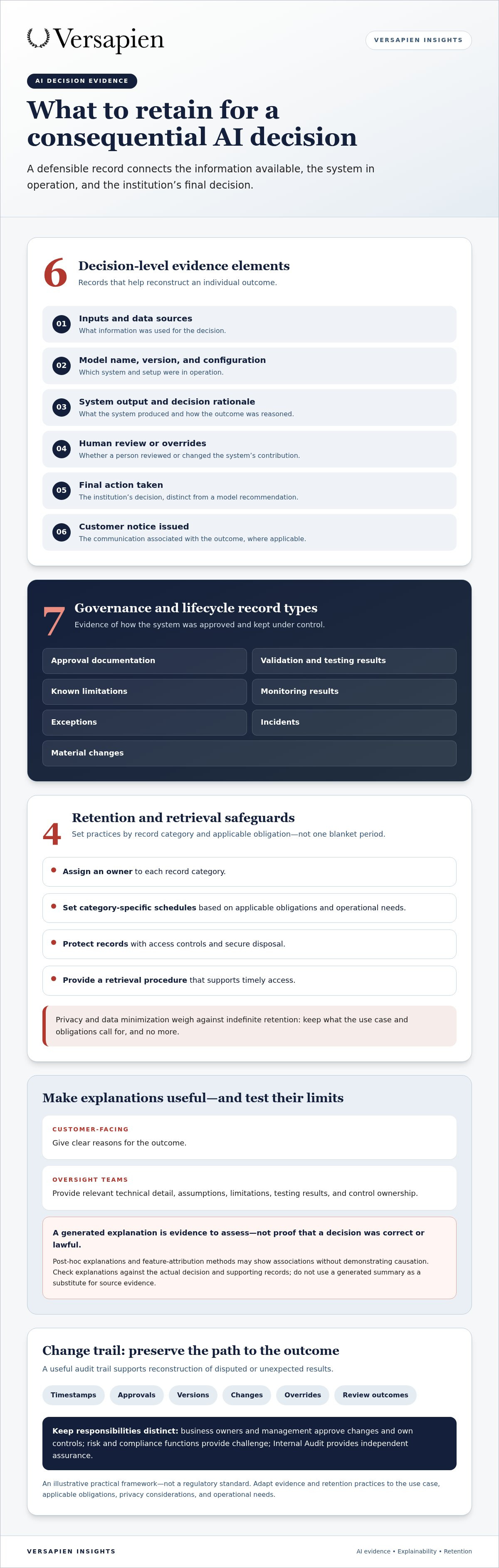
Decision-level evidence lets a reviewer reconstruct a single outcome. For a consequential decision, consider retaining:
inputs and data sources used
model name, version, and configuration in operation
the output and the decision rationale
human review or overrides
the final action taken
any customer notice issued
Together, these records distinguish what the model recommended from what the institution decided.
Governance and Lifecycle Records
Lifecycle records show how the system was approved and kept under control. They include approval documentation, validation and testing results, known limitations, monitoring results, exceptions, incidents, and material changes. For guidance on what to document, see AI Risk Evidence.
Retention, Retrieval, and Protection
Assign an owner to each record category, and set retention schedules by category and applicable obligation rather than by a single blanket period. Pair them with access controls, secure disposal, and a procedure for timely retrieval.
Privacy and data minimization point away from indefinite retention. The Gramm-Leach-Bliley Act (GLBA) privacy and safeguards requirements apply according to the institution, activity, and regulator's jurisdiction; they do not establish a universal AI records-retention period. Retention design should therefore reflect the specific use case, applicable obligations, protection requirements, and legitimate operational need.
Evaluating Explanations and Maintaining Defensible Records
Audience-Specific Explanations
Customer-facing notices should communicate the reasons for a decision clearly and accurately, consistent with applicable requirements. Management, model risk reviewers, auditors, and regulators may need additional evidence, including assumptions, limitations, testing results, and control ownership. Tailoring explanations to their audiences supports transparency, but a generated summary should never substitute for the underlying decision records.
Faithfulness and Limitations
An explanation is evidence to assess, not proof that a decision was correct or lawful. Post-hoc explanations and feature-attribution methods may show associations without demonstrating causation. Validate each explanation against the actual decision and its supporting records, and treat machine-generated analysis as an input to review.
Similar caution is necessary when evaluating fairness. No single metric establishes that an AI-assisted decision is fair, and an observed disparity does not, by itself, establish its cause or demonstrate unlawful discrimination. Select and interpret measures in light of the decision being evaluated, the outcome definition, data quality, and intended use.
Audit Trails and Change Management
An audit trail records changes and relevant actions so that disputed or unexpected results can be reconstructed. Preserve timestamps, approvals, versions, changes, overrides, and review outcomes. For broker-dealers subject to Exchange Act Rule 17a-4, the electronic-record requirements include a time-stamped audit trail for modifications and deletions, including action dates and times and, if applicable, the responsible individual's identity. These requirements apply to the records and entities within that rule's scope, not universally to all AI systems or financial institutions.
Tie review and approval to the nature and impact of the change and to the institution's established decision rights. Routine technical updates differ from changes that materially affect intended use, data, decisions, controls, or affected parties. Business owners and management approve changes and own controls; risk and compliance functions challenge them; Internal Audit provides independent assurance. See AI Change Control for more.
Implementing a Risk-Based Evidence and Retention Framework
The steps below are an illustrative practical framework, not a regulatory standard. Adapt them to the institution's risk appetite, controls, and use cases.
Define Standards by Use Case
Inventory AI applications and classify them by decision impact, applicable obligations, data sensitivity, and operational risk. For each use case, specify the required records and name an accountable owner. A use case that influences credit decisions will warrant a fuller record set than an internal drafting aid.
Test Evidence Quality and Retrieval
Test the standard with a real case. Take a denied credit application and attempt to reconstruct the outcome from retained records alone. Then:
Retrieve the inputs, model version, output, reviewer actions, and final decision.
Compare the reasons in the customer notice with the decision rationale in the record.
Note any missing or conflicting evidence, and log it for remediation.
A customer-servicing complaint can be tested the same way. If the institution cannot retrieve the record, or the explanation conflicts with it, the evidence standard needs work.
Monitor and Improve
Re-evaluate the standard when systems, models, data, purposes, or legal requirements change. Assign owners to remediate identified gaps, and confirm that retention and disposal still reflect applicable obligations and privacy considerations. The aim is a defensible record for each use case, not the retention of every artifact.
Executive Takeaways
Define the evidence standard for each high-impact AI use case before it enters production.
Keep decision-level records that separate the model's output from the institution's final determination.
Separate binding requirements from proposals, advisories, and voluntary frameworks when setting retention expectations.
Treat explanations as evidence to validate against the decision record, not as proof of correctness or lawfulness.
Assign owners for capture, retention, retrieval, and disposal, and align retention with privacy and data minimization.
Test retrieval periodically with real cases, and remediate missing or conflicting evidence.
How Versapien Can Help
Versapien's AI & Digital Transformation Services, Risk Management Consulting, and Regulatory Compliance Advisory can help financial institutions define evidence standards, assess records and explanation practices against applicable obligations, and clarify control responsibilities. For financial crime applications, Financial Crime Compliance can connect these considerations with the institution's compliance program. Contact Versapien to discuss how these issues relate to your organization's AI use cases.



Comments