
AI Governance Maturity: A Roadmap for Financial Institutions
Financial institutions are moving artificial intelligence from controlled experiments into core business processes, from credit underwriting and fraud detection to customer service and marketing. As these use cases proliferate, governance capabilities often develop unevenly, creating gaps between innovation and oversight. The central management challenge is no longer whether to adopt AI, but how to establish governance that is proportionate to the use case and integrated with existing risk, compliance, technology, data, model, and third-party management frameworks.
An ad hoc approach, where individual business lines adopt AI without a central framework, exposes the institution to significant operational, compliance, and reputational risks. A sound AI governance program provides a structured approach to identifying, measuring, monitoring, and controlling these risks, ensuring that the use of AI aligns with the institution’s strategic objectives and risk appetite.
Table of Contents
The Convergence of Artificial Intelligence and Regulatory Oversight
AI governance in financial services is the systemic framework of policies, procedures, controls, and accountabilities ensuring that AI systems operate in a safe, sound, fair, and compliant manner. It addresses the full lifecycle of an AI application, from initial concept and data sourcing through development, validation, deployment, monitoring, and eventual retirement. The objective is to manage the unique risks posed by AI technologies while enabling the institution to realize their benefits.
This requires a careful integration of fast-paced technological development with the deliberate pace of established risk management disciplines. The primary business problem is the potential for a governance gap, where legacy frameworks are not adapted to account for the specific attributes of AI, such as the complexity of algorithms, their potential for rapid change, and their dependence on vast datasets.
Re-evaluating Model Risk Management under SR 11-7
For many banks, the foundational principles of model risk management (MRM), as articulated in documents like the OCC and Federal Reserve’s SR 11-7, remain a critical starting point for AI oversight. The core tenets of robust validation, conceptual soundness, ongoing monitoring, and outcomes analysis are as relevant to AI as they are to traditional statistical models. However, institutions should avoid applying SR 11-7 uniformly to every AI application.
The first step is to determine whether a specific AI system meets the institution's definition of a "model." A simple rules-based automation may not qualify, whereas a complex machine learning system used for credit decisioning almost certainly will. For systems classified as models, the challenge lies in adapting traditional validation cycles to dynamic algorithms that may evolve after their initial deployment. This requires a shift in model risk management from periodic reviews to more continuous performance monitoring and testing against established thresholds.
Identifying the Core Risks of AI-Driven Financial Services
The risks associated with AI in financial services extend beyond model performance. Institutions must consider a broader spectrum of potential issues, including operational, reputational, and compliance risks unique to automated systems. For instance, customer-facing generative AI tools, such as financial advice chatbots, introduce new risks. An inaccurate or inappropriate response generated by such a tool could lead to poor customer outcomes and potential reputational damage. While not necessarily an immediate violation, such incidents can attract regulatory scrutiny under consumer protection standards prohibiting unfair or deceptive acts or practices.
A Maturity Roadmap for AI Governance
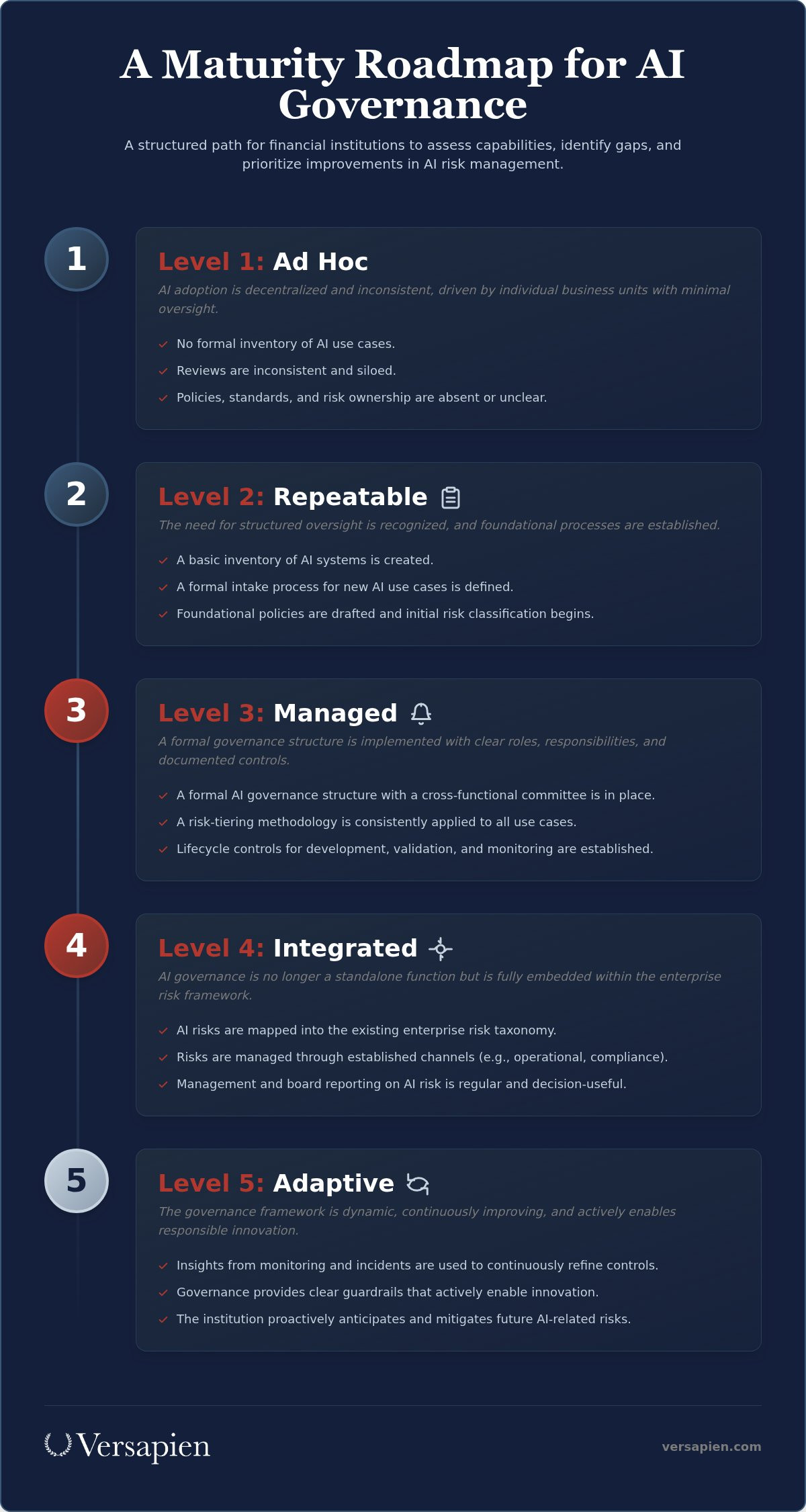
Developing effective AI governance is an evolutionary process. A maturity model provides a structured path for institutions to assess their current capabilities, identify gaps, and prioritize improvements. This roadmap outlines five distinct stages of maturity, allowing an organization to benchmark its progress and plan for a more integrated and adaptive approach to AI risk management.
A visual representation of this journey might take the form of a matrix, with the five maturity levels as columns and key governance domains (e.g., Strategy & Accountability, Policy & Procedures, Risk Identification & Tiering, Lifecycle Controls, and Reporting & Escalation) as rows. This allows an institution to plot its current state and define a target state for each critical area.
Level 1 – Ad Hoc: At this initial stage, AI adoption is typically decentralized and driven by individual business units. There is no formal inventory of AI use cases, and reviews are inconsistent. Policies and standards are largely absent, and risk ownership is unclear.
Level 2 – Repeatable: The institution begins to recognize the need for structured oversight. A basic inventory of AI systems is established, and a formal intake process for new use cases is defined. Foundational policies are drafted, and initial attempts are made to classify AI applications by risk.
Level 3 – Managed: A formal AI governance structure is in place, with clearly defined roles and responsibilities, often including a cross-functional committee. A risk-tiering methodology is consistently applied to categorize use cases. Lifecycle controls for development, testing, validation, and monitoring are established and documented.
Level 4 – Integrated: AI governance is no longer a standalone function but is fully embedded within the enterprise risk management (ERM) program. AI-related risks are mapped into the existing risk taxonomy and managed through established governance channels for operational risk, compliance, third-party risk, and technology. Management and board reporting on AI risk is regular and decision-useful.
Level 5 – Adaptive: The governance framework is dynamic and continuously improving. The institution uses insights from monitoring, incident analysis, and emerging industry practices to refine its controls and policies. Governance actively enables innovation by providing clear guardrails, and there is a proactive approach to anticipating and mitigating future AI-related risks.
Integrating AI into the Enterprise Risk Management Framework
Achieving higher levels of maturity requires treating AI governance not as a new silo but as a critical extension of existing risk management disciplines. The goal is to determine how AI use cases fit within established structures for operational risk, information security, data governance, and third-party risk management. This integration ensures that AI-specific risks are analyzed and controlled with the same rigor as other enterprise risks.
Leveraging the NIST AI Risk Management Framework
The NIST AI Risk Management Framework (AI RMF) provides a valuable, voluntary resource for financial institutions seeking to structure their governance efforts. Rather than prescribing a universal risk classification, the AI RMF guides organizations in developing their own risk-tiering methodology. Institutions can adapt its principles to create a bespoke system that considers factors relevant to their specific context, such as:
The potential for negative customer impact or consumer harm.
The severity of financial, legal, or reputational consequences.
The level of autonomy the AI system possesses in making decisions.
The sensitivity of the data used to train and operate the system.
The degree of explainability or interpretability required for the use case.
The complexity and novelty of the underlying model or technology.
Establishing Board-Level Accountability and Reporting
Effective governance requires clear accountability that extends to executive management and the board of directors. Senior management should establish clear accountability for AI governance and ensure that the Board or appropriate Board committee receives concise, decision-useful reporting on the institution's AI risk profile. This reporting should move beyond technical details to focus on material risks and the effectiveness of corresponding controls. Key indicators may include metrics on model performance drift, the frequency of bias testing for high-risk applications, the status of validation findings, and an overview of emerging AI-related threats. More information on this topic is available in our article on what boards and executive management should know about AI governance.
Addressing Fair Lending and UDAAP Risks in Automated Systems
Supervisory focus on algorithmic bias remains a critical consideration, particularly when AI is used in consumer-facing applications such as lending. Institutions should assess whether automated systems could produce discriminatory outcomes or create other consumer protection risks, with controls tailored to the nature and potential impact of the use case. This includes a risk-based approach to testing, monitoring, and documentation.
For example, under the Equal Credit Opportunity Act (ECOA), lenders must provide specific and accurate reasons for adverse actions, such as a credit denial. When that decision is based on a complex, "black box" algorithm, generating a compliant notice can be challenging. Governance frameworks must account for this by ensuring that lending systems are sufficiently explainable to meet legal and regulatory requirements.
Mitigating Algorithmic Bias in Consumer Finance
For high-risk models used in consumer finance, a robust compliance program often includes proactive measures to mitigate bias. This may involve statistical analysis to identify and address "proxy variables" that could correlate with protected characteristics and lead to disparate impact. A sound practice includes documenting the search for less discriminatory alternative algorithms during the model development process. This documentation can be crucial in demonstrating a commitment to fair lending principles during a regulatory examination on consumer lending compliance.
Transparency and Consumer Protection Considerations
Principles of Unfair, Deceptive, or Abusive Acts or Practices (UDAAP) can also apply to AI-driven marketing and product recommendations. Governance programs should include controls to ensure that AI-powered communications are clear, accurate, and not misleading to consumers. The need for explainable AI (XAI) is not a universal regulatory mandate but becomes a critical control in specific contexts. Where an institution must be able to explain a decision to a customer or a regulator, or where understanding a model's logic is essential for risk management, investing in interpretable models and explanation techniques is a necessary component of a sound control environment.
Actions for Management to Consider
As institutions advance along the AI governance maturity roadmap, senior management and the board should periodically assess their progress by asking a series of fundamental questions. These questions help identify areas for improvement and ensure the governance framework remains effective and aligned with the organization's strategic goals.
Inventory and Risk Tiering: Do we have a sufficiently complete inventory of our material AI use cases across the enterprise? Are these use cases risk-tiered using consistent, well-defined criteria?
Roles and Accountability: Are governance roles, responsibilities, and escalation paths for AI-related risks clearly defined and understood by all stakeholders?
Framework Integration: How are we ensuring that AI risks are integrated into our existing enterprise risk management frameworks, including model risk, third-party risk, operational risk, and compliance?
Proportionate Controls: Are our requirements for testing, validation, monitoring, and documentation proportionate to the risk of each AI use case?
Management and Board Reporting: Is the information provided to senior management and the board on AI risk decision-useful? Does it allow them to provide effective challenge and oversight?
Adaptability: How will our governance framework adapt as AI technology, internal use cases, and external expectations continue to evolve?
By systematically addressing these questions, financial institutions can strengthen their governance capabilities, identify gaps between their current and target maturity levels, and prioritize improvements based on the risks presented by their AI use cases.


Comments