
AI Implementation for Risk Management in Consumer Financial Services
The potential for artificial intelligence to enhance risk management in consumer financial services is clear, but the path from concept to effective implementation is not. Financial institutions often face a wide array of potential AI applications, yet not every risk management problem is a suitable candidate for an AI solution. The critical management challenge is moving beyond technological possibility to a disciplined evaluation of business value, operational readiness, and regulatory durability.
Before committing significant resources, leadership must determine which problems are worth solving with AI, whether the technology is likely to improve the current process, and if the necessary data is available and reliable. A structured approach is required to assess the risks an implementation could introduce, define how success will be measured, and establish clear criteria for when a pilot should be scaled, redesigned, or discontinued. This article provides a practical framework for selecting, prioritizing, piloting, and scaling AI use cases within a risk management program, ensuring that innovation is aligned with sound governance and measurable outcomes.
Table of Contents
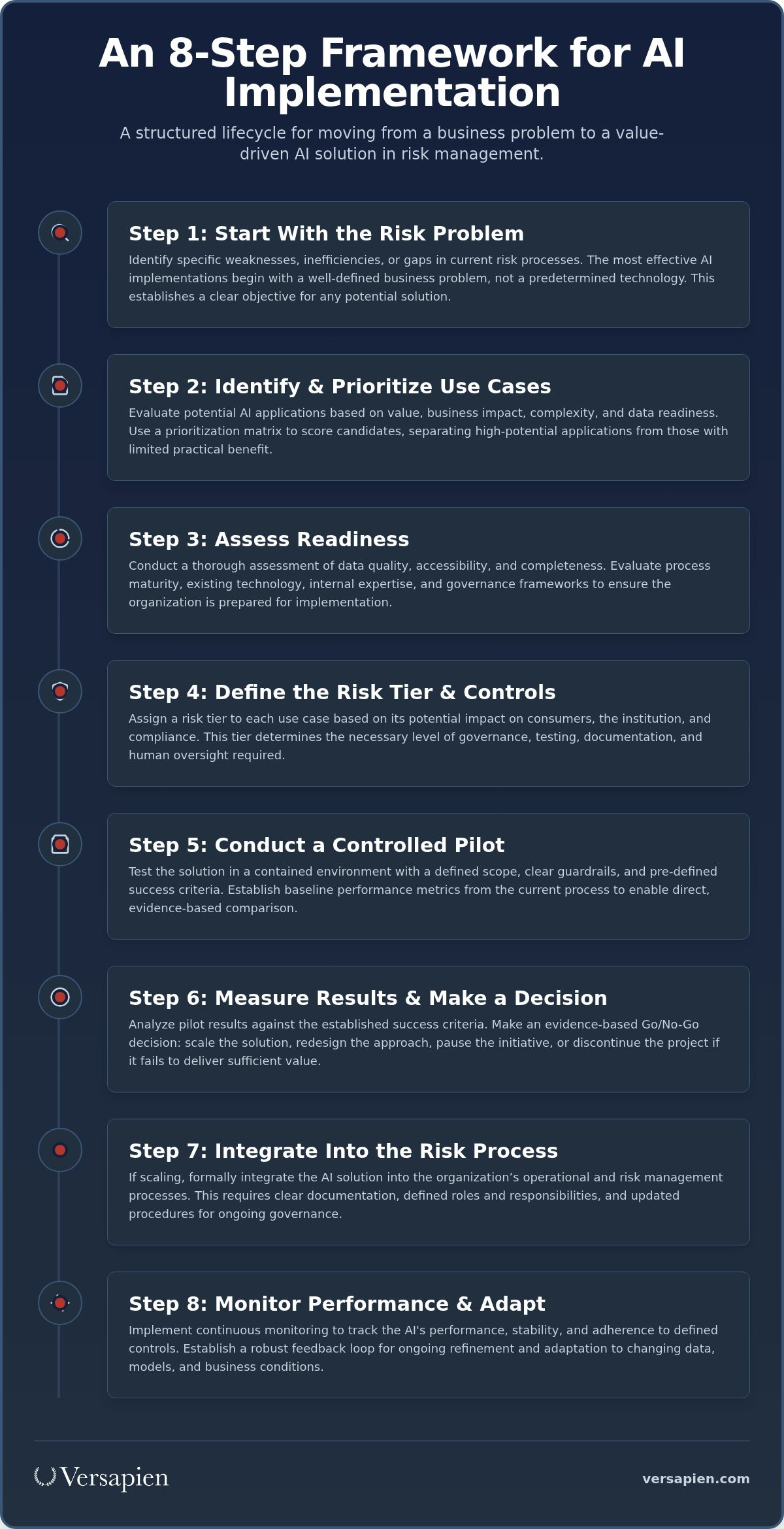
An 8-Step Framework for AI Implementation in Risk Management
A successful AI implementation for risk management depends less on the sophistication of the algorithm and more on the rigor of the implementation process itself. The following eight-step lifecycle provides a structured path from identifying a business problem to integrating a monitored, value-driven AI solution into the organization’s risk management framework.
Step 1: Start With the Risk Problem, Not the Technology
Step 2: Identify and Prioritize Candidate AI Use Cases
Step 3: Assess Organizational and Data Readiness
Step 4: Define the Risk Tier and Appropriate Controls
Step 5: Conduct a Controlled Pilot Program
Step 6: Measure Results and Make a Go/No-Go Decision
Step 7: Integrate Into the Risk Management Process
Step 8: Monitor Performance and Adapt Over Time
Step 1: Start With the Risk Problem, Not the Technology
The most effective AI implementations begin with a well-defined business or risk management problem, not a predetermined technological solution. The initial focus should be on identifying specific weaknesses, inefficiencies, or gaps in current risk processes. For example, a compliance department may be struggling with the high volume of false positives in its transaction monitoring system, or an operational risk team may lack the tools to analyze unstructured data from consumer complaints. By clearly articulating the limitations of the existing process, the organization can establish a clear objective for any potential AI solution.
Step 2: Identify and Prioritize Candidate AI Use Cases
Once a problem is defined, the next step is to evaluate potential AI use cases. This evaluation should be a multi-faceted analysis that considers expected value, business impact, implementation complexity, data readiness, and potential risks. A prioritization matrix can be a useful tool, scoring candidates against criteria such as potential for cost reduction, improvement in risk detection, impact on customer experience, and alignment with strategic goals. This process helps separate high-potential applications from those that are technologically interesting but offer limited practical benefit.
Step 3: Assess Readiness
A promising use case can fail if the organization is not prepared for implementation. A thorough readiness assessment is critical, examining several key areas. Data quality, accessibility, and completeness are critical considerations and can significantly influence the performance and reliability of an AI solution. The assessment must also consider process maturity, existing technology capabilities, and the availability of internal expertise. Dependencies on third-party vendors and the applicability of existing governance frameworks must also be evaluated to ensure the organization has the foundational elements in place to support the project. A clear-eyed view of these factors can prevent costly missteps and delays.
Step 4: Define the Risk Tier and Appropriate Controls
Not all AI use cases carry the same level of risk. An AI tool used to summarize regulatory publications has a different risk profile from one that influences credit decisions. Each use case should be assigned a risk tier based on its potential impact on consumers, the institution, and regulatory compliance. This tier determines the necessary level of governance and control. Higher-risk applications may warrant more extensive testing, documentation, human oversight, and ongoing monitoring. Depending on the nature of the use case and the institution's governance framework, some applications may also fall within the scope of formal model risk management. Lower-risk use cases may require less stringent, but still clearly defined, controls.
Step 5: Conduct a Controlled Pilot
Before a full-scale rollout, a controlled pilot is essential to test the AI solution in a contained environment. The pilot must have a clearly defined scope, established guardrails to prevent unintended consequences, and pre-defined success criteria. A crucial element of the pilot is establishing baseline performance metrics from the current process. This allows for a direct, evidence-based comparison of the AI solution's effectiveness. The goal is to gather empirical data on the model's performance, identify operational challenges, and refine the implementation plan based on real-world results.
Step 6: Measure Results and Make a Decision
At the conclusion of the pilot, the project team must analyze the results against the established success criteria. Did the AI solution deliver the expected improvements in efficiency or accuracy? Did it introduce any new or unexpected risks? The decision of whether to proceed should be based on this evidence. The possible outcomes are not limited to a simple yes or no. Management may decide to scale the solution as planned, redesign the approach based on pilot findings, pause the initiative pending further data or technological maturity, or discontinue the project entirely if it fails to deliver sufficient value.
Step 7: Integrate Into the Risk Management Process
If the decision is made to scale, the AI solution must be formally integrated into the organization’s operational and risk management processes. This is more than a technical handoff; it requires clear definition of ownership, standard operating procedures, and escalation paths for exceptions or issues. Change management is critical to ensure that affected employees understand their new roles and responsibilities. Reporting mechanisms must be established to provide ongoing visibility to management and other stakeholders, creating a clear line of accountability for the solution’s performance.
Step 8: Monitor and Adapt
The implementation process does not end at deployment. Ongoing monitoring is essential to ensure the AI solution continues to perform as intended and deliver the expected benefits. This includes tracking key performance indicators, monitoring for model drift or degradation, and identifying emerging risks. The environment in which the AI operates is dynamic; consumer behaviors, market conditions, and regulatory requirements all change. The organization must have a process for adapting the AI solution to these material changes, ensuring its long-term effectiveness and durability.
Practical Applications: From Problem to Pilot
To illustrate this framework, consider several practical examples from consumer financial services. Rather than attempting to cover all possible applications, these use cases demonstrate how a structured approach can be applied to common risk management challenges.
Use Case: Complaint and Issue Analysis
The Problem: A mid-sized consumer lender receives thousands of customer complaints and inquiries through various channels. Manually reviewing and categorizing this unstructured data is slow, resource-intensive, and prone to inconsistency, making it difficult to identify systemic issues or emerging risks in a timely manner.
The AI Application: A natural language processing (NLP) model could be trained to automatically ingest, classify, and analyze complaint data. The model could identify recurring themes, detect potential UDAAP concerns, and flag high-risk issues for immediate human review, providing a more comprehensive and timely view of conduct risk.
Key Risks and Limitations: The model's accuracy is highly dependent on the quality and volume of historical training data. Misclassification of a serious complaint could delay remediation. The model may also struggle with novel issues or industry-specific jargon not present in its training set.
Measuring Success: Success could be measured by the reduction in manual review time, the increased speed of issue identification (time from complaint receipt to escalation), and the accuracy of the model's classifications compared to a human-audited sample.
Use Case: Fraud or Financial Crime Alert Prioritization
The Problem: A fintech’s BSA/AML transaction monitoring system generates a high volume of alerts, the majority of which are false positives. Analysts spend a significant amount of time reviewing low-risk alerts, which can delay the investigation of genuinely suspicious activity and increase operational costs.
The AI Application: A machine learning model can be developed to score and rank alerts based on a wide range of variables, moving beyond simple rule-based triggers. This allows analysts to focus their attention on the highest-risk alerts first, improving the efficiency and effectiveness of the financial crime compliance function. For more on this, see Versapien’s analysis of BSA/AML program modernization.
Key Risks and Limitations: An incorrectly calibrated model could suppress a legitimate high-risk alert, creating a compliance gap. The institution should maintain documentation and validation evidence appropriate to the model's role, risk, and potential impact, including how the alert-prioritization approach is tested and monitored. The model also requires ongoing tuning to adapt to new fraudulent typologies.
Measuring Success: Key metrics would include a reduction in the false positive rate, an increase in the number of productive investigations (alerts leading to SAR filings), and a decrease in the average time to disposition for high-risk alerts.
Use Case: Regulatory Change Management
The Problem: The compliance team at a national mortgage originator must track regulatory changes from multiple federal and state agencies. The manual process of monitoring sources, identifying relevant changes, and assessing their impact on business policies and procedures is time-consuming and carries the risk of missing a critical update.
The AI Application: An AI-powered tool can monitor regulatory publications, legal updates, and supervisory guidance in near-real time. It can identify and summarize changes relevant to the institution's specific business lines and map them to internal controls and policies, flagging potential gaps for the compliance team to address.
Key Risks and Limitations: The tool may misinterpret the nuance of legal or regulatory text, or it may fail to identify the applicability of a change to a unique business process. It is an assistive tool, not a replacement for legal and compliance expertise. Over-reliance on the tool without human verification is a significant risk.
Measuring Success: Success would be demonstrated by a reduction in the hours spent on manual monitoring, faster identification of applicable regulatory changes, and a decrease in the number of internal audit or regulatory findings related to outdated policies.
Executive Takeaways: Questions to Guide AI Implementation
Before scaling an AI pilot or committing to a new implementation, executive management (and, where appropriate, the Board or relevant Board committee) should have clear answers to a set of fundamental questions. These questions serve as a final governance check, confirming that the initiative is grounded in a sound business case and a durable risk management approach.
What specific risk problem are we solving, and have we clearly defined the limitations of our current process?
Is AI likely to provide a measurable improvement over the existing approach, and what is the evidence supporting that conclusion?
Is the underlying data—and the governance surrounding it—sufficiently reliable to support this use case?
What new risks could this solution introduce, including operational, compliance, and third-party risks? For a deeper dive, consider the framework for managing AI vendor risk.
What level of controls, testing, and human oversight is appropriate for the risk profile of this implementation?
How will we measure success, and what specific, quantifiable metrics will be used?
Who has the authority to decide whether to scale, redesign, or stop the project based on the pilot results?
How will the solution’s performance and risk profile be monitored after full implementation, and who is accountable for its ongoing effectiveness?


Comments