
AI Implementation for Risk Management in Consumer Financial Services
Updated: Sep 22
Artificial intelligence is rapidly moving from experimentation to implementation across consumer financial services. For risk and compliance leaders, AI implementation for risk management presents a dual mandate: harnessing its analytical capabilities to improve decision-making and operational effectiveness while establishing governance frameworks capable of withstanding regulatory scrutiny.
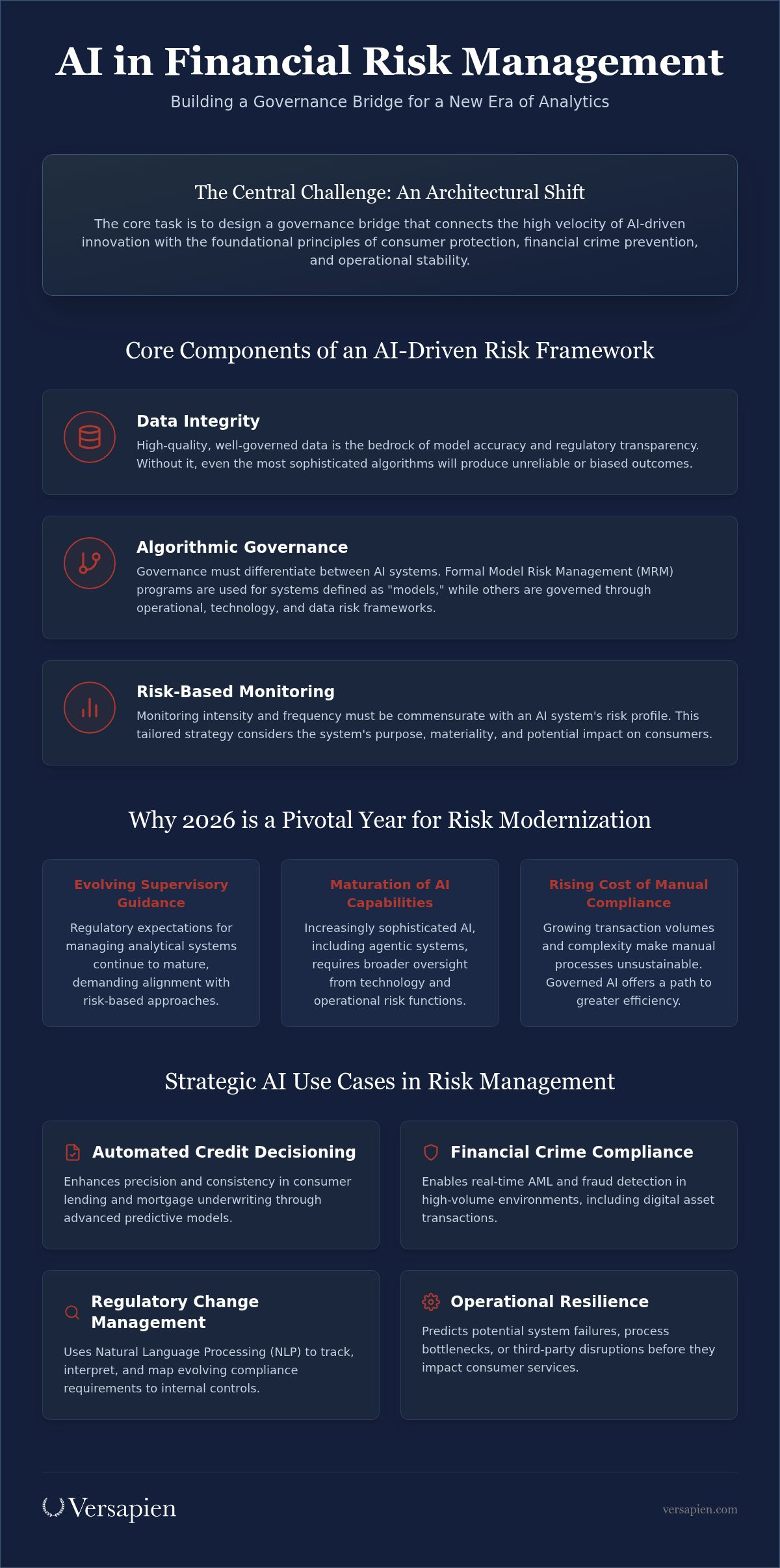
The central challenge is not merely technological but architectural. It involves designing a governance bridge that connects the high velocity of AI-driven innovation with the foundational principles of consumer protection, financial crime prevention, and operational stability. Success depends on a disciplined approach that aligns data integrity, algorithmic governance, and risk-based monitoring with the institution’s specific risk appetite and business objectives.
Table of Contents
Defining AI Implementation for Risk Management in 2026
In the context of consumer finance, AI-driven risk management is the systematic integration of machine learning and other advanced analytical systems into an institution’s governance, risk, and compliance (GRC) frameworks. This marks a fundamental departure from traditional, backward-looking assessments that rely on historical data and periodic reviews. Instead, AI enables a shift toward real-time, predictive modeling that can identify, measure, and mitigate risk as it emerges.
This evolution transforms disparate, manual data silos into an integrated and intelligent risk ecosystem. For institutions operating in high-velocity sectors like consumer lending, auto finance, and digital assets, this modernization is not just an efficiency gain; it is a prerequisite for maintaining competitiveness and managing the complexity of a digital-first economy.
The Core Components of an AI-Driven Risk Framework
Data Integrity: High-quality, well-governed data is the bedrock of model accuracy, predictive power, and regulatory transparency. Without it, even the most sophisticated algorithms will produce unreliable or biased outcomes.
Algorithmic Governance: The governance structure must be sophisticated enough to differentiate between AI systems. For analytical systems that fall within the applicable definition of a “model,” a formal model risk management (MRM) program provides the necessary structure. For other AI systems, governance must be established through operational, technology, data, and third-party risk frameworks.
Risk-Based Monitoring: The intensity and frequency of monitoring for AI systems should be commensurate with their risk profile. This involves moving away from a one-size-fits-all approach toward a tailored strategy where monitoring is appropriate to the system’s purpose, use, materiality, and potential impact on consumers or the institution.
Why 2026 is a Pivotal Year for Risk Modernization
2026 Model Risk Management Reset: In April 2026, the federal banking agencies issued revised interagency model risk management guidance, SR 26-2 , replacing long-standing supervisory guidance and reinforcing a more tailored, risk-based approach. The revised guidance also clarifies that generative and agentic AI fall outside its formal scope, increasing the importance of broader enterprise governance for emerging AI use cases.
Maturation of AI Capabilities: The increasing sophistication of AI, including agentic systems capable of executing complex tasks, requires a parallel evolution in governance. These systems may not fit traditional model definitions, demanding broader oversight from technology, cybersecurity, and operational risk functions.
The Rising Cost of Manual Compliance: As transaction volumes and regulatory complexity grow, the cost and inherent limitations of manual compliance processes become unsustainable. AI implementation offers a path to improve effectiveness and efficiency, but only if governed correctly.
Strategic AI Use Cases Across the Risk Management Lifecycle
AI implementation offers tangible benefits across the primary functions of risk management, from front-line decisioning to back-office compliance. By automating analysis and identifying patterns invisible to human reviewers, AI can enhance precision, reduce operational friction, and strengthen an institution’s overall risk posture.
Automated Credit Decisioning: Enhancing precision and consistency in consumer lending and mortgage underwriting through advanced predictive models.
Financial Crime Compliance: Enabling real-time AML and fraud detection in high-volume environments, including digital asset transactions.
Regulatory Change Management: Using natural language processing (NLP) to track, interpret, and map evolving compliance requirements to internal policies and controls.
Operational Resilience: Predicting potential system failures, process bottlenecks, or third-party disruptions before they impact consumer services.
AI in Consumer Lending and Auto Finance
In direct-to-consumer lending, AI systems can drive significant improvements in risk assessment and operational efficiency. Predictive delinquency models can help institutions mitigate credit losses by identifying at-risk borrowers earlier in the lifecycle. For fair lending, bias-detection algorithms can be used during model development and monitoring to assess and mitigate potential disparities. In mortgage and auto loan originations, AI can streamline document verification and data extraction, reducing manual effort and accelerating funding times.
Financial Crime and Digital Asset Oversight
For institutions managing financial crime risk, particularly those with exposure to digital assets, AI provides critical capabilities. Sophisticated AI systems can enhance transaction monitoring by identifying complex, multi-layered illicit financing typologies that evade traditional rule-based systems. In Know Your Customer (KYC) and Bank Secrecy Act (BSA) workflows, AI can reduce false positives, allowing compliance teams to focus their resources on higher-risk alerts. For firms acting as institutional crypto custodians or exchanges, AI can provide increasingly valuable capabilities for managing BSA/AML risk at scale, particularly where transaction volumes, typologies, and data complexity exceed the practical limits of traditional rule-based approaches.
Navigating the Regulatory Bridge: Compliance and Governance
A primary concern for financial institutions is that the complexity of certain AI systems can create “black box” decisioning that is difficult to explain, validate, or defend during regulatory examinations. The appropriate response is not to avoid AI, but to establish governance that emphasizes transparency, documentation, validation, accountability, and appropriate human oversight. The concept of Explainable AI (XAI) is central to this effort, providing techniques to make model decisioning processes understandable to stakeholders, including model users, senior management, and regulators.
Aligning an AI governance program with established frameworks like the NIST AI Risk Management Framework provides a solid foundation. However, for financial institutions, this must be supplemented with a deep understanding of specific supervisory expectations from agencies like the CFPB, OCC, and the Federal Reserve.
Aligning AI Innovation with Supervisory Expectations
Institutions must first determine whether a given AI or analytical system falls within the applicable definition of a “model.” The federal banking agencies’ revised interagency model risk management guidance, issued in April 2026 through Federal Reserve SR 26-2 and OCC Bulletin 2026-13 , defines a model as a complex quantitative method, system, or approach that applies statistical, economic, or financial theories to process input data into quantitative estimates. The guidance is expected to be most relevant to banking organizations with more than $30 billion in total assets, although it may also be relevant to smaller institutions with significant exposure to model risk.
Where an AI system meets this definition, MRM practices should be applied. This involves documenting model development, validation, and limitations to a standard that can withstand third-party scrutiny and effective challenge. However, it is equally important to recognize that not all AI systems fall within the scope of formal model risk guidance. The revised interagency guidance specifically excludes generative and agentic AI models from its scope, reflecting the agencies’ view that these technologies are novel and rapidly evolving. For systems outside the model risk framework, institutions should determine appropriate governance and controls through their broader risk management practices, which may include technology, operational, cybersecurity, data governance, third-party, compliance, and other relevant risk frameworks. The role of human-in-the-loop (HITL) also remains a key control, particularly for high-stakes decisions impacting consumers.
Governance as a Stability Mechanism
Effective governance provides the stability required for sustainable innovation. This begins with establishing clear board-level oversight for the institution’s AI strategy and implementation projects. A dedicated AI governance committee or similar function can ensure accountability and provide a forum for cross-functional risk assessment. Management must also create measurable key performance indicators (KPIs) for AI-driven risk reduction, ensuring that technology investments deliver tangible results. This structured approach to governance ensures the AI program remains durable and adaptable as the regulatory landscape evolves.
The AI Implementation Roadmap: From Strategy to Execution
A successful AI implementation for risk management follows a structured, phased approach that moves methodically from initial assessment to ongoing optimization. This ensures that projects are properly scoped, governed, and integrated into the broader enterprise risk framework.
Phase 1: Diagnostic Assessment. The first phase involves identifying high-impact risk areas where AI can deliver the most value. This includes a thorough inventory of existing data sources and an assessment of any gaps in data quality or availability that could hinder model performance.
Phase 2: Framework Design. This phase focuses on building the governance and compliance architecture. It includes classifying AI systems to determine the appropriate governance path—whether through a formal MRM program or other risk frameworks—and establishing policies for data handling, model development, and validation.
Phase 3: Controlled Pilot. Before a full-scale rollout, institutions should test AI systems within a controlled environment and establish clear success criteria, risk limits, escalation procedures, and human oversight requirements. The pilot should evaluate not only model or system performance, but also data quality, control effectiveness, user behavior, potential consumer impacts, and the institution’s ability to identify and respond to unexpected outcomes.
Phase 4: Scaled Integration. Once a pilot is successful, the AI system can be deployed across core risk and resilience functions. This phase requires careful change management and training to ensure that business users understand the system’s capabilities and limitations.
Phase 5: Ongoing Monitoring and Refinement. AI implementation is not a one-time project. The final phase involves ongoing, risk-based monitoring and iterative model refinement to ensure that systems continue to perform as expected and remain aligned with the institution’s risk tolerances.
Data Preparation and Integrity
The success of any AI initiative is predicated on the quality of the underlying data. Legacy data often requires significant cleaning and normalization to create high-fidelity training sets. Establishing clear data governance policies is also essential to protect consumer privacy and ensure compliance with data protection regulations. Ultimately, data hygiene—the practice of maintaining clean, accurate, and well-governed data—is the primary predictor of success in AI implementation.
Program and Project Management for AI
The technical complexity and regulatory sensitivity of AI projects demand a high degree of project management discipline. Structured milestones, clear communication channels, and rigorous change management are essential for balancing the need for rapid innovation with regulatory requirements. Where specialized expertise is needed, external advisors can help institutions accelerate framework design, establish governance structures, assess AI use cases, and build implementation capabilities. The objective, however, should be to strengthen sustainable internal ownership and capabilities rather than create long-term dependency on outside support.
Executive Takeaways
For boards and senior management, overseeing the implementation of AI in risk management requires asking the right questions to ensure that innovation is pursued responsibly and sustainably. The focus should be on the integrity of the underlying governance framework rather than on the technical details of the algorithms themselves.
System Classification: Does our AI inventory clearly distinguish between systems that meet the supervisory definition of a “model” and those governed under other risk frameworks (e.g., operational, technology, third-party)?
Risk-Based Governance: Is our approach to AI validation, monitoring, and documentation appropriately risk-based? Or are we applying a costly one-size-fits-all methodology that does not align resources with the systems that pose the greatest potential risk?
Oversight for Non-Model AI: For systems like generative or agentic AI that fall outside formal model risk guidance, what specific governance framework is in place, and which executive is accountable for managing the associated risks?
Third-Party Dependency: For AI systems sourced from third-party vendors, have we conducted sufficient due diligence and independent validation to understand their performance, limitations, and compliance with our internal standards, or are we overly reliant on vendor assurances?
How Versapien Can Help
Versapien helps financial institutions design and implement practical risk, compliance, governance, and transformation frameworks for emerging technologies. Our approach focuses on helping organizations move from AI strategy and experimentation to sustainable, risk-based implementation.



Comments