
Auto Finance Compliance: Emerging Regulatory Risks and Governance
The auto finance industry is navigating a period of intense regulatory focus, where legacy compliance practices are no longer sufficient to manage emerging risks. Federal and state examiners are applying heightened scrutiny to long-standing industry practices, from indirect lending and dealer compensation to the use of automated systems in underwriting. For Chief Risk and Compliance Officers, the challenge is not simply to keep pace with new rules but to re-evaluate the fundamental design of their compliance management systems (CMS) to withstand this pressure.
Regulators, particularly the Consumer Financial Protection Bureau (CFPB), are looking beyond technical adherence to rules, focusing instead on consumer outcomes. This shift requires a compliance function that is deeply integrated with business operations, capable of identifying and mitigating potential consumer harm before it materializes into enforcement actions, litigation, or reputational damage.
Table of Contents
Evolving Regulatory Scrutiny and UDAAP Interpretations
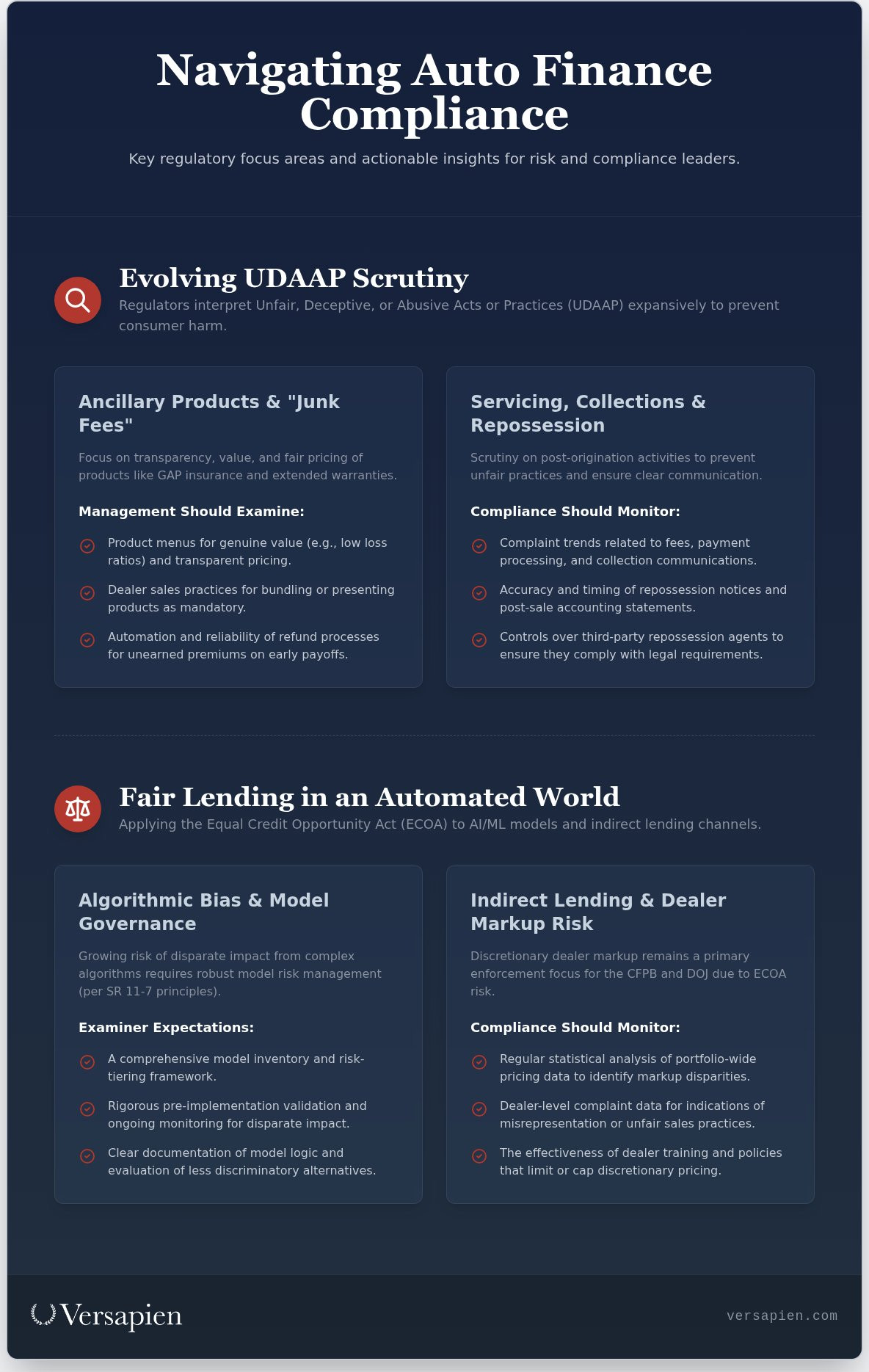
The regulatory landscape for auto finance is being reshaped by an expansive interpretation of Unfair, Deceptive, or Abusive Acts or Practices (UDAAP). This principle is now the primary lens through which regulators examine core auto lending activities, moving compliance from a checklist-based function to a risk-based discipline centered on preventing consumer harm.
Ancillary Products and "Junk Fees"
A significant area of regulatory concern involves the sale and financing of ancillary products, such as Guaranteed Asset Protection (GAP) insurance, extended warranties, and credit insurance. Examiners are focused on whether consumers are pressured into buying these products, whether the costs and terms are transparently disclosed, and whether the products provide a genuine benefit. The CFPB has signaled its intent to scrutinize products that offer little value or are priced unfairly, labeling them as potential "junk fees."
What management should examine:
Review the entire product menu for value and pricing. Are there products with extremely low loss ratios or high cancellation rates?
Assess sales practices at the dealer level. Are products bundled or presented as mandatory?
Ensure refund processes for unearned premiums (e.g., after an early loan payoff or repossession) are automated and reliable. Failure to issue timely refunds is a consistent source of UDAAP findings.
Servicing, Collections, and Repossession
Compliance risks do not end after loan origination. Servicing and repossession activities are under a microscope for potentially unfair practices. This includes the accuracy of deficiency balances, the handling of personal property in repossessed vehicles, and the use of starter-interruption devices. Examiners expect firms to have robust controls to prevent wrongful repossessions and to ensure all consumer communications are clear and accurate.
What compliance should monitor:
Complaint trends related to servicing fees, payment processing, and collection communications.
The accuracy and timing of repossession notices and post-sale accounting statements.
Controls over third-party repossession agents to ensure they comply with legal requirements and company policies.
Fair Lending in an Automated World: Models and Dealer Oversight
The Equal Credit Opportunity Act (ECOA) remains a cornerstone of auto finance compliance, but its application is growing more complex. The proliferation of machine learning (ML) models in underwriting and the inherent risks of the indirect lending model require a more sophisticated approach to fair lending oversight.
Algorithmic Bias and Model Governance
As lenders increasingly rely on complex algorithms and alternative data to make credit decisions, the risk of discriminatory outcomes, or disparate impact, grows. Even if a model does not use prohibited characteristics like race or national origin, its inputs may act as proxies, leading to biased results. Regulators expect lenders to understand, test, and be able to explain their models’ decisions.
While not all automated systems fall under the formal definition of a "model" subject to regulatory guidance like the Office of the Comptroller of the Currency (OCC) and the Federal Reserve's SR 11-7, the principles of sound model risk management represent the supervisory expectation for any lender using complex underwriting systems. This includes rigorous validation, ongoing performance monitoring, and clear documentation.
What an examiner expects to see:
A comprehensive model inventory and risk-tiering framework.
Robust pre-implementation validation and ongoing monitoring for fair lending risk, including testing for disparate impact using methodologies like the Adverse Action Ratio or Marginal Effects analysis.
Documentation demonstrating that the lender understands the model’s logic and has evaluated less discriminatory alternatives if significant disparities are found.
Indirect Lending and Dealer Markup Risk
The indirect lending model, where lenders purchase loans originated by auto dealers, presents a persistent fair lending challenge. Discretionary dealer markup, where dealers can add to the interest rate offered by the lender, has been a consistent focus of enforcement actions by the CFPB and the Department of Justice (DOJ). When dealer discretion results in protected groups paying higher markups on average, it creates significant risk under ECOA.
Effective oversight requires more than just policies. Lenders are expected to actively monitor their dealer partners for potential discrimination and take corrective action when issues are identified. This includes analyzing loan data for disparities in markup and providing clear guidance or establishing controls, such as caps on discretionary adjustments.
What compliance should monitor:
Regular statistical analysis of dealer-specific and portfolio-wide pricing data to identify disparities in markup across prohibited bases.
Dealer-level complaint data and any indications of misrepresentation or unfair sales practices.
The effectiveness of dealer training programs and the enforcement of policies limiting discretionary pricing.
Building a Defensible Compliance Management System (CMS)
A modern CMS is not a static set of policies and procedures; it is a dynamic system designed to identify, measure, monitor, and control compliance risk. For auto lenders, this system must be tailored to the specific risks of the business, particularly those related to third-party oversight and complex products. An effective way to assess the strength of a CMS is to evaluate its maturity across key functional areas.
The Auto Finance Compliance Maturity Matrix
This matrix provides a framework for assessing a compliance program’s current state and identifying a clear path toward a more resilient, optimized model. It moves beyond a simple pass/fail view, allowing leadership to target specific areas for investment and improvement.
Board Oversight and Examination Readiness
Ultimately, the responsibility for a sound compliance culture rests with the Board of Directors and senior management. Regulators expect leadership to be actively engaged, setting a clear tone from the top and holding the organization accountable for its compliance performance. A passive or uninformed Board is a significant red flag during an examination.
To fulfill their oversight duties, Board members and executive leaders should be prepared to ask probing questions that go beyond surface-level reports. These inquiries demonstrate engagement and help ensure that management is proactively addressing the most critical risks.
Key Questions for the Board and Risk Committee
Dealer Oversight: How do we risk-rate our dealer partners, and what actions do we take when a dealer is identified as high-risk for fair lending or UDAAP violations?
Fair Lending Analytics: What were the results of our most recent fair lending analysis for pricing and underwriting? Were any statistically significant disparities identified, and what was the documented business justification or corrective action?
Ancillary Products: Which of our ancillary products have the highest complaint and cancellation rates? What analysis has been done to ensure these products provide a tangible benefit to consumers?
Model Governance: For our automated underwriting system, can management explain how it works in simple terms? How have we tested it for bias, and what were the results?
Complaint Root Cause: What are the top three systemic issues identified through our complaint analysis in the last quarter, and what is the action plan to address them?
Repossession Controls: What controls do we have in place to prevent wrongful repossessions, and what is our error rate? How do we oversee our third-party repossession agents?
Regulatory Preparedness: If we were to be examined by the CFPB tomorrow, what would be our one or two greatest areas of vulnerability, and what is our remediation plan? An honest answer to this question is a sign of a mature risk culture. See our guide on preparing for a banking regulatory exam for common compliance gaps.
Executive Takeaways
The heightened regulatory environment demands more than incremental adjustments to auto finance compliance programs. It requires a strategic shift toward a proactive, data-driven, and integrated approach to risk management. For executive leadership, the focus should be on building a durable compliance framework that not only satisfies examiners but also strengthens the institution's market standing and customer trust.
The path forward involves several key actions:
Conduct a Gap Analysis: Use a maturity framework to conduct an honest assessment of the current CMS against regulatory expectations and best practices, particularly in dealer oversight and fair lending.
Invest in Data and Analytics: Upgrade the tools and talent needed to effectively monitor pricing, underwriting models, and complaint data for emerging risks. Manual sampling and spreadsheets are no longer adequate.
Strengthen Third-Party Governance: Treat dealer and vendor oversight as a critical risk management function, with clear accountability, robust monitoring, and decisive enforcement actions.
Empower the Board: Equip the Board with the information and expertise necessary to provide effective challenge and oversight of the compliance program.
Navigating the complexities of modern auto finance compliance is a significant undertaking, but one that is essential for sustainable growth. By embedding a strong risk culture and building a resilient compliance infrastructure, lenders can meet regulatory demands while fostering a fair and transparent marketplace. The advisory work performed by firms like Versapien often focuses on helping institutions build these capabilities, moving them from a reactive posture to a state of sustained compliance readiness.


Comments