
Auto Finance Compliance: Emerging Regulatory Risks and Governance
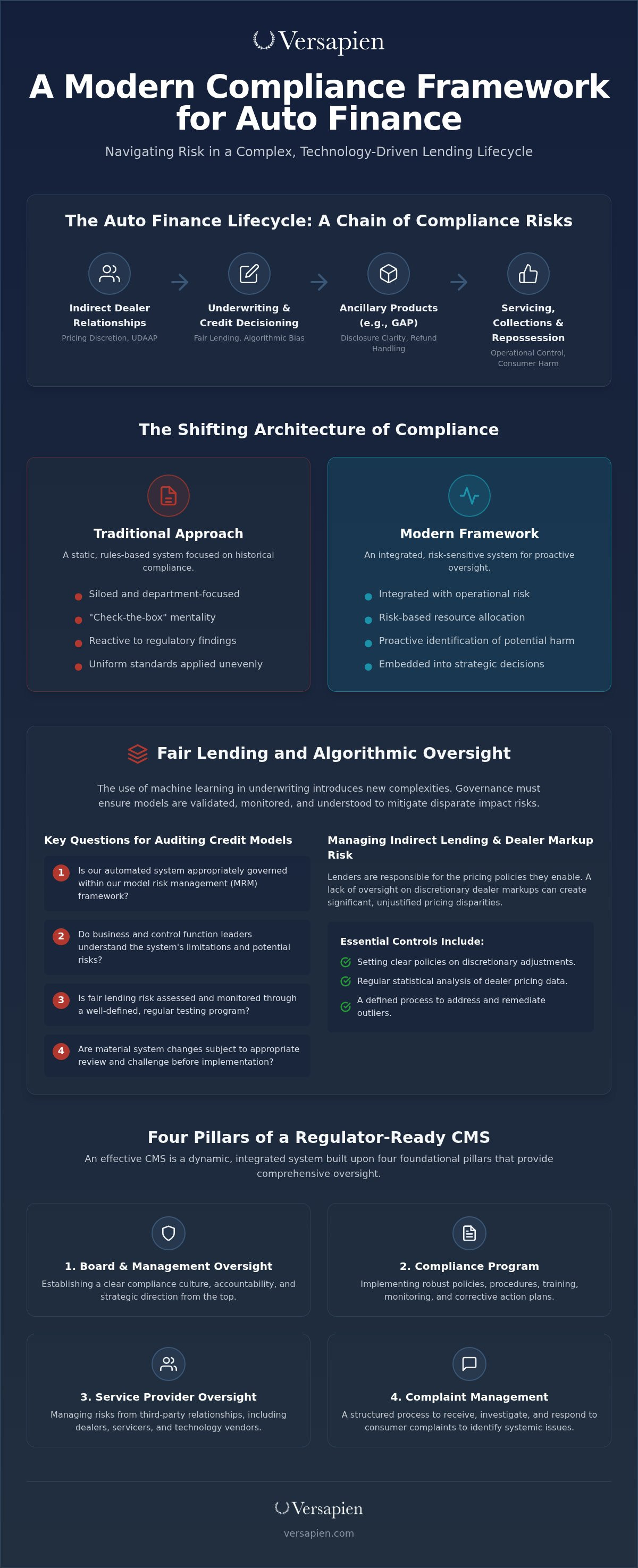
Auto finance companies face a persistent challenge: maintaining effective compliance oversight across a complex and distributed operational lifecycle. Risks can arise from numerous sources, including indirect dealer relationships, pricing discretion, the sale of ancillary products, underwriting and credit decisioning, and the full spectrum of servicing, collections, and repossession activities. As these processes become increasingly automated, the need for an integrated and risk-sensitive governance framework becomes more critical.
For senior risk and compliance executives, the central question is how to evolve their compliance management system (CMS) to provide robust oversight without impeding business operations. This requires integrating compliance considerations into significant business, product, technology, and operational decisions. A modern auto finance compliance framework is an integrated system of consumer protection, data integrity, and operational resilience designed to identify and mitigate risk proactively.
Table of Contents
The Shifting Architecture of Auto Finance Compliance
The effectiveness of an auto finance compliance program is determined by its ability to adapt to changes in business strategy, technology, and the regulatory environment. An institution's charter, business model, product mix, and risk profile all influence supervisory focus. A risk-based governance model allows firms to allocate resources to the areas of highest potential consumer harm or operational failure, rather than applying a uniform, check-the-box standard across the organization. This is particularly important for national lenders that must also account for a complex patchwork of state-level privacy, lending, and servicing laws.
Regulatory Pressures and UDAAP Implications
Regulatory bodies continue to communicate their focus on potential Unfair, Deceptive, or Abusive Acts or Practices (UDAAP) across the lending lifecycle. Areas that can create significant consumer compliance risk include servicing practices, the handling of GAP insurance cancellations and refunds, repossession practices, ancillary products, and related disclosures. Institutions should consider whether their consumer disclosures and digital contracting processes provide sufficient transparency, particularly regarding ancillary products and fees. A pattern of consumer complaints related to these areas can signal a weakness in controls and may attract examiner scrutiny.
The Intersection of Compliance and Operational Risk
In auto finance, compliance failures are frequently intertwined with operational risk. A weakness in the oversight of a third-party repossession agent, for example, is both a consumer compliance issue and an operational control gap. When governance frameworks fail to connect these functions, issues can escalate, leading to potential consumer harm, regulatory action, and reputational damage. Integrating compliance monitoring with broader operational risk management provides a more holistic view of an institution's risk profile, allowing management to identify and address systemic weaknesses before they result in significant financial or regulatory consequences.
Fair Lending and Algorithmic Oversight in Auto Credit
The Equal Credit Opportunity Act (ECOA) and its implementing Regulation B remain cornerstones of auto finance compliance. The increasing use of machine learning models and alternative data in underwriting and pricing introduces new complexities for fair lending oversight. While these technologies offer significant efficiency gains, they also require robust governance to identify and mitigate the risk of disparate impact, where a neutral policy or practice has a disproportionately adverse effect on a protected class.
For institutions where automated underwriting or pricing systems are designated as models under their model risk management (MRM) framework, the principles outlined in guidance such as SR 11-7 may provide a relevant structure for governance. This includes ensuring appropriate model validation, ongoing performance monitoring, documentation, and independent review and challenge. The objective is to ensure management understands the model's limitations and risks and that fair lending considerations are assessed throughout the model's lifecycle. Refer to Versapien's insights on the structure of AI governance committees and board oversight for further analysis of this topic.
Auditing Complex Credit Models
A primary challenge with complex, non-linear credit models is ensuring their decisions are explainable and their outcomes are fair. Management should consider several practical questions:
Is our automated underwriting or pricing system appropriately governed within our risk management framework?
Does the business line and control function leadership understand the system's significant limitations and potential risks?
Is fair lending risk assessed and monitored through a well-defined testing program?
Are material changes to the system subject to appropriate review and challenge before implementation?
Developing a consistent testing cadence to detect and analyze potential disparities in credit and pricing outcomes is a critical component of a sound compliance program.
Indirect Lending and Dealer Markup Risks
In the indirect auto lending model, the discretionary nature of dealer markups can create heightened fair lending risk. Because lenders are responsible for the pricing policies they enable, a lack of oversight can lead to disparities that are not justified by creditworthiness or other objective criteria. Establishing a robust monitoring framework for third-party dealer networks is essential. This includes setting clear policies on discretionary adjustments, conducting regular statistical analysis of dealer-specific pricing data to identify outliers, and implementing a clear process for addressing identified issues. Effective third-party risk management is not just a best practice; it is a fundamental requirement for managing the compliance risks inherent in this business model.
Building an Effective Auto Finance Compliance Management System (CMS)
An effective Compliance Management System is a dynamic, integrated system rather than a static set of policies and procedures. A useful framework for consumer compliance management includes four interdependent components: Board and management oversight, a compliance program, consumer complaint response, and compliance audit.
Within those components, effective oversight of service providers, dealers, and other third parties should be integrated into the institution's broader governance, risk assessment, monitoring, and issue-management processes. The specific structure and level of oversight should reflect the institution's business model, products, operational complexity, and risk profile.
For auto finance companies, an effective CMS should also connect these components across the lending lifecycle, from dealer relationships and product design through underwriting, pricing, servicing, collections, repossession, complaint management, and remediation.
Furthermore, a well-functioning complaint management system serves as a critical early warning indicator for systemic issues. Analyzing complaint data for trends and performing root-cause analysis can help institutions identify and remediate problems with products, services, or third-party conduct before they escalate into widespread compliance violations or attract regulatory attention.
Framework: The Auto Finance Compliance Maturity Matrix
Institutions can assess the maturity of their CMS by evaluating its key attributes. This matrix provides a framework for comparing different states of compliance program development, focused on increasing integration, consistency, and management visibility.
Preparing for CFPB and Federal Reserve Examinations
Examinations of auto finance operations often reveal common gaps. These can include insufficient oversight of third-party service providers (especially repossession agents), weaknesses in fair lending monitoring programs for dealer markups, and inadequate processes for handling consumer complaints and disputes. Institutions can prepare by conducting self-assessments or independent reviews against supervisory expectations, ensuring that documentation is organized and that management is prepared to demonstrate the effectiveness of its CMS. Proactively identifying and remediating these gaps is a hallmark of a mature compliance program.
Key Considerations for Management
A sound compliance culture requires active oversight from the Board of Directors and accountable execution by senior management. While the Board provides strategic direction and effective challenge, management is responsible for the design, implementation, and operation of the compliance program. To ensure the program remains effective and aligned with the institution’s risk profile, management should consider the following actions:
Assess Dealer and Third-Party Oversight: Review the governance framework for all dealer and third-party relationships, ensuring that risk-based monitoring, performance standards, and corrective action protocols are clearly defined and consistently executed.
Review Pricing Discretion and Fair Lending Monitoring: Evaluate the controls over discretionary pricing, and validate that the fair lending monitoring program is statistically sound and capable of identifying and explaining disparities at the portfolio and dealer levels.
Evaluate Ancillary Product Practices: Examine the end-to-end process for ancillary product sales, cancellations, and refunds to confirm that practices are transparent, consumer-friendly, and aligned with regulatory expectations and contractual obligations.
Use Data to Identify Systemic Issues: Leverage complaint, operational, and quality assurance data to perform robust root-cause analysis, identifying systemic issues that may require changes to policies, procedures, systems, or training.
Validate Servicing and Collections Controls: Confirm that controls over key servicing, collections, and repossession activities are well-documented and operating effectively to prevent consumer harm.
Ensure Appropriate Escalation and Remediation: Verify that significant compliance issues are escalated to the appropriate levels of management and the Board in a timely manner and that remediation plans are comprehensive and tracked to completion.
Provide Decision-Useful Reporting: Ensure that reporting to management and the Board is concise, risk-focused, and provides the necessary information to facilitate effective oversight and strategic decision-making.
By focusing on these areas, auto finance leadership can strengthen their governance frameworks and position their compliance programs as a key component of sound business management.


Comments