
Building a Compliance Program for High-Growth Fintech Companies
High-growth fintech companies face an operational paradox: the need for rapid product iteration and market expansion often conflicts with the deliberate, structured pace of regulatory compliance. The central challenge is not a lack of intent, but the absence of an operating model that allows compliance capabilities to scale in tandem with the business. A reactive approach ofadding policies, controls, and personnel only after problems emerge creates friction, invites regulatory scrutiny, and accumulates organizational debt that eventually stalls growth.
A scalable compliance program is built on a deliberate framework that connects product development, regulatory requirements, risk assessment, ownership, and governance. It requires building the right capabilities at the right stage of growth, transforming fintech risk management from a defensive necessity into a foundational component of sustainable expansion. This article outlines a four-stage maturity model for building a compliance program that evolves with the business, focusing on the specific capabilities and management decisions required at each phase.
Table of Contents
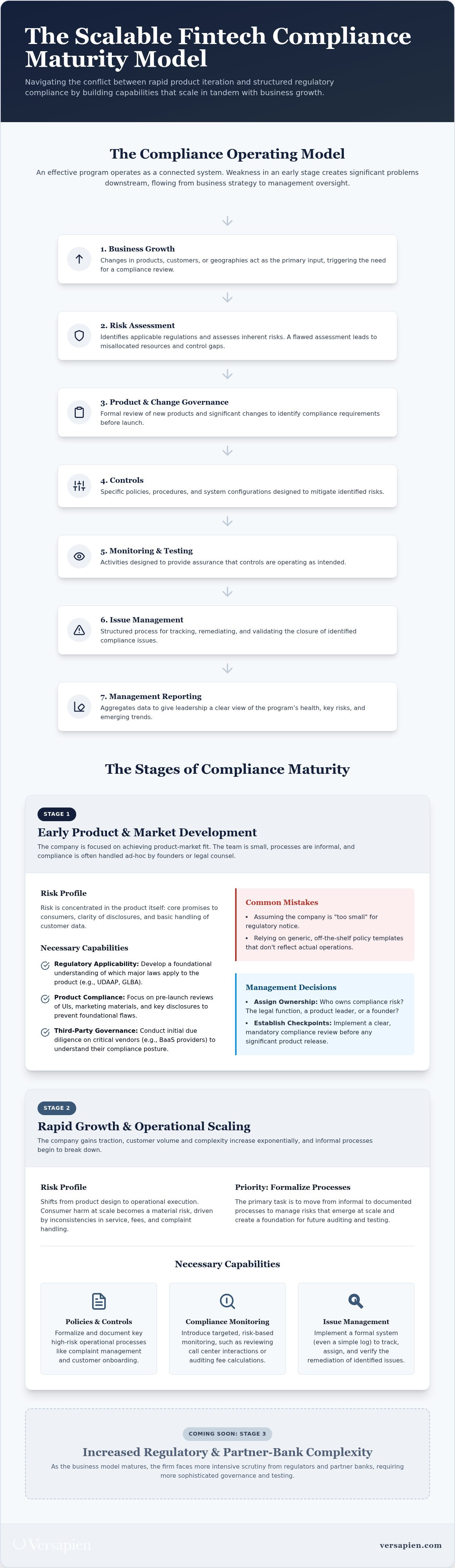
The Scalable Fintech Compliance Operating Model
An effective compliance program operates as a connected system, not a series of disconnected activities. Weakness in an early stage of the process inevitably creates significant problems downstream. This operating model illustrates the logical flow of a scalable compliance framework, where each component builds upon the last to create a defensible and efficient structure.
Business Growth: Changes in products, customers, geographies, or activities act as the primary input, triggering the need for a compliance review.
Risk Assessment: The process of identifying applicable regulations and assessing the inherent risks associated with business changes. A flawed risk assessment leads to misallocated resources and control gaps.
Product & Change Governance: A formal process for reviewing new products and significant operational changes to identify compliance requirements before launch. Without it, compliance becomes a reactive cleanup exercise.
Controls: The specific policies, procedures, and system configurations designed to mitigate the identified risks. Controls that are not based on a sound risk assessment are often ineffective or inefficient.
Monitoring & Testing: Activities designed to provide assurance that controls are operating as intended. If controls are poorly designed, monitoring and testing will consistently generate negative findings.
Issue Management: A structured process for tracking, remediating, and validating the closure of identified compliance issues. A weak issue management process allows known problems to persist, signaling a poor compliance culture to regulators and partners.
Management Reporting: The aggregation of data from the preceding stages to give leadership a clear view of the compliance program’s health, key risks, and emerging trends. Without this, executives lack the information needed for strategic oversight.
Stage 1: Early Product and Market Development
In the initial stage, the company is focused on achieving product-market fit. The team is small, processes are informal, and the primary goal is building a viable product. Compliance is often an afterthought, handled on an ad-hoc basis by founders or legal counsel.
Risk Profile and Necessary Capabilities
The risk profile is concentrated in the product itself. The primary exposures relate to core promises made to consumers, the clarity of disclosures, and the basic handling of customer data. The key is to build a foundation that does not have to be completely dismantled later.
Regulatory Applicability: The most critical capability is developing a foundational understanding of which major federal and state laws apply to the product. This includes baseline requirements for marketing (UDAAP), privacy (GLBA), and any specific rules governing the core offering (e.g., payments, lending).
Product Compliance: Compliance involvement should focus on pre-launch reviews of user interfaces, marketing materials, and key disclosures. The goal is to prevent foundational design flaws that are difficult to correct later.
Third-Party Governance: For fintechs reliant on critical vendors (e.g., BaaS providers, data aggregators), initial due diligence is essential to understand their compliance posture and codify responsibilities.
Common Mistakes and Management Decisions
A common mistake at this stage is to assume the company is "too small" for regulatory notice or to rely on generic, off-the-shelf policy templates that do not reflect actual operations. This creates a false sense of security and can embed non-compliant processes early on.
Management must make a critical decision: who owns compliance risk? Is it assigned to the legal function, a product leader, or a founder? Clarifying this ownership is the first step in building accountability. The leadership team should also establish a clear checkpoint for a compliance review before any significant product is released to the public.
Stage 2: Rapid Growth and Operational Scaling
As the company gains traction, it experiences rapid growth in its customer base, transaction volumes, and employee count. Operational and regulatory complexity increases significantly as the business scales. What worked for 1,000 customers fails for 100,000.
Risk Profile and Necessary Capabilities
The risk profile shifts from product design to operational execution. The potential for consumer harm at scale becomes a material risk, driven by inconsistencies in customer service, fee assessments, and complaint handling. The company's brand and reputation become more valuable and more vulnerable.
Policies, Procedures, and Controls: The priority is to formalize and document key operational processes. This is not about creating a large policy library, but about documenting how high-risk activities like complaint management, customer onboarding, and payment processing are actually performed.
Compliance Monitoring: The company should introduce targeted, risk-based monitoring. This could involve reviewing call center interactions for adherence to scripts, auditing fee calculations, or sampling marketing campaigns for disclosure accuracy.
Issue Management: A formal system—even a simple one—is needed to track, assign, and verify the remediation of identified issues. An Excel log is better than nothing; it demonstrates a commitment to correcting deficiencies.
Regulatory Change Management: A process must be established to identify, analyze, and implement relevant changes in the regulatory environment.
Common Mistakes and Management Decisions
The most frequent error is under-investing in compliance expertise. Many firms hire a junior compliance analyst and expect them to build a comprehensive program, an unrealistic and dangerous expectation. Another pitfall is creating policies that are disconnected from operational reality, which are quickly ignored by business lines and serve only as "shelfware."
Management must decide how to resource the compliance function. This involves determining the right mix of in-house staff and external expertise. Leaders must also empower the compliance function with the authority to challenge business decisions and ensure that escalation paths are clear when significant risks are identified. A key resource for this stage is understanding how to begin modernizing a compliance management system to handle this new scale.
Stage 3: Increased Regulatory and Partner-Bank Complexity
At this stage, the fintech is no longer under the radar. Its scale attracts the attention of regulators, competitors, and sophisticated partners, most notably sponsor banks. The company may be expanding into new jurisdictions or product lines, each with its own set of rules.
Risk Profile and Necessary Capabilities
The risk of a formal regulatory enforcement action, a damaging audit finding, or the loss of a critical sponsor-bank relationship becomes the dominant concern. The company must be able to demonstrate, not just assert, that it has a functioning compliance program.
Formalized Risk Assessment: The ad-hoc regulatory analysis of Stage 1 must mature into a documented, repeatable compliance risk assessment process. This framework should identify inherent risks, assess the quality of controls, and determine the residual risk level.
Compliance Testing: The company should establish a sufficiently independent and objective approach to testing key controls, with the degree of formality reflecting the company's size, complexity, and risk profile. This involves evaluating whether key controls are designed appropriately and operating effectively over time.
Robust Third-Party and Partner-Bank Governance: Oversight of critical partners must become more rigorous. This includes enhanced due diligence, clear contractual obligations, performance monitoring, and providing reliable reporting to meet the expectations of sponsor banks and their regulators. Effective third-party risk management is no longer optional.
Management Reporting: Reporting to senior leadership and the board must mature from anecdotal updates to data-driven insights. This includes metrics on issue aging, testing results, complaint trends, and key risk indicators (KRIs).
Common Mistakes and Management Decisions
A significant mistake is underestimating the depth of due diligence required by sponsor banks and their regulators (e.g., the OCC or FDIC). Fintechs often fail to provide the evidence and assurance their partners need, straining the relationship. Another error is treating compliance reporting as a bureaucratic exercise, failing to use the data to make informed business decisions.
Management must ensure the compliance function is appropriately resourced, independent, and has a direct line of communication to the executive team and the board. Leaders must ask whether they have a clear, evidence-based view of the company’s most significant compliance risks and the status of remediation efforts.
Stage 4: Mature Governance and Sustainable Scale
The fintech now operates with the scale and complexity of a mature financial institution. The primary challenge is no longer building capabilities but ensuring they remain effective, efficient, and integrated across a larger, more complex organization.
Risk Profile and Necessary Capabilities
The risk profile is now enterprise-wide. The focus shifts to maintaining a demonstrable culture of compliance, managing risks across diverse product lines, and ensuring the governance structure can effectively oversee emerging threats. The company may face increasingly formal oversight from regulators, partner institutions, auditors, or other stakeholders, depending on its regulatory structure, products, and business model.
Integrated Governance: The company should operate a well-defined governance model, such as the three lines of defense, where roles and responsibilities between the business, compliance, and internal audit are clearly delineated and understood.
Board Oversight: The board's governance structure should be appropriate for the company's size and risk profile. This may involve a dedicated risk committee or a clear cadence of in-depth compliance reporting and review at the full board level.
Data-Driven Program Management: The compliance function should use data analytics and KRIs not just for reporting but for proactively identifying risk concentrations and allocating resources. The goal is to anticipate problems, not just react to them. For those facing this reality, it is useful to review common compliance gaps found during regulatory exams.
Common Mistakes and Management Decisions
At this stage, the primary danger is that the compliance program becomes a bureaucratic bottleneck that stifles innovation. The "three lines" may exist on paper but fail in practice, with poor communication and overlapping responsibilities. The board may receive voluminous reports but lack the concise, actionable insights needed for effective oversight.
The executive team and board must regularly assess the effectiveness of their governance model. They should consider whether the board has the right mix of expertise to oversee the company’s evolving risk profile. A key management focus is on measuring the effectiveness of the compliance program and driving continuous improvement, ensuring that the firm's approach to fintech risk management remains a source of strength.
Executive Takeaways
Building a scalable compliance program requires leaders to move beyond a reactive posture. It demands a forward-looking approach that aligns compliance investment with business growth. Senior management and boards should consider the following questions to assess their organization’s maturity:
Is our compliance function scaling ahead of business growth, or is it constantly reacting to problems, audit findings, and partner-bank pressures?
Are new products and significant business changes formally reviewed for compliance implications before key decisions are finalized and resources are committed?
Are ownership and accountability for compliance risks clearly defined across the business lines, compliance, legal, risk, and operations?
Can senior management and the board readily identify the company’s most significant compliance issues and the status of corresponding remediation efforts?
Are the responsibilities between our company and our critical third parties, especially sponsor banks, clearly documented, understood, and monitored?


Comments