
Consumer Lending Compliance: Preparing for Increased Regulatory Scrutiny
Table of Contents
The Challenge: Moving Beyond Reactive Compliance
Consumer lenders face increasing pressure to demonstrate that their compliance management systems can keep pace with changes in products, technology, customer expectations, and regulatory priorities. The challenge is not simply understanding individual regulations; it is determining whether the organization can identify emerging risks, translate requirements into effective controls, detect problems, and respond before weaknesses become significant issues. Increased regulatory scrutiny is best addressed by strengthening the underlying compliance management system—not by preparing for the next examination after it has been scheduled.
An effective Compliance Management System (CMS) is not a static set of policies and procedures. It is a dynamic, interconnected framework that links regulatory change, risk assessment, product governance, controls, monitoring, complaints, issue management, and executive oversight. When any part of this system is weak, the entire structure is compromised, creating vulnerabilities that can lead to consumer harm, regulatory findings, and costly remediation. This article outlines a practical framework for evaluating and strengthening the core components of a modern consumer lending compliance program.
A Framework for Proactive Consumer Lending Compliance
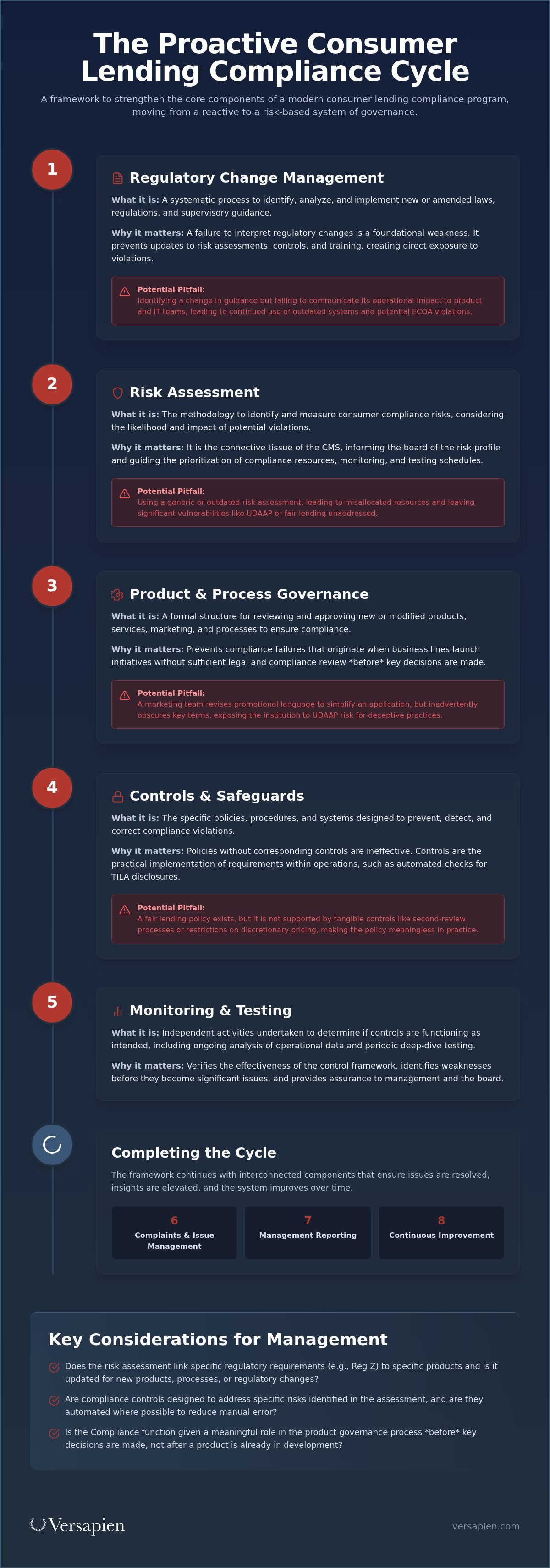
A robust CMS can be viewed as a continuous cycle where each component informs the next. This structure enables an organization to move from a reactive, checklist-based approach to a proactive, risk-based system of governance. Weakness in one area can create downstream risk in others.
The Consumer Lending Compliance Management Cycle includes:
Regulatory Change Management
Risk Assessment
Product & Process Governance
Controls & Safeguards
Monitoring & Testing
Complaints & Issue Management
Management Reporting
Continuous Improvement
1. Regulatory Change Management
What it is: The process for identifying, analyzing, and disseminating information about new or amended laws, regulations, and supervisory guidance relevant to consumer lending.
Why it matters: A failure to properly identify and interpret regulatory changes is a foundational weakness. Without a systematic process, an organization cannot update its risk assessments, controls, or training, leaving it exposed to violations. This process must go beyond simply subscribing to news alerts; it requires a structured evaluation of how changes from the Consumer Financial Protection Bureau (CFPB), prudential regulators, and state authorities impact specific products, services, and operations.
What can go wrong: The compliance function identifies a change in guidance on collecting and evaluating certain types of customer data but fails to communicate the operational impact to the product and IT teams. As a result, the institution continues to use outdated data fields in its automated underwriting system, creating a potential violation of the Equal Credit Opportunity Act (ECOA) and Regulation B.
2. Risk Assessment
What it is: The methodology for identifying and measuring the consumer compliance risks inherent in the institution’s products, services, and activities. A strong risk assessment considers the likelihood and impact of potential violations.
Why it matters: The risk assessment is the connective tissue of the CMS. It informs the board and senior management of the institution’s risk profile and provides the basis for prioritizing compliance resources, including monitoring and testing schedules. A generic or outdated risk assessment leads to a misallocation of resources, with teams focusing on low-risk issues while significant vulnerabilities,such as those related to UDAAP (Unfair, Deceptive, or Abusive Acts or Practices) or fair lending, go unaddressed.
What should management consider: Does the risk assessment process link specific regulatory requirements (e.g., Regulation Z disclosure rules) to specific products (e.g., a new digital-first credit card)? Is it updated when new products are launched, processes are automated, or significant regulatory changes occur? A well-executed risk assessment provides a foundation for prioritizing compliance activities and allocating resources across the entire regulatory compliance advisory program.
3. Product & Process Governance
What it is: The formal structure for reviewing and approving new or modified consumer lending products, services, marketing campaigns, and operational processes to ensure compliance with applicable laws.
Why it matters: Many compliance failures originate here, when business lines launch initiatives without sufficient compliance and legal review. Effective governance requires compliance to have a meaningful seat at the table before key decisions are made, not after a product is already in development. This is especially critical for digital lending platforms, where changes to user interfaces, fee structures, or automated communication can be implemented rapidly.
What can go wrong: A marketing team, seeking to simplify the online application process, revises the language around a promotional interest rate. The new language inadvertently obscures key terms and conditions. Because the change was not reviewed through a formal governance process, the institution exposes itself to UDAAP risk for deceptive practices. The problem is only discovered months later through customer complaints.
4. Controls & Safeguards
What it is: The specific policies, procedures, and systems designed to prevent, detect, and correct compliance violations. Controls are the practical implementation of regulatory requirements within business operations.
Why it matters: Policies without corresponding controls are ineffective. For example, a fair lending policy is meaningful only if it is supported by controls such as documented underwriting criteria, second-review processes for marginal applications, and restrictions on discretionary pricing exceptions. In an environment of increasing automation, controls over algorithms, data inputs, and adverse action notices under Regulation B are critical components of a sound risk management framework.
What should management consider: Are controls designed to address the specific risks identified in the risk assessment? Are they automated where possible to reduce manual error? For example, a control that prevents a loan from being disbursed before all required Truth in Lending Act (TILA) disclosures are delivered and acknowledged is far more effective than a post-closing manual review.
5. Monitoring & Testing
What it is: The independent activities undertaken to determine whether controls are functioning as intended. Monitoring often involves ongoing analysis of operational data, while testing involves more periodic, in-depth reviews of specific processes or transactions.
Why it matters: This is how management and the board gain assurance that the CMS is working. Without robust monitoring and testing, an institution is effectively flying blind, unaware of control weaknesses until they are identified by auditors or examiners. This function should be risk-based, focusing its resources on the areas of greatest potential consumer harm, such as loan pricing, collections practices, and denial decisions.
What can go wrong: A lender introduces a new, automated pricing model intended to provide more competitive rates. The compliance testing plan, however, continues to focus on manual underwriting processes and does not include a statistical analysis of the new model’s outcomes. Six months later, an internal review reveals that the model, while facially neutral, is producing statistically significant pricing disparities for applicants in majority-minority census tracts, creating significant fair lending risk.
6. Complaints & Issue Management
What it is: The system for capturing, analyzing, and resolving consumer complaints and for tracking and remediating all identified compliance issues, regardless of their source (e.g., testing, audits, examinations).
Why it matters: Complaints are a critical source of risk intelligence. A rising trend in complaints about a specific fee or a confusing monthly statement is an early warning indicator of a potential UDAAP issue or disclosure weakness. An effective issue management program ensures that once a weakness is identified, it is assigned ownership, given a corrective action plan with a clear timeline, and tracked to completion. A weak issue management process can raise concerns during audits and examinations because it may indicate that identified deficiencies are not being addressed effectively.
What can go wrong: The customer service department logs a growing number of complaints about delays in processing loan payments, resulting in unwarranted late fees. The complaints are resolved on a case-by-case basis by refunding the fees, but the data is not aggregated or analyzed by the compliance function. The root cause (e.g., a flaw in a new third-party payment processing system) goes unaddressed, allowing the consumer harm to continue and expand.
7. Management Reporting
What it is: The process of summarizing and communicating compliance performance, risks, and issue remediation status to senior management and the board of directors.
Why it matters: Effective board oversight is impossible without clear, concise, and actionable reporting. Reports should be more than a simple list of completed tasks; they should provide insight into risk trends, the status of significant corrective actions, and results from monitoring and testing. This information enables leadership to challenge assumptions, allocate resources, oversee significant risks and issues, and monitor progress on remediation. A well-structured reporting framework is a key element in building a compliance program that can scale with the business.
What should management consider: Does our reporting clearly distinguish between inherent and residual risk? Can the board easily identify the most significant compliance issues facing the organization and understand the progress toward resolving them? Do reports include key risk indicators (KRIs), such as complaint volumes by product or fair lending monitoring results?
8. Continuous Improvement
What it is: The commitment to using the outputs of the CMS—such as testing results, complaint trends, and audit findings—to refine and strengthen the program over time.
Why it matters: The compliance environment is not static, and neither is the business. A CMS that does not evolve will quickly become ineffective. The final step in the cycle is to ensure that lessons learned are fed back into the system. For example, a testing finding that reveals a control weakness should trigger not only a correction of that specific issue but also a review of the underlying risk assessment and control design to prevent recurrence.
Executive Takeaways
Strengthening a consumer lending compliance program is a continuous governance responsibility, not a one-time project. For senior management and the board, overseeing this process requires asking probing questions that test the integrity of the CMS cycle:
Risk Identification: Are we identifying emerging consumer compliance risks early enough, or are we consistently surprised by audit or examination findings?
Integration: Are compliance considerations fully integrated into our product development and process change initiatives from the beginning?
Risk Intelligence: What are our complaint trends and testing results telling us about actual customer outcomes and potential UDAAP risks?
Prioritization: Is our compliance monitoring and testing plan truly risk-based, focusing resources on the areas of greatest potential harm?
Visibility: Can senior management and the board clearly see the status of our most significant compliance issues and the progress of remediation efforts?
Root Cause Analysis: Are we addressing recurring problems at their root cause, or are we merely treating the symptoms?
By focusing on the health of the underlying system, lenders can build a more durable compliance framework and better manage the risks inherent in consumer lending.


Comments