
Operational Risk Management in an AI-Enabled Financial Institution
Fragmented silos, regulatory escalation, and opaque algorithmic models now define the modern financial landscape. While many institutions still treat operational risk management as a reactive compliance exercise, the most resilient firms are repositioning it as a core strategic asset. The mounting pressure from DORA and the Basel III endgame make it increasingly difficult to quantify operational health for the Board. It's a common frustration to see risk data trapped in disparate departments while the 2026 U.S. Treasury Financial Services AI Risk Management Framework demands a more holistic view.
This analysis provides an executive roadmap for evolving your risk function from a defensive cost center into a unified resilience framework. We'll examine how to align with the latest FDIC model risk guidance and the EU AI Act's transparency requirements without stifling innovation. By the end of this discussion, you'll understand how to develop regulator-ready remediation plans that offer the transparency needed for high-stakes strategic decision-making. We'll move beyond generic compliance to focus on a governance model that provides a steadying force in a complex environment.
Table of Contents
The Evolution of Operational Risk: Beyond Process Failures to Strategic Resilience
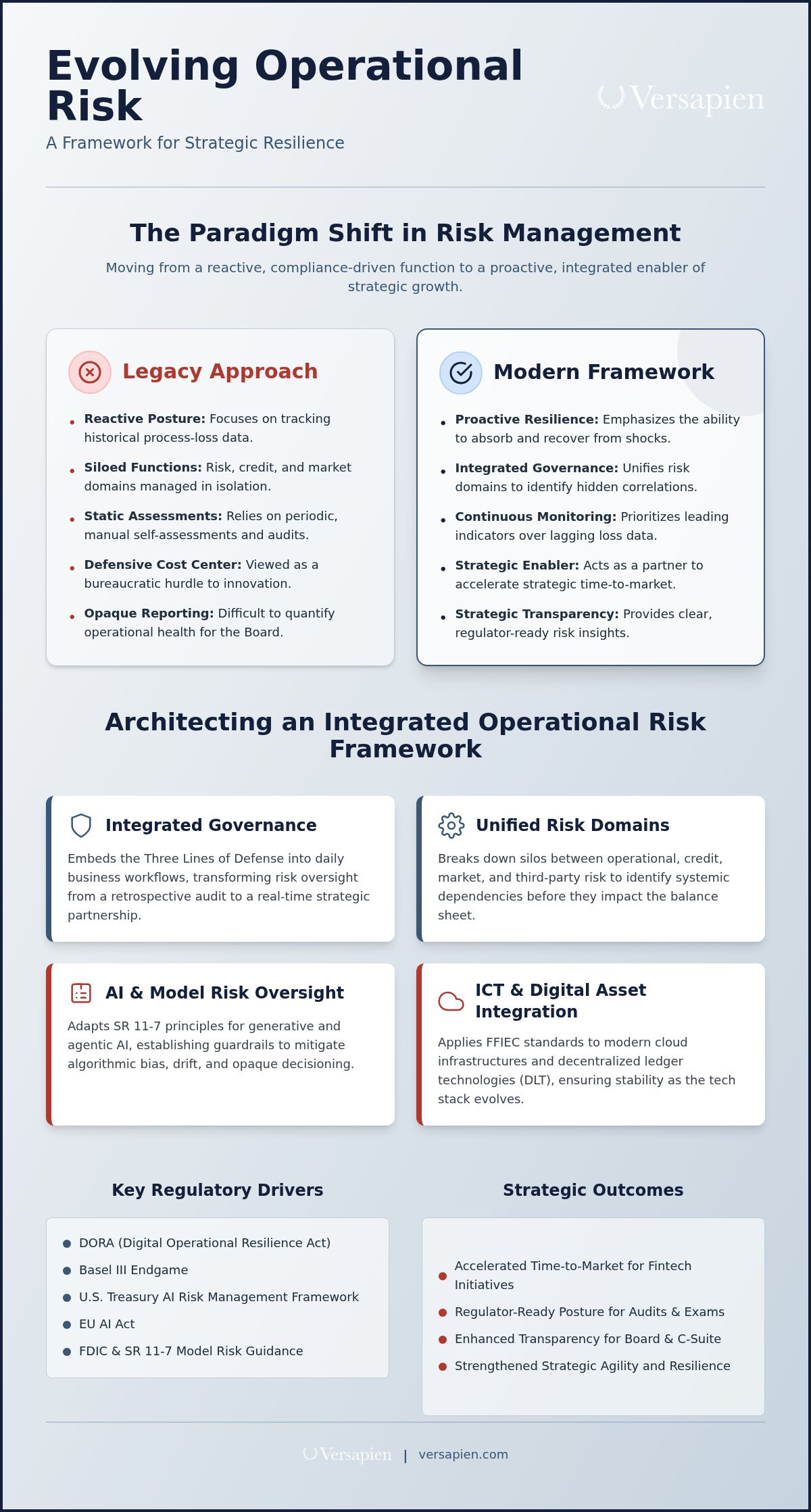
Siloed data, manual assessments, and reactive remediation often define the legacy risk function. While the traditional definition of operational risk focused strictly on losses from internal failures, this narrow scope is insufficient for the high-velocity, digital-first environment of 2026. Modern operational risk management is a governance discipline that enables strategic agility while maintaining regulatory boundaries.
The resilience gap emerges when institutions prioritize prevention over the ability to absorb and recover from systemic shocks. Relying on perimeter defense alone leaves a firm vulnerable to the cascading effects of ICT (Information and Communication Technology) failures or algorithmic drift. Regulatory shifts, particularly the convergence of the Basel Committee’s updated principles and the Digital Operational Resilience Act (DORA), now require a more integrated approach. Effective risk management consulting emphasizes a proactive posture that aligns operational continuity with strategic growth objectives.
Regulatory Pressures and the 2026 Landscape
The Basel III endgame requirements have fundamentally altered the capital charge landscape for operational risk. By August 2026, the industry focus has shifted toward more stringent, data-driven resilience metrics as mandated by the OCC and the Federal Reserve. These regulators expect institutions to move beyond qualitative narratives, requiring granular proof of operational stability during periods of extreme market volatility. This shift necessitates a move from periodic self-assessments to continuous, automated monitoring of risk indicators.
The Interconnectedness of Risk Domains
Operational volatility is rarely an isolated event. It's often the primary driver behind credit defaults or market liquidity crises, yet many firms still manage these domains in disparate silos. Third-party risk management (TPRM) has become a critical focal point, as reliance on external cloud providers and AI vendors introduces systemic dependencies. Integrating these domains into a cohesive framework allows leadership to identify hidden correlations before they manifest as balance sheet losses. By breaking down these silos, institutions can better quantify how an operational failure in one department might trigger a broader market risk event.
Architecting an Integrated Operational Risk Framework
Legacy frameworks often treat the Three Lines of Defense as a series of disconnected walls. This isolation prevents the risk function from providing timely insights during rapid digital product development. A modern architecture requires active collaboration, where the second line provides oversight that is integrated into the first line's agile workflows. By embedding operational risk management into the daily cadence of business units, institutions can identify vulnerabilities in real-time rather than during retrospective audits. This collaborative posture ensures that risk professionals act as strategic partners rather than bureaucratic hurdles.
Developing a robust risk taxonomy is the next logical step in this evolution. It's necessary to differentiate between traditional process failures and risks stemming from decentralized ledger technology or cloud-native architectures. For instance, anti-money laundering compliance for fintech represents a critical subset of operational integrity that requires specific technical oversight within the broader framework. A clear decision matrix helps the Board understand which risks are systemic and which are localized, allowing for more precise capital allocation.
ICT and Digital Asset Integration
Managing the operational complexities of digital assets requires a departure from legacy oversight models. As institutions adopt decentralized ledger technology (DLT), the threat surface expands beyond traditional database vulnerabilities. Applying the FFIEC Information Technology Examination Handbook to modern cloud-based infrastructures ensures that third-party dependencies are properly vetted and monitored. This structured approach maintains stability even as the underlying technology stack evolves, providing a durable foundation for digital transformation.
Model Risk and AI Oversight
Integrating AI governance into the ORM framework involves adapting SR 11-7 and model risk management (MRM) principles for non-traditional models. The primary challenge lies in mitigating algorithmic bias and drift, which can lead to significant regulatory and reputational damage if left unchecked. It's vital to establish responsible AI guardrails that monitor model performance against established benchmarks on a continuous basis. Effective governance requires that human-in-the-loop oversight remains a non-negotiable component for all automated credit decisioning systems. Achieving this level of integration often requires a strategic evaluation of current governance structures to ensure they remain fit for purpose in an automated environment.
Operationalizing Risk: From Self-Assessment to Strategic Transparency
Subjectivity, lag, and fragmentation often render the traditional Risk and Control Self-Assessment (RCSA) ineffective. While static annual exercises might satisfy basic compliance requirements, a modern approach to operational risk management requires a shift toward continuous, data-informed monitoring. This transition removes the inherent bias of self-reporting by integrating real-time telemetry from core systems directly into the risk profile. By moving away from anecdotal evidence, firms gain a more accurate reflection of their actual control environment.
Effective oversight depends on Key Risk Indicators (KRIs) that function as leading signals of failure. Lagging indicators, such as realized loss data, primarily confirm that a breakdown has already occurred. In contrast, leading indicators like system latency, elevated employee turnover, or increasing model drift provide the necessary foresight to intervene before a risk matures into a loss event. This level of granularity is particularly important when managing AI vendor risk, where third-party dependencies can introduce rapid volatility into the internal ecosystem.
Board-Level Reporting and Governance
Translating technical vulnerabilities into strategic business impacts is a primary challenge for the Board Risk Committee. Directors don't require a list of IT tickets; they require a quantifiable view of how operational failures affect capital adequacy and reputational standing. Using scenario analysis and stress testing allows leadership to validate resilience claims against hypothetical yet plausible shocks, such as a localized network failure or a coordinated attack on AI training data. This structured reporting ensures that the Board can make informed decisions about risk appetite and resource allocation.
Data Integrity in Risk Reporting
Reliable reporting is impossible without high-fidelity data. The "garbage in, garbage out" phenomenon frequently plagues operational loss databases, leading to skewed risk profiles that misguide executive strategy. Leveraging AI-driven solutions for real-time anomaly detection within internal controls can rectify these inconsistencies. These systems identify patterns of control circumvention that manual audits might miss, ensuring that the data reaching the executive level is both accurate and actionable. Maintaining this level of integrity is a prerequisite for satisfying the data-driven expectations of the OCC and Federal Reserve.
Regulator-Ready Reporting Checklist:
Alignment of KRIs with specific risk appetite statements approved by the Board.
Evidence of continuous monitoring for high-risk AI systems as defined by the EU AI Act.
Documented scenario analysis for ICT disruptions under DORA requirements.
Clear mapping of third-party dependencies to critical business functions.
Transitioning ORM from a Cost Center to an Innovation Enabler
Executive leadership often perceives the risk function as a defensive necessity. However, those who successfully integrate their governance models find that operational risk management acts as a catalyst for growth. While many institutions view these frameworks as friction points that slow development, a mature posture allows firms to accelerate the launch of new fintech products by streamlining the internal approval cycle. A refined "approval to launch" process doesn't imply a reduction in oversight; rather, it indicates that risk parameters are pre-defined and synchronized with the development lifecycle. When the boundaries are clear and the controls are automated, the business can move with greater velocity.
Adopting a "Regulator-Ready" posture transforms the examination cycle from a period of high-stakes remediation into a routine validation of excellence. Instead of reacting to findings from the OCC or FDIC, a proactive stance ensures that the institution maintains a constant state of audit-readiness. This resilience provides a significant competitive advantage, as it frees up executive bandwidth to focus on market expansion rather than crisis management. Robust governance isn't a brake on innovation; it's the steering mechanism that allows for higher speeds and safer navigation of the financial landscape.
The Versapien perspective emphasizes senior-led advisory to bridge the gap between high-level Big-Four theory and the granular reality of implementation. By focusing on practical, implementation-focused strategies, institutions can move beyond generic frameworks to build durable systems that satisfy both internal stakeholders and external regulators. This approach ensures that the risk function remains a partner in the institution's long-term health and growth.
Practical Next Steps for Senior Leadership
To move from a reactive state to a strategic one, leadership should prioritize the following actions to ensure their framework remains fit for purpose in 2026:
Conduct a comprehensive gap analysis of existing frameworks against the latest 2026 regulatory expectations from the Federal Reserve and the EU AI Act.
Review the integration of AI and ICT risk into the enterprise-wide risk taxonomy to ensure no silos exist between emerging technology and traditional process oversight.
Evaluate the current RCSA process to identify opportunities for transitioning from manual, subjective reporting to automated, data-driven monitoring.
Engage a specialized regulatory compliance advisory to assist in building a program that scales with digital transformation goals.
Securing a Durable Competitive Advantage through Governance
Resilience, transparency, and agility define the modern risk function. The transition from a defensive compliance posture to a proactive resilience framework is a necessity for long-term institutional durability. By integrating AI governance and ICT resilience into a unified taxonomy, senior leaders move beyond the limitations of subjective self-assessments and reactive loss tracking. This shift toward data-driven transparency ensures that operational risk management functions as a strategic enabler rather than a bureaucratic hurdle.
A regulator-ready posture provides the structural integrity needed to launch complex digital products with speed and precision. Leveraging implementation-focused advisory allows institutions to navigate the intricate requirements of the OCC and FDIC while maintaining a focus on growth. Versapien provides senior-led expertise, rooted in former Big-Four directorships and deep specialization in consumer lending compliance, to translate complex mandates into actionable business strategies. Establishing a steadying force within this high-stakes environment is the most direct path to sustainable innovation.
Strategic Perspectives on Operational Resilience
The Interplay Between Operational and Enterprise Governance
Enterprise Risk Management serves as the comprehensive umbrella framework that oversees all risk categories, including credit, market, and strategic risks. In contrast, operational risk management focuses specifically on the risks of loss resulting from inadequate or failed internal processes, people, and systems. While enterprise frameworks address the firm's overall risk appetite and capital allocation, the operational function deals with the granular, day-to-day execution of controls and the resilience of the institution's operating model.
Supervisory Standards for AI and Algorithmic Oversight
Regulators like the OCC and CFPB emphasize that AI adoption must align with existing safety and soundness standards while ensuring fair lending and consumer protection. The OCC's 2026 risk perspectives highlight that AI systems are now viewed as integral components of a bank’s cybersecurity and operational resilience profile. Institutions are expected to apply model risk management principles to AI, ensuring that algorithmic transparency and human oversight prevent UDAAP violations or systemic operational failures.
Mitigating Human Bias in Control Self-Evaluations
Inherent subjective bias and a lack of data-driven evidence represent the primary challenges in executing effective control assessments. Many business units treat the evaluation as a periodic compliance checkbox rather than a continuous monitoring tool. This approach results in a stale risk profile that fails to capture emerging threats. Effective assessments require executive-level accountability and the integration of real-time key risk indicators to replace anecdotal reporting with objective, verifiable performance metrics.
Quantifying the Financial Impact of Operational Stability
Operational resilience improves profitability by reducing the direct costs of losses and optimizing capital allocation under Basel III requirements. A robust framework also enhances operational efficiency by identifying redundant processes and streamlining internal controls. A regulator-ready posture accelerates the time-to-market for new digital products. By minimizing the time spent on reactive remediation, leadership can redirect resources toward innovation and strategic growth initiatives that drive long-term revenue and market share.
Extending Resilience Frameworks to Third-Party Ecosystems
Firms should integrate third-party risk management by treating external vendors as extended components of their own internal process environment. This involves mapping critical service providers to specific business functions within the broader taxonomy to identify systemic dependencies. Following the FFIEC Information Technology Examination Handbook, institutions should implement continuous monitoring for cloud and AI providers. This ensures that a failure at a third-party level doesn't trigger a catastrophic breakdown of the institution's primary operational resilience.



Comments