
Shadow AI Governance: How Financial Institutions Can Detect and Control Unapproved AI Use
Updated: Sep 22
Generative AI and other AI-enabled tools can enter a financial institution through channels that were never designed to support formal technology or risk-management review. Employees may use publicly available tools to summarize documents, analyze information, generate content, or perform other tasks without the use case, data involved, or associated risks being visible to management. This “shadow AI” can create risks involving confidential information, cybersecurity, privacy, consumer protection, operational resilience, and regulatory compliance.
The challenge is not simply to prohibit unapproved AI use. Financial institutions need sufficient visibility to understand where AI is being used, what risks those uses create, and which governance processes are appropriate to the particular use case. That requires distinguishing AI governance from model risk management and applying each framework where it is relevant.
This article examines a practical, risk-based approach to identifying, assessing, governing, and remediating unapproved AI use across the organization.
Table of Contents
Understanding the Shadow AI Risk
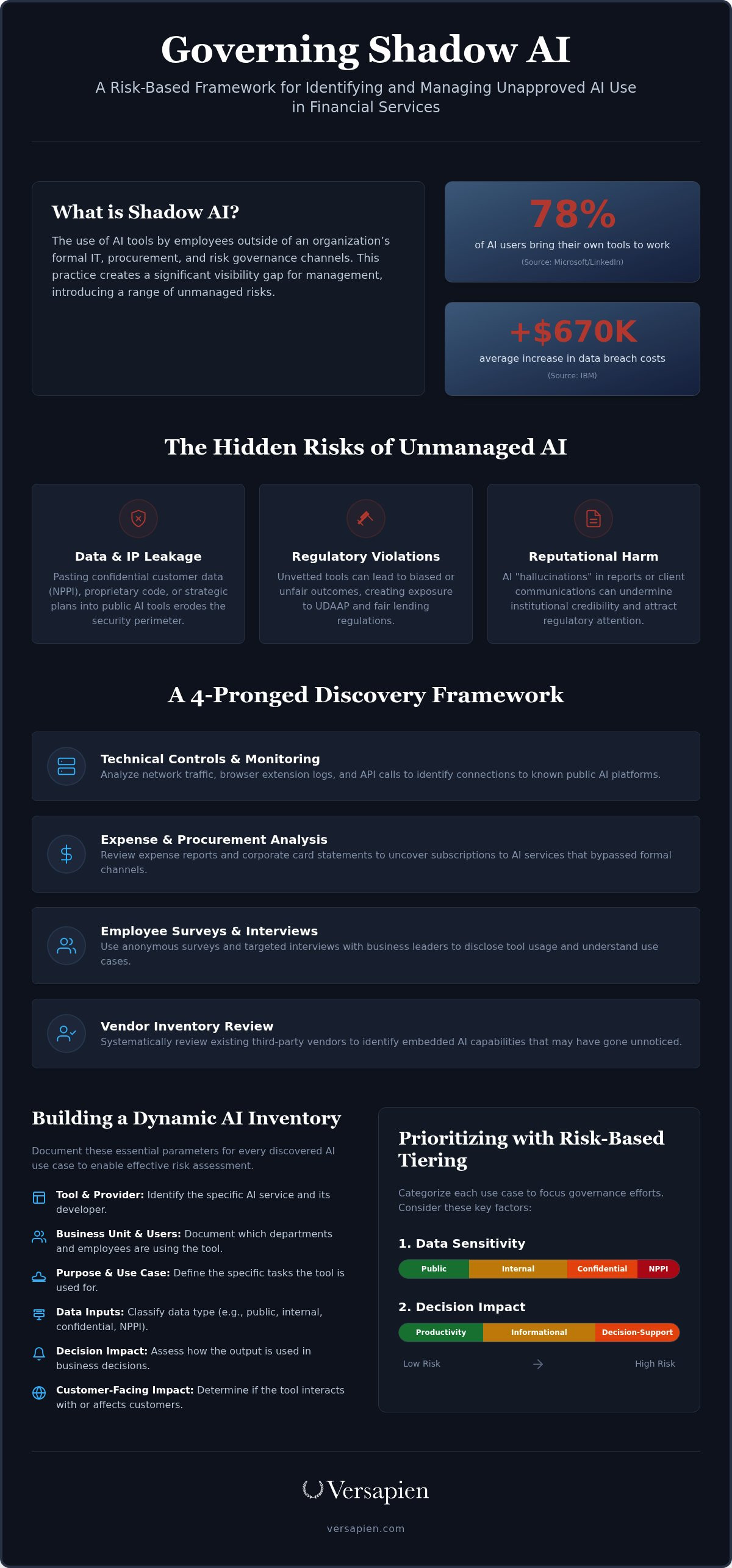
Shadow AI refers to the adoption and use of artificial intelligence capabilities by employees outside of an organization’s formal procurement, IT, and risk governance channels. Unlike traditional Shadow IT, shadow AI can introduce additional complexity because AI-enabled tools may generate content, process sensitive information, support decisions, or, in some cases, perform tasks with varying degrees of autonomy. The proliferation of powerful, publicly accessible generative AI tools has accelerated this trend, creating a significant visibility gap for risk and compliance functions.
The risks are not inherent to AI technology itself but emerge from its unmanaged application. The level of risk depends on the specific use case, the sensitivity of the data involved, the impact of the tool’s output on decisions, and its degree of autonomy. For example, an employee using a public generative AI tool to draft an internal memo creates a different risk profile than a loan officer using an unvetted AI tool to analyze a borrower’s financial data. The latter could introduce risks related to privacy, data security, fair lending, consumer protection, and the reliability of decisions informed by the tool.
Recent data highlights the scale of the challenge. A 2024 Microsoft/LinkedIn Work Trend Index report found that 78% of AI users are bringing their own AI tools to work. This widespread adoption, while often aimed at improving productivity, expands the institution's risk perimeter. Research from IBM indicates that organizations with high levels of shadow IT and AI face significantly higher costs in the event of a data breach, with one study noting an average increase of approximately $670,000.
The Erosion of the Traditional Risk Perimeter
Cloud-based AI tools can easily bypass traditional security controls like internal firewalls and data loss prevention (DLP) protocols. When an employee pastes confidential customer information, proprietary code, or strategic planning documents into a public AI interface, the institution loses control over that data. This creates direct risks of data leakage, intellectual property loss, and cybersecurity vulnerabilities. For financial institutions, the exposure of nonpublic personal information (NPPI) or sensitive data related to consumer lending, wealth management, or proprietary trading models can indicate a significant weakness in the institution’s data-governance, information-security, or internal-control environment.
Reputational and Regulatory Exposure
Unvetted AI tools can also create significant reputational and regulatory harm. Generative AI is known to produce inaccurate or fabricated information, often called “hallucinations.” If such data finds its way into regulatory filings, board reports, or customer-facing communications, it can undermine the institution's credibility and attract regulatory attention. Furthermore, the use of unapproved AI in customer interactions or credit-related analysis could lead to inconsistent, biased, or unfair outcomes, potentially creating fair lending, consumer protection, privacy, or other compliance risks depending on the use case and resulting decisions or communications.
Discovering and Assessing Unapproved AI Use
Effective shadow AI governance begins with discovery. Institutions cannot govern what they cannot see. Building and maintaining a sufficiently complete inventory of identified AI use requires a multi-faceted approach that moves beyond simple technology scans. The goal is to develop a clear understanding of which AI tools are in use, for what purpose, by whom, and with what data. This forms the foundation for a risk-based approach to governance and remediation.
A practical discovery process often includes a combination of the following methods:
Technical Controls and Network Monitoring: Analyzing network traffic, browser extension logs, and API calls can help identify connections to known public AI platforms and services.
Expense and Procurement Analysis: Reviewing expense reports, corporate credit card statements, and procurement records can uncover subscriptions to AI services that were not routed through formal IT or vendor management channels.
Employee Surveys and Interviews: Anonymous surveys can encourage employees to disclose the tools they use to enhance productivity. Follow-up interviews with business-unit leaders can provide deeper context on specific use cases and perceived benefits.
Vendor Inventories: Many existing third-party vendors are embedding AI capabilities into their software and services. A targeted review of the current vendor inventory can identify these embedded AI tools that may have previously gone unnoticed. For more on this, see our guide to building a risk-based vendor inventory.
Building an AI Use Inventory
The output of the discovery phase should be a dynamic AI use inventory, not just a static list of tools. This inventory should document the essential parameters for risk assessment, including:
The name and provider of the AI tool.
The business unit and employees using the tool.
The intended purpose and specific use cases.
The types of data being input into the tool (e.g., public, internal, confidential, NPPI).
The nature of the tool’s output and how it is used in decision-making.
Whether the tool has any customer-facing impact.
Risk-Based Categorization and Tiering
Once the inventory is established, each AI use case should be categorized and tiered based on its potential risk. This allows the institution to focus its governance efforts where they are most needed. A risk-based tiering framework should consider several factors:
Data Sensitivity: Use cases involving confidential, proprietary, or customer data receive a higher risk tier.
Decision Impact: Tools that directly inform or make significant business decisions (e.g., credit analysis, fraud detection, compliance monitoring) are tiered higher than those used for administrative tasks.
External Impact: Any AI use that affects customers, third parties, or regulatory reporting carries a higher risk.
Autonomy: Systems that operate with a high degree of autonomy and limited human oversight require more stringent governance.
Regulatory Significance: Use cases involving areas such as fair lending, BSA/AML, consumer privacy, or regulatory reporting may warrant heightened scrutiny based on the nature and potential impact of the use case.
Applying the Right Governance Framework
A common point of confusion is how AI governance relates to established model risk management (MRM) frameworks. While the two are related, they are not interchangeable. Effective shadow AI governance requires understanding this distinction and applying the appropriate level of oversight based on the specific tool and its use case.
The interagency Supervisory Guidance on Model Risk Management, issued on April 17, 2026, by the Federal Reserve, FDIC, and OCC, provides a useful reference point. This guidance is nonbinding, risk-based, and most relevant to banking organizations with over $30 billion in total assets, though its principles can be informative for smaller institutions with significant model risk exposure. Crucially, the guidance defines a "model" as a quantitative approach applying statistical, economic, or financial theory to process data into quantitative estimates. It explicitly states that generative AI and agentic AI are outside the scope of this guidance.
Therefore, a quantitative system used for credit underwriting may fall within the institution’s model risk management framework if its methodology meets the applicable definition of a model, while a generative AI tool used by the marketing department to draft social media posts would generally require a different governance approach.
Effective Challenge, Validation, and Third-Party Oversight
Although generative AI tools are outside the scope of the 2026 MRM guidance, the underlying principles of sound risk management remain relevant for high-risk AI use cases. Institutions may find it useful to apply analogous governance practices where appropriate. For example:
Independent Review: For higher-risk AI use cases, review by appropriately qualified individuals with sufficient objectivity and expertise can help identify limitations, data risks, control weaknesses, and potential unintended outcomes.
Performance Testing: Instead of a formal model validation, a high-risk AI tool should undergo rigorous testing to assess its accuracy, reliability, and fairness for its intended purpose. This is particularly critical when relying on third-party AI systems where the underlying code is proprietary.
Vendor Oversight: Institutions should not rely solely on vendor-provided claims about an AI tool's performance or controls. Third-party oversight should be commensurate with the risk and intended use of the AI capability and may include appropriate testing, ongoing monitoring, and contractual provisions addressing matters such as data usage, security, access, change management, and accountability.
The intensity of these activities should align with the risk tier of the AI use case. A low-risk administrative tool may only require basic vendor due diligence and an acceptable use policy, while a high-risk tool influencing customer outcomes would warrant a much deeper level of scrutiny. For a deeper dive, read our analysis of model risk management in the age of AI.
Moving from Shadow AI to Managed AI
The ultimate goal of a shadow AI governance program is not to eliminate unapproved tools but to transition them into a managed and governed environment. This approach allows the institution to harness the productivity benefits of AI while mitigating the associated risks. It transforms shadow AI from an unknown liability into a strategic capability.
This transition requires establishing clear governance structures, accountability, and processes for remediation and ongoing monitoring. While some organizations may establish a formal AI governance committee, the specific structure is less important than ensuring clear ownership and escalation paths. Key functions should be assigned to individuals or groups across Risk, Compliance, Legal, IT, and relevant business units.
Integrating AI Risk into Enterprise Risk Management
To be effective, AI governance cannot exist in a silo. It must be integrated into the institution’s existing Enterprise Risk Management (ERM) framework. This involves determining how AI-related risks should be incorporated into the institution’s existing risk taxonomy and assessing how AI use may affect established risk domains such as operational risk, compliance risk, information security, strategic risk, and reputational risk. The aggregate risks posed by the interaction of multiple AI systems should also be considered and reported to senior management and the Board.
Remediation, Approved Alternatives, and Ongoing Monitoring
Once the AI inventory is tiered, the institution can develop a clear roadmap for remediation. This is not a one-size-fits-all process. The appropriate action depends on the risk level and business value of each use case:
Prohibit and Block: For high-risk use cases with unacceptable data security or compliance risks (e.g., inputting NPPI into a public AI tool), the institution may determine that the appropriate response is to prohibit the use case, restrict access, or implement other controls designed to address the identified risk.
Formalize and Govern: For high-value, moderate-to-high-risk use cases, the path is to bring the tool into the formal governance structure. This involves conducting thorough risk assessments, implementing necessary controls, and establishing ongoing monitoring.
Provide Sanctioned Alternatives: A key element of successful governance is providing employees with approved, secure alternatives that meet their productivity needs. By deploying an enterprise-grade, secure AI platform, the institution can reduce the incentive for employees to use unvetted public tools.
Accept and Monitor: For very low-risk use cases (e.g., using a public tool with non-sensitive data for brainstorming), the institution may choose to formally accept the risk, documenting it and providing clear guidelines for acceptable use.
Finally, it is important to clarify the role of Internal Audit. Internal Audit can provide independent assurance over the effectiveness of the institution’s AI governance and risk-management processes, consistent with the institution’s audit methodology and organizational structure. This includes assessing the completeness of the AI inventory, the appropriateness of the risk-tiering methodology, and the adequacy of the controls in place for high-risk systems. For more on this, see our guidance on creating an AI governance policy.
Executive Takeaways
Visibility Is the Foundation: Financial institutions cannot manage the risks of shadow AI if they do not know where it is being used. A multi-faceted discovery process that combines technical scans, expense analysis, and business-unit engagement is the essential first step to building a comprehensive AI use inventory.
Distinguish AI Governance from Model Risk Management: Not every AI tool is a “model” under regulatory definitions. Applying a one-size-fits-all MRM framework to all AI is inefficient. A risk-based approach that tailors governance to the specific use case, data sensitivity, and decision impact is more effective.
The 2026 MRM Guidance Has a Specific Scope: The interagency guidance on model risk is nonbinding and explicitly places generative AI outside its scope. While institutions may find certain model-risk-management concepts useful when designing governance for higher-risk AI systems, it should not be treated as a direct compliance requirement for all AI.
Focus on Providing Sanctioned Alternatives: A strategy based solely on prohibiting unapproved tools is likely to fail. A more sustainable approach involves providing employees with secure, enterprise-grade AI capabilities that meet their business needs, reducing the incentive to use unauthorized public tools.
Integrate AI Risk into ERM: Shadow AI governance should not be a standalone function. AI-related risks should be incorporated into the institution’s broader risk-management framework in a manner appropriate to its risk profile and governance structure to ensure that AI-related risks are identified, measured, monitored, and reported alongside other key business risks.
Governance Enables Innovation: The objective of shadow AI governance is not to stifle innovation but to enable it safely. By transforming unmanaged AI use into a governed, transparent capability, institutions can accelerate the adoption of new technologies while protecting their operational integrity and regulatory standing.
How Versapien Can Help
Versapien helps financial institutions develop and implement practical, risk-based AI governance frameworks. Our senior-led advisory team, with deep experience in risk management and regulatory compliance, provides implementation-focused guidance to help organizations identify unapproved AI use, establish appropriate controls, and align AI innovation with enterprise risk management principles. We assist clients in building programs designed to withstand regulatory scrutiny while supporting strategic business objectives.


Comments