
AI Data Readiness for Financial Institutions: Building the Foundation for Reliable Models and Automation
In financial institutions, an artificial intelligence system can be mathematically sound and still produce unreliable outcomes when its underlying data foundation is fragmented, misattributed, or stale. Data readiness for AI is not a generic technical milestone or an IT inventory exercise. It is a strategic business, risk, and investment determination regarding whether data is sufficiently accurate, timely, well-governed, and legally permissible for a specific, consequential decision.
For executive leadership, evaluating data fitness must precede capital allocation and deployment. When underlying records lack contextual integrity, automation can accelerate errors across credit underwriting, fraud detection, transaction monitoring, customer operations, compliance processes, and management reporting. Executive teams require a structured methodology to evaluate data suitability, establish cross-functional accountability, and determine whether to proceed, narrow, remediate, or defer proposed AI applications.
Table of Contents
Data Readiness as a Business and Investment Decision
Board members and senior executives frequently evaluate AI initiatives through the lens of algorithmic sophistication or software vendor capabilities. In practice, the reliability of a deployed model depends on the quality, meaning, provenance, and permitted use of the data supplied to it. Machine learning models identify patterns, while generative systems retrieve and generate from historical records and source documents. If those inputs reflect operational workarounds, conflicting domain definitions, or undocumented customer handling, the system can reproduce and scale those deficiencies across the enterprise.
The business consequences of deploying AI on unready data extend far beyond minor analytical variance. In consumer lending and mortgage origination, inconsistent income definitions or incomplete debt calculations can distort underwriting and borrower treatment. In transaction monitoring, feeds that drop fields or aggregate timestamps can obscure sequential activity and weaken suspicious activity detection. In customer servicing, unverified product documentation can cause a generative system to provide inaccurate information about fees, waivers, or contractual terms. Similar defects can distort fraud decisions, operational workflows, compliance reviews, and regulatory or management reporting. Leadership should require evidence of the defect, its affected population, the resulting decision impact, and the remediation or control needed before approving deployment.
Data readiness cannot be measured as an abstract enterprise score. Data that is perfectly adequate for exploratory marketing analytics or broad operational capacity modeling is often entirely unacceptable for automated credit line decreases, fraud blocking, or regulatory reporting. Readiness is strictly use-case specific. Executives must evaluate the operational and legal consequences of false positives and false negatives for each defined workflow before approving development.
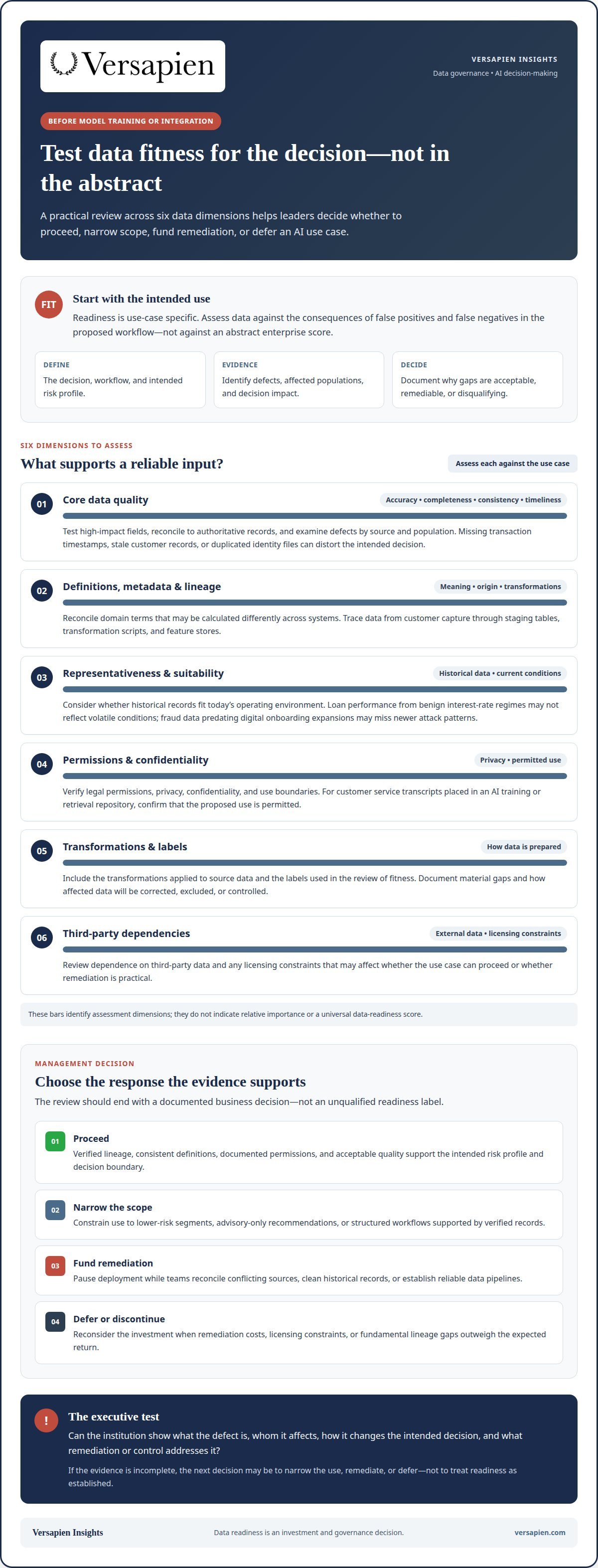
When leadership evaluates data fitness against a proposed use case, the review should yield one of four definitive business decisions:
Proceed: The data possesses verified lineage, consistent definitions, documented permissions, and acceptable quality thresholds that support the intended risk profile and decision boundary.
Narrow the Scope: The broader dataset exhibits localized gaps, leading management to constrain the model to low-risk customer segments, advisory-only recommendations, or structured workflows supported by fully verified records.
Fund Remediation: The business case justifies the investment, but deployment is paused until engineering teams reconcile conflicting sources, clean historical records, and establish reliable pipelines.
Defer or Discontinue: Remediation costs, third-party data licensing constraints, or fundamental data lineage gaps outweigh the expected return, prompting leadership to redirect capital toward higher-yield opportunities.
Treating readiness as an investment gate helps organizations avoid committing capital to initiatives that lack the data foundation needed for reliable operations or that cannot satisfy applicable legal, regulatory, or internal governance requirements. To balance strategic ambition with governance, leaders must align data readiness reviews directly with their broader enterprise AI portfolio governance to prioritize capital where data infrastructure can genuinely support production deployment.
Assessing Data Fitness for the Intended Use
Assessing data readiness requires an empirical evaluation of fitness for purpose rather than passive reliance on generic compliance checklists. A checklist cannot establish that a dataset reflects the economic realities of target borrowers, the current behavior of customers, or the evolving patterns of financial crime. Senior management should require evidence across six operational dimensions before authorizing model training or integration: core data quality; definitions, metadata, and lineage; representativeness and suitability; permissions and confidentiality; transformations and labels; and third-party dependencies. The review should identify material defects, quantify their effect on the intended decision where practical, assign remediation owners, and document why the remaining gaps are acceptable, remediable, or disqualifying for that use case.
First, teams must evaluate core accuracy, completeness, consistency, and timeliness against the intended decision. In retail banking, missing transaction timestamps prevent models from detecting rapid automated clearing house velocity anomalies. Stale customer data, such as income records updated only during initial account opening three years prior, distorts credit capacity assessments. Duplicated customer identification files cause models to fragment relationship histories, skewing risk scoring across lending and AML platforms. Leadership should require defect-rate analysis by source and population, testing of high-impact fields, reconciliation to authoritative records, and a documented plan for correction, exclusion, or controlled use of affected data.
Second, organizations must examine domain definitions, metadata, and lineage. A variable labeled "past due balance" in a core banking platform often reflects different grace periods and calculation mechanics than the same term in a legacy collections system. When models ingest these fields without semantic reconciliation, the output reflects conflicting institutional logic. Data lineage documentation should provide sufficient traceability from the original source through material transformations and systems to support validation, issue investigation, and oversight.
Third, leadership must verify the representativeness and suitability of historical data for current operating environments. Historical loan performance collected during benign interest-rate regimes does not prepare an automated decisioning engine for volatile macroeconomic shifts. Similarly, fraud detection data gathered prior to major digital onboarding expansions lacks the attack vectors required to identify sophisticated synthetic identity fraud.
Fourth, legal permissions, privacy, confidentiality, and permitted-use boundaries must be verified. Regulatory restrictions and consumer disclosure agreements govern how personal financial information may be used. Before customer service transcripts are placed in an AI training or retrieval repository, management should require confirmation of the permitted purpose, access restrictions, retention requirements, treatment of non-public personal information, and evidence that sensitive content has been appropriately identified or removed. The same review applies when data is reused for a purpose different from the one for which it was collected.
Fifth, source-record reliability, transformation logic, and labeling integrity require rigorous validation. Supervised machine learning depends on accurate training labels. If loan officers historically misclassified loan denial reasons to bypass operational friction, automated systems trained on those labels will perpetuate administrative errors and produce unreliable decision explanations. Leaders should require sampling against source records, reconciliation of labels to approved business definitions, testing of transformation code, documentation of imputation and exclusions, and remediation or restricted use where the evidence is inadequate.
Finally, third-party and external data dependencies introduce vendor risk. External alternative credit data, commercial fraud scoring feeds, and synthetic identity flags operate under proprietary supplier models. Management should require documentation of the supplier's data sources, permitted uses, service and change commitments, audit or validation rights, delivery-quality measures, and continuity arrangements. If a vendor changes its underlying calculation methodology or drops historical records without warning, the institution's downstream models can experience performance degradation; that possibility should be addressed through contractual controls, monitoring, contingency procedures, and reassessment triggers.
The Strategic AI Data Readiness Evaluation Framework
Data readiness considerations diverge significantly between traditional predictive models and generative AI systems. Traditional machine learning applications often rely on structured data and engineered features, although they may also incorporate unstructured information. Data readiness therefore requires evaluating the quality, relevance, and limitations of the inputs and transformations used in the specific application. In contrast, generative AI and large language models ingest unstructured narrative data, such as call center logs, credit memos, and policy manuals.
For generative applications, data readiness hinges on document chunking quality, metadata taxonomy, retrieval provenance, and vector embedding accuracy. A generative compliance assistant cannot provide reliable answers if it retrieves superseded regulatory bulletins stored alongside active operating procedures. Furthermore, organizations must verify whether source material contains confidential business records or consumer information before exposing repositories to retrieval-augmented generation architectures.
Establishing Ownership and Governance
A reliable data foundation cannot be created or maintained by engineering teams alone. Technology departments manage systems architecture, database performance, and data pipeline uptime. They do not own the commercial purpose of the data, the economic assumptions behind the business line, or the legal consequences of incorrect outputs. Data readiness requires clear, enforceable ownership across business, risk, and technical functions.
Organizations must establish distinct, non-overlapping accountabilities:
Business Unit Leaders: Own the commercial objective, define acceptable business outcomes, approve the specific use cases, and formally accept the residual risk of deploying the model within their operational lines.
Data Owners: Senior business executives who hold authority over specific data domains, such as retail deposits, residential mortgages, or customer identity. They establish authoritative definitions, determine permitted business uses, and authorize the remediation of discovered defects.
Data Stewards: Operational specialists within business and functional units who maintain data dictionaries, monitor metadata quality, track lineage changes, and coordinate day-to-day data cleaning initiatives.
Technology and Engineering Teams: Responsible for technical infrastructure, data pipeline reliability, system access controls, encryption, and the mechanical execution of feature stores. Technology teams cannot unilaterally accept data quality shortcuts or approve changes to data definitions.
Risk and Compliance: Provide oversight and effective challenge consistent with their assigned responsibilities. Depending on the institution's governance structure, these functions may assess regulatory and consumer protection risks, evaluate fair lending exposure, review data-use controls, and challenge assumptions supporting AI applications.
Internal Audit: Provides third-line independent assurance to the board audit committee regarding whether data governance policies, supervisory controls, and operational validation routines operate effectively. Internal Audit does not design controls or assume management decision-making authority.
Institutions must codify unambiguous escalation pathways for unresolved data defects. When a data steward identifies that a legacy loan origination system frequently drops secondary applicant employment fields, that defect cannot be quietly patched with synthetic imputation without formal business approval. If an operational change in customer intake alters how residential status is captured, the data owner and risk function must evaluate whether downstream scoring models remain valid.
Documented escalation pathways ensure that disagreements between commercial units pursuing rapid deployment and risk functions identifying foundational data gaps are resolved by executive risk committees rather than informal technical workarounds. Institutional governance must maintain transparent evidentiary trails, as detailed in our analysis of documenting AI risk evidence across regulated workflows.
Making Data Readiness a Continuing Management Discipline
Treating data readiness as a one-time project sign-off exposes financial institutions to severe operational and model drift. Production environments are dynamic. Customer behaviors shift, core IT platforms undergo version updates, third-party data aggregators adjust API feeds, and new regulatory interpretations emerge. An AI model that operates on pristine data during initial deployment can degrade into an unreliable system within quarters if data pipelines and definitions are not continuously managed.
Executive leadership must implement data readiness as a continuous management discipline across the entire model lifecycle. Prior to initiating development, management must establish formal acceptance criteria tailored to the proposed application. These standards must clearly differentiate bounded, internal-facing pilots from high-impact production releases. A proof-of-concept analyzing internal policy text may tolerate minor formatting anomalies, whereas a customer-facing automated dispute resolution application requires stronger completeness, consistency, and monitoring controls across intake channels.
Continuous readiness requires tracking leading risk indicators that reflect pipeline health and semantic stability. These indicators include data pipeline latency, rate of missing or null fields, distribution shifts in core features, and unexplained schema alterations at source systems. When automated alerts indicate that incoming transaction categories have diverged significantly from the baseline training distribution, the operational workflow must pause automated execution or route borderline decisions to trained analysts under established human-in-the-loop controls.
Furthermore, institutions must establish mandatory trigger events that require a formal re-evaluation of data readiness. Reassessment must occur whenever:
The institution introduces new credit or banking products that alter transactional patterns.
Underlying core platforms, payment gateways, or customer relationship management systems undergo migration or major schema updates.
Customer demographics expand into new geographic markets or commercial tiers.
External data suppliers modify their delivery formats, data capture methodologies, or licensing rights.
The business seeks to expand the scope of an approved AI tool from internal operational support to direct customer decisioning.
Every decision to proceed, restrict, remediate, or defer an AI use case should be documented, including the supporting evidence, accountable decision-makers, required risk or compliance review, and any conditions attached to approval. Post-deployment data updates and prompt architecture adjustments should be subjected to formal AI change control to prevent unapproved data modifications from silently altering production decisions. The record should state the acceptance criteria, material defects, remediation commitments, monitoring requirements, approval authority, and reassessment date. By embedding data fitness into ongoing governance routines, executive teams can direct investment toward reliable use cases and maintain accountability as conditions change.
Executive Takeaways
Data readiness for AI is a strategic, economic, and risk management determination rather than an isolated IT milestone. Sophisticated models deployed on unverified, incomplete, or poorly governed data can produce unreliable decisions, operational disruption, and regulatory exposure. Senior management must establish business gates, cross-functional ownership, and continuous oversight before allocating capital to automated decisioning.
Evaluate data readiness by use case: Recognize that data suitable for exploratory analytics is often inadequate for consequential credit, fraud, or customer-facing operations. Define operational acceptance criteria for each specific decision workflow.
Require evidence across six fitness dimensions: Demand empirical validation of accuracy, semantic lineage, population representativeness, legal privacy permissions, transformation integrity, and external vendor data stability before funding model development.
Establish four clear investment paths: Empower executive committees to choose decisively among proceeding, narrowing operational scope, funding foundational remediation, or deferring the initiative based on net business value and risk exposure.
Separate business ownership from technical delivery: Assign clear accountability for domain definitions and risk acceptance to commercial business leaders and data owners, while maintaining independent challenge through second-line risk functions and third-line audit.
Institute trigger-based continuous monitoring: Move beyond one-time project certifications by tracking ongoing feature drift, schema updates, and pipeline integrity, mandating formal reassessments when products, populations, or source systems change.
How Versapien Can Help
Versapien advises financial institutions, fintechs, and consumer lenders through its AI Governance & Responsible AI, Risk Management Consulting, and Regulatory Compliance Advisory practices. Our advisory support includes data-readiness gap assessments, reviews of governance and control practices, and practical recommendations for use-case acceptance criteria, remediation priorities, escalation paths, and ongoing oversight.



Comments