
AI Incident Management: Preparing Financial Institutions for Model Failures, Harmful Outputs and Service Disruption
When an AI system gives a flawed lending recommendation, exposes customer data in a response, or stalls a customer-support workflow, the consequences reach customer outcomes, financial transactions, regulatory compliance, service availability, and institutional reputation. Standard cybersecurity and operational incident workflows may not cover AI-specific elements such as model behavior, training data, prompts, retrieval sources, and autonomous tool actions. Financial institutions should adapt and expand the incident management arrangements they already have to address these failure modes, rather than build a separate, siloed response organization.
An AI incident response framework does this by connecting detection, assessment, containment, investigation, recovery, and post-incident review into one management process with defined decision rights. The National Institute of Standards and Technology finalized SP 800-61 Revision 3 in April 2025. It reframes incident response as part of ongoing cybersecurity risk management and structures it as a CSF 2.0 Community Profile. That integration with enterprise risk management is a sound reference point for institutions extending their own programs.
Table of Contents
What is AI incident response?
AI incident response coordinates how an institution detects, assesses, and manages failures in AI-enabled operations. These failures are not only cyberattacks. They may be operational, data governance, or model-risk events, and the response should reflect that.
Detection and classification
Detection draws on monitoring for unexpected model outputs, sensitive data appearing in responses, unauthorized access, suspected data poisoning, and service disruptions. AI-assisted anomaly detection can flag departures from an established baseline, but alerts should be treated as investigative leads rather than confirmed incidents. Institutions should establish procedures for validating alerts, assessing potential impact, and determining whether escalation is warranted. Classification then separates routine technical errors from security events and customer-impacting incidents. An odd output from an internal summarization tool may warrant a different path from inconsistent recommendations in a lending workflow.
Analysts should review the affected use case, the quality of the evidence, the potential consequences, and whether related signals share an underlying source. Correlated signals are not necessarily independent proof, so their reliability deserves a check.
Assessment and escalation
Assessment applies formal criteria. These include the use case, business and customer impact, evidence fidelity, operational dependencies, and possible regulatory reporting triggers. Each institution should set its own escalation thresholds under its governance framework and document who decides when they are met.
Reporting duties depend on the institution, the incident, the affected information, and applicable law. Cybersecurity incident notifications differ from privacy, customer data breach, and operational disruption requirements, and each follows its own rules. CIRCIA, enacted by the U.S. Congress in 2022, concerns cyber incident reporting for covered U.S. critical infrastructure entities. It does not impose one blanket reporting requirement or deadline on every financial institution, and its reach depends on entity type and incident characteristics. Institutions should consult the official CISA CIRCIA resources and have Legal and Compliance determine which obligations apply.
A management process for AI incidents
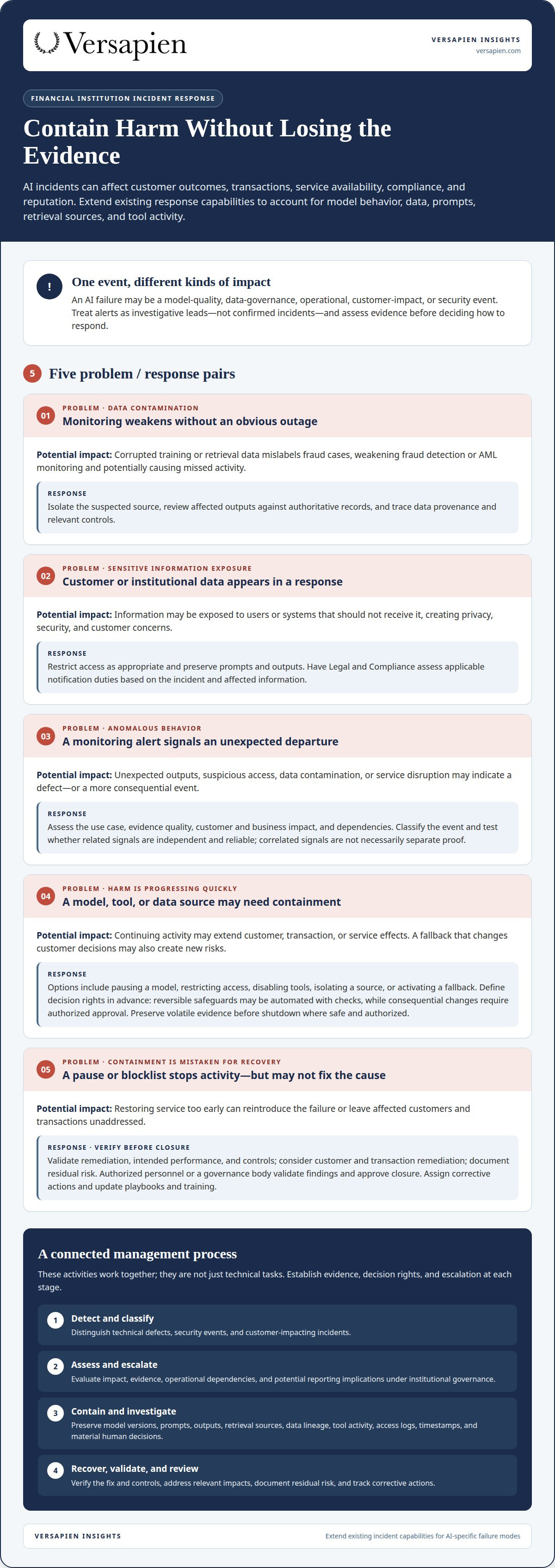
The stages below form one interconnected process. Each gate specifies the evidence needed to move forward, who may authorize the transition, and what remains unresolved. This is a practical, illustrative framework, not a regulatory standard.
Containment without losing the evidence
Containment options include pausing a model, restricting access, disabling tools, isolating data sources, and triggering fallback procedures. Orchestration can automate reversible safeguards, such as pausing a test workload with notification and follow-up checks. Production credential revocation, workload isolation, or a fallback that changes customer decisions should follow pre-established authorization and escalation procedures. Institutions should define which actions can be taken immediately by designated responders, which require management approval, and how emergency actions are documented and reviewed. Set automation thresholds based on confidence, potential impact, speed of progression, and reversibility, and name approvers and alternates in advance.
Preserve relevant evidence before or during containment whenever it is safe and practicable. Short-lived containers and serverless functions can terminate quickly, so capture volatile data where feasible. However, evidence preservation should not delay urgent action needed to prevent continuing customer harm, unauthorized access, or further compromise.
Investigation and evidence preservation
Reconstruction requires model versions, system prompts, outputs, retrieval corpora, data lineage, tool executions, access logs, timestamps, and key human interventions. Design logging to balance investigative needs with privacy controls. Investigation then traces the source, whether contaminated training data, an exposed record, a poisoned retrieval source, or a misconfigured tool.
Recovery, validation, and review
Containment stops harm. Verified recovery shows the problem is fixed. Pausing a model or blocking a source is a triage measure, and an allow-block list is not lasting remediation. Recovery criteria should cover remediation validation, restoration of intended performance and controls, customer and transaction remediation, and documentation of residual risk. Authorized personnel or a governance body should validate findings and approve closure.
Post-incident review assigns remediation owners, assesses control or detection breakdowns, and updates playbooks and training. Test the plan with tabletop exercises that simulate unavailable decision-makers and competing containment options, recording decision points, evidence gaps, and escalation delays.
Who is on the response team
Business owners assess customer and service impact. Technology teams implement authorized changes. Data owners trace lineage and access. Risk and Compliance provide oversight and challenge consistent with their responsibilities, while Legal advises on applicable notification and reporting obligations. The response plan should identify who coordinates these functions and who has authority to make time-sensitive incident decisions. Internal Audit provides independent assurance and does not approve or operate the response.
Financial-services scenarios
Five scenarios show how the same process applies in different settings.
Training data contamination and sensitive information exposure
If corrupted training or retrieval data mislabels fraud cases, fraud detection or AML monitoring can weaken without any visible outage. Impact is missed activity. Response means isolating the source, reviewing affected outputs against authoritative records, and examining data provenance and control effectiveness. If an AI-generated response exposes customer or institutional data, containment may mean restricting access and preserving prompts and outputs, followed by Legal and Compliance assessment of notification duties.
Flawed recommendations, outages, and autonomous agents
When a model produces inaccurate data or recommendations relied on in lending decisions, the question is which decisions were affected and whether customers need remediation. This is a model-risk event as much as a technical one. A fallback to older rules is not automatically appropriate, so suspension and fallback authority should be assigned beforehand.
An outage in AI-driven customer support can delay transactions, so containment weighs dependencies and a controlled manual process. An autonomous agent that executes unauthorized actions through integrated enterprise software calls for disabling its tools, revoking credentials with approval, and reviewing tool execution logs. Agents should operate under predefined authority with monitoring and exception handling.
AI-specific incident response frameworks
Traditional incident response can miss threats rooted in model behavior, prompts, retrieval sources, and tool execution. None of the references below is mandatory for financial institutions. They are resources that institutions can use as they see fit.
The Coalition for Secure AI (CoSAI) published its AI Incident Response Framework, Version 1.0, approved by its Project Governing Board on October 27, 2026. It is an industry framework, not a regulatory mandate. Its playbooks address training data poisoning, prompt injection, memory injection, retrieval-augmented generation poisoning, and cloud credential abuse. Useful forensic telemetry includes prompt logs, model inference activity, tool executions, and memory state changes.
The MITRE ATLAS knowledge base is a threat-intelligence repository of adversary tactics and techniques against AI systems. It informs threat scenarios for red-team planning and detection engineering, but it is not an incident response framework itself. The NIST AI Risk Management Framework organizes AI risk around Govern, Map, Measure, and Manage, and ISO/IEC 42001 specifies requirements for an AI management system. Both support aligning incident governance with broader AI oversight.
NIST SP 800-61 Revision 3 provides a complementary foundation for the overall incident-response process. It integrates incident response into ongoing cybersecurity risk management and aligns with the NIST Cybersecurity Framework 2.0. Financial institutions can use it alongside AI-specific resources such as CoSAI and MITRE ATLAS to connect AI incident scenarios with established enterprise response arrangements.
An AI incident response plan should define permitted uses, detection signals, severity criteria, decision authority, containment options, evidence retention, recovery checks, and closure criteria. It should also state what happens when an approver is unavailable. Map each playbook to lifecycle stages with entry criteria, accountable owners, escalation triggers, and exit conditions.
Executive Takeaways
Keep AI incidents inside the institution's existing incident and risk management structure, extending playbooks to cover model versions, prompts, retrieval sources, and tool activity.
Settle authority, evidence access, and recovery ownership before an incident occurs, separating reversible automated safeguards from containment actions needing managerial approval.
Preserve evidence before any containment changes are made.
Define recovery and closure criteria that demand verified remediation, not just a paused model, and have Legal and Compliance map which reporting regimes apply rather than assuming one rule covers every incident.
Run tabletop exercises using lending, fraud detection, and agent-misuse scenarios, and feed the findings into playbook updates.
How Versapien Can Help
Versapien advises financial institutions on extending incident arrangements to AI through its AI & Digital Transformation Services, Risk Management Consulting, and Regulatory Compliance Advisory. That work can include assessing current practices, identifying responsibility gaps across business, technology, data, and control functions, clarifying decision rights, and developing practical recommendations for playbooks and exercises. To discuss AI incident response for your institution, contact Versapien.



Comments