
AI Regulation Readiness: Building an Enterprise Approach to Emerging U.S. State and Federal Requirements
Financial institutions are being asked to deploy artificial intelligence while navigating a regulatory environment that is developing across multiple jurisdictions and supervisory channels. The challenge for executives is not simply tracking new laws; it is determining which requirements apply to the institution's products, customers, data, and AI use cases and translating them into accountable controls before gaps affect customers or regulatory obligations.
An effective readiness approach must distinguish binding law from supervisory guidance and voluntary frameworks, assign ownership for applicability decisions, and maintain evidence that required changes have been implemented. This article examines how financial institutions can assess emerging U.S. state and federal AI-related requirements and establish an enterprise process for managing regulatory change, governance, and implementation.
Table of Contents
Understanding the U.S. AI Regulatory Landscape
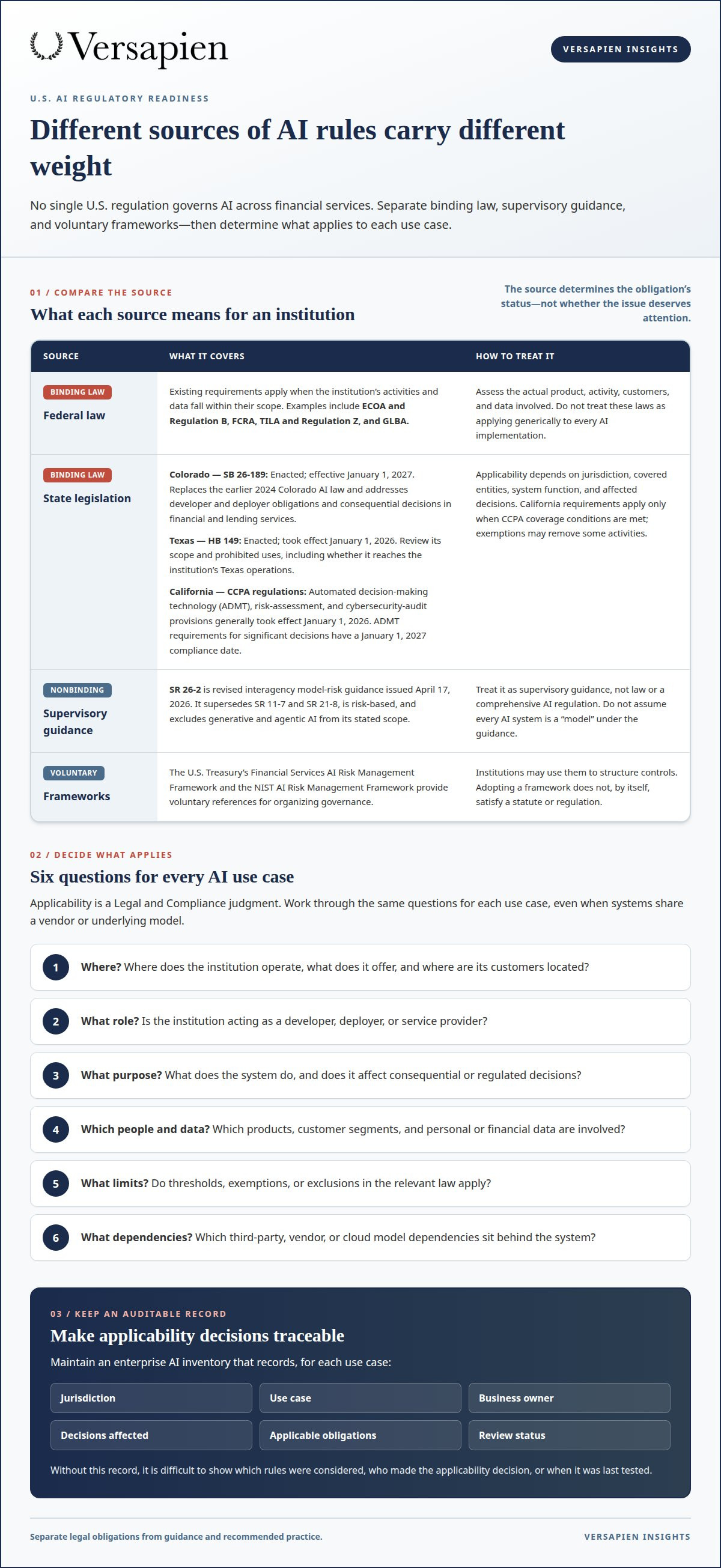
No single U.S. regulation governs AI across financial services. Obligations come from four sources that carry different weight, and senior leaders should keep them separate in every governance paper and board report.
Binding law
The first source is existing federal law that regulates specific activities. Fair lending, consumer protection, privacy, information security, and financial crime requirements apply when an AI system is used in an activity those laws cover. ECOA and Regulation B, FCRA, TILA and Regulation Z, and GLBA each apply according to the institution's actual activities and data, not to every AI implementation generically.
The second source is state AI legislation, where applicability turns on jurisdiction, covered entities, system functions, and the decisions affected. Three developments carry material financial-services impact.
Colorado. Colorado SB 26-189 is an enacted state law; see the enacted version on the Colorado General Assembly site. Effective January 1, 2027, it replaces the earlier 2024 Colorado AI law with an automated decision-making framework. It addresses developer and deployer obligations and consequential decisions in financial and lending services. The superseded 2024 law should no longer be treated as current.
Texas. HB 149, the Texas Responsible Artificial Intelligence Governance Act, is an enacted state law that took effect January 1, 2026. Institutions should review its scope, its prohibited uses, and whether it reaches their operations in Texas, using the enrolled bill text and the Texas Legislature site.
California. The CCPA regulations on automated decision-making technology (ADMT), risk assessments, and cybersecurity audits are set out in the approved regulatory text and the CPPA rulemaking page. The regulations became effective January 1, 2026, but compliance deadlines vary by requirement. ADMT requirements involving significant decisions have a January 1, 2027 compliance date, while certain risk-assessment and cybersecurity-audit obligations have phased implementation deadlines. Applicability depends on CCPA coverage, the specific business activity, and any applicable exemptions. Institutions should verify the relevant deadlines and coverage conditions rather than assume the requirements apply uniformly to every institution or data set.
Supervisory guidance and voluntary frameworks
Federal banking supervisory guidance is not law. The revised interagency model risk guidance, SR 26-2, issued April 17, 2026, supersedes SR 11-7 and SR 21-8. It is risk-based and nonbinding, with applicability tailored to an institution's model-risk profile, size, and complexity. The guidance is expected to be most relevant to banking organizations with more than $30 billion in total assets, although it may also be relevant to smaller organizations with significant model-risk exposure. Generative and agentic AI are outside its stated scope, but institutions should still establish appropriate governance and controls for these systems. SR 26-2 is not a comprehensive AI statute or regulation, and institutions should not assume every AI system qualifies as a model under the guidance.
Voluntary frameworks guide governance without creating independent legal obligations. The U.S. Treasury's Financial Services AI Risk Management Framework is voluntary, sector-specific guidance, not a regulation. Treasury's announcement (see also the Treasury site) confirms the February 19, 2026 release. The framework, Risk and Control Matrix, Guidebook, and supporting materials are hosted by the Cyber Risk Institute in coordination with the Financial Services Sector Coordinating Council. The NIST AI Risk Management Framework is likewise a voluntary reference for organizing governance across the AI lifecycle. Institutions can adopt either as a structure for controls, but adoption does not itself satisfy a statute or regulation.
Determining Which Requirements Apply
Applicability is a judgment that Legal and Compliance own. A practical sequence starts with six questions about each AI use case.
Where does the institution operate, what does it offer, and where are its customers located?
What is its role, such as developer, deployer, or service provider?
What is the system's purpose, and does it affect consequential or regulated decisions?
Which products, customer segments, and personal or financial data are involved?
Do thresholds, exemptions, or exclusions in the relevant law apply?
Which third-party, vendor, or cloud model dependencies sit behind the system?
Consider how these questions play out across the business. A credit decisioning tool in consumer lending or mortgages raises fair lending, adverse-action, and state automated decision-making questions. An insurance underwriting or pricing model brings state insurance regulation into view. A customer service assistant raises different questions about data use, disclosures, and consumer protection. A compliance monitoring tool or a financial crime alert model touches BSA/AML procedures and authorized decision structures. Each use case may land in a different place even when the same vendor model sits underneath.
The working record for these decisions is an enterprise AI inventory. For each use case it should capture the jurisdiction, the use case itself, the business owner, the decisions affected, the applicable obligations, and the review status. Without it, institutions cannot show which rules were considered, who decided, or when the answer was last tested. For related guidance on ownership, see AI Operating Model Design.
Translating Requirements into Governance and Controls
Once applicable requirements are identified, the next task is converting them into controls with named owners. Leaders should label each control as legally required, expected under supervisory guidance, or a recommended practice, because the consequences of a gap differ. The control areas below are illustrative and should be tailored to the institution's risk appetite and use cases.
Inventory and obligation mapping. Link each use case to the requirements identified for it.
Risk and impact assessments. Scale them to the system's purpose and potential customer impact. Some state and CCPA provisions may require assessments where they apply, while in other cases they are a recommended practice.
Data privacy and permitted use. Define access rights, permitted uses, and treatment of third-party data in line with GLBA, state privacy law, and internal policy.
Transparency and human oversight. Determine what disclosures and explanations apply and where human judgment stays in consequential decisions. An AI-generated explanation does not automatically satisfy adverse-action requirements, and explainability alone does not establish accuracy or fairness. See Adverse Action Notices and Decisioning Controls.
Accuracy, bias, and customer-impact testing. Choose methods based on the decision tested and the data. A disparity warrants investigation but does not alone establish causation or unlawful discrimination.
Documentation and audit trails. Preserve inputs, assumptions, limitations, and review evidence.
Vendor risk management. Reflect data rights, audit access, and model changes in contracts and oversight. Third-party models do not automatically need the same validation as internally built ones. See AI Procurement Risk.
Material changes. Tie review to the nature and impact of the change and to the institution's decision rights.
Monitoring and escalation. Define who reviews exceptions and who can suspend a system.
Roles should stay distinct. Business owners answer for use cases and outcomes, technology teams for implementation, data owners for quality, access, and lineage, and Risk and Compliance for oversight and challenge. Internal Audit provides independent assurance and does not approve or operate controls.
Establishing an Ongoing Enterprise Readiness Program
Readiness is an operating cycle rather than a point-in-time review. A practical program runs seven steps.
Monitor authoritative legislative, regulatory, and supervisory sources.
Triage developments by status, effective date, jurisdiction, and applicability.
Map applicable obligations to products, AI use cases, policies, and controls.
Assign designated owners, action items, and deadlines.
Track implementation evidence, compliance gaps, and remediation.
Reassess controls when laws, guidance, products, data, vendors, or AI implementations change.
Report material risks, implementation status, and open decisions to executive leadership and governance committees.
Automated monitoring tools can surface new text and flag possible control impacts, but they do not decide legal applicability. Legal and Compliance must make that determination, and reviewers should verify material findings against the authoritative source. Reporting to leadership should separate confirmed obligations from items awaiting interpretation, and completed actions from planned work. Related topics include AI change control and regulatory issue closure.
Executive Takeaways
AI readiness depends on knowing which rules reach which use cases and who decided. Binding law, supervisory guidance, and voluntary frameworks call for different responses, and the program should reflect that difference. Executives should treat applicability as a governed decision with evidence behind it.
Require an enterprise AI inventory that records jurisdiction, use case, owner, affected decisions, obligations, and review status.
Assign Legal and Compliance clear authority for applicability determinations, rather than relying on monitoring tools alone.
Replace references to SR 11-7 with SR 26-2, and confirm which systems fall outside its scope, including generative and agentic AI.
Review Colorado SB 26-189, Texas HB 149, and California CCPA provisions against actual products, roles, and customers.
Present the Treasury framework and similar references to the board as voluntary guidance.
Ask for regular reports on open decisions, gaps, and remediation evidence.
How Versapien Can Help
Versapien advises financial institutions on AI Governance & Responsible AI, Regulatory Strategy, Enterprise Risk, and Consumer Compliance. For the issues discussed in this article, Versapien can help institutions assess existing AI governance practices, identify gaps in regulatory applicability and control mapping, evaluate model and operational risk considerations, clarify governance and decision responsibilities, and develop practical recommendations for implementation and executive reporting.



Comments