
AI in Credit Underwriting: Executive Oversight of Model Use, Explainability and Lending Outcomes
Can AI replace a credit analyst? It can support parts of underwriting, but managing risk in AI-assisted credit underwriting requires consequential lending judgments to remain within a governed process with appropriate analyst review. Automation can organize information and surface signals, but it cannot establish on its own that a decision is accurate, fair, or suitable for a borrower.
This article covers both commercial credit underwriting and consumer lending, while recognizing that the applicable obligations differ. In commercial underwriting, AI-assisted analysis may organize financial statements, cash-flow evidence, covenant information, and repayment sources for business-credit decisions. In consumer lending, the same types of tools may process application and credit-report data, but fair lending, adverse-action, and consumer-data requirements can apply in ways that depend on the product, applicant, jurisdiction, and decision. The article explains where AI-assisted analysis can fit, how it differs from rules-based automation, and what executive oversight should cover. It also explores how to make outputs interpretable, monitor lending outcomes, and assign clear responsibilities for business ownership, technology implementation, risk and compliance challenge, and independent assurance. The central question is not simply whether to automate, but which activities can be delegated safely, what evidence supports reliance on an output, and when a qualified analyst should review or escalate a determination.
Table of Contents
Governance and oversight for AI in credit underwriting
Governance should connect each underwriting use to its data, decision authority, and monitoring plan. An effective governance approach defines permitted uses, assigns accountable owners, and sets clear limits on agent actions.
Alternative Data for Borrower Assessment
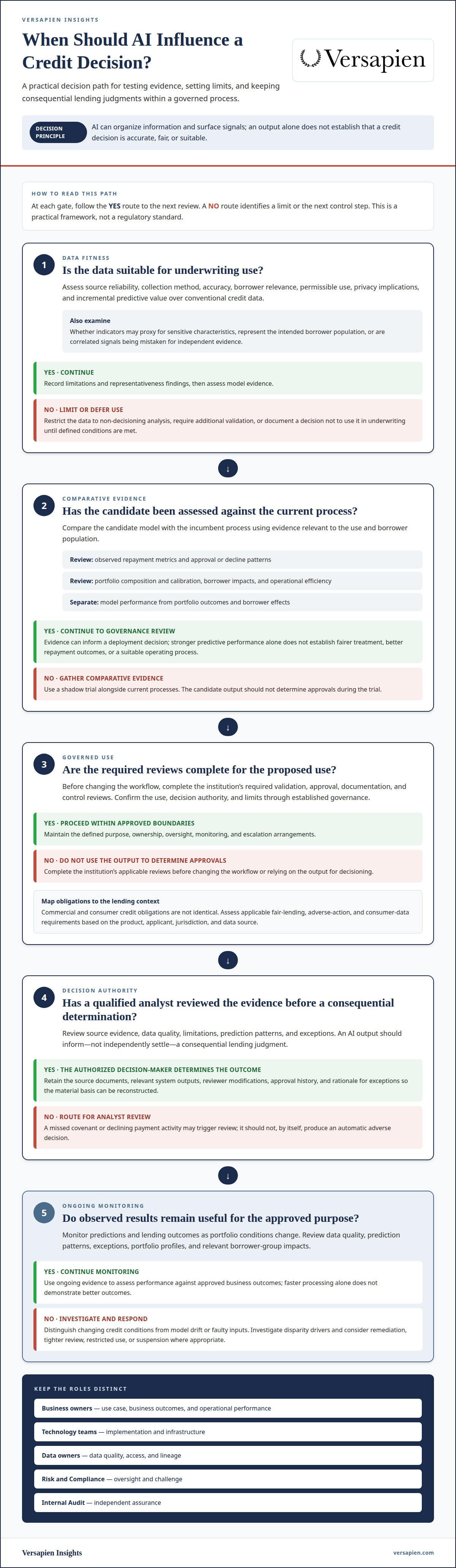
Alternative data is borrower information beyond conventional credit files, such as business payment activity or cash-flow records. Before underwriting use, executives should require documented assessment of the source’s reliability, collection method, accuracy, borrower relevance, permissible use, privacy implications, and incremental predictive value over conventional credit data. They should also assess whether the data reflects proxy variables for protected or otherwise sensitive characteristics, whether it represents the intended borrower population, and whether correlated indicators are being treated incorrectly as independent evidence. Data owners should record limitations and representativeness findings. Where quality, relevance, lawful use, privacy, or representativeness is insufficient, management should restrict the data to non-decisioning analysis, require additional validation, or document a decision not to use it in underwriting until defined conditions are met.
Bias and Model Oversight
Bias can enter through historical lending data, proxy variables, or design choices that produce uneven outcomes across borrower groups. For example, a model using business location may reflect differences in access rather than repayment capacity. Where consumer credit or other covered credit activity is involved, institutions should assess obligations under the Equal Credit Opportunity Act and Regulation B, including whether model inputs, proxies, processes, and outcomes create discriminatory effects or unjustified disparities. Commercial credit may also fall within applicable fair-lending requirements, but the legal and disclosure requirements are not identical to those for consumer lending; institutions should map requirements to the product, applicant, and jurisdiction rather than apply a uniform standard. Oversight should investigate disparity drivers, test whether each input is necessary and supported by evidence, document conclusions, and establish remediation, tighter review, restricted use, or suspension where appropriate. A disparity alone does not establish causation or unlawful discrimination, and explainability alone does not establish fairness.
For covered consumer credit decisions, Regulation B, § 1002.9(a)(2) and (b)(2) require creditors to provide either a statement of specific reasons for adverse action or the prescribed disclosure of the applicant's right to request those reasons. When specific reasons are provided, they must identify the principal factors actually considered or scored by the creditor. Those reasons must be the actual reasons for the decision and identify the principal reasons; an AI-generated explanation, feature-importance score, or general statement that a score was low does not automatically satisfy that requirement. Consumer-report use and related consumer-data duties should likewise be assessed based on the product and data source, rather than assumed to govern every commercial credit workflow. Business credit applicants are subject to different notification procedures under Regulation B, § 1002.9(a)(3), depending on the business's preceding fiscal-year revenue and the type of credit. Institutions should account for these distinctions when designing AI-assisted underwriting and adverse-action processes.
Implementation Benefits and Responsible Deployment
AI can expand analytical capacity and support timely evaluations, but implementation also involves technology, staffing, data protection, oversight, and maintenance costs. Assess operational capacity, realized financial returns, and risk reduction separately: faster processing alone does not demonstrate better outcomes. Responsible deployment starts by defining the purpose and permitted data, assigning business and technology owners, assessing data quality and borrower impacts, and securing approval through established decision rights. Then monitor lending outcomes, document limitations, and set escalation and fallback authority. These steps help leaders decide whether to continue, modify, or expand an AI use based on approved outcomes and evidence.
Monitoring AI underwriting models and portfolios
Accuracy depends on the model, borrower population, data, and outcome measured, so no general comparison with traditional processes is reliable. Benchmark a candidate model against the existing underwriting process using observed repayment metrics, approval and decline patterns, portfolio composition and calibration, borrower impacts, and operational efficiency. Separate model performance from portfolio-level outcomes and borrower effects: a stronger predictive metric does not by itself establish fairer treatment, better repayment outcomes, or a suitable operational process.
Model Monitoring and Shadow Trials
Model monitoring tracks whether predictions and lending outcomes remain useful as portfolio conditions change. A shadow trial runs a candidate model alongside current processes without allowing its output to determine approvals. Compare the candidate with the incumbent process using repayment outcomes, portfolio profiles, relevant borrower-group impacts, exception patterns, and review workload. Shadow testing supplies evidence for a deployment decision; it does not automatically validate the model for live use or transfer decision authority. Before changing the workflow, management should complete the institution’s required validation, approval, documentation, and control reviews.
Connect early-warning signals to borrower evidence. A missed covenant or declining payment activity can trigger analyst review, not an automatic adverse decision. Review data quality, prediction patterns, and exceptions to distinguish changing credit conditions from model drift or faulty inputs.
Audit Trails and Model Accuracy
An audit trail records the evidence behind a credit decision. Retain source documents and source-data documentation, extracted fields, model and prompt or ruleset versions where relevant, system outputs, reviewer modifications, approval histories, and the rationale for exceptions. Records should allow an authorized reviewer to reconstruct the material rationale for the decision and determine whether the outcome was driven by the model or other automated logic, the underlying data, or human judgment. Explainability should answer the practical question faced by the reviewer and distinguish observed facts from assumptions or inferred relationships; feature importance alone may not provide a legally sufficient reason for an adverse consumer credit decision.
Compare models using more than a single aggregate score. Assess repayment prediction, portfolio calibration, and decision consistency across relevant borrower groups. Review false positives, missed risk, payment performance, customer effects, and analyst overrides. A model may rank risk effectively yet remain unsuitable if its inputs are unreliable or its results cannot support a defensible decision.
Portfolio reports can connect covenant alerts with balance changes and payment patterns. Treat correlated indicators as related signals, not separate confirmation. Track which alerts prompted useful review, which proved misleading, and whether escalation worked. This evidence helps leaders decide whether to adjust monitoring rules, model use, or portfolio response processes.
Balancing AI-assisted analysis with credit decision authority
The key distinction is whether software informs an analyst or determines an application’s disposition. A rules-based workflow applies predefined conditions; an AI system may infer patterns from historical data or analyze documents. Neither label determines the risk. Assess customer impact, regulatory consequences, validation, monitoring, and escalation needs. Fixed scoring or a small balance alone does not make a decision low-risk.
AI-assisted analysis can extract figures from borrower statements, summarize supporting sources, or flag inconsistencies for review. These applications can reduce manual information gathering, but analysts should verify material outputs against authoritative records. For example, reconcile a cash-flow summary with the underlying statements before using it in repayment analysis. Greater speed is useful only when the evidence remains reliable and decision-makers understand the system’s limitations.
Automated decisioning gives software authority to approve, decline, or otherwise determine an application under defined conditions. The institution’s governance should specify which decisions may be automated, which accountable business officer approves that authority and material changes, who evaluates exceptions, and which cases require an authorized credit decision-maker. Business owners remain accountable for use-case outcomes; technology teams implement the workflow; Risk and Compliance provide challenge. Internal Audit provides independent assurance, not operational approval. Where consumer adverse-action rules apply, the approved process must also produce and retain the actual, specific, and accurate reasons for the action required by Regulation B, § 1002.9(b)(2), rather than relying on an AI-generated explanation or feature-importance score.
A practical decision path begins by classifying the task as information extraction, recommendation, or consequential determination. Information extraction can organize figures or documents for verification; a recommendation can prioritize review or suggest terms; a consequential determination approves, declines, or otherwise materially affects access to credit. For each category, assess the data, potential borrower impact, supporting evidence, and available human-review capacity. The accountable business owner should approve permitted automated decisions, an authorized credit officer or designated committee should evaluate exceptions and material adverse or ambiguous cases, and only named roles should be permitted to override an output. For an AI agent, define permitted actions and exception routes before deployment, then monitor activity and preserve its decision trail.
Finally, assign authority in advance to pause or suspend a system and select a fallback when outputs are unreliable, data quality deteriorates, material drift appears, or required evidence is unavailable. The fallback may require manual underwriting, a previously approved process, or a hold pending review, as defined by the institution’s procedures. A material change to data, intended use, or approval logic should be reviewed under the institution’s decision rights; routine technical changes can follow established change controls. This keeps efficiency goals separate from the authority to make consequential credit decisions.
The next decision is whether the institution’s operating model can support the intended AI use, not simply whether a tool performs well in testing. A sound approach to AI credit underwriting risk management connects the business case to accountable ownership, ongoing oversight, and clear authority over consequential decisions.
Executive Takeaways
AI oversight is a management responsibility that connects the intended business use with evidence, controls, and decision rights. Senior leaders should use that connection to determine where AI adds useful capacity and what conditions support its continued use.
Define the business outcome each underwriting use is intended to support.
Assign owners for data, implementation, business performance, and independent assurance.
Review whether explanations serve the people who rely on them.
Use observed outcomes and ongoing costs when deciding whether to adjust or expand a use case.
How Versapien Can Help
Versapien’s AI & Digital Transformation Services, Risk Management Consulting, and Regulatory Compliance Advisory help financial institutions evaluate how AI can be responsibly integrated into credit underwriting and portfolio oversight. We can assist leadership in assessing proposed AI use cases, evaluating data and model-related risks, identifying governance and control gaps, and clarifying accountability across business, technology, risk, and compliance functions. Our advisory support can also help institutions strengthen decision frameworks for AI-assisted analysis and automated decisioning, establish appropriate human-review and escalation processes, and develop practical recommendations for monitoring lending outcomes and managing changes in AI use.



Comments