
AI Operating Model Design: Defining Executive Accountability, Decision Rights and Business Ownership
AI governance breaks down when accountability is shared in principle but unclear in practice. Financial institutions may establish AI policies, committees, and technical controls, yet still lack clear answers to fundamental operating questions: Who owns the business outcome? Who has authority to approve or change an AI-enabled process? Who challenges unreliable outputs, resolves exceptions, and determines when a workflow must be suspended? Without defined decision rights, even well-designed governance frameworks can fail when AI becomes part of daily operations.
An effective AI operating model translates governance principles into practical responsibilities, decision authority, and operational processes. Business ownership, technology implementation, independent oversight, and assurance must be clearly distinguished, while verification, escalation, and fallback arrangements must be incorporated into the way AI-enabled activities operate. This article examines how financial institutions can design an accountable operating model that supports responsible AI adoption while preserving appropriate management oversight and control.
Table of Contents
1. Designing an Accountable AI Operating Model
A recurring vulnerability in financial services innovation is the tendency to treat artificial intelligence as a centralized technology initiative rather than a core business capability. When accountability for an AI-enabled process is delegated primarily to data science teams or information technology departments, the operational context of the decision becomes separated from business ownership. Technology teams excel at building pipelines, evaluating statistical metrics, and maintaining infrastructure, but they do not manage customer relationships, allocate regulatory capital, or carry profit-and-loss responsibility. An effective AI operating model establishes that business leaders own the business purpose, intended outcomes, and associated operational risks of use cases within their authority. Compliance responsibilities and control obligations remain distributed across the institution's established governance structures, including business controls, risk and compliance functions, and other designated control owners.
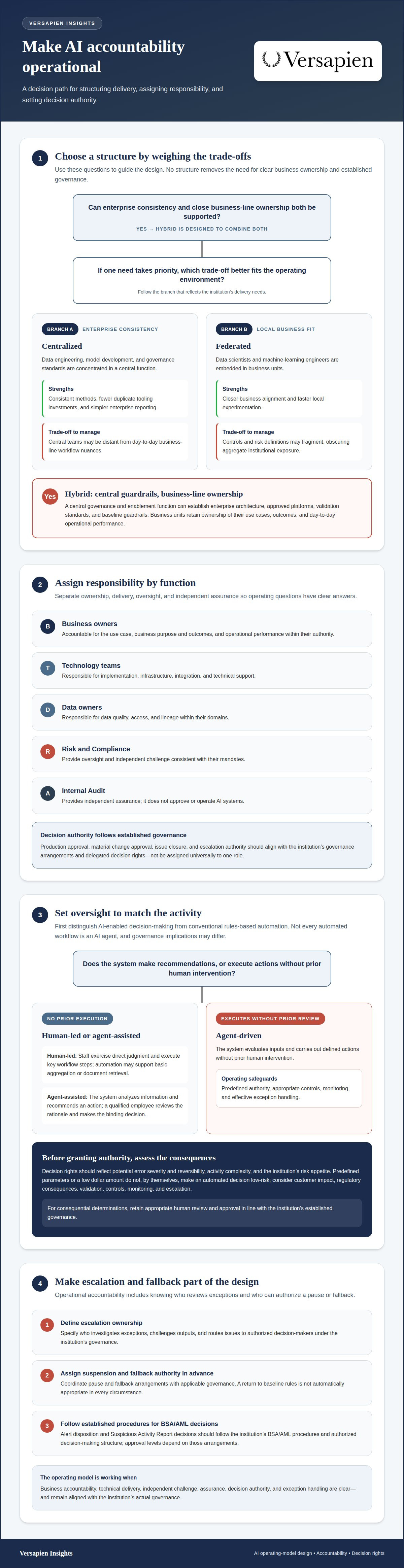
Structuring AI delivery requires financial institutions to navigate the trade-offs between centralized, federated, and hybrid organizational structures. A fully centralized model concentrates data engineering, model development, and governance standards within a single center of excellence. This structure maximizes consistency across methodologies, prevents duplicate tooling investments, and simplifies enterprise reporting. However, centralized teams often operate at an arm's length from day-to-day business line realities, leading to tools that fail to address subtle workflow nuances. Conversely, a fully federated model embeds data scientists and machine learning engineers directly into specific business units, such as retail lending, wealth management, or commercial payments. While federation enhances business alignment and accelerates local experimentation, it frequently fragments enterprise controls, creates inconsistent risk definitions, and obscures aggregate institutional exposure.
A hybrid structure combines enterprise consistency with business-line accountability. A centralized governance and enablement function can establish enterprise architecture, approved technology platforms, validation standards, and baseline guardrails, while designated business units retain ownership of specific use cases, business outcomes, and day-to-day operational performance. Business owners are accountable for the use case and its outcomes. Technology teams are responsible for implementation, infrastructure, integration, and technical support. Data owners oversee data quality, access, and lineage within their domains. Risk and Compliance provide oversight and independent challenge consistent with their mandates, while Internal Audit provides independent assurance without assuming management responsibilities for AI systems or controls. The business line executive may sponsor the initiative and remain accountable for business performance, but authority to approve production deployment must align with the institution's established governance arrangements and delegated decision rights rather than being assigned universally to one role.
Successful execution under any operating model requires targeted workforce transformation. Deploying automated workflows does not simply reduce headcount; it fundamentally alters the analytical skills required across the front, middle, and back offices. Operational personnel who previously spent their days performing manual calculations, data extraction, or transaction matching must transition into roles centered on exception handling, anomaly investigation, and analytical interpretation. Organizations must equip staff to evaluate model confidence scores, detect subtle operational drift, and challenge automated recommendations when market conditions shift. Evaluating these investments requires executives to measure operational capacity gains, process quality, and risk reduction separately from direct financial returns, recognizing that ongoing expenses for data governance, system monitoring, and specialized talent will accompany long-term automation.
2. Establishing Decision Rights and Human Oversight
Establishing operational clarity requires financial institutions to distinguish AI-enabled decision-making from conventional rules-based automation and to segment activities by the degree of autonomy granted to a system. Not every automated workflow is an AI agent: deterministic rules, scheduled processing, and workflow routing may be governed under different technology, control, and change-management requirements than systems that infer, generate, or adapt outputs. Operational activities generally fall into three distinct operating modes: human-led, agent-assisted, and agent-driven. In human-led tasks, staff exercise direct judgment and execute all key workflow steps, utilizing automation solely for basic data aggregation or document retrieval. In agent-assisted tasks, an algorithm or intelligent agent analyzes data, identifies patterns, and generates recommendations, but a qualified employee reviews the rationale and makes the binding decision. In agent-driven workflows, the automated system evaluates inputs and executes defined actions without prior human intervention, relying on predefined authority thresholds, controls, monitoring, and exception handling.
Decision rights must correspond directly to the severity and reversibility of potential errors, the complexity of the underlying activity, and the institution's defined risk appetite. Consequential decisions affecting consumer credit eligibility, regulatory reporting, capital adequacy, or customer access to funds require decision authority, safeguards, and oversight proportionate to their potential impact. Where automated execution is permitted, institutions should establish explicit boundaries, monitoring, and escalation procedures. For instance, in automated credit underwriting, an algorithm may evaluate applicant financial records, calculate debt-to-income metrics, and prepare a preliminary recommendation. Any automated approval authority, including for applicants with apparently strong or prime profiles, requires appropriate model validation where applicable, effective internal controls, fair lending oversight, compliance with adverse-action requirements, and decision rights formally authorized under the institution's governance framework. Applications involving borderline credit profiles, significant overrides, or potential adverse actions may require mandatory human review according to those controls. Prime credit approvals should not be treated as inherently low-risk merely because they fall within conservative, predefined parameters.
Institutions must formally document who possesses the authority to approve a use case for production, authorize material modifications, override an automated recommendation, suspend a live workflow, and accept residual risk. Operating procedures should clearly distinguish between routine analytical support and definitive management approvals. In automated anti-money laundering investigations, an intelligent agent can aggregate transaction histories, screen adverse media, and draft an alert narrative. Decisions about alert disposition and whether to file a Suspicious Activity Report should follow the institution's established BSA/AML procedures, defined roles, and decision structures, with sign-off requirements proportionate to the nature and risk of the decision rather than identical for every case. Operating procedures must explicitly empower operational staff to challenge and override machine recommendations whenever qualitative context or uncaptured data conflicts with the model output, without fearing administrative friction.
Illustrative Decision Rights and Oversight Framework
This illustrative, risk-based matrix is a supporting decision-rights mechanism, not a prescriptive set of universal rules. Institutions should map each activity to their actual governance structures, delegated authorities, and risk appetite. Agent-driven operations require predefined authority thresholds, controls, monitoring, and defined exception-handling procedures.
Defining concrete thresholds for intervention is essential to prevent passive rubber-stamping in human-in-the-loop controls. When frontline staff face high transaction volumes, they may default to approving automated suggestions without rigorous scrutiny. Operating models must incorporate defensible review standards, sampling programs, and operational capacity limits that give analysts adequate time to investigate complex cases. When an automated output approaches defined tolerance limits, such as an unexpected shift in credit risk scores or an unusual jump in payment exceptions, the workflow must enforce systematic escalation to designated senior authorities who possess the technical and commercial standing to evaluate the issue.
3. Embedding Governance, Explainability, and Accountability
Governance in an AI operating model must operate across the entire solution lifecycle rather than functioning as a single administrative checkpoint prior to deployment. Traditional governance models that rely solely on an initial, exhaustive committee approval struggle to address systems that adapt to shifting consumer patterns and evolving financial environments. Lifecycle governance requires ongoing oversight that encompasses initial problem definition, permitted data sourcing, explicit operational guardrails, deployment sign-offs, production monitoring, and periodic re-validation. Clear parameters must specify which corporate databases a system can access, what downstream actions it can initiate, and what operational constraints govern its daily behavior.
A central pillar of accountable governance is model explainability. Explainability is not merely an engineering metric; it is an operational prerequisite for management oversight, risk challenge, and regulatory accountability. Business owners, operational reviewers, and control functions must be able to understand which input variables drove a specific conclusion, what assumptions shaped the analysis, and what limitations constrain the output's reliability. In consumer lending, explainability supports the institution's ability to provide specific and accurate reasons when an adverse-action notice is required under the CFPB's Regulation B. An adverse action may be triggered by a denial of credit, termination of an existing account, or another covered action identified by applicable law; not every unfavorable change in terms is necessarily an adverse action. Explainability alone does not establish compliance: institutions must also identify applicable triggers, follow required notice timing and content rules, and ensure that the stated reasons accurately reflect the actual decision.
However, executive leadership must recognize that explainability alone does not establish accuracy, operational stability, or legal compliance. A mathematical explanation may confirm that an algorithm weighted specific borrower attributes heavily, but it cannot determine whether those weights produce disparate impacts or reflect flawed training data. Similarly, in generative AI systems that summarize research or compile financial disclosures, explainability cannot guarantee the absence of factual inaccuracies or hallucinations. Control procedures should require human reviewers to verify material claims, figures, and legal assertions against authoritative source records, ensuring that documentation serves as an active tool for verification rather than superficial compliance paperwork.
To preserve operational agility while maintaining strict compliance, institutions should institute tiered AI change control procedures. Technical updates that do not alter model logic, data scope, or decision thresholds, such as infrastructure optimization or routine security patching, can follow standard IT release controls without comprehensive committee re-review. Conversely, material changes, such as ingesting new external data feeds, altering underlying objective functions, recalibrating decision cut-offs, or expanding a model into a new consumer segment, should automatically trigger rigorous reassessment. By establishing distinct governance tracks, financial institutions ensure that critical alterations undergo rigorous second-line challenge while routine maintenance proceeds without unnecessary administrative overhead.
Model risk management principles reinforce the separation of responsibilities. Governance, validation, ongoing monitoring, documentation, and independent challenge should be proportionate to a system's intended purpose, complexity, and potential financial, customer, or regulatory impact. Not every AI-enabled tool meets the formal regulatory or institutional definition of a model, so formal model validation and re-validation requirements should apply according to the institution's classification and risk framework rather than automatically to every AI system. Throughout the lifecycle, institutions should maintain appropriate AI governance documentation that supports oversight, demonstrates challenge by risk functions, and enables independent evaluation by Internal Audit.
4. Operationalizing Verification, Escalation, and Fallback
Even the most sophisticated AI architectures encounter operational disruptions, data corruption, and market volatility. Consequently, an operationalized AI model must incorporate resilient mechanisms for input verification, exception escalation, and controlled fallback. Financial institutions cannot assume that automated pipelines will function seamlessly under stressed conditions. Management must define formal monitoring triggers, calibrated to the specific use case, data environment, and operational impact, that flag conditions before unverified outputs influence business operations or external reporting. Relevant triggers may include missing data feeds, material shifts in input distributions, conflicting records across ledgers, changes in output behavior that exceed use-case tolerances, or degraded data and system quality.
Consider financial planning and analysis. An intelligent forecasting agent may ingest daily treasury transactions, macroeconomic indices, and loan pipeline estimates to generate rolling liquidity projections. If an upstream batch process fails or an unexpected liquidity shock disrupts interbank lending spreads, the model may generate distorted cash flow forecasts. A resilient operating model dictates that when key data inputs are delayed or corrupted, or when monitoring detects behavior with material operational impact for the use case, the system must immediately pause automated updates rather than quietly propagating skewed figures into executive dashboards. The process owner and designated financial analysts must verify source data, review underlying variance drivers, and manually confirm operational assumptions before any modified forecast is released to the asset-liability committee.
When an automated workflow encounters an anomaly, operating protocols must provide an unambiguous escalation path. Exception handling procedures should identify precisely who investigates the discrepancy, the timeframe required for resolution, and the executive level authorized to approve an override. In financial crimes operations, for example, if an AI transaction-monitoring system exhibits an unexpected drop in alert generation following a software update, frontline analysts must have an immediate channel to notify model risk managers, compliance leaders, and systems engineering. Authority to suspend automated alert filtering and activate a fallback procedure must be assigned in advance to designated roles under the institution's BSA/AML governance. The approved fallback may involve baseline rules or another validated process, but the appropriate response should be defined for the specific workflow rather than presumed universally.
Fallback arrangements represent the institution's insurance policy against automation failure, yet they are frequently neglected in operational design. A fallback plan that exists solely as an abstract policy document is insufficient; backup processes must be operationally viable, fully staffed, and periodically tested under simulated outage conditions. If an automated customer identity verification system experiences a service disruption or data vendor failure, the institution must possess a validated alternative, such as routing applicants to a secondary verified data service or engaging an internal verification queue. Clear operating instructions must govern how transactions are processed manually, how pending backlogs are managed, and how records are reconciled once the primary AI system is restored. Every disruption, manual override, and emergency suspension must be formally logged, creating a transparent audit trail that enables continuous learning and informs periodic control reassessments.
Executive Takeaways
Effective AI operating models translate innovation into accountable management practice. Senior executives and boards should use the following actions to establish clear ownership, decision authority, oversight, and operational resilience:
Establish Direct Business Line Ownership: Assign named business owners accountability for the business purpose, outcomes, operational performance, and associated risks of each deployed AI use case, while retaining compliance and control responsibilities within the institution's established governance structures.
Align Decision Rights with Error Severity: Clearly delineate human-led, agent-assisted, and agent-driven workflows, reserving mandatory human review and explicit approval under applicable governance procedures for consequential decisions affecting credit, compliance, and capital.
Implement End-to-End Lifecycle Governance: Institute continuous oversight encompassing data access, operational guardrails, and post-deployment monitoring, ensuring that material modifications trigger formal re-assessment while routine maintenance proceeds efficiently.
Make Explainability Operationally Usable: Mandate that automated recommendations provide transparent documentation of key inputs, core assumptions, and analytical boundaries, while requiring operational reviewers to independently verify material facts against authoritative source records.
Test and Validate Operational Fallback Procedures: Develop, document, and regularly stress-test manual fallback processes and alternative data sources, establishing explicit authority to pause, restrict, override, or discontinue automated workflows when material data, system, or operational concerns arise.
How Versapien Can Help
Versapien assists financial institutions in designing and evaluating accountable AI operating models before automated solutions move into critical production environments. Through its AI & Digital Transformation Services and Risk Management Consulting, the firm works with executive teams to assess use-case viability, establish clear decision rights, identify operational control gaps, and align governance structures across business lines and technology functions. Versapien's Regulatory Compliance Advisory and Financial Crime Compliance practices help institutions examine how automated workflows interface with applicable compliance standards, consumer protection expectations, and transaction monitoring obligations.



Comments