
AI Procurement Risk: Contract Clauses for Data Rights, Audit Access and Model Changes
AI procurement creates contractual risks that extend beyond conventional cybersecurity and service-level commitments. Financial institutions must understand how vendors use institutional data, what evidence is available to support oversight, and how changes to AI models or services may affect performance, risk, and compliance.
Broad commitments to protect data or continuously improve a product may leave important questions unanswered. Can a vendor use prompts, documents, or customer information to train its models? Can the institution obtain relevant audit evidence? Will it receive notice when a model, underlying service, or subcontractor changes materially? Contract terms should address these questions in a way that reflects the intended use and potential impact of the AI system.
Effective procurement governance connects contractual protections with vendor due diligence, internal decision rights, ongoing monitoring, and exit planning. AI-assisted contract review can help identify missing or inconsistent language, but automated analysis should support, and not replace, legal, procurement, and risk judgment.
This article examines the contract provisions financial institutions should evaluate when procuring AI systems, how to assess AI-assisted clause review, and how to establish accountable processes for negotiating, approving, and monitoring AI-related contractual obligations.
Table of Contents
Section 1: Defining Contractual Protections for AI Data and Intellectual Property
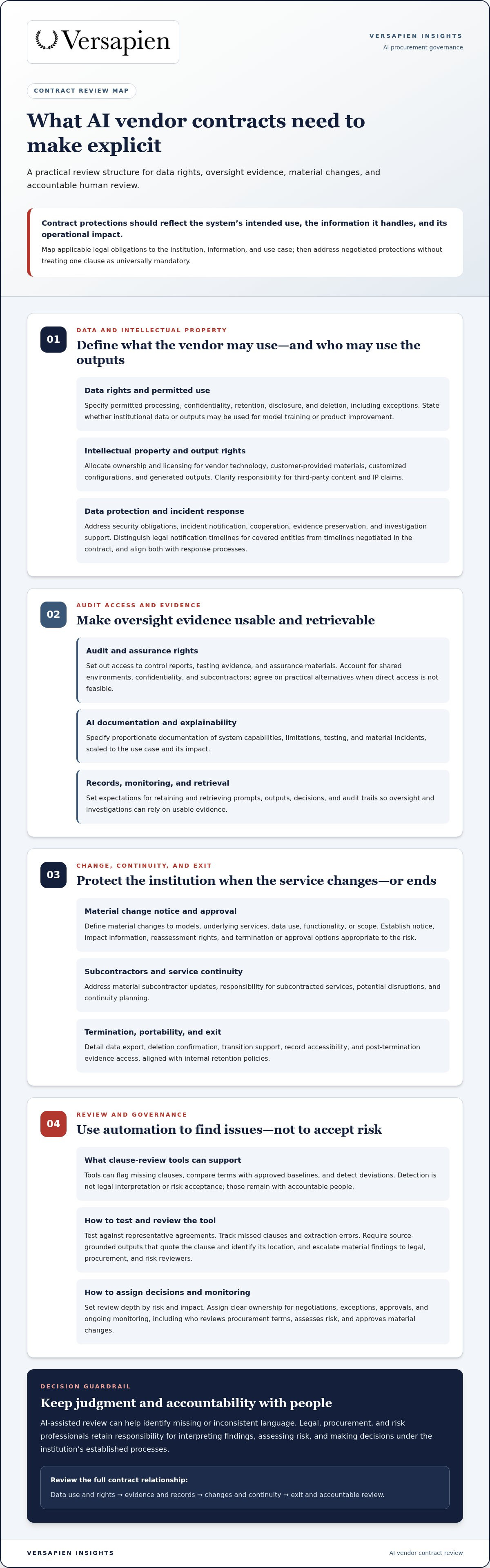
Contract terms should reflect the system’s intended use, data, and operational impact. Below, legal requirements, recommended practices, and negotiated terms are distinguished; no single clause is universally mandatory.
Data Rights and Permitted Use
Address permitted processing, confidentiality, retention, disclosure, and deletion, along with any exceptions. Be explicit about whether the vendor may use institutional data or outputs for model training or product improvement. Applicable legal obligations depend on the institution, information, and use case, so map them rather than assume a single AI-specific rule; recommended practices and negotiated terms can then build on that baseline.
Intellectual Property and Output Rights
Allocate ownership and licensing for vendor technology, customer-provided materials, customized configurations, and generated outputs. Clarify responsibility for third-party content and for IP claims. These terms shape later deployment and reuse, and ambiguity can constrain operational decisions.
Data Protection and Incident Response
Describe security obligations, incident notification, cooperation, evidence preservation, and investigation support. Distinguish notification timelines set by law for covered entities (for example, GDPR Article 33 for covered controllers) from timelines negotiated in the contract, and align both with the institution’s response processes.
Section 2: Audit Access, Transparency, and Evidence Rights
Contractual protections are only useful when an institution can obtain the evidence needed to evaluate whether a vendor is meeting its obligations. AI agreements should establish practical rights to access relevant documentation, testing results, control evidence, and records supporting oversight and investigations. The scope of these rights should reflect the system’s intended use and risk, while accounting for legitimate confidentiality and shared-environment constraints.
Audit and Assurance Rights
Outline access to control reports, testing evidence, and assurance materials. Recognize limits arising from shared environments, confidentiality, and subcontractors, and agree on practical alternatives where direct access is not feasible.
AI Documentation and Explainability
Specify proportionate documentation of system capabilities, limitations, testing, and material incidents, scaled to the use case and its impact.
Records, Monitoring, and Retrieval
Set expectations for retaining and retrieving prompts, outputs, decisions, and audit trails so oversight and investigations can rely on usable evidence.
Section 3: Model Changes, Vendor Resilience, and Exit Protections
AI systems and the services supporting them can change after a contract is signed. Model updates, changes in data practices, new subcontractors, and evolving capabilities may affect performance, risk exposure, or the institution’s ability to meet its obligations. Contracts should establish how material changes are communicated and assessed, how service continuity is maintained, and how the institution can transition away from a vendor when necessary.
Material Change Notification and Approval
Define material changes to models, underlying services, data use, functionality, or scope. Establish notice periods, impact information, reassessment rights, and termination or approval options appropriate to the risk.
Subcontractors and Service Continuity
Address material subcontractor updates, liability for subcontracted services, disruptions, and continuity planning.
Termination, Portability, and Exit
Detail data export, deletion confirmation, transition support, record accessibility, and post-termination evidence access, aligned with internal retention policies.
Section 4: Operationalizing AI Contract Review and Governance
Strong contractual protections depend on a repeatable process for identifying risks, evaluating proposed language, resolving exceptions, and obtaining appropriate approvals. AI-assisted review can help procurement teams analyze agreements more efficiently, but its effectiveness depends on reliable testing, clear escalation criteria, and accountable human decisions. Institutions should integrate these capabilities into established procurement, legal, risk, and vendor-management workflows.
AI-Assisted Clause Detection
Tools can flag missing clauses, match terms against approved baselines, and detect deviations. Detection is not legal interpretation or risk acceptance; those remain with accountable people.
Testing and Human Review
Test tools against representative agreements, amendments, and different drafting styles. Track missed clauses, incorrect extractions, and misleading interpretations, and require source-grounded outputs that quote the relevant language and identify its location. Route material findings and ambiguous provisions to appropriate legal, procurement, and risk reviewers. Use reviewer corrections and recurring errors to improve the process, and do not treat automated results as legal advice or final risk determinations.
Risk-Based Approval and Ongoing Monitoring
Set review depth by risk and impact, and assign clear ownership for negotiations, exceptions, approvals, and ongoing monitoring. Decide deliberately who owns procurement review, who assesses risk, and who approves material changes.
Executive Takeaways
Data rights: define permitted use, training limits, retention, and deletion.
Audit access: secure proportionate evidence and records for oversight.
Material-change protections: require notice and reassessment rights for significant changes.
Vendor exit provisions: plan export, deletion confirmation, and transition support.
Accountable human review: keep legal, procurement, and risk judgment over automated analysis.
How Versapien Can Help
Procuring AI solutions requires more than evaluating technology and negotiating contract terms. Financial institutions also need to understand how vendor relationships affect their risk exposure, governance responsibilities, and ability to maintain effective oversight as systems evolve. Versapien works with organizations to assess their AI procurement and governance practices, identify gaps in contractual and operational controls, and develop practical recommendations tailored to their business objectives and risk profile. Contact Versapien to discuss your AI procurement priorities and how we can help you evaluate opportunities, address risks, and strengthen your approach.