
AML Alert Backlogs as a Risk Signal: Measuring Aging, Escalation and Missed Detection
An anti-money laundering (AML) alert backlog is more than an operational workload measure. When alerts remain unresolved, investigators may be slower to identify suspicious activity, connect related transactions, and make timely escalation or reporting decisions. However, a large backlog does not automatically indicate a control failure, just as a shrinking queue does not necessarily demonstrate effective investigations.
Financial institutions need to understand not only how many alerts remain open, but also how old they are, which risks they represent, why they are delayed, and whether investigation quality is deteriorating. Intake volumes, resolution rates, aging patterns, escalation timeliness, and quality-review results provide a more complete picture when evaluated together.
This article examines how AML leaders can measure backlog risk, identify the operational and control weaknesses driving delays, and establish risk-based escalation and remediation practices. The objective is to improve visibility into unresolved exposure, not simply to reduce the number of open alerts.
Table of Contents
Understanding AML Alert Backlogs and Their Risk Implications
An investigation determines whether a monitoring alert reflects explainable activity or warrants escalation. Analysts review transaction details and customer context, then document the evidence and rationale behind their decision. A backlog matters because it delays that judgment, but its meaning depends on what is waiting and why.
How AML Alert Backlogs Develop
Backlogs develop when incoming alert volume outpaces investigator capacity, or when workflow friction slows review. Case complexity, manual handoffs, incomplete customer or transaction data, and scenario quality each contribute. A scenario that generates many low-value alerts can crowd out the cases that need the most attention.
Routine fluctuations, such as a seasonal rise in volume or a temporary absence, typically recover as capacity catches up. Persistent operational deterioration looks different: intake exceeds dispositions across several periods, older items accumulate, and the same causes recur. Distinguishing the two keeps management from overreacting to noise or tolerating a structural problem.
Why Aging Matters
Aging alerts with unresolved risk indicators, or potential links to other transactions, warrant prioritization because delay can separate related activity and weaken the picture an investigator can build. An older alert tied to a higher-risk scenario or to activity across accounts should generally be reviewed ahead of a newer, isolated item.
Age alone does not establish suspicious activity or a control failure. Many aged alerts prove explainable once reviewed. Internal service-level agreements (SLAs) are management tools and recommended practices; they are not regulatory deadlines, and no particular alert age automatically constitutes a regulatory violation.
The Risk of Missed Detection
Missed detection risk rises when investigations are disconnected. If related alerts are reviewed separately by different analysts, a pattern across accounts or time may never be seen. Premature closures driven by workload rather than evidence can have the same effect, as can bulk closure based on age.
Inadequate documentation and delayed escalation compound the problem. When rationale is thin, reviewers cannot later test whether a closure was sound, and material risks can remain unresolved without anyone owning them. Quality review of dispositions helps show whether this is occurring.
Measuring Backlog Risk and Investigation Performance
Core Backlog and Aging Metrics
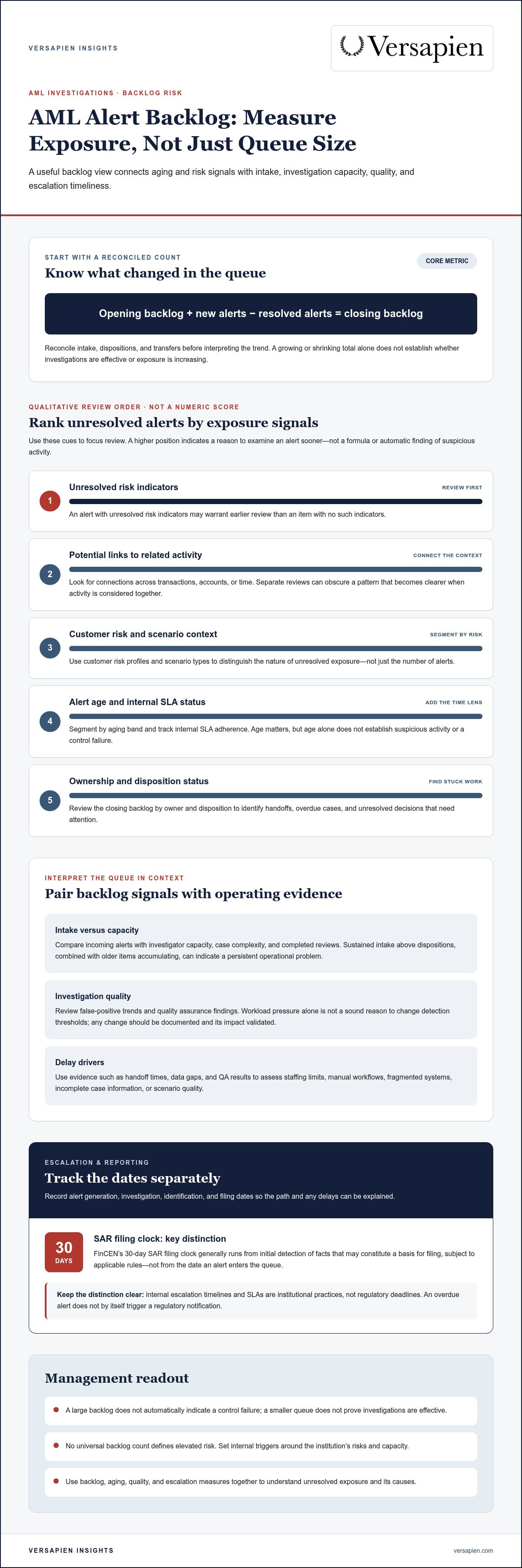
Start with a reconciled count: opening backlog + new alerts − resolved alerts = closing backlog. Reconciliation confirms that dispositions, transfers, reassignment activity, and new intake are all accounted for before management interprets a trend. Investigate unexplained differences rather than treating the reported closing balance as reliable.
Track the calculation consistently by reporting period, business line, alert type, and investigative team. This establishes whether queue growth reflects higher intake, slower resolution, changes in workflow, or incomplete reporting, and it gives management a dependable basis for capacity and remediation decisions.
Segment the closing backlog by aging band, risk category, scenario, customer or account relationship, owner, and current disposition. Review the concentration of older items and unresolved risk indicators rather than relying on an aggregate count. A queue with fewer alerts can still present greater exposure if its remaining items involve higher-risk customers, complex activity, or potential links to other transactions.
Track adherence to internal service-level agreements (SLAs), including the number and percentage of alerts that are overdue and the length of the delay. Metrics vary by institution because staffing, customer mix, products, and scenario coverage differ. No universal backlog count defines elevated risk; internal triggers should reflect risk, capacity, complexity, and investigation quality.
Intake, Capacity, and Quality
Compare incoming work against investigator capacity, case complexity, and completed reviews. Capacity analysis should account for available investigative hours, experience levels, training, leave, quality-review responsibilities, rework, and the time required for higher-risk or cross-account cases. A nominal headcount may therefore overstate the capacity available for timely, effective review.
FFIEC examination procedures consider whether staffing is sufficient to review alerts and investigate items, but they do not set a universal headcount or backlog limit. Management should examine whether dispositions consistently keep pace with intake and whether unresolved work is concentrated in particular teams, products, scenarios, or complexity bands.
Evaluate false-positive patterns and quality-assurance (QA) findings before adjusting scenarios or staffing. Repeated alerts on documented, explainable behavior may support tuning, but a high apparent false-positive rate can also reflect incomplete customer information, weak case linking, inconsistent analyst decisions, or inadequate documentation.
Staffing pressure alone is not a sound reason to change detection thresholds. Any scenario, workflow, or staffing change should be documented, approved through the institution’s change process, and validated for its effect on alert quality, missed detection risk, escalation, and reporting outcomes.
Escalation and Reporting Timeliness
Track handoffs, overdue cases, escalation decisions, and relevant reporting milestones. Record separate dates for alert generation, assignment, investigation activity, identification of facts that may support filing, escalation, filing, and closure so the institution can distinguish queue delay from decision or reporting delay.
Review these measures by risk category, scenario, business line, and investigative team. Repeated handoff delays, overdue high-risk cases, or long gaps between identification and escalation can indicate unclear ownership, insufficient information, workflow friction, or inadequate management oversight.
FinCEN's 30-day SAR filing clock generally runs from the date of initial detection of facts that may constitute a basis for filing, subject to applicable rules, rather than the date an alert enters the queue. Institutions should therefore preserve the relevant detection and decision dates and ensure that internal workflows support timely review of facts that may require reporting.
That requirement is regulatory; internal escalation timelines are institutional practice. An overdue alert does not by itself trigger a regulatory notification, but overdue work can increase the risk that a reporting milestone is missed. Management reporting should distinguish an internal SLA breach from a missed regulatory obligation and document the basis for each conclusion.
Identifying Root Causes and Prioritizing Unresolved Exposure
Diagnosing the Drivers of Delay
Backlogs arise when transaction monitoring intake exceeds investigative capacity or workflows delay review and disposition. Staffing limits, manual workflows, fragmented systems, incomplete case information, and poorly calibrated scenarios can each create friction. Complexity also matters: cases involving multiple accounts, products, jurisdictions, or counterparties may require substantially more time than routine alerts.
Ground each finding in evidence, such as intake-to-disposition trends, handoff times, data-gap rates, rework, aging by team, and QA results, rather than assuming a single cause. Compare temporary disruption with recurring deterioration by examining whether the same delay drivers persist across reporting periods and whether older work continues to accumulate after corrective actions.
Risk-Based Prioritization and Escalation
Customer risk profiles, scenario types, unresolved questions, potential exposure, and cross-account connections should determine investigation priority rather than queue order. Establish documented escalation thresholds with explicit ownership, so each decision to escalate or hold is traceable to the activity and relationships behind it.
Exposure can increase when a growing queue includes aged alerts with unresolved indicators or repeat activity across accounts. Before closing aged cases, use a documented, risk-based methodology, preserve disposition rationale, and assess whether related activity was reviewed together.
Management Reporting and Remediation
Dashboards should show risk concentration, aging, intake versus dispositions, investigative capacity, internal SLA adherence, quality assurance findings, escalation status, accountable owners, and remediation progress. Reporting should enable leaders to move from aggregate trends to the underlying alerts, scenarios, teams, and process steps driving exposure. It should also distinguish internal SLA breaches from potential delays in regulatory reporting obligations and identify where management intervention is needed.
Management should set thresholds for investigation and action, document the rationale for those thresholds, and monitor whether remediation changes the risk profile. Reducing queue volume without maintaining disposition quality, preserving evidence, and reviewing connected activity does not constitute success.
Strengthening Backlog Governance and Sustained Control Effectiveness
Clear Ownership and Decision Rights
AML operations are responsible for alert handling and queue management, while the BSA Officer provides oversight of the AML program and applicable escalation and suspicious activity reporting processes. Compliance, risk, and quality assurance functions provide oversight and challenge as defined by the institution’s governance structure; IT supports the underlying data and systems; and executive leadership provides resources and reviews significant risks and remediation progress. Documented decision rights help prevent gaps in accountability.
These responsibilities should be supported by documented handoffs, approval points, and access to the information needed for each decision. Ownership should remain clear when an alert moves between teams, is combined with related activity, is escalated for case review, or becomes part of a reporting decision.
Testing and Continuous Improvement
Use case sampling, retrospective reviews, confirmed outcomes, and missed-detection analyses to verify that process changes improve both timeliness and quality, not one at the expense of the other.
Testing should include aged alerts, closed alerts, escalated matters, and cases involving related accounts or transactions. Reviewers should assess whether investigators had sufficient information, followed prioritization rules, documented their reasoning, and escalated material questions within the expected timeframe.
Technology and Automation
Analytics and AI can help prioritize alerts, identify potentially related activity, and surface patterns that may be difficult to detect through isolated reviews. Before relying on these capabilities, institutions should evaluate their performance against relevant cases, document their limitations, and establish procedures for handling errors and overrides. The audit trail should show what information and system outputs informed each analyst’s decision, preserving appropriate human accountability.
Automation should support, not obscure, the investigation record. Institutions should be able to identify the data, rules, model output, analyst judgment, and approvals that influenced prioritization or disposition, including when an automated recommendation was overridden.
A Practical Management Action Plan
Establish baselines, define risk-based triggers, assign accountable owners and deadlines, and verify that remediation reduces exposure without compromising investigation rigor. This is a recommended practice, not a regulatory standard.
Review progress at defined intervals using the same backlog, aging, capacity, escalation, reporting, and QA measures used to establish the baseline. If queue volume improves while aging, rework, or adverse QA findings worsen, management should treat that result as incomplete remediation.
Executive Takeaways
Effective AML alert backlog management requires more than reducing the number of open alerts. Financial institutions need to understand where unresolved exposure is concentrated, identify the causes of delays, and ensure that investigation quality and reporting obligations are not compromised by workload pressures. The following takeaways highlight the key measures and governance practices leaders can use to strengthen oversight and drive sustained improvement.
Aging and Risk: Prioritize older alerts when unresolved indicators or links to related activity suggest elevated exposure; age alone does not establish a control failure.
Capacity and Quality: Compare incoming alerts with investigative capacity, case complexity, dispositions, and quality assurance results.
Escalation and Reporting: Track the relevant dates and distinguish internal SLA breaches from potential missed regulatory obligations.
Accountability: Assign clear owners, escalation criteria, and remediation deadlines, supported by documented decisions.
Sustained Improvement: Verify that corrective actions improve timeliness and investigation quality without simply reducing queue volume.
How Versapien Can Help
An aging AML alert backlog can signal deeper challenges in investigative capacity, workflow design, risk prioritization, or control effectiveness. Versapien helps financial institutions assess these challenges, identify gaps in alert management and escalation processes, and develop practical recommendations to strengthen oversight and operational performance. Through our Financial Crime Compliance, Risk Management, and Digital Transformation services, we help organizations evaluate where processes, governance, and technology can work together more effectively to manage unresolved exposure and support timely, well-documented decisions.



Comments