
Enterprise AI Portfolio Governance: How Financial Institutions Should Prioritize Use Cases and Funding
As financial institutions accelerate their investment in artificial intelligence, senior leaders face an increasingly important business question: Which AI initiatives deserve funding, and how should limited capital, technology resources, and organizational capacity be allocated to generate the greatest business value? The challenge is no longer simply identifying opportunities to use AI. It is determining which initiatives support strategic priorities, offer credible financial or operational benefits, can be implemented responsibly, and justify the investment required to bring them into production. Research reinforces the importance of this challenge. McKinsey's 2025 State of AI survey found that nearly two-thirds of organizations had not yet begun scaling AI across the enterprise, while only 39% reported an impact on enterprise-level earnings before interest and taxes (EBIT). The findings highlight the difficulty organizations face in translating widespread AI adoption and experimentation into measurable financial performance.
For financial institutions, effective AI portfolio governance requires more than ranking proposed use cases by projected return or implementation speed. Leaders must evaluate competing opportunities against business objectives, delivery feasibility, risk exposure, resource constraints, and the time required to produce credible evidence of results. They must also consider how initiatives depend on shared data, technology, governance, and operating capabilities. This article examines how financial institutions can establish a disciplined approach to prioritizing AI use cases, allocating funding across an enterprise portfolio, and making evidence-based decisions about which initiatives to advance, defer, expand, or discontinue.
Table of Contents
Enterprise AI Portfolio Prioritization: Establishing the Right Framework
Use a practical framework that compares business impact, delivery feasibility, and time to credible evidence. Treat it as a decision aid, not a regulatory standard, and tailor the criteria to institutional priorities and risk. An AI use case prioritization framework is a repeatable way to compare proposed initiatives, recording each candidate's owner, intended outcome, evidence, dependencies, and decision status.
Ranking individual use cases is only the starting point. The objective is to govern an investment portfolio that advances institutional priorities within available resources and acceptable risk levels. Leaders must allocate funding, people, technical capacity, and management attention across initiatives rather than simply approving the highest-scoring proposals. That requires attention to how competing initiatives work together, which capabilities they share, and how the portfolio should evolve over time:
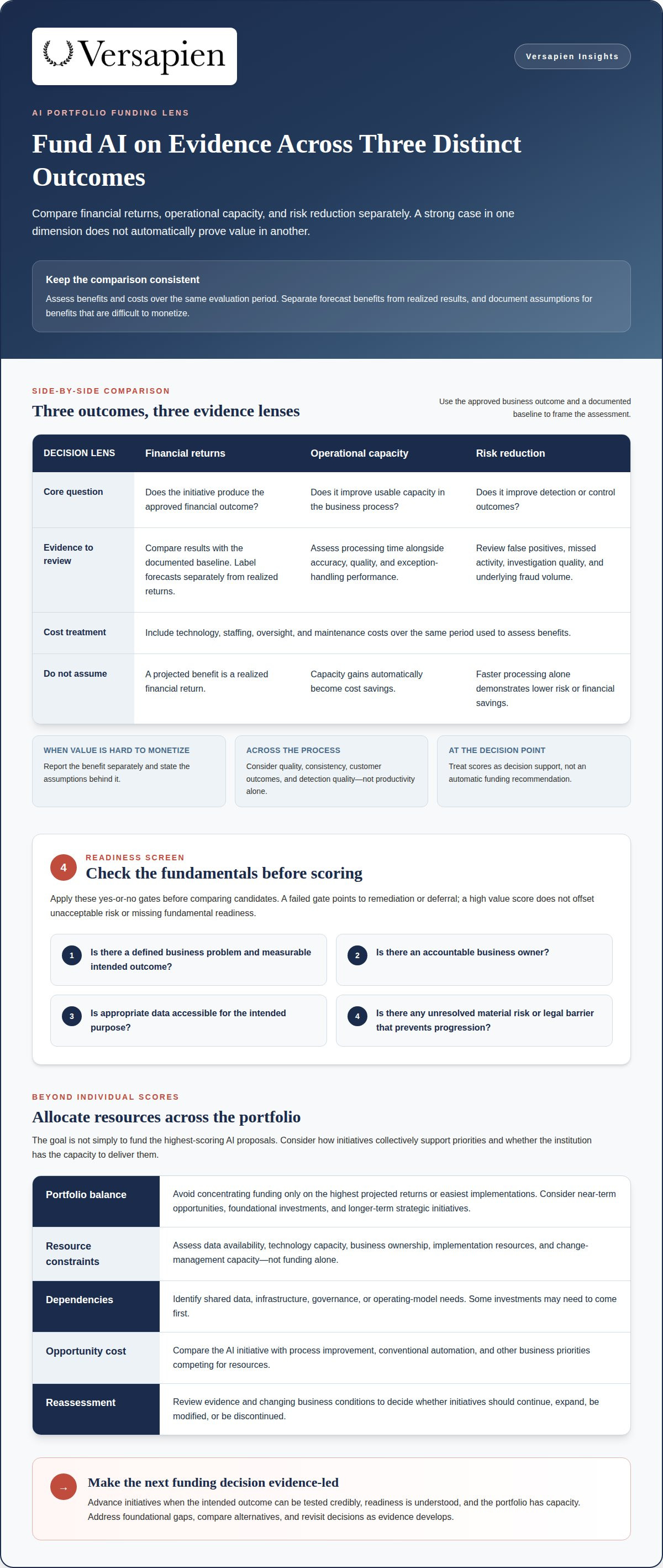
Portfolio balance: Avoid funding only the highest projected returns or simplest implementations. Maintain a mix of near-term opportunities, foundational investments, and long-term strategic initiatives.
Resource constraints: Funding is not the only limit. Consider data availability, technology capacity, business ownership, implementation resources, and change-management capacity.
Dependencies: Identify initiatives that rely on shared data platforms, infrastructure, governance capabilities, or operating-model changes, and note where specific investments must precede others.
Opportunity cost: Evaluate whether an AI initiative is a better use of resources than process improvement, conventional automation, or other business priorities.
Portfolio reassessment: Hold periodic reviews to decide whether initiatives should continue, scale, adjust, or be terminated based on changing business conditions and implementation evidence.
Establishing the portfolio view allows executives to consider how individual AI opportunities fit together and compete for limited resources. Some initiatives may offer near-term business benefits, while others require foundational investments in data, technology, or governance before their value can be realized. The next step is to evaluate individual candidates consistently, considering their potential value, delivery feasibility, and ability to produce credible evidence before committing funding.
Evaluating AI Use Cases by Value, Feasibility, and Speed to Signal
Compare candidates using consistent criteria, evidence, and decision gates. Time to signal means how soon a pilot can produce credible evidence about its intended outcome.
Set value, feasibility, and speed criteria
Define each measure before scoring so stakeholders assess candidates on the same basis. For value, consider the approved business outcome and its baseline. For feasibility, assess delivery capacity, workflow changes, and operational readiness. For time to signal, estimate when a pilot can produce evidence that tests the outcome, not merely confirm that the technology works.
Assess use cases and data foundations
Review the data each candidate requires, including access, quality, relevance, and permitted use. A transaction-monitoring use case, for example, depends on data that supports useful alert decisions. Record gaps and remediation needs alongside feasibility scores. Distinguish an attractive opportunity from one whose data foundation can support a meaningful test.
Apply weighted scores and screening gates
Score candidates on a defined scale, such as 1-5, with descriptors for each rating. Institutions may use a weighted scorecard to compare candidates, assigning relative importance to business value, delivery feasibility, and time to credible evidence. The weights should reflect institutional priorities and total 100% across the selected criteria. There is no universal weighting model. Define scoring descriptions for each dimension, document the rationale for the weights, and apply the methodology consistently across proposed initiatives. Treat the resulting scores as decision support rather than an automatic funding recommendation.Apply four yes-or-no gates before scoring:
Defined business problem and measurable intended outcome.
Accountable business owner.
Access to appropriate data for the intended purpose.
No unresolved material risk or legal barrier that prevents progression.
A failed gate prompts remediation or deferral. High business-value scores cannot compensate for unacceptable risk or a lack of fundamental readiness.
Account for governance and risk factors
Assess privacy, security, regulatory relevance, and governance readiness before ranking candidates. Risk affects feasibility when controls, review responsibilities, or decision rights need development. Consider the consequences of errors and the customers affected, not just adoption or workflow speed. Then sequence candidates into delivery waves: advance testable work, address foundational gaps, and reassess priorities as evidence develops.
Aligning AI Investments with Business Priorities and Funding Decisions
Link proposed AI work to an institutional objective, an accountable owner, and a defined decision. This assessment helps leaders distinguish strategic opportunities from initiatives that are technically attractive but poorly aligned.
Define business problems and goals
Invite stakeholders from business lines, operations, and technology to identify recurring friction, unmet customer needs, or decisions that rely on manual judgment. State the problem in operational terms, describe the desired change, and name the accountable owner. For example, a servicing team might explore whether AI could help route complex inquiries to the right specialists. Do not define success as simply launching a tool.
Assess business value and strategic fit
Assess whether the proposed outcome supports approved priorities and fits the institution’s operating model. Consider how the work interacts with existing products, customer journeys, and planned technology integration. Ask which business leader will own adoption and how teams would incorporate the output into their decisions. Two initiatives with similar projected value can differ materially if one advances an established priority while the other creates competing processes or dependencies.
Compare time-to-value priorities
Use time to value to sequence the roadmap, not as a substitute for strategic fit. A narrowly scoped use case may produce decision-quality evidence sooner, while a broader initiative may depend on coordinated changes across functions. Identify what evidence would support continuation, modification, or deferral, and set those decision points before delivery begins. This gives executives a basis for adjusting priorities as business needs or implementation conditions change.Translate evaluations into one of three funding outcomes:
Fund and advance: The initiative supports an approved business priority, has an accountable owner, and demonstrates sufficient feasibility and risk readiness.
Defer or invest in prerequisites: The opportunity is attractive, but data, technology, governance, staffing, or other foundational capabilities need to be addressed first.
Decline or discontinue: The business case is weak, risks cannot be appropriately addressed, or the initiative no longer represents a compelling use of resources.
Estimate ROI against the full cost over the same period, including implementation, technology, staffing, oversight, and maintenance. Distinguish released capacity from actual expense reductions, since capacity has financial value only when the institution identifies how it will use it. Business owners should lead scoring, with technology, operations, and risk and compliance contributing evidence; Internal Audit may assess governance independently but should not own management's scoring decisions.
Portfolio governance becomes meaningful when it changes how funding decisions are made. Treat the AI use case prioritization framework as an ongoing management discipline, not a one-time ranking exercise. Compare AI proposals with conventional automation, process enhancements, and other business investments competing for the same resources. As business conditions, operating capacity, dependencies, and delivery evidence change, revisit whether each initiative still supports an approved objective and whether its assumptions remain sound.
Set regular portfolio review cycles with defined evidence thresholds and decision rights. At each review, determine whether an initiative should continue, scale, adjust scope, be deferred while prerequisites are addressed, or be discontinued. Review progress against intended outcomes, resource consumption, dependency resolution, risk indicators, and changes in business priorities. This evidence-led cadence helps leaders reallocate funding and capacity while preserving a balanced mix of near-term opportunities, foundational investments, and long-term strategic initiatives.
Ultimately, effective AI portfolio governance requires executives to treat investment prioritization as an ongoing business discipline. Funding decisions should reflect not only the potential value of individual initiatives, but also their strategic importance, dependencies, resource requirements, and ability to deliver credible results. Institutions that regularly reassess their portfolios can redirect funding and capacity toward the initiatives that offer the greatest contribution to business priorities while avoiding continued investment in initiatives that no longer justify their cost or risk.
How Versapien Can Help
Prioritizing AI investments requires more than evaluating individual business cases. Financial institutions need a disciplined approach to aligning initiatives with business objectives, assessing implementation readiness, understanding dependencies, sequencing shared prerequisites, and maintaining accountability for results. Versapien advises financial services leaders on AI and digital transformation, enterprise risk, and program governance, helping organizations evaluate investment priorities, identify execution and governance gaps, and develop practical recommendations.



Comments