
Generative AI in Compliance Operations: Where Automation Can Improve Efficiency Without Weakening Controls
Compliance leaders face a practical question as generative AI becomes more accessible: Which compliance activities can be automated or assisted by AI without weakening the quality of analysis, the reliability of evidence, or the controls supporting important decisions? Applications that summarize regulatory publications, organize compliance testing evidence, prepare draft policies, or assist with investigative documentation may reduce manual effort. But an inaccurate summary, overlooked requirement, or unsupported conclusion can create additional risk if employees rely on generated outputs without appropriate verification.
The challenge is to determine where AI improves efficiency, how outputs are validated, and which decisions require accountable human judgment. Financial institutions need clear rules for approved uses, data access, source verification, employee oversight, documentation, and monitoring. This article examines practical compliance applications and the controls needed to realize operational benefits without compromising compliance effectiveness.
Table of Contents
Where Generative AI Can Improve Compliance Operations
Financial institutions operate under vast volumes of unstructured text, shifting regulatory issuances, and repetitive documentation demands. Generative AI offers practical operational support when applied to structured, repeatable compliance workflows. Rather than replacing compliance specialists, these tools serve as analytical accelerators that ingest complex documentation, draft preliminary materials, and surface relevant facts for professional evaluation.
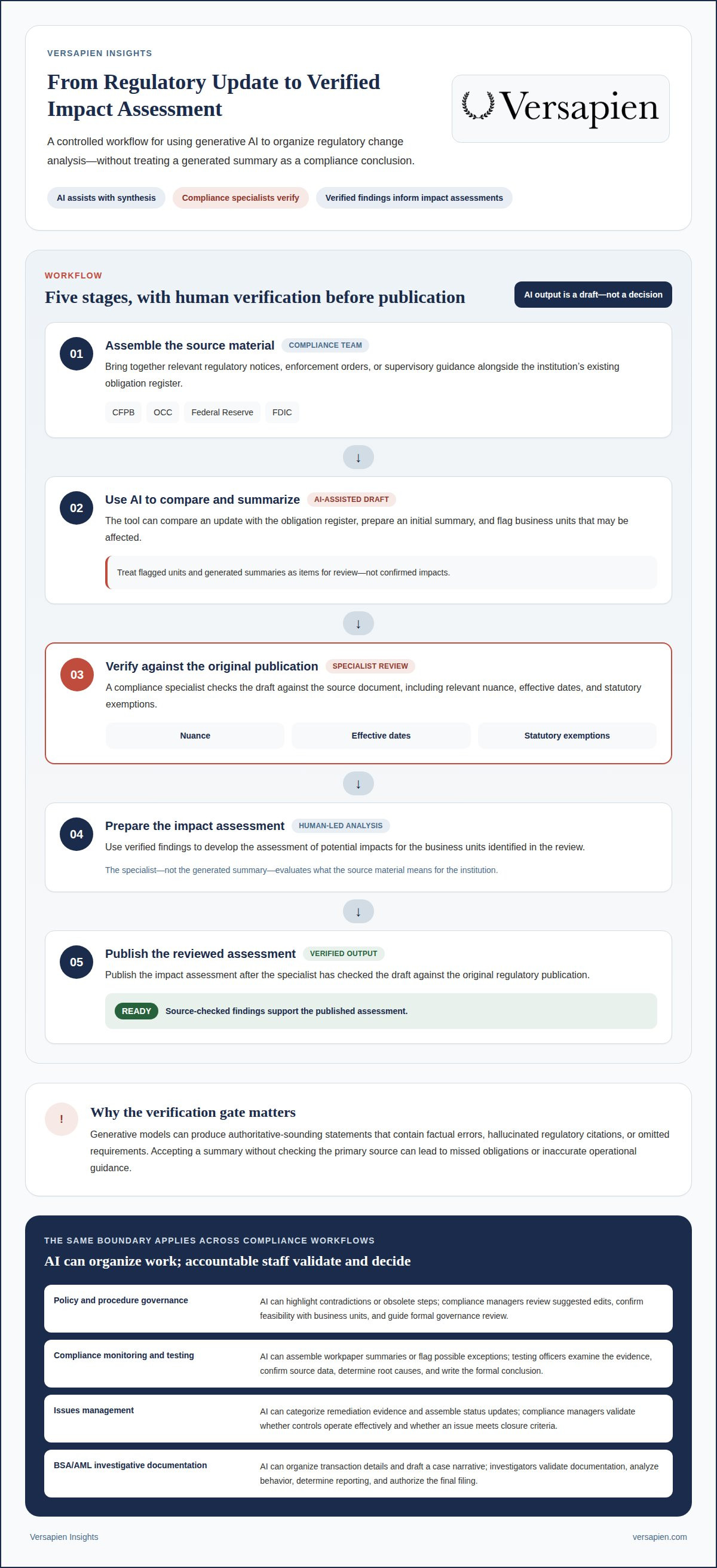
In regulatory change management, compliance teams track notices, enforcement orders, and supervisory guidance across agencies such as the Consumer Financial Protection Bureau, the Office of the Comptroller of the Currency, the Federal Reserve, and the Federal Deposit Insurance Corporation. Generative AI tools can ingest voluminous rule updates, compare them against an institution’s existing obligation register, and produce an initial summary highlighting affected business units. A compliance specialist can then review the draft summary against the original publication to verify that nuance, effective dates, and statutory exemptions are accurately captured before publishing impact assessments.
Policy and procedure governance represents another viable application. Organizations maintaining separate manuals across retail banking, mortgage origination, auto finance, and commercial lending frequently experience documentation drift. Large language models can ingest internal policy archives alongside updated operational guidelines to highlight textual contradictions, identify obsolete procedural steps, or generate redline comparisons between operational manuals. A compliance manager still reviews the suggested edits, confirms operational feasibility with business units, and guides the revisions through the formal governance committee approval process.
Within compliance monitoring and testing, analytical assistants can ingest transaction sampling records, operational notes, and customer correspondence to assemble workpaper summaries. For instance, when testing loan disclosures under the Real Estate Settlement Procedures Act or Truth in Lending Act, an AI tool can flag potential timing discrepancies for human review. Disclosure rules and timing depend on transaction specifics and relevant provisions of Regulation X and Regulation Z, rather than a basic timestamp comparison. The testing officer must then examine the flagged exceptions, confirm source data integrity, determine root causes, and write the formal testing conclusion.
Issues management functions benefit from automated synthesis during remediation. When corrective action plans involve hundreds of validation artifacts across technology, operational, and customer-facing teams, AI tools can categorize incoming remediation evidence, track progress against milestone deliverables, and assemble status updates for management committees. Authorized personnel or governance bodies validate whether remediated controls operate effectively and whether an issue meets the institutional criteria for closure.
In financial crime operations, Bank Secrecy Act and anti-money laundering teams handle heavy narrative drafting requirements. During investigative reviews, generative AI can extract relevant transactional details from core banking systems, organize counterparty data, and draft structured case narratives. The investigator then validates source documentation, analyzes the underlying behavior, makes the authorized determination regarding any required reporting, and authorizes the final filing. AI-generated outputs should not substitute for authorized personnel's assessment of customer or transaction risk, required reporting decisions, or case closure. Institutions should define which analytical tasks AI may support and retain appropriate human review and approval for consequential determinations.
Where Automation Creates Risk and Requires Stronger Oversight
While productivity opportunities are substantial, deploying generative models in compliance operations introduces distinct operational and regulatory vulnerabilities. The primary failure mode stems from the tendency of generative models to produce authoritative-sounding statements that contain factual errors, hallucinated regulatory citations, or omitted requirements. An analyst who accepts an automated summary without verifying it against primary source documents risks introducing non-compliant practices into operational policies or missing supervisory mandates.
Automation bias represents a significant behavioral vulnerability in risk operations. When automated tools consistently deliver accurate baseline drafts, analysts and investigators tend to reduce their critical scrutiny over time. In high-volume operations such as alert adjudication or complaint review, staff may treat AI-generated drafts as verified findings, glossing over subtle discrepancies. This dynamic can weaken independent review and reduce the effectiveness of second-line challenge.
Information security and data privacy controls must also be calibrated to the specific architecture of generative tools. Entering non-public personal information, sensitive borrower records, or proprietary risk methodologies into unapproved AI platforms can expose confidential information and create privacy, security, contractual, and regulatory risks. Institutions should establish approved-platform requirements, access restrictions, and controls over how providers store, use, and retain submitted information. Institutions should align AI platform access with existing entitlement architectures and establish contractual and technical safeguards governing the retention and use of submitted information. Organizations should prohibit vendors from using confidential institutional or customer information for model training unless that use has been explicitly reviewed and authorized.
Third-party dependencies introduce operational instability through unannounced model changes, performance drift, and service interruptions. When commercial model providers update underlying algorithms, the system’s interpretation of regulatory text or classification of customer complaints can shift unpredictably. Effective risk management requires institutions to implement ongoing validation procedures and apply robust risk-tiering methods for generative AI use cases to scale oversight controls directly to operational complexity and consumer impact.
External regulatory requirements reinforce this need for strict control. In the European Union, the EU AI Act phases in obligations on different dates. August 2, 2025, applies specifically to obligations for providers of general-purpose AI models; it is not a blanket deadline for every organization using generative AI. The European Commission's AI Act framework sets out the applicable implementation timeline. Financial institutions should govern generative systems within established operational risk, data protection, compliance, and accountability frameworks.
Establishing Governance and Controls for AI-Assisted Compliance Work
To realize operational efficiencies without weakening internal controls, financial institutions must build an integrated governance framework tailored to compliance operations. Governance cannot rely on informal staff guidance. It requires clear policies that define permitted use cases, data boundaries, validation steps, and accountable ownership.
The governance structure begins by classifying generative AI applications into approved and prohibited categories. Low-impact administrative activities such as generating initial summaries of public agency speeches, drafting training outlines, or reformatting internal meeting notes require baseline validation. Conversely, applications that directly influence customer communications, regulatory disclosures, credit determinations, or financial crime disposition require formal risk assessment, second-line review, and explicit management approval before operational rollout.
Data access protocols must enforce strict containment rules. Compliance staff should use institutionally approved AI platforms operating within security environments appropriate to the sensitivity of the information and the intended use. Policies must explicitly forbid inputting customer identifiers, account details, suspicious activity deliberations, or confidential supervisory information into unvetted tools. Where appropriate, institutions can use Retrieval-Augmented Generation (RAG) to ground responses in approved internal knowledge sources. However, RAG does not eliminate inaccurate or incomplete outputs. Employees should continue to verify material assertions against authoritative source documents.
A practical governance approach ensures that operational speed does not compromise output integrity. Institutions should define how each AI-supported compliance task is bounded, controlled, verified, reviewed, documented, and monitored over time, with the level of oversight proportionate to the use case and its potential impact.
A Governance Approach from AI Output to Accountable Decision
Deploying generative AI within compliance workflows requires an unbroken chain of accountability. The following six-stage approach provides a practical governance structure for evaluating and controlling AI-assisted work; it is not a universal or mandatory regulatory standard:
Set the Use Boundary: Classify applications into approved and prohibited categories, define permitted analytical tasks, and establish risk-based requirements for human review and approval before operational use.
Control Data and Platforms: Restrict activity to enterprise-sanctioned platforms, apply access and data-containment rules, and use vetted source documents with sensitive identifiers appropriately protected.
Verify Against Source Material: Where appropriate, use Retrieval-Augmented Generation to ground responses in approved internal knowledge sources, while requiring employees to verify material assertions against authoritative documents and confirm that relevant context has not been omitted.
Review, Challenge, and Decide: A qualified compliance specialist independently reviews the draft, assesses operational and business impact, challenges inaccuracies or omissions, and applies professional judgment. Authorized personnel or governance bodies make consequential decisions and approvals.
Preserve Traceability: The system produces a draft work product and, where supported by the technology, identifies source references for material assertions. Reviewers should verify that citations accurately support the associated statements and that relevant source material has not been omitted. An authorized decision-maker approves the final deliverable, with appropriate records of employee identity, material modifications, supporting evidence, and approval rationale retained in accordance with institutional recordkeeping and access-control requirements.
Monitor the Workflow Over Time: Quality assurance and oversight teams sample AI-assisted workpapers, track errors, rework, user modifications, model or provider changes, and other risk indicators, then adjust controls, review intensity, or the use case as conditions change.
Integrating these controls into existing compliance management systems requires active collaboration across lines of defense. First-line business and operational units retain ownership of their respective processes and controls, while second-line compliance provides oversight and challenge. Together, they must design clear human-in-the-loop controls that prevent automated systems from executing unilateral actions. Compliance quality assurance teams should routinely sample AI-assisted workpapers to measure error rates, track user modification trends, and evaluate whether staff are exercising adequate independent scrutiny.
Documentation standards must support defensibility appropriate to the use case. When an institution produces a revised compliance manual, an exam response, or an investigative file, it must be able to demonstrate how the analysis was conducted. Maintaining appropriate records of model versions, material inputs, source documents, employee edits, and approvals can support internal oversight, audit reviews, and regulatory examinations. Documentation and retention requirements should reflect the use case, applicable requirements, and institutional policies.
Measuring Business Value Without Weakening Compliance Effectiveness
Executive leadership must measure the true business value of compliance automation using balanced operational metrics. A common error in early adoption is equating rapid document generation with net cost savings. Calculating efficiency strictly by the minutes saved in generating a first draft obscures the full cost of downstream verification, error remediation, and model governance.
To establish a realistic return on investment, leadership must distinguish between operational capacity gains and realized financial savings. Generating a compliance testing workpaper in thirty minutes rather than two hours creates operational capacity, but it does not represent immediate financial savings unless that time is redirected toward high-value risk analysis, backlog reduction, or lower external vendor spend. Furthermore, if an analyst must spend forty-five minutes correcting inaccurate regulatory citations or hallucinations produced by an unanchored model, the net productivity gain diminishes significantly.
Performance scorecards should evaluate the complete workflow life cycle across four core dimensions:
Throughput and Cycle Time: Measure the end-to-end duration required to finalize a compliance deliverable, capturing initial drafting, source verification, specialist revision, and managerial sign-off.
Defect and Rework Rates: Track the volume and frequency of factual errors, hallucinated citations, or omitted requirements caught during secondary review or quality assurance testing.
Analyst Intervention Metrics: Quantify the proportion of generated text that specialists must rewrite before approval, identifying prompt weaknesses or areas where automation adds negligible value.
Control and Audit Performance: Monitor the results of independent compliance testing, quality control samples, and internal audit assessments on AI-assisted workflows to ensure control effectiveness remains uncompromised.
Accounting for the total cost of ownership is essential when determining whether to scale an operational pilot. Institutions must factor in licensing fees, cloud compute infrastructure, specialized integration, initial staff training, periodic validation, and ongoing governance monitoring. Leaders should review these operational and financial metrics periodically to determine whether an AI-assisted workflow should be expanded across other compliance verticals, adjusted to strengthen human oversight, or discontinued in favor of conventional procedural workflows.
Executive Takeaways
Generative AI offers meaningful operational opportunities to streamline repetitive compliance documentation, summarize regulatory developments, and accelerate investigative research. However, these tools cannot replace independent professional judgment, establish final risk ratings, or assume regulatory accountability. Senior management and board risk committees should focus oversight on establishing rigorous governance, enforcing verification protocols, and measuring sustainable operational value.
Establish clear boundaries that define approved and prohibited compliance use cases, preventing unsupervised AI deployment in consequential decisions such as alert disposition, adverse action determinations, or issue closures.
Require source verification and review proportionate to the risk and materiality of the use case, with compliance analysts cross-referencing material automated assertions and citations against primary authoritative records.
Enforce strict data protection guardrails that prevent non-public personal information, confidential supervisory information, and proprietary risk parameters from entering unapproved commercial platforms.
Integrate AI-assisted deliverables into established compliance quality assurance, monitoring, and internal audit programs to track error rates, rework frequency, automation bias, and changes in workflow risk over time.
Measure implementation performance by evaluating the full workflow cost, factoring in necessary human verification, technology infrastructure, and ongoing governance rather than relying solely on initial drafting speed.
How Versapien Can Help
Versapien advises financial institutions, fintechs, and consumer lenders seeking to integrate artificial intelligence into their compliance and operational frameworks without compromising regulatory controls. Through its AI Governance & Responsible AI practice, the firm assists leadership teams in designing comprehensive AI risk assessments, implementation roadmaps, and oversight frameworks that establish clear decision rights and accountability boundaries. Working alongside Versapien’s Risk Management Consulting and Regulatory Compliance Advisory practices, institutions can evaluate current compliance workflows, identify control gaps in third-party and automated systems, clarify roles and responsibilities, and receive recommendations for governance protocols and oversight improvements.



Comments